
What if the standard medical diagnosis of being “fine” is actually the greatest obstacle to your peak performance? For many high-achievers, the frustration of a ten-minute clinical visit that merely addresses symptoms rather than systems is all too familiar. You shouldn’t have to settle for basic wellness when your goal is advanced metabolic optimization. Knowing the right questions to ask a functional medicine practitioner is the first step in moving beyond reactive care and toward a bespoke health strategy. Finding a partner who treats your biology as a unique blueprint requires a discerning eye and a data-driven approach.
It’s understandable to feel overwhelmed by the variety of certifications and testing methods available today. You deserve a clear framework for interviewing potential providers to ensure they can deliver the root-cause resolution you demand. This guide provides an exact roadmap to vet your next health architect with confidence. We will explore how to distinguish between basic wellness practitioners and true experts in physiological enhancement, ensuring your choice supports both your immediate recovery and your long-term vitality.
Key Takeaways
- Shift your perspective from hiring a clinician to selecting a health architect who proactively manages your complex physiological systems for peak performance.
- Identify the essential questions to ask a functional medicine practitioner to verify their advanced diagnostic training and commitment to root-cause resolution.
- Learn why advanced metabolic and genetic testing is necessary to move beyond standard “normal” lab ranges toward true biological optimization.
- Understand the value of multi-month protocols and why boutique practices often operate outside traditional insurance to provide the depth of care required for lasting change.
- Recognize the clinical “green flags” that signal a provider is truly invested in your individual success and sustainable metabolic resilience.
Beyond the Resume: Why Your Functional Medicine Practitioner is a Health Architect
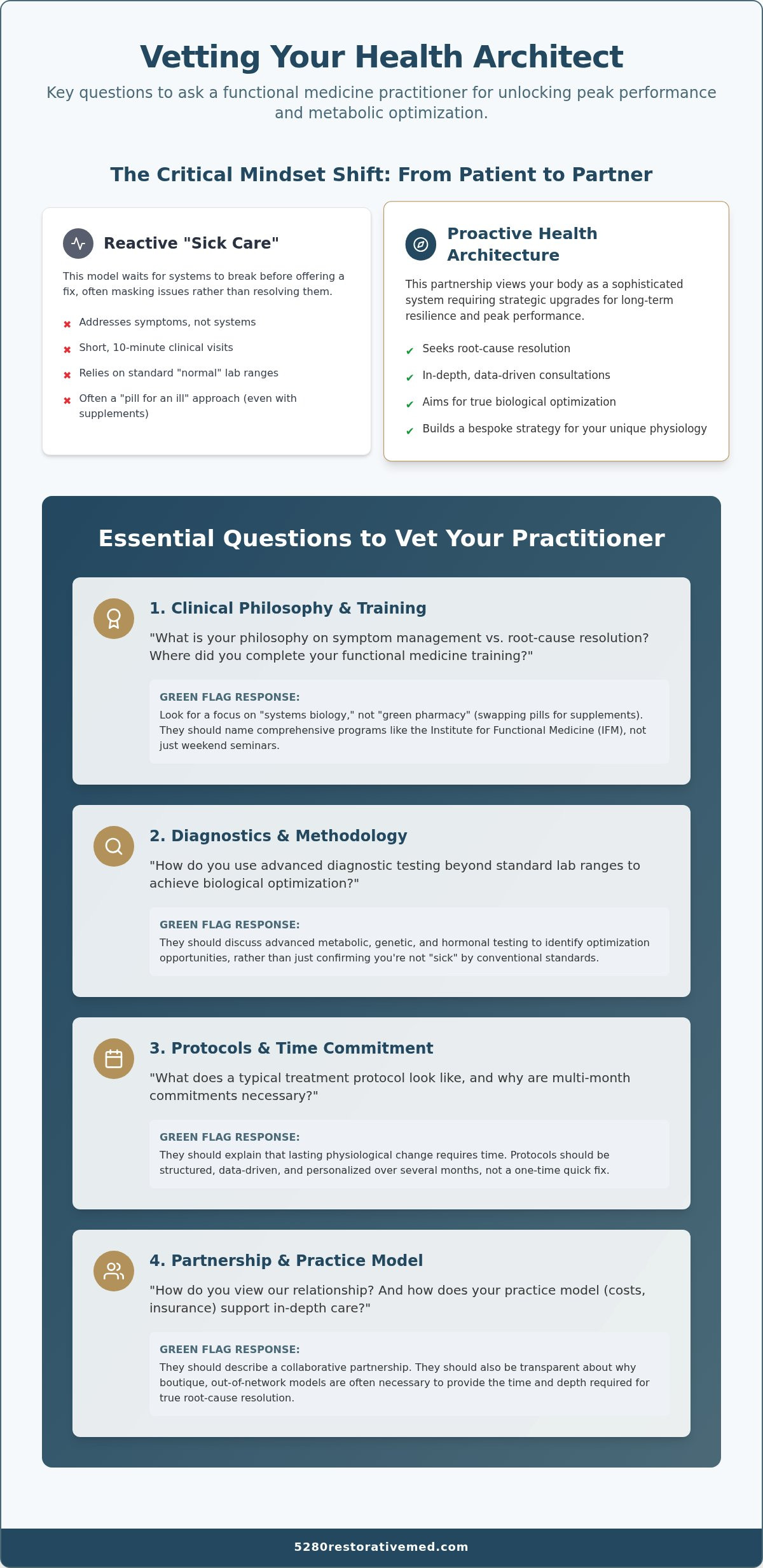
The shift from traditional “sick care” to proactive biological optimization marks the difference between merely surviving and truly thriving. In the conventional model, you wait for a system to break before seeking a fix. A health architect, however, views your body as a sophisticated, interconnected structure that requires constant maintenance and strategic upgrades. A skilled practitioner doesn’t just review lab results; they act as a project manager for your physiology, coordinating various biological systems to ensure they work in harmony. This approach moves beyond reactive treatments and focuses on building a foundation for sustainable energy and long-term resilience.
When considering your options, the list of questions to ask a functional medicine practitioner should begin with their philosophy on symptom management versus systemic resolution. Some clinics practice what is known as “green pharmacy.” This approach simply replaces synthetic drugs with natural supplements without addressing the underlying dysfunction. While natural, it’s still a form of symptom masking. True functional medicine seeks the root cause, ensuring that your cognitive function and metabolic health are built on a solid foundation rather than a temporary fix. You want a guide who digs into the “why” behind a thyroid imbalance rather than one who simply hands you a bottle of iodine and calls it progress.
The Partnership Model: Shifting from Patient to Partner
High-performers aren’t looking for a lecturer; they’re looking for a high-level consultant. You should ask: “How do you view the patient-practitioner relationship in the context of my performance goals?” This question reveals if the clinician is willing to collaborate on complex health decisions or if they prefer a top-down, authoritarian approach. An expert guide respects your time and intelligence, providing the data you need to make informed choices about your biology. They should welcome your insights and treat your health journey as a shared mission toward exceeding your baseline performance.
Evaluating Bedside Manner and Clinical Empathy
Active listening is a non-negotiable trait for a root-cause expert. During your initial conversation, observe if the practitioner is truly hearing the “why” behind your search for optimization. Do they ask about your professional demands, your daily stressors, and your specific lifestyle challenges? If they don’t understand the environment you operate in, they can’t build a protocol that fits your life. Clinical empathy serves as the essential bridge between complex biological data and the creation of a truly personalized care plan. It’s the difference between a generic protocol and a bespoke strategy designed for your unique metabolic signature.
Essential Questions Regarding Clinical Training and Diagnostic Philosophy
A standard medical degree provides the legal and clinical framework to practice, but it doesn’t automatically qualify someone to unravel the complexities of chronic, system-wide dysfunction. While an MD, DO, or DPT degree ensures a baseline of safety and anatomical knowledge, functional medicine requires a separate, rigorous set of diagnostic tools. You want a practitioner who has moved beyond the “pill for an ill” mentality. The most revealing questions to ask a functional medicine practitioner often center on how they’ve expanded their education to include systems biology and metabolic optimization. This advanced training is what allows them to see the body as a whole rather than a collection of separate parts.
Assessing Specialized Training and Certifications
Ask: “Where did you receive your specific functional medicine training, and how long have you been practicing this model?” It’s vital to distinguish between a clinician who attended a single weekend seminar and one who has completed a comprehensive program like the Institute for Functional Medicine (IFM) certification. Board certification in a primary specialty adds an essential layer of clinical safety, ensuring they can manage acute needs while pursuing long-term optimization. If you’re seeking a Functional Medicine Consultation, look for a provider who treats their education as a continuous, high-level pursuit. This commitment ensures they stay at the forefront of medical innovation.
The Root-Cause Discovery Process
Ask: “Can you walk me through your process for identifying the root cause of a symptom like chronic fatigue?” A skilled practitioner won’t just look at your thyroid in isolation. They will look for the “diagnostic lens” that connects your gut health to your cognitive clarity and your stress response to your metabolic rate. They should explain how they investigate systemic triggers like chronic inflammation, gut dysbiosis, or hormonal imbalances. This ability to synthesize disparate data points into a cohesive narrative is what separates a health architect from a standard clinician. They don’t just see a symptom; they see a biological signal that requires a deeper investigation into your unique physiology.
Finally, inquire about their experience with cases similar to your own health challenges. Every biology is unique, but a practitioner who has successfully navigated complex autoimmune or metabolic cases will have a more refined intuition for the subtle biomarkers others might miss. They should be able to describe their specific diagnostic priorities-the markers and patterns they focus on to uncover what conventional tests often overlook. This depth of insight is what ensures you aren’t just getting a generic wellness plan. You’re receiving a tailored strategy designed for peak performance and sustainable health.
Deep-Diving into Methodology: Testing, Protocols, and Bio-Optimization
High-performers operate on a different biological frequency than the average patient. Standard reference ranges found on typical blood tests are based on a bell curve of the general population, which frequently includes individuals struggling with sub-clinical chronic issues. To exceed baseline performance, you need a practitioner who prioritizes “optimal” ranges specifically for your demographic and activity level. One of the most critical questions to ask a functional medicine practitioner is how they interpret results for someone who demands peak cognitive and physical function. If they only look for values that fall outside the standard “normal,” they will miss the subtle metabolic shifts that signal a decline in your vitality.
Advanced Diagnostic Testing and Laboratory Partners
Ask: “Which specialty labs do you use for metabolic, genetic, and gut health assessments?” A boutique practice should partner with advanced laboratories that provide deep insights into cellular health, systemic inflammation, and nutrient bioavailability. Metabolic testing identifies why a high-performance lifestyle might be stalling despite “normal” blood work. These specialized assessments allow your health partner to see exactly how your mitochondria are producing energy and how your gut microbiome is impacting your neurotransmitters. This level of data is the foundation of a truly proactive health journey.
Customization vs. Standardized Protocols
Ask: “How do you personalize nutrition and supplement protocols based on my unique biomarkers?” You should avoid any practitioner who offers a “supplement-in-a-box” solution or a one-size-fits-all diet plan. High-level care often involves sophisticated interventions like hormone optimization and BHRT, which must be precisely tuned to your genetic profile and current metabolic demands. Genetic analysis provides a permanent blueprint for how your body processes nutrients, detoxifies environmental stressors, and manages inflammation. Without this data, any protocol is merely an educated guess.
Sustainable biological change doesn’t happen in a single, isolated appointment. A multi-month health optimization program is superior to one-off visits because it allows for iterative adjustments based on your body’s response to the protocol. This programmatic structure ensures that your treatment plan evolves as your biology improves, moving you steadily toward a superior state of physical function. By treating your health as a long-term investment rather than a series of quick fixes, you secure the metabolic resilience needed for a demanding career and an active life.
The Business of Wellness: Navigating Costs, Time Commitments, and Insurance
Investing in your biology requires a shift in how you view healthcare expenditures. Traditional insurance models are designed for acute care and disease management, often limiting visits to ten minutes. This reactive approach doesn’t support the deep investigation required for root-cause resolution. High-end functional practices often operate outside standard insurance to ensure the practitioner has the time and resources to build a truly bespoke protocol. One of the essential questions to ask a functional medicine practitioner involves their fee structure and how they ensure transparency throughout your health journey.
Understanding Fee-for-Service and Program Models
Ask: “Do you offer structured programs or individual consultations, and what is included in your enrollment fees?” While fee-for-service models might seem flexible, they often lack the comprehensive oversight needed for complex metabolic shifts. Bundled programs provide the accountability and continuous monitoring essential for significant, lasting results. These multi-month structures ensure you have clinical access between visits, preventing your progress from stalling. You should evaluate the level of ongoing support provided, as this often determines the success of your optimization protocol.
Measuring the ROI of a Health Optimization Program
The true cost of health is often realized only when it’s missing. Productivity loss, mounting medical bills, and a diminished quality of life represent a significant financial burden. Investing in functional health and wellness acts as a high-yield insurance policy for your future performance. It’s about securing your most valuable asset: your ability to show up at your best every day. Ask: “What metrics will we use to track my progress and justify the investment over time?” A data-driven practitioner will point to specific biomarkers and performance indicators that prove the protocol is working.
When you choose a boutique practice, you’re paying for expertise and a personalized partnership. This isn’t just about the absence of illness; it’s about reaching a superior state of physical function that supports your professional and personal ambitions. If you’re ready to move beyond the limitations of standard care, consider how a Functional Medicine Consultation can provide the roadmap you need for metabolic resilience.
Synthesizing the Answers: How to Choose Your High-Performance Health Partner
After completing your initial interviews, the final step is to synthesize the responses to your questions to ask a functional medicine practitioner. You aren’t just looking for clinical competence; you’re looking for a long-term collaborator who understands the high-stakes environment of a high-performer. A suitable health partner should demonstrate a sophisticated understanding of how your professional demands and personal stressors impact your biological systems. If a practitioner feels like a generic clinician rather than a specialized guide, they likely won’t provide the depth of care required for true optimization.
Red Flags to Watch For During the Consultation
While identifying “green flags” is essential, recognizing potential warnings is equally critical for your clinical safety and financial investment. Watch for these red flags during your vetting process:
- Promises of “Quick Fixes”: Chronic or complex metabolic issues rarely resolve overnight. Any practitioner promising a fast, easy solution for long-standing dysfunction is likely oversimplifying your biology.
- Dismissive Communication: If a clinician is unwilling to explain the “why” behind a specific test or protocol, they aren’t treating you as a partner in your health.
- One-Size-Fits-All Protocols: Practices that rely on a single, proprietary supplement line for every patient without clear diagnostic justification are practicing “green pharmacy” rather than personalized medicine.
The “vibe” of a boutique practice is more than just aesthetics; it reflects the level of personalized attention and clinical rigor you can expect. High-performers require a high-touch environment where their time is respected and their intelligence is valued. Your decision should ultimately rest on whether the practitioner has the specific expertise required for engineering metabolic resilience. This level of care goes beyond basic wellness and into the territory of physiological enhancement and long-term vitality.
Taking the Next Step with 5280 Restorative Medicine
At 5280 Restorative Medicine, we specialize in bridging the gap between complex science and daily well-being for executives and high-performers nationwide. Our protocols move past the guesswork of standard care by utilizing comprehensive metabolic and genetic analysis to create a roadmap unique to your biology. We focus on building sustainable energy and metabolic resilience through structured, multi-month programs that provide the accountability you need to succeed. To maximize the value of your initial intake, we recommend documenting your health trends and clarifying your top performance goals in advance.
Ready to move beyond feeling “fine” and start reaching your peak physical and mental state? Schedule a consultation with Dr. Marci Catallo-Madruga to begin your bespoke optimization journey today.
Secure Your Biological Future
Choosing the right clinical partner is the most critical investment you’ll make in your long-term performance. By mastering the questions to ask a functional medicine practitioner, you move beyond the limitations of standard care and into a realm of proactive physiological optimization. You’ve learned that true root-cause resolution requires more than a simple supplement; it demands a comprehensive strategy rooted in advanced data and a partnership that respects your high-performance lifestyle. Sustainable energy and metabolic resilience are not accidental. They are the results of a deliberate, data-driven approach to health architecture.
At 5280 Restorative Medicine, we provide the expertise and tools necessary to exceed your baseline. Through specialized metabolic and genetic testing, we develop bespoke protocols designed specifically for the unique demands of high-performers. Whether you are local or seeking one of our national virtual consultations, our focus remains on your individual success and renewal. It’s time to stop settling for “fine” and start engineering the peak physical and mental state you deserve.
Reclaim Your Vitality: Apply for Our Executive Health Program and take the first step toward a superior state of function today. You have the power to transform your health from a reactive necessity into a proactive competitive advantage.
Frequently Asked Questions
Do functional medicine practitioners take insurance?
Most boutique functional medicine practices do not accept standard insurance billing for consultations. This model allows for the extended appointment times and in-depth analysis required for root-cause resolution. Patients can often use Health Savings Accounts (HSAs) or Flexible Spending Accounts (FSAs) to cover these costs. Some specialized lab tests may be eligible for partial reimbursement through your insurance provider depending on your specific coverage.
What is the difference between a functional medicine doctor and a holistic doctor?
Functional medicine focuses on the biochemical and physiological systems of the body to identify specific root causes of dysfunction. While holistic medicine takes a “whole person” approach, functional medicine is more data-driven, utilizing advanced metabolic and genetic testing to guide treatment. It acts as a bridge between conventional science and lifestyle-based wellness, prioritizing measurable biological optimization rather than just general wellness.
How much does a typical functional medicine consultation cost?
Industry averages for an initial functional medicine consultation typically range from $200 to $950, depending on the complexity of the case. Follow-up appointments often average around $325, while advanced laboratory testing can range from $500 to over $2,500. These costs reflect the specialized expertise and deep diagnostic time required to engineer a bespoke health protocol that exceeds baseline performance for high-achievers.
Can a functional medicine practitioner prescribe medication?
The ability to prescribe medication depends entirely on the practitioner’s underlying medical license. If your provider is a Medical Doctor (MD), Doctor of Osteopathic Medicine (DO), or Nurse Practitioner (NP), they have the legal authority to prescribe pharmaceuticals when necessary. This is one of the important questions to ask a functional medicine practitioner if you are managing conditions that require medication alongside lifestyle interventions.
How long does it take to see results with a functional medicine protocol?
Most patients begin to feel initial shifts in energy and mental clarity within the first 4 to 8 weeks of a multi-month protocol. However, achieving sustainable metabolic resilience and root-cause resolution typically requires a commitment of 6 to 12 months. This timeframe allows the body to complete cellular renewal cycles and stabilize new physiological patterns, ensuring your results are permanent rather than temporary fixes.
What happens if my conventional doctor’s labs are all ‘normal’?
Conventional lab ranges are based on a broad population average, which frequently includes individuals with sub-clinical illnesses. If your standard labs are “normal” but you still feel suboptimal, those tests aren’t looking for functional excellence. A functional practitioner uses narrower, “optimal” ranges and advanced biomarkers to identify early-stage metabolic stalls that standard screenings often overlook. This prevents health issues from escalating into chronic disease.
Is functional medicine evidence-based?
Functional medicine is a science-based field that relies heavily on peer-reviewed research in biochemistry, genetics, and physiology. Practitioners utilize validated diagnostic tools and laboratory testing to create protocols grounded in measurable data. By focusing on the underlying biological mechanisms of disease and performance, the model provides a rigorous, evidence-driven alternative to reactive symptom management. It prioritizes the latest medical innovation to support long-term vitality.
How do I find a functional medicine practitioner near me who offers virtual visits?
Many boutique practices now offer virtual consultations nationwide to accommodate the schedules of busy executives and high-performers. When researching providers, look for clinics that specialize in remote care and use digital portals for secure data sharing. One of the essential questions to ask a functional medicine practitioner during your search is how they manage follow-ups and testing logistics for patients outside their immediate geographic area.