
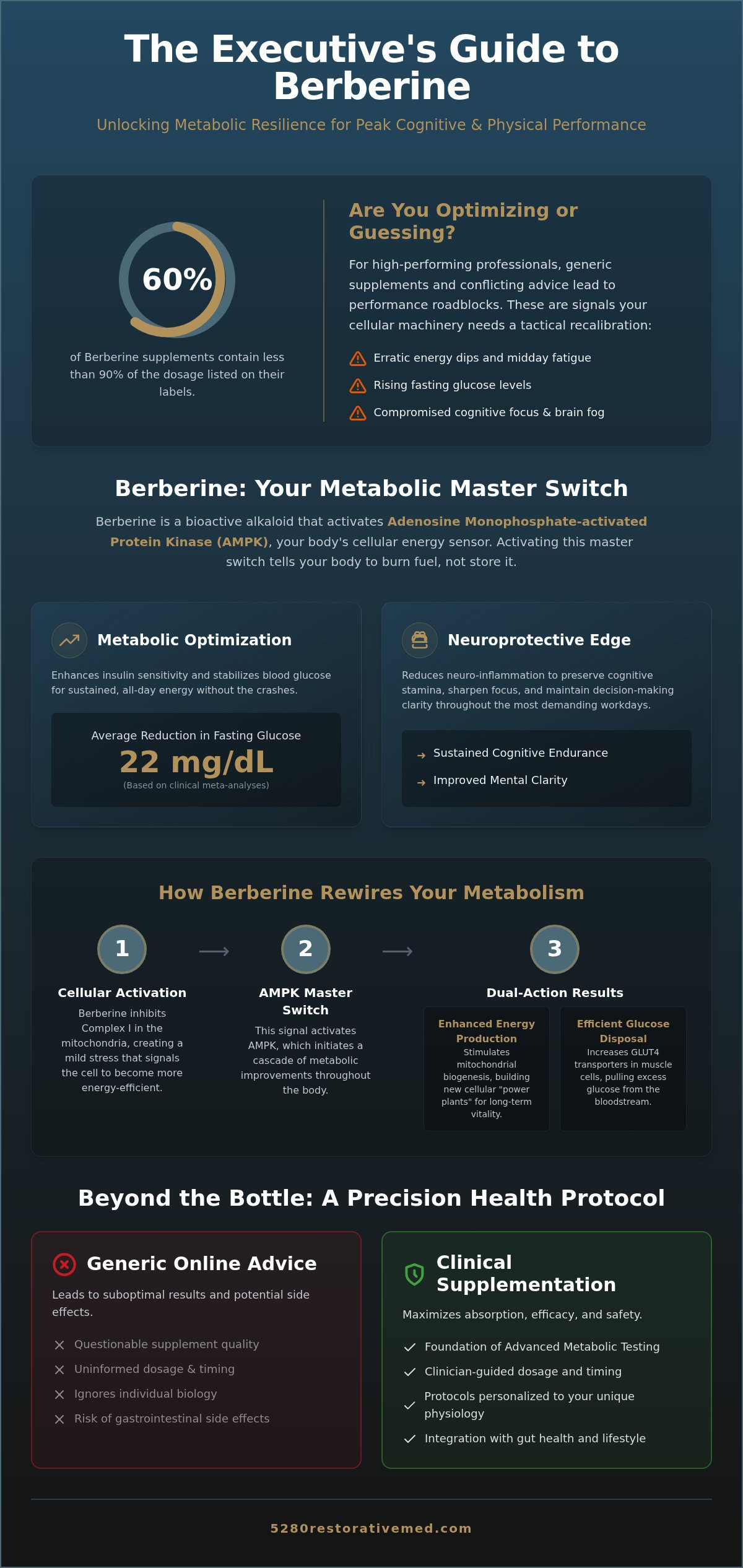
Did you know that 60% of berberine supplements on the market contain less than 90% of the dosage listed on their labels? While social media labels it “nature’s Ozempic,” utilizing berberine for metabolic health requires a far more sophisticated approach than simply picking a bottle off a retail shelf. For the high-performing professional, erratic energy dips and rising fasting glucose levels aren’t just inconveniences. They are signals that your cellular machinery needs a tactical recalibration to maintain your edge.
You likely recognize that maintaining peak cognitive focus and long-term cardiovascular health is non-negotiable for your lifestyle. It’s frustrating when conflicting advice and questionable supplement quality stand in the way of your results. This guide provides the clinical clarity you need to master the science of berberine, helping you optimize insulin sensitivity and achieve the stable, all-day energy required for executive-level performance. We’ll explore the latest 2026 clinical findings, including meta-analyses showing average reductions in fasting glucose of 22 mg/dL, and show you how to integrate this potent botanical into a bespoke protocol informed by advanced metabolic testing.
Key Takeaways
- Understand how berberine activates the AMPK pathway, acting as a biological master switch to enhance cellular energy production and fat oxidation.
- Learn how to strategically use berberine for metabolic health to improve insulin sensitivity and stabilize blood glucose levels for sustained executive performance.
- Discover the neuroprotective benefits of berberine, which helps reduce neuro-inflammation to preserve cognitive stamina and decision-making clarity throughout the workday.
- Master a clinical supplementation framework, including precise timing and dosage strategies to maximize absorption while avoiding common gastrointestinal side effects.
- Explore why the most effective supplement protocols are built on a foundation of advanced Metabolic Testing and clinical oversight rather than generic online advice.
Understanding Berberine: The Master Switch for Metabolic Health
Found in several traditional plants like Goldenseal, Barberry, and Oregon Grape, Berberine is a naturally occurring bioactive alkaloid. While historically valued for its antimicrobial properties, modern clinical science has refocused its utility on the cellular level. For high-performers, metabolic health isn’t just about the absence of disease; it’s the engine that drives cognitive endurance and physical stamina. Without a stable metabolic foundation, even the most disciplined executive will struggle with midday fatigue and brain fog.
Central to this process is the Adenosine Monophosphate-activated Protein Kinase (AMPK) pathway. Think of AMPK as your body’s metabolic master sensor or a fuel gauge for your cells. When energy levels are low, AMPK flips a switch to increase energy production and decrease energy storage. By activating this pathway, using berberine for metabolic health helps your body prioritize burning fat and glucose for immediate use rather than storing them as adipose tissue.
Berberine is a potent AMPK activator that modulates glucose and lipid metabolism at the cellular level.
The Evolution of Berberine in Modern Medicine
The transition from traditional botanical use to a 2026 clinical staple reflects a broader shift toward functional medicine. In the past, berberine was often dismissed as a “natural alternative” to pharmaceuticals. Today, it’s recognized as a primary tool for metabolic optimization. Clinical research in 2026 has expanded our understanding of how it interacts with the gut microbiome and P-glycoprotein to influence systemic health. Executives increasingly turn to these compounds because they offer a sophisticated way to manage longevity without the systemic side effects often associated with standard interventions. It’s about proactive enhancement rather than reactive treatment.
Metabolic Resilience vs. Baseline Health
Achieving “normal” results on a standard lab panel is a low bar for someone operating at a high level. There’s a significant difference between baseline health and true metabolic resilience. Resilience is your body’s ability to maintain stable glucose and energy levels even under the intense pressure of a 60-hour work week or frequent travel. Standard labs often use broad ranges that don’t account for peak performance needs. Utilizing berberine for metabolic health allows you to bridge the gap between surviving and thriving. By focusing on Functional Health and Wellness: A Guide to Root-Cause Optimization in 2026, we move beyond the superficial to ensure your internal biology supports your external ambitions.
The Science of AMPK Activation: How Berberine Rewires Your Metabolism
When integrating berberine for metabolic health, the primary objective is to optimize how your body manages energy at the molecular level. Berberine achieves this by activating Adenosine Monophosphate-activated Protein Kinase (AMPK). This enzyme acts as a cellular fuel gauge, sensing the ratio of available energy (ATP) to used energy (AMP). By inhibiting Complex I in the mitochondria, berberine creates a mild, beneficial stress that forces the cell to produce energy more efficiently. This process doesn’t just burn through existing fuel; it stimulates mitochondrial biogenesis, essentially building new “power plants” within your cells to enhance long-term vitality.
The metabolic benefits extend to how your body handles dietary sugars. Berberine increases the translocation of GLUT4, a glucose transporter, to the surface of your muscle cells. This allows your body to clear glucose from the bloodstream more effectively, even in the absence of high insulin levels. Interestingly, recent 2026 clinical insights highlight that much of this work begins in the gut. Your microbiome converts berberine into more absorbable metabolites, which then enter the systemic circulation to perform their metabolic heavy lifting. This symbiotic relationship underscores why a Functional Medicine Consultation is vital to ensure your internal environment is primed for these transformations.
Insulin Sensitivity and Glucose Disposal
Berberine functions similarly to the metabolic effects of high-intensity exercise. It signals your muscle tissues to pull in glucose for fuel while simultaneously telling your liver to reduce hepatic glucose production. This dual action is why many high-performers see a significant stabilization in their fasted blood sugar. A 2025 meta-analysis of 27 randomized controlled trials confirmed this impact, showing that berberine reduced fasting glucose by an average of 22 mg/dL. For the executive, this means avoiding the dreaded afternoon “crash” and maintaining sharp cognitive focus from the first meeting to the final email of the day.
Lipid Metabolism and Cardiovascular Protection
Metabolic health and cardiovascular longevity are inextricably linked. Berberine protects the heart by upregulating LDL receptors in the liver, which allows the body to clear “bad” cholesterol from the blood more efficiently. Unlike standard interventions that simply block cholesterol production, berberine improves the body’s natural clearance mechanisms. This makes berberine for metabolic health a foundational tool for those looking to improve their lipid profile and reduce triglycerides. Sustaining executive-level performance requires a cardiovascular system that can handle the physiological demands of a high-stakes career, and berberine provides the cellular support necessary to maintain that edge.
Strategic Advantages: Why High-Performers Use Berberine for Cognitive and Metabolic Edge
Operating at a high level requires more than just biological survival; it demands a surplus of cellular energy. For the executive, cognitive stamina and decision-making clarity are the ultimate competitive advantages. Metabolic health is the primary driver of this mental endurance, as the brain consumes approximately 20% of the body’s total energy. When you utilize berberine for metabolic health, you aren’t just managing systemic blood sugar. You’re ensuring your brain has a reliable, high-octane fuel source that doesn’t fluctuate with your last meal.
Beyond fuel, berberine offers significant neuroprotective potential by crossing the blood-brain barrier to reduce neuro-inflammation. Chronic stress and sub-optimal metabolic function often lead to low-grade inflammation in the central nervous system. This often manifests as decreased processing speed or a lack of mental “snap.” By dampening these inflammatory markers, berberine helps maintain the structural and functional integrity of your neural pathways. This allows for sustained daily output without the erratic energy spikes often associated with caffeine or other stimulants.
It’s also essential to reframe weight management. For the high-performer, maintaining an ideal body composition is a byproduct of metabolic efficiency rather than a primary goal of calorie restriction. When your mitochondria are optimized to burn fuel cleanly, excess energy storage becomes unnecessary. This synergy between berberine and mitochondrial health ensures that your physical state reflects your professional discipline.
Cognitive Endurance and Brain Energy
The prefrontal cortex, which governs complex planning and executive function, is highly sensitive to glucose fluctuations. Insulin resistance in the brain is a major contributor to what many describe as “executive fog.” This isn’t just a lack of sleep; it’s a metabolic failure to power the brain’s most demanding regions. Optimizing your glucose metabolism through Functional Medicine for High-Performers: Engineering Metabolic Resilience ensures your cognitive “battery” remains charged during high-stakes negotiations and deep-work sessions.
Longevity and Cellular Aging (Senolytic Potential)
High-performers view their biological health as a long-term asset that requires careful management. Berberine supports this by promoting autophagy, the body’s internal cellular “cleanup” process. By helping the body identify and clear out damaged cells and misfolded proteins, berberine helps protect against age-related metabolic decline. This senolytic-like potential makes berberine for metabolic health a cornerstone of longevity-focused protocols. It ensures your biological age remains lower than your chronological age, allowing you to sustain your peak performance years well into the future.
Clinical Implementation: Dosage, Purity, and Safe Supplementation Frameworks
Implementation is where biological theory meets clinical reality. To effectively use berberine for metabolic health, consistency and timing are paramount. The standard clinical protocol typically involves a dosage of 500mg taken two to three times daily. This frequency is necessary because berberine has a relatively short half-life in the body. By spacing out your intake, you maintain stable systemic levels that support continuous AMPK activation. Always take your dose during or immediately after a meal. This timing isn’t just for comfort; it leverages the presence of dietary fats and the digestive process to maximize absorption while minimizing potential gastrointestinal upset.
While standard berberine hydrochloride (HCl) is the most studied form, newer delivery systems like phytosomes and liposomal formulations are gaining traction. These technologies wrap the berberine molecule in a lipid layer, which significantly enhances its bioavailability. In fact, a clinical trial published in the International Journal of Clinical Trials in August 2026 found that a 200mg daily dose of a bio-optimized formulation could achieve glucose-lowering results comparable to much higher standard doses. Choosing the right delivery system allows for lower total intake while achieving superior metabolic outcomes.
Managing Potential Side Effects
Gastrointestinal distress is the most common hurdle when starting a protocol. This usually occurs because berberine has mild antimicrobial properties that can shift the gut microbiome balance. To avoid this, we recommend a titration strategy: start with 500mg once daily for the first week before gradually increasing to the full clinical dose. It’s also vital to monitor for interactions. Berberine can influence the P-glycoprotein and CYP450 enzyme pathways, which affects how your body processes certain medications like statins or blood thinners. Professional oversight ensures that your use of berberine for metabolic health doesn’t interfere with other essential treatments or lead to unintended nutrient deficiencies.
Sourcing and Quality Standards
The supplement industry remains a “buyer beware” landscape. A 2026 market analysis revealed that 60% of tested berberine products contained less than 90% of the dosage claimed on the label. When selecting a supplement, look for products standardized to at least 97% berberine HCl and verified by third-party testing for purity, potency, and the absence of heavy metals. Adulterated botanical products are a significant risk in the mass market, often containing fillers that dilute the active compound. High-performers require precision, which is why we integrate these pharmaceutical-grade standards into our Executive Health Programs: Beyond the Physical to Peak Performance. If you’re ready to move beyond generic advice and build a protocol tailored to your unique biology, consider scheduling a Functional Medicine Consultation today.
Beyond Supplementation: Integrating Berberine into a Precision Health Protocol
Taking a supplement without data is like flying a plane without a dashboard. While the research on berberine for metabolic health is compelling, its true clinical value is only realized when it’s integrated into a comprehensive, data-driven framework. At 5280 Restorative Medicine, we don’t view berberine as a standalone solution. Instead, it serves as a tactical component within a broader Executive Health Program designed to achieve superior physiological states. By moving away from the “magic pill” narrative, we focus on how this alkaloid interacts with your specific biology to drive measurable results.
Individual responses to botanical compounds vary significantly based on your unique genetic profile. When we utilize berberine for metabolic health, we use Genetic Analysis to determine how your body metabolizes alkaloids and whether you’re predisposed to specific metabolic challenges. This level of precision ensures that we aren’t just following a generic protocol but engineering a solution that respects your body’s distinct requirements. We monitor markers of systemic inflammation and lipid metabolism to ensure every intervention is moving the needle in the right direction for your long-term vitality.
The Role of Advanced Diagnostic Testing
Effective metabolic management requires more than a standard annual physical. We utilize Metabolic Testing to establish a baseline and track your “metabolic footprint” over time. By monitoring HbA1c and fasting insulin, we can calibrate your berberine dosage with surgical precision. This data-driven approach eliminates the guesswork that often plagues self-prescribed supplement routines. Executives can’t afford the low ROI of trial-and-error health; they need actionable insights that translate into sustained cognitive and physical performance.
Your Path to Metabolic Mastery
True metabolic mastery involves a shift from reactive care to proactive optimization. Partnering with a boutique functional medicine practice provides you with the clinical oversight necessary to navigate the complexities of cellular health safely. We provide the expertise and advanced diagnostics required to turn clinical science into a personalized lifestyle strategy. It’s time to stop guessing and start measuring. If you’re ready to optimize your biology for peak performance, Apply for a Functional Medicine Consultation to begin your journey toward restorative health.
Elevating Your Metabolic Resilience
Mastering your cellular energy is the ultimate competitive advantage for any high-stakes career. You’ve seen how berberine acts as a biological master switch, but its true power is only unlocked through clinical precision. By focusing on high-purity formulations and strategic timing, you can transform your insulin sensitivity and eliminate the energy crashes that hinder executive performance. Utilizing berberine for metabolic health is most effective when it’s part of a data-driven framework rather than a self-prescribed experiment.
At 5280 Restorative Medicine, we specialize in moving beyond standard care to achieve peak physical and mental states. Led by Dr. Marci Catallo-Madruga, our practice utilizes advanced metabolic testing and genetic analysis to build bespoke protocols tailored to your unique biology. We offer national virtual consultations, ensuring that high-performers across the country can access specialized functional medicine oversight. It’s time to stop guessing and start engineering your health for longevity and stamina. Schedule Your Executive Metabolic Assessment today to take full control of your metabolic journey. Your peak performance is within reach.
Frequently Asked Questions
Is berberine safe for long-term use in healthy adults?
Berberine is generally considered safe for long-term use when taken at clinically recommended dosages. Most research studies span three to six months, showing sustained benefits without toxic effects. However, because it has mild antimicrobial properties, some practitioners recommend cycling the supplement or taking periodic breaks to preserve gut microbiome diversity. Regular bloodwork and professional oversight ensure that long-term use remains supportive of your unique physiological needs without causing unintended nutrient imbalances.
How does berberine compare to metformin for metabolic health?
Clinical research suggests that using berberine for metabolic health performs similarly to metformin in its ability to activate the AMPK pathway. Both compounds improve insulin sensitivity and reduce hepatic glucose production. However, berberine offers additional advantages in lipid metabolism, often leading to improved triglyceride and LDL levels. While metformin is a pharmaceutical requiring a prescription, berberine provides a potent botanical option for those seeking a functional medicine approach to engineering metabolic resilience.
What is the best time of day to take a berberine supplement?
The optimal time to take berberine is approximately 20 to 30 minutes before or during your largest meals. Because berberine has a short half-life, splitting the total daily dose into two or three servings helps maintain stable blood levels throughout the day. Taking it with food also leverages the body’s natural digestive response to improve absorption and significantly reduces the risk of gastrointestinal upset, which is the most common side effect for new users.
Can I take berberine if I am already on blood sugar medication?
You shouldn’t combine berberine with existing blood sugar medications without direct clinical supervision. Because berberine is highly effective at lowering glucose, combining it with drugs like insulin or sulfonylureas can increase the risk of hypoglycemia, which is dangerously low blood sugar. Additionally, berberine interacts with the CYP450 enzyme system, which may alter how your body processes other medications. A professional consultation is essential to safely integrate berberine into a multi-drug regimen.
How long does it take to see measurable changes in metabolic markers?
Most individuals begin to see measurable improvements in fasting glucose and post-meal energy levels within four weeks of consistent use. However, changes in long-term biomarkers like HbA1c typically require three months to manifest, as this metric reflects the average blood sugar over the life of a red blood cell. We recommend conducting a baseline metabolic assessment and a follow-up lab review at the 90-day mark to accurately quantify your physiological progress.
Does berberine cause weight loss, and if so, how?
Berberine can facilitate weight loss, but it’s important to understand it isn’t a traditional stimulant. Instead, it promotes weight reduction by improving insulin sensitivity and activating the AMPK pathway, which encourages the body to burn stored fat for fuel. By reducing insulin levels, the body spends less time in storage mode and more time in burn mode. This metabolic shift often leads to a reduction in visceral fat and waist circumference over time.
Are there specific foods I should avoid while taking berberine?
There aren’t specific foods that cause a dangerous reaction with berberine, but high-sugar and highly processed carbohydrates can counteract its benefits. A diet rich in refined sugars forces the body into a state of chronic insulin spikes, making it harder for berberine to optimize your metabolic baseline. To maximize the efficacy of berberine for metabolic health, we recommend a diet focused on whole foods, healthy fats, and adequate protein to support stable blood glucose levels.
What should I look for in a high-quality berberine supplement in 2026?
In 2026, purity and delivery technology are the most critical factors. A recent study found that 60% of tested products contained less than 90% of the claimed dosage. Look for supplements standardized to at least 97% berberine HCl and verified by third-party labs for heavy metals. Additionally, prioritize advanced delivery systems like phytosomes or liposomal formulations, which overcome berberine’s naturally low absorption rates. Ensure the manufacturer follows Current Good Manufacturing Practices (cGMP) for maximum safety.