
What if the very blood tests meant to provide answers are actually hiding the truth about your exhaustion? You’ve likely sat in a sterile office, clutching a stack of “perfect” results, while being told there’s no clinical reason for your burnout. It’s a frustrating cycle that leaves you wondering, “why am i so tired even when my labs are normal,” as you reach for another caffeine fix just to survive the afternoon. We understand that “normal” is not the same as “optimal.” Standard lab reference ranges are often based on a broad bell curve of the general population, meaning you can be within the “healthy” range while functioning at 40% of your actual capacity.
At 5280 Restorative Medicine, we see this gap as an opportunity for true restoration. You deserve a clear biological explanation for your fatigue that goes beyond a standard CBC. This article reveals how hidden metabolic markers and cellular health dictate your daily energy levels. We’ll provide a roadmap to move past the medical gaslighting and into a state of total optimization. You’ll discover the advanced testing options we use to uncover the root causes of your brain fog, allowing you to finally reclaim your vitality and peak performance.
Key Takeaways
- Understand the critical distinction between “normal” pathological ranges and functional “optimal” ranges to see why your bloodwork might be masking chronic fatigue.
- Identify hidden biological energy drains, such as the mitochondrial bottleneck and cellular hypothyroidism, that standard diagnostic panels often overlook.
- Discover the specific missing biomarkers, including full thyroid panels and ferritin storage levels, needed to answer the question: why am i so tired even when my labs are normal?
- Learn how to implement circadian hygiene and targeted nutritional strategies to stabilize blood sugar and restore peak cellular energy production.
- Shift from reactive symptom management to proactive metabolic optimization to achieve sustainable high performance and long-term vitality.
The “Normal” Lab Result Paradox: Why Your Bloodwork Doesn’t Match Your Fatigue
You wake up exhausted, rely on caffeine to survive the afternoon, and struggle with brain fog that makes simple tasks feel monumental. When you finally seek help, your bloodwork returns with a clean bill of health. This disconnect leaves many patients wondering, “why am i so tired even when my labs are normal?” At 5280 Restorative Medicine, we recognize that being “not sick” is not the same as being healthy. The standard medical model often overlooks the subtle physiological shifts that precede a formal diagnosis, leaving you stranded in a gap between clinical data and your actual lived experience.
Understanding the Reference Range Trap
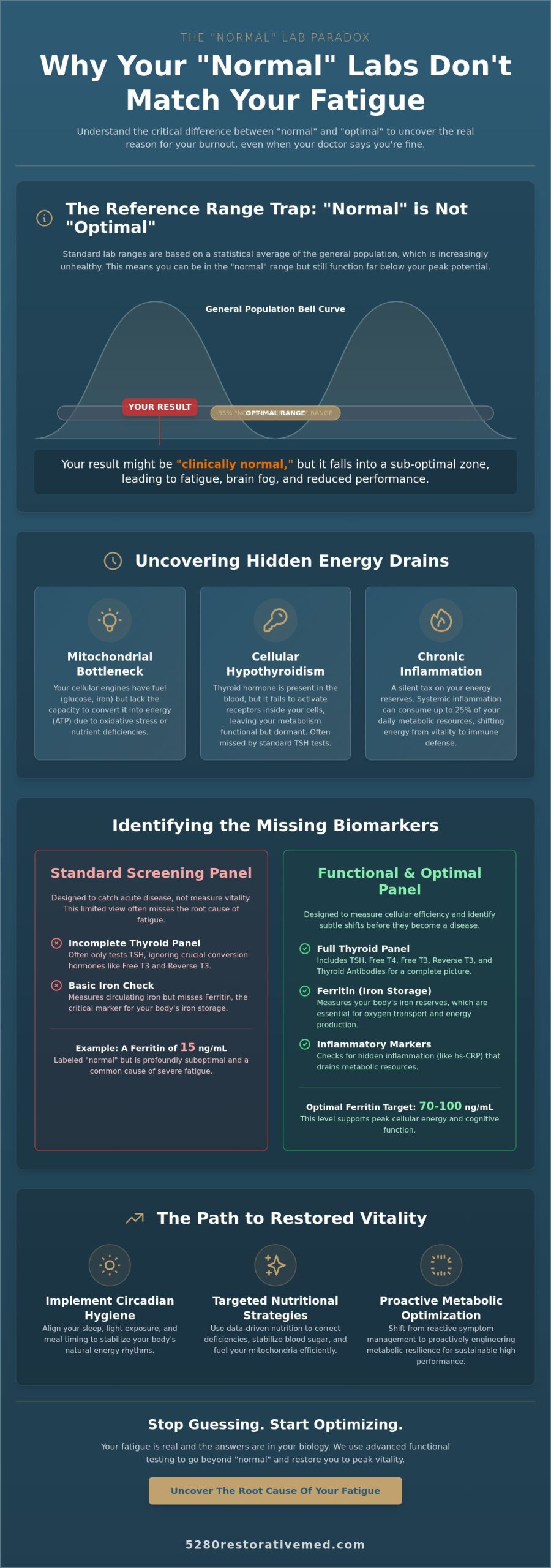
Laboratories establish “normal” ranges by calculating a statistical average from the 95% of people who were tested at that facility over a specific period. Because the general population is increasingly struggling with chronic metabolic and inflammatory issues, these ranges are skewed by an inherently unhealthy demographic. If your results fall in the bottom 5% of a range, your doctor might tell you that you’re fine, even though your body is struggling to maintain basic functions. Functional optimization is the pursuit of the narrowest, healthiest biomarker windows. By shifting the focus from common averages to ideal levels, we can identify why your energy is flagging long before a disease state manifests.
The Limitations of Standard Screening
Standard screenings like the Complete Blood Count (CBC) or Comprehensive Metabolic Panel (CMP) are designed to catch acute pathology, such as kidney failure or severe anemia. They are not built to measure vitality or cellular efficiency. For example, a TSH level of 4.2 uIU/mL or a Ferritin level of 15 ng/mL might be labeled “normal” by a lab, yet these low-normal figures frequently cause profound, life-altering fatigue. Functional medicine practitioners look deeper, prioritizing your subjective symptoms alongside the data. When a provider dismisses your fatigue because it doesn’t fit a narrow diagnostic box, it creates a cycle of clinical gaslighting. We believe your symptoms are the most important data point we have, and we use them to guide our strategy for restoration and optimization.
Hidden Biological Energy Drains: Beyond Basic Blood Panels
The frustration of hearing your labs are normal while you feel completely drained is a common experience for high achievers in Denver. This paradox exists because the standard diagnostic process for fatigue is designed to find advanced disease, not to measure peak physiological efficiency. When you find yourself asking why am i so tired even when my labs are normal, the answer usually hides in the gaps between conventional reference ranges.
One primary culprit is the Mitochondrial Bottleneck. This occurs when your cellular engines have plenty of fuel but lack the capacity to process it. Even if your glucose and iron levels look perfect on paper, your cells might be struggling to convert those nutrients into Adenosine Triphosphate (ATP). This metabolic stall often stems from subclinical thyroid dysfunction. Standard TSH tests frequently miss cellular hypothyroidism, a condition where thyroid hormone is present in the blood but fails to activate the receptors inside your cells. This leaves you with a metabolism that’s technically functional but practically dormant.
Chronic low-grade inflammation, often called inflammaging, acts as a silent tax on your energy reserves. This systemic activation of the immune system can consume up to 25% of your daily metabolic resources. Much of this inflammation originates in the Gut-Brain-Mitochondria axis. When intestinal permeability allows toxins to enter the bloodstream, it triggers a survival response that shifts energy away from brain function and physical vitality toward immune defense. You aren’t just tired; your body is stuck in a permanent state of biological repair.
Mitochondrial Dysfunction and Cellular Respiration
Mitochondria are the powerhouses of your cells, but they’re incredibly sensitive to oxidative stress. When these organelles are damaged, your energy production drops regardless of how much sleep you get. Reclaiming your vitality requires specific cofactors that act as spark plugs for cellular respiration. Key nutrients include:
- CoQ10: Essential for the electron transport chain.
- Magnesium: A necessary cofactor for over 300 enzymatic reactions, including ATP synthesis.
- B-Vitamins: The primary drivers of the Krebs cycle.
At 5280 Restorative Medicine, we often utilize red light therapy to bypass these bottlenecks. This technology uses specific wavelengths of light to stimulate cytochrome c oxidase, directly enhancing mitochondrial output and reducing oxidative damage.
The HPA Axis and the “Burnout” Spectrum
The term adrenal fatigue is technically a myth, but the clinical reality of HPA axis dysregulation is very real. This is a communication breakdown between the hypothalamus, pituitary, and adrenal glands. For those in high-pressure executive roles, chronic cortisol elevation eventually leads to cortisol resistance. Your cells stop “listening” to the signal to be alert. This is why am i so tired even when my labs are normal; your cortisol might be in the reference range, but your body can no longer use it effectively. This results in the classic wired but tired feeling that prevents deep restoration. If you feel like you’re running on empty, it may be time to restore your hormonal balance with a professional assessment of your stress response system.
Functional vs. Conventional Testing: Identifying the Missing Biomarkers
You walk out of the doctor’s office with a clean bill of health, yet you can barely make it through the afternoon without a nap. Standard diagnostic models typically address common causes of fatigue like acute anemia or overt organ failure, yet they often overlook the nuanced biomarkers that dictate daily vitality. If you’ve asked yourself why am i so tired even when my labs are normal, the answer often lies in the difference between clinical and optimal ranges. Conventional labs use a broad bell curve of the general population; we focus on the narrow window where you actually feel your best.
A primary example is iron testing. Most clinics only check serum iron or hemoglobin. We prioritize Ferritin, which measures your body’s iron stores. A Ferritin level of 15 ng/mL might be labeled normal by a lab, but clinical experience shows that levels below 30 ng/mL often trigger profound exhaustion. Similarly, we look beyond extracellular blood levels for nutrients. Intracellular testing reveals what’s actually getting inside your cells to fuel ATP production, rather than just what’s floating in your bloodstream.
We also investigate the role of mast cell activation syndrome as a hidden driver of fatigue. When your immune system is in a state of constant hyper-reactivity, it consumes massive amounts of metabolic energy, leaving you drained even if your basic blood counts look perfect.
The Complete Thyroid and Hormone Picture
Standard thyroid screening usually stops at TSH. This is a mistake because the thyroid produces about 90 percent T4, which is an inactive storage hormone. Your body must convert T4 into Free T3, the active form that powers your metabolism. Many patients fail this conversion process due to stress or nutrient deficiencies. We utilize BHRT to restore hormonal equilibrium when these pathways falter. By optimizing Free T3 alongside DHEA and Pregnenolone, the mother hormone of the energy cascade, we can effectively restart your cellular engine.
Metabolic and Genetic Markers
An estimated 40 percent of the population carries a mutation in the MTHFR gene, which impairs detoxification and energy production. We use Organic Acids Testing (OAT) to identify these metabolic roadblocks in real time. We also look at fasting insulin rather than just glucose. A patient can have a normal blood sugar of 90 mg/dL while their insulin is skyrocketing to 25 uIU/mL to keep it there. This hidden insulin resistance is a leading reason why am i so tired even when my labs are normal, as it prevents your cells from efficiently accessing fuel.
Restoring Vitality: Targeted Strategies for Cellular Energy Optimization
Understanding why am i so tired even when my labs are normal requires shifting your focus from basic blood counts to the efficiency of your cellular machinery. If your standard tests show no deficiencies, the issue often lies in how your body manages its energy resources. True restoration begins by aligning your lifestyle with your internal biological rhythms and providing the specific fuel your mitochondria require to thrive.
Circadian Biology and Sleep Architecture
Spending eight hours in bed is not a guarantee of recovery. There is a profound difference between “unconscious time” and restorative sleep architecture. Your mitochondria, the power plants of your cells, undergo essential repair processes specifically during deep sleep stages. Exposure to blue light in the 450 to 490nm range during evening hours suppresses melatonin production for up to 90 minutes, which delays these repair cycles.
To maximize REM and deep sleep, we recommend an “Executive Wind-Down” routine. This involves three specific steps:
- Dimming overhead lights two hours before sleep to signal the brain’s pineal gland.
- Eliminating digital screens 60 minutes prior to bed to prevent cortisol spikes.
- Maintaining a bedroom temperature of 65 to 68 degrees Fahrenheit to facilitate the necessary drop in core body temperature.
Nutritional Engineering for High-Performers
Achieving sustained focus requires metabolic flexibility, which is the body’s ability to switch efficiently between burning carbohydrates and fats. Many patients wondering why am i so tired even when my labs are normal are actually experiencing “energy vampires” in their diet. Processed seed oils and hidden sugars create oxidative stress that “gums up” cellular signaling.
To optimize cognitive output, prioritize 1.2 to 1.6 grams of protein per kilogram of body weight. This intake supports the synthesis of neurotransmitters like dopamine and norepinephrine. By stabilizing blood sugar through high-quality proteins and healthy fats, you eliminate the mid-afternoon “brain fog” that plagues many high-achievers.
Beyond nutrition, targeted supplementation protocols move the needle where generic multivitamins fail. We focus on bioavailable forms of CoQ10 at 100 to 200mg dosages and methylated B-vitamins to support the Krebs cycle. Finally, we utilize hormetic stressors to reboot metabolic resilience. A three-minute cold plunge at 50 degrees Fahrenheit or a 20-minute sauna session at 170 degrees triggers heat shock proteins and mitochondrial biogenesis, effectively “upgrading” your cellular hardware.
Ready to move beyond standard lab results and reclaim your peak performance? Schedule your personalized vitality consultation with 5280 Restorative Medicine today.
Engineering Metabolic Resilience: The Path to Sustainable High Performance
You’ve likely spent months asking, “why am i so tired even when my labs are normal?” while receiving no actionable answers from the traditional medical system. Standard healthcare is designed to catch organ failure or acute disease, not to engineer success. When your tests come back in the normal range, it simply means you aren’t pathologically ill. It doesn’t mean you’re functioning at your peak. At 5280 Restorative Medicine, we pivot from reactive symptom management to proactive health optimization. We recognize that your fatigue isn’t a mystery; it’s a data point that standard labs are simply not equipped to decode.
True vitality requires metabolic resilience, which is the body’s ability to adapt to stressors and maintain energy production without crashing. Our approach to functional medicine for high-performers provides a distinct competitive advantage. By looking at cellular health, mitochondrial efficiency, and hormonal synergy, we identify the specific bottlenecks holding you back. We utilize advanced diagnostics that go 10 steps beyond the basic panel to find why your engine is stalling despite having a full tank of fuel. Your fatigue is real, and the data to solve it exists if you know where to look.
The Executive Health Advantage
Investing in health optimization is the highest ROI an executive can achieve. A 15% increase in cognitive clarity or a 20% boost in daily stamina translates directly into better decision-making and more effective leadership. There’s a profound difference between “health,” which is the mere absence of illness, and “peak performance,” which is the presence of abundant energy. Our personalized protocols eliminate the guesswork that plagues most wellness routines. We don’t guess; we test. This saves busy professionals hundreds of hours by replacing generic supplements with precision-engineered interventions that actually work.
Taking the Next Step Toward Restoration
The journey back to your best self begins with a comprehensive metabolic assessment. This process involves a deep dive into your unique biochemistry, looking at markers for systemic inflammation, gut microbiome health, and micronutrient deficiencies. We don’t just hand you a list of results and send you on your way. We build a long-term clinical partnership to ensure your vitality is sustainable for the next 20 or 30 years of your career. It’s time to stop wondering “why am i so tired even when my labs are normal” and start measuring the metrics that actually matter for your lifestyle.
Ready to reclaim your energy? Learn how our Executive Health Programs can restore your edge.
Take Control of Your Metabolic Future
Standard blood panels often ignore the nuance of sub-optimal biomarkers, leaving high-performers stuck in a cycle of exhaustion. You don’t have to accept a baseline that feels like burnout. By shifting from conventional ranges to functional optimization, we identify the specific cellular drains and genetic predispositions that traditional medicine overlooks. You’re no longer left wondering why am i so tired even when my labs are normal; instead, you gain a data-driven roadmap to metabolic resilience.
Led by Dr. Marci Catallo-Madruga, an expert in metabolic optimization, 5280 Restorative Medicine uses advanced genetic and metabolic testing protocols to restore your vitality. We specialize in tailoring these strategies for high-performing executives who require sustained mental clarity and physical energy. It’s time to move past the paradox of “normal” results and reach a superior state of health. Your path to peak performance starts with a personalized assessment designed for your unique biology.
Reclaim Your Vitality; Schedule Your Functional Medicine Consultation
You deserve to feel as vibrant as your labs claim you are. Let’s start building your foundation for lasting energy today.
Frequently Asked Questions
Why does my doctor say my thyroid is fine when I have all the symptoms of hypothyroidism?
Your doctor likely only tested Thyroid Stimulating Hormone (TSH), which doesn’t account for how your body uses thyroid hormone at a cellular level. Standard labs often ignore Free T3, Free T4, and Reverse T3 markers that reveal conversion issues. At 5280 Restorative Medicine, we look for TSH levels closer to 1.0 to 2.0 mIU/L to ensure true metabolic restoration and optimization.
What is the difference between “normal” and “optimal” lab ranges?
Normal lab ranges are calculated based on the average values of the population visiting that specific lab, which often includes individuals with chronic conditions. This statistical average explains why am i so tired even when my labs are normal. Optimal ranges represent the physiological levels found in healthy, high-performing individuals. We focus on these tighter windows to identify subtle imbalances before they progress into clinical disease.
Can chronic stress cause fatigue even if my cortisol levels look normal on a morning blood test?
A single morning blood draw only captures a snapshot of your cortisol, failing to show how your levels fluctuate throughout the 24 hour cycle. Research from the Endocrine Society indicates that cortisol should peak within 30 minutes of waking and decline steadily. If your levels drop too quickly in the afternoon, you’ll feel exhausted. We utilize 4 point salivary testing to map your entire circadian rhythm.
What are the best functional medicine tests for chronic fatigue?
The most effective diagnostic tools include the DUTCH Plus for hormones and the GI-MAP for microbiome health. These tests analyze over 50 different biomarkers that standard blood work ignores. We also utilize Organic Acids Testing (OAT) to evaluate mitochondrial function and nutrient deficiencies. These specific data points allow us to create a personalized plan for your restoration and optimization.
How long does it take to see energy improvements with a functional medicine approach?
Most patients report a measurable increase in vitality within 21 to 42 days of starting their personalized protocol. While cellular repair is a journey, initial shifts in blood sugar stability and sleep quality often happen in the first 2 weeks. Full hormonal and metabolic restoration typically requires 3 to 6 months of consistent intervention to achieve lasting results and peak performance.
Is it possible to be “too healthy” for standard labs to detect my issues?
You aren’t too healthy for testing, but your symptoms likely fall into the subclinical range that standard medicine doesn’t treat. Conventional doctors often wait for a marker to fall outside the 95% confidence interval before intervening. We identify patterns of decline early. If your ferritin is at 15 ng/mL, it’s normal by lab standards, but you’ll feel exhausted until it reaches at least 50 ng/mL.
What role does gut health play in my daily energy levels?
Your gut health directly dictates your energy because it’s where you absorb the raw materials for ATP production. Your gastrointestinal tract also produces 90% of your body’s serotonin, which influences sleep and mood. Over 70% of your immune system resides in the gut lining; if it’s inflamed, your body diverts energy to fight low grade infections. This explains why am i so tired even when my labs are normal.
Can food sensitivities cause extreme tiredness even if I don’t have digestive issues?
Food sensitivities trigger systemic inflammation that can manifest as profound fatigue without any bloating or gas. Delayed IgG reactions can occur up to 72 hours after ingestion, making it difficult to link your diet to your energy levels. Studies show that eliminating reactive foods can reduce C-Reactive Protein (CRP) levels, a key marker of inflammation, by 25% or more within 30 days.