
What if the search for an in-network provider is actually the primary barrier to your cellular health optimization? You likely pay $4,400 or more in annual premiums only to be rushed through a 15-minute appointment that ignores the root cause of your fatigue or gut issues. It feels like your insurance benefits are designed for reactive crisis management rather than proactive vitality. If you’re searching for how to find a functional medicine doctor who takes insurance, you’ve likely realized that the traditional system rarely prioritizes long-term restoration.
We understand the frustration of deciphering “Superbills” and fearing a $2,000 surprise lab bill. At 5280 Restorative Medicine, we believe your health journey should be a proactive pursuit of peak performance. This 2026 guide reveals how to leverage the new $4,400 HSA contribution limits and $3,400 FSA caps to fund elite-level care. We’ll show you how to manage out-of-network claims and use the latest 2026 CPT code updates to maximize your reimbursements. By shifting your focus from in-network to reimbursable, you can finally access personalized metabolic testing and hormone optimization without sacrificing your financial peace of mind.
Key Takeaways
- Understand why the traditional insurance model’s 15-minute time limit often fails to address the complex biological root causes of chronic health issues.
- Master the strategy of how to find a functional medicine doctor who takes insurance by prioritizing practitioners who provide Superbills for out-of-network reimbursement.
- Maximize your 2026 tax-advantaged accounts by applying HSA and FSA funds toward advanced metabolic testing and hormone optimization protocols.
- Follow a clear five-step framework to verify your carrier’s specialist benefits and avoid unexpected costs for comprehensive gut health and genetic assessments.
- Shift your perspective from short-term co-pays to long-term restoration, ensuring your healthcare investment yields measurable improvements in vitality and longevity.
Why Traditional Insurance and Functional Medicine Often Conflict
Functional medicine treats the body as an integrated system rather than a collection of independent symptoms. Many patients begin their journey by asking how to find a functional medicine doctor who takes insurance, only to discover a fundamental mismatch between the insurance industry’s “standard of care” and the requirements of root-cause restoration. While traditional medicine excels at managing acute crises, the insurance billing model is largely incompatible with the complex, biology-based investigations required to resolve chronic fatigue, gut dysfunction, or hormonal imbalances. Because conventional carriers focus on symptom suppression, they often fail to cover the comprehensive consultations necessary for true healing.
Some categorize functional medicine as a form of alternative medicine, yet its foundation is deeply rooted in peer-reviewed biochemistry and systems biology. The core conflict exists because insurance carriers prioritize the “absence of disease” rather than the “presence of vitality.” When you’re searching for how to find a functional medicine doctor who takes insurance, it’s helpful to understand that the best practitioners often bypass standard billing to protect their clinical autonomy. This allows them to focus on your individual success rather than insurance-mandated volume quotas. Practitioners in this space prioritize results over coding; they ensure your health journey isn’t dictated by a corporate actuary.
The Limitations of ICD-10 Coding in Restorative Care
Insurance reimbursement relies on ICD-10 codes, which require a specific diagnosis of a disease state before payment is authorized. If your goal is hormonal optimization or cellular longevity, your carrier might flag preventative metabolic testing as “not medically necessary” because you don’t yet meet the criteria for a pathology. This “diagnosis-first” requirement creates a significant barrier for high-performers who want to address dysfunction before it becomes a chronic illness. At 5280 Restorative Medicine, we see this as a missed opportunity for restoration. We focus on achieving a superior state of health rather than just returning you to a baseline of “not sick.”
The Time-Value Paradox of Modern Healthcare
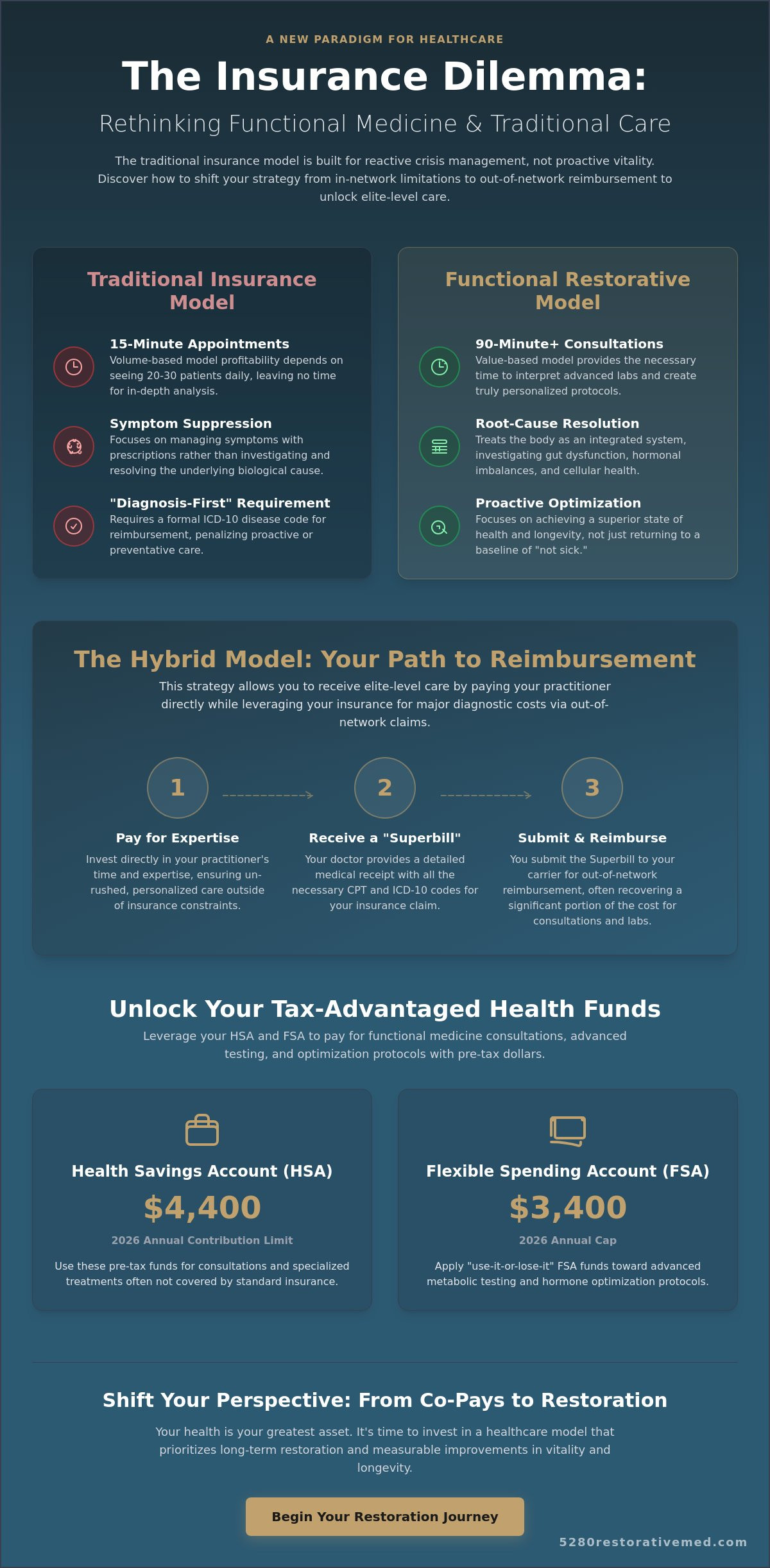
Clinical time is the most valuable asset in identifying the hidden drivers of chronic illness. Insurance-based clinics operate on a volume-based model where profitability depends on seeing 20 to 30 patients per day. In contrast, functional health and wellness in 2026 represents a shift toward value-based care where a single consultation might last 90 minutes. This depth is essential for interpreting advanced labs and crafting the personalized, non-generic treatment plans that define our philosophy. You can’t solve a decade of gut issues in a 15-minute slot. True optimization requires a health partner who is deeply invested in your individual transformation.
The Hybrid Model: Leveraging HSA, FSA, and Out-of-Network Benefits
Many patients start their search by looking for how to find a functional medicine doctor who takes insurance, only to be disappointed by the limited number of in-network options. The solution for high-performers in 2026 is the “Hybrid Model.” This approach separates the clinical time of the practitioner from the diagnostic tools used to assess your health. You pay privately for the doctor’s expertise and time, which ensures you aren’t limited to a rushed, 15-minute window. Simultaneously, you leverage your insurance for the significant costs associated with laboratory testing and diagnostic imaging. This strategy allows you to receive elite-level care while still utilizing the benefits you pay for every month.
Central to this model is the “Superbill.” This document provides the specific medical codes your insurance carrier needs to process an out-of-network claim. While it doesn’t guarantee 100% coverage, it often results in meaningful reimbursement for those with PPO plans. When navigating insurance for complementary care, the Superbill acts as your primary bridge between private restoration and corporate coverage. It’s the most effective way to offset the cost of a comprehensive Functional Medicine Consultation without compromising on the depth of your care.
Maximizing Your HSA and FSA Contributions
Your Health Savings Account (HSA) and Flexible Spending Account (FSA) are your best allies in funding root-cause medicine. For 2026, the HSA contribution limits have risen to $4,400 for individuals and $8,750 for families. These are pre-tax dollars that you can use for clinical fees, specialized testing, and even certain supplement protocols when prescribed for a diagnosed condition. Always maintain a digital folder of your invoices and prescriptions. This documentation is vital for both tax compliance and proving to your insurance carrier that your treatments are qualified medical expenses.
Laboratory Insurance Hacks: The “In-Network” Lab Loophole
One of the most effective ways to lower costs is to use the “In-Network Lab Loophole.” Even if your doctor is private-pay, they can often send orders for standard bloodwork to national labs like Quest or Labcorp. Since these facilities are usually in-network for most major insurers, your standard lab work may be fully covered or subject only to your deductible. Contrast this with specialized kits for genetic analysis or gut health, which are often cash-pay because they provide data that exceeds the current insurance “standard of care.” To improve your chances of reimbursement for these advanced tests, ask your provider for a “Letter of Medical Necessity” that explains why these specific markers are essential for your treatment plan.
Comparing In-Network Holistic Clinics vs. Private Restorative Practices
Choosing between an insurance-based clinic and a private restorative practice is about more than just the final bill. It’s about the quality of the data gathered and the time spent analyzing your unique biological markers. While you may initially focus on how to find a functional medicine doctor who takes insurance, it’s vital to consider the opportunity cost of restricted care. In-network clinics often operate under the same volume-based pressures as standard primary care. This results in “hidden costs” such as multiple $50 co-pays, repeated visits for unresolved symptoms, and the frustration of a health journey that feels stagnant despite your insurance coverage.
The return on investment for your health is highest when you get the right answer the first time. Private restorative models prioritize this accuracy by utilizing advanced diagnostics that insurance-first clinics often bypass. For those seeking functional medicine for high-performers, the difference is clear. You’re not just looking for the absence of a diagnosis; you’re looking for the presence of peak metabolic resilience. This level of health engineering requires a partner who isn’t limited by the narrow definitions of corporate medical necessity.
The “Insurance-Only” Functional Clinic
The primary advantage of an insurance-only clinic is the lower immediate out-of-pocket expense for the consultation itself. However, these environments are often forced into 15-minute or 20-minute appointment slots to remain profitable under standard reimbursement rates. This time constraint frequently leads to a “supplement-for-a-symptom” approach that mimics the very pharmaceutical model functional medicine aims to replace. Because practitioners in these settings are often overworked, these clinics frequently experience high turnover, which disrupts the continuity of your care and prevents a deep, long-term health partnership.
The Private Restorative Model
A private restorative practice functions like a boutique health partner. The focus shifts from billing codes to your individual success and cellular optimization. While the upfront investment is higher, the clinical depth is unparalleled. You receive unlimited clinical time, detailed genetic analysis, and highly personalized protocols that address the specific physiological causes of your symptoms. For the high-achiever in Denver or beyond, this model is the most efficient path to restoration. It eliminates the downtime of illness and ensures every intervention is backed by precise metabolic testing. When you calculate the cost of lost productivity and years of ineffective treatments, the value of a private, results-oriented practice becomes undeniable.
5 Steps to Secure Functional Care While Maximizing Insurance
Securing elite-level care doesn’t mean you have to ignore your insurance benefits. While the initial search for how to find a functional medicine doctor who takes insurance might feel discouraging, a structured approach can unlock significant reimbursements. For those in the Denver area and beyond, understanding these logistics is the first step toward true vitality. By following these five steps, you can bridge the gap between high-end restorative medicine and your existing coverage.
- Step 1: Verify Out-of-Network (OON) Benefits. Call your carrier to ask specifically about your OON deductible and coinsurance. Many PPO plans reimburse 60% to 80% of the “allowed amount” once you meet your deductible.
- Step 2: Identify Providers Offering Superbills. Look for MDs or DPTs with functional certifications. A Superbill is a detailed receipt with the necessary ICD-10 and CPT codes for you to submit a claim yourself.
- Step 3: Explore Co-Management. Ask if the specialist can work alongside your Primary Care Physician (PCP). Your PCP may be able to order standard screenings that your insurance already covers.
- Step 4: Audit Lab Partnerships. Confirm if the practice uses national diagnostic partners like Quest or Labcorp. This ensures that while you pay for the interpretation, the actual testing remains in-network.
- Step 5: Conduct a Discovery Call. Use this time to ask about the practice’s financial workflow. A transparent office will clearly explain how they support your reimbursement efforts.
Questions to Ask Your Insurance Provider
When you call your insurance company, clarity is essential. Use this specific script: “I am seeking care from an out-of-network specialist. What is my OON deductible, and what is the coinsurance percentage once that’s met? Specifically, what is the ‘Allowed Amount’ for CPT code 99205?” This code represents a complex new patient visit, which is standard for a deep-dive Functional Medicine Consultation. You should also verify if a formal referral is required to preserve these benefits, as some plans are strict about the “gatekeeper” model.
Vetting the Practice Financial Policy
A trusted practice demonstrates clinical authority through total transparency in their billing and financial expectations. Inquire if the clinic handles the “Prior Authorization” process for advanced labs or if they provide letters of medical necessity. Many high-end practices now offer all-inclusive programs that bundle consultations and testing, which prevents the “nickel-and-diming” often found in traditional settings. This approach ensures your focus remains on cellular optimization rather than administrative hurdles. If you’re ready to move beyond standard billing and into proactive health, explore our personalized restoration programs today.
Beyond the Billing Code: Investing in Restoration
You’ve navigated the logistical hurdles of how to find a functional medicine doctor who takes insurance, but the final step in your journey is a mindset shift. While maximizing your 2026 insurance benefits is a savvy financial move, the ultimate goal isn’t just a reimbursed claim. It’s a restored life. High-performers understand that healthcare is a strategic investment in their most valuable asset: their own biology. True restoration happens when you move beyond the limitations of what a corporate actuary deems “medically necessary” and begin to prioritize peak performance and cellular longevity.
At 5280 Restorative Medicine, we structure our programs to ensure maximum clinical impact by focusing on the underlying drivers of health rather than just managing symptoms. We believe that vitality and mental clarity are achievable at any age. This proactive approach requires a departure from the reactive insurance mindset that only addresses health once a disease is present. By investing in a private, results-oriented model, you gain access to a health partner who is deeply invested in your individual success and long-term metabolic resilience. We help you bridge the gap between complex science and your daily well-being.
Why High-Performers Choose Private Protocols
Executives and high-achievers face unique physiological demands, including the need for sustained energy, sharp cognitive clarity, and robust stress resilience. Standard insurance-based labs often miss the subtle markers of dysfunction that precede a chronic diagnosis. Private protocols allow for specialized genetic analysis and comprehensive metabolic testing that go far beyond what traditional carriers typically offer. These advanced diagnostics provide a personalized blueprint for your health, ensuring every intervention is precise and effective. For our national clients, the ease of virtual consultations ensures that elite-level care is accessible regardless of your location, allowing you to maintain your health engineering schedule without the downtime of travel.
Take Control of Your Health Narrative
It’s time to stop viewing healthcare as a sunk cost and start seeing it as a vital component of your performance strategy. When you prioritize hormone optimization and gut health through a root-cause lens, you’re not just avoiding illness. You’re engineering a superior state of health. You don’t have to settle for the “standard of care” when you can achieve a state of optimized vitality. Take the lead in your own health story by choosing a partner who values your longevity as much as you do. Optimize your vitality with a personalized restorative protocol and discover the difference of a truly proactive approach to medicine.
Take Command of Your Biological Future
Your health is a strategic asset that requires a sophisticated management plan. While the initial question of how to find a functional medicine doctor who takes insurance often leads to restrictive, volume-based clinics, you now have the framework to secure elite care through a hybrid model. By utilizing Superbills and maximizing your 2026 HSA contribution limits of $4,400 for individuals, you can offset the costs of deep-dive metabolic testing while maintaining access to premium clinical expertise. You don’t have to settle for symptom management when restoration is within reach.
At 5280 Restorative Medicine, we specialize in helping high-performers achieve superior metabolic resilience and hormonal optimization. Led by Dr. Marci Catallo-Madruga, our practice is dedicated to executive vitality through personalized, data-driven protocols. Whether you are in Denver or require our national virtual consultations, we provide the expert guidance needed to move beyond reactive care. It’s time to stop letting billing codes dictate your quality of life. Apply for an Executive Health Optimization Program today and begin your journey toward lasting peak performance. You deserve a health partner who is as invested in your longevity as you are.
Frequently Asked Questions
Does Medicare cover functional medicine practitioners?
Medicare does not currently recognize functional medicine as a distinct specialty for reimbursement. While Medicare covers standard diagnostic tests and basic evaluation services, the 60 to 90-minute consultations required for root-cause analysis often exceed their strict coverage guidelines. Patients typically pay privately for these extended restorative sessions to ensure the practitioner has sufficient time to analyze complex biological systems without the constraints of government billing codes.
Can I use my HSA for functional medicine supplements?
You can use your Health Savings Account (HSA) for supplements only if they’re prescribed by a licensed provider to treat a specific medical condition. For 2026, the HSA contribution limit is $4,400 for individuals. To ensure compliance, your doctor must provide a Letter of Medical Necessity (LMN) that links the supplement protocol to a diagnosed health issue like gut dysfunction or hormonal imbalance. Always keep digital copies of these letters for your tax records.
What is a Superbill and how do I submit it to my insurance?
A Superbill is a detailed medical invoice containing the specific CPT and ICD-10 codes your insurance carrier requires for processing. To submit it, you typically upload the document to your insurer’s member portal or mail it with a standard claim form. This document is the primary tool for how to find a functional medicine doctor who takes insurance indirectly through out-of-network reimbursement, allowing you to reclaim a portion of your clinical investment.
How much of a functional medicine visit is typically reimbursed out-of-network?
Reimbursement rates generally range from 60% to 80% of the “allowed amount” determined by your carrier. It’s important to remember that you must first meet your out-of-network deductible, which in 2026 often starts at $1,700 for individual plans. Once that deductible is met, your insurer covers their percentage of the standard rate for the specific billing codes provided on your Superbill. Contact your carrier’s benefits department to confirm your specific plan’s “allowed amount” for specialist visits.
Why do most functional medicine doctors not participate in insurance panels?
Most practitioners choose private models to avoid the “15-minute trap” mandated by traditional insurance reimbursement rates. Insurance panels prioritize volume, whereas restorative medicine requires significant clinical time for genetic analysis and metabolic testing. By remaining independent, doctors maintain the clinical autonomy necessary to create personalized, non-generic treatment plans. This approach ensures your care focuses on long-term vitality and cellular health rather than short-term symptom suppression.
Are functional medicine lab tests like GI-MAP or DUTCH covered by insurance?
Specialized functional labs like the GI-MAP or DUTCH test are frequently categorized as “investigational” by major insurance carriers. While standard bloodwork ordered through national labs like Quest or Labcorp is often covered, these advanced kits usually require a cash-pay fee. Some patients successfully apply their 2026 FSA funds, capped at $3,400, toward these diagnostic tools. This strategy allows you to use pre-tax dollars for the advanced data needed to optimize your metabolic resilience.
Can my primary care doctor order functional medicine tests for me?
Your primary care physician can order standard metabolic and nutrient panels, but they rarely have access to specialized functional kits. Most conventional doctors are restricted by their health system’s laboratory contracts and insurance-mandated “standard of care” guidelines. Effective restoration requires a specialist who is trained to interpret the complex interplay of biomarkers found in advanced gut and hormone assessments. A functional specialist provides the depth of analysis that standard primary care isn’t designed to offer.
What is the average out-of-pocket cost for an initial functional medicine consultation in 2026?
In 2026, the cost for an initial consultation typically ranges from $200 to $800. Some high-end restorative practices charge between $350 and $950 for comprehensive sessions that include a deep-dive history and lab interpretation. These fees reflect the value of the practitioner’s time and the sophisticated clinical expertise required to engineer a path toward peak performance. Investing in this initial session often saves money long-term by identifying the correct root cause rather than paying for years of ineffective treatments.