
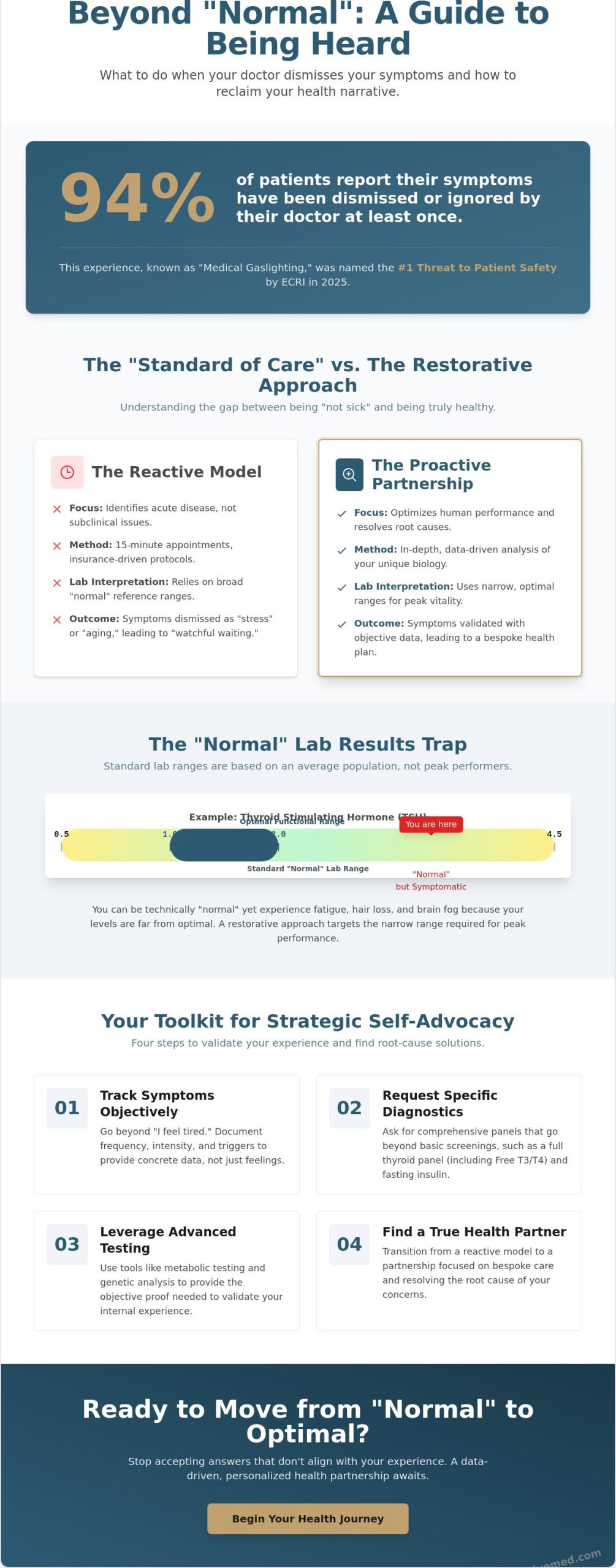
Over 94% of patients report that their doctors have ignored or dismissed their symptoms at least once. This experience, often called medical gaslighting, was named the number one threat to patient safety by ECRI in 2025. It’s incredibly isolating to feel your health declining while a professional tells you that everything looks fine on paper. Learning what to do when your doctor dismisses your symptoms is the first step toward reclaiming your agency and finding the clinical answers you deserve.
You’re right to trust your intuition when something feels off in your body. We believe that health is a proactive journey, not just the absence of a diagnosed disease. This article provides a clear framework for moving beyond standard reactive models toward a more personalized, boutique approach to care. You’ll discover how to use objective tools like metabolic testing, genetic analysis, and hormone optimization to validate your physical concerns. We’ll help you move from simply managing stress to identifying and resolving the biological root causes that others might have overlooked.
Key Takeaways
- Identify the gap between the “standard of care” and metabolic optimization to understand why common symptoms are often overlooked.
- Learn exactly what to do when your doctor dismisses your symptoms by using objective symptom tracking and requesting specific diagnostic codes.
- Distinguish between “normal” lab reference ranges and the optimal ranges required for peak physical and mental performance.
- Leverage advanced tools like genetic analysis and metabolic testing to provide the objective proof needed to validate your internal experience.
- Transition from a reactive medical model to a restorative health partnership focused on bespoke care and root-cause resolution.
Understanding Medical Dismissal and the ‘Standard of Care’ Gap
Medical dismissal occurs when a healthcare provider ignores, trivializes, or incorrectly attributes genuine physical symptoms to psychological factors. It’s rarely a matter of clinical negligence, which involves a direct breach of duty or clear harm. Instead, it’s usually a byproduct of the “Standard of Care.” This clinical benchmark is designed to identify acute disease rather than optimize human performance. If you’ve been told your labs are normal despite feeling exhausted, you’re experiencing the gap between being “not sick” and being truly healthy. Knowing what to do when your doctor dismisses your symptoms starts with understanding that the current medical system isn’t built to help you thrive; it’s built to keep you from a crisis.
We view health as a proactive journey toward peak physical and mental states. When a provider relies solely on a reactive model, they miss the subtle physiological shifts that precede a diagnosis. This systemic limitation leaves many people stuck in a state of subclinical dysfunction, where they’re technically “functioning” but far from their best selves.
The Reality of Medical Gaslighting in 2026
Many high-performers hear familiar refrains: “It’s just stress,” “You’re just getting older,” or “Try getting more sleep.” This is medical gaslighting. It’s particularly prevalent among individuals who maintain a high level of external function. Because you still look fit and productive, your complaints of brain fog or metabolic slowing are often dismissed as lifestyle issues. This can lead to a cycle of self-doubt where you begin to wonder if the problem is in your head. Effective patient advocacy is necessary to bridge this divide, ensuring your internal experience is matched with objective clinical investigation rather than being brushed aside.
Why Traditional Medicine Struggles with Subclinical Symptoms
The modern healthcare system operates on a 15-minute appointment model. This brief window is sufficient for diagnosing a sinus infection, but it fails when addressing the complexity of chronic fatigue or hormonal imbalances. Traditional doctors are often bound by insurance-driven protocols that dictate which tests they can order. If a symptom doesn’t fit into a specific diagnostic code for an acute illness, the system often defaults to “watchful waiting.” This reactive approach is the opposite of the data-driven methodology required for peak vitality. Understanding what to do when your doctor dismisses your symptoms requires moving beyond these institutional constraints toward a model that values bespoke, non-standardized care protocols over sheer patient volume.
Why ‘Normal’ Lab Results Don’t Always Mean You Are Healthy
You open your patient portal, heart racing, only to see a sea of green “Normal” flags. Yet, you can barely get through your afternoon meetings without a third cup of coffee, and your focus feels permanently clouded. This disconnect is one of the most frustrating aspects of figuring out what to do when your doctor dismisses your symptoms. Standard lab reference ranges are not based on peak vitality. They are calculated using a statistical bell curve of the general population. In many cases, that population includes individuals who are already dealing with undiagnosed chronic conditions or subclinical dysfunction. If the “average” person is increasingly unhealthy, being “normal” is no longer the goal.
Falling into the “Normal” trap means sitting in the 10th percentile of a range where you feel terrible, yet no clinical action is taken. This is why medical advocacy involves looking at biomarkers like fasting insulin, Vitamin D3, and full thyroid panels including Free T3 and Free T4. These markers offer a much more granular view of your internal environment than a standard checkup ever could.
Reference Ranges vs. Functional Optimization
Functional medicine utilizes narrower, health-centric ranges designed to identify shifts in physiology before they become pathology. For instance, the “normal” range for Thyroid Stimulating Hormone (TSH) is often quite broad. You might sit at the very edge of that range, experiencing hair loss and cold intolerance, yet remain “normal” in the eyes of a traditional provider. Ferritin is another example; a level that merely prevents anemia isn’t necessarily the level that supports optimal energy and hair growth. The Standard of Care range is essentially a tool for identifying existing disease, not a roadmap for achieving health.
The Problem with Basic Blood Panels
A standard annual physical usually includes a Complete Blood Count (CBC) and a Comprehensive Metabolic Panel (CMP). While useful, these only scratch the surface of your metabolic story. They rarely account for inflammatory markers like hs-CRP or specific micronutrient levels that dictate cellular energy. To truly understand your baseline, you need a deeper look. Our Functional Health and Wellness Guide details how root-cause optimization looks beyond these basic panels. True Shared Decision Making requires that you and your provider have access to the same high-level data. If you’re ready to stop guessing and start measuring, a functional medicine consultation can provide the clinical clarity standard labs miss.
Strategic Advocacy: How to Navigate Your Next Appointment
Navigating a medical appointment when you feel unheard requires more than just persistence; it requires a data-driven strategy. Research into Understanding Medical Dismissal shows that symptom invalidation causes lasting psychological harm, making it even harder to advocate for yourself in future consultations. To break this cycle, you must transform your subjective experience into objective data that fits into a clinical framework. Learning what to do when your doctor dismisses your symptoms is about reclaiming the narrative of your health through precise documentation and strategic communication.
Objective Symptom Documentation
Vague descriptions like “I feel tired” or “I’m just not myself” are easily dismissed as the results of a busy lifestyle. You can change the conversation by presenting functional limitations backed by data. Use wearables or a dedicated journal to track specific patterns. Instead of saying you’re fatigued, tell your doctor, “I experience a profound energy crash at 3pm daily that prevents me from completing my afternoon tasks, despite eight hours of sleep.” This shifts the focus to measurable performance output and metabolic health. By documenting exactly when and how your symptoms interfere with your baseline function, you provide a roadmap for deeper investigation that standard checkups often miss.
Effective Communication with Your Provider
Approach the conversation as a collaborative partner rather than a passive recipient of care. If you suspect a complex issue like Mast Cell Activation Syndrome, frame it through the lens of recent research and your specific data. Ask, “Based on my tracking of these specific triggers, what clinical markers can we use to rule out mast cell involvement?” This phrasing demands clinical reasoning rather than a reflexive dismissal.
If a provider refuses a specific test you believe is necessary, ask them to “document the refusal and the clinical reasoning behind it in my permanent medical record.” This request often prompts a reconsideration, as it creates a paper trail of their decision-making. Additionally, asking for the specific diagnostic codes they’re using to justify your current care plan can reveal gaps in their logic. Knowing what to do when your doctor dismisses your symptoms also includes recognizing when a partnership has reached its limit. If you’re consistently met with resistance rather than curiosity, it’s time to seek a health partner who values root-cause optimization and bespoke care protocols.
Using Advanced Metabolic and Genetic Testing as Your Advocate
Subjective symptoms are often the first sign that something is wrong, yet they are also the easiest for traditional providers to overlook. When you’re searching for what to do when your doctor dismisses your symptoms, the answer lies in shifting the focus from narratives to numbers. Advanced metabolic testing acts as a bridge between your lived experience and objective clinical proof. It transforms “unexplained” fatigue into measurable data points regarding mitochondrial efficiency and cellular energy production. This data-driven approach is the ultimate antidote to medical gaslighting, providing a clear, biological explanation for why you don’t feel your best.
Systemic inflammation often hides behind “normal” results on a basic blood panel. A comprehensive Gut Health Assessment can reveal imbalances in the microbiome that trigger immune responses and brain fog. By identifying these subclinical issues, you move from a state of reactive concern to proactive optimization. You no longer have to convince a provider that your symptoms are real; the data speaks for itself.
Metabolic Resilience and Performance
Identifying root-cause metabolic stalls can validate years of frustration. For many, “brain fog” isn’t a psychological state; it’s a reflection of suboptimal mitochondrial health impacting executive function. Our approach to Functional Medicine for High-Performers utilizes an engineering mindset to identify these specific physiological bottlenecks. By assessing how your body utilizes fuel and manages oxidative stress, we can move beyond the “standard” checkup to engineer true metabolic resilience. This level of depth is essential for anyone whose daily energy demands exceed the baseline performance expected by traditional medicine.
Genetic Analysis: Your Biological Blueprint
Your genetic makeup dictates how you process nutrients, clear toxins, and respond to environmental stressors. Standard labs often miss these predispositions entirely because they only look at your current state, not your underlying potential for dysfunction. Through Genetic Analysis, we examine Single Nucleotide Polymorphisms (SNPs) to understand your unique biological blueprint. This allows us to move away from “one size fits all” advice and toward a bespoke health strategy.
Your genes might explain why a popular supplement protocol or diet works for others but leaves you feeling depleted. Understanding these variations helps us create highly personalized Supplement Protocols that align with your DNA. If you are ready to use objective data to reclaim your health, our Executive Health Program offers the comprehensive diagnostics needed to validate your symptoms and optimize your performance.
Transitioning to a Restorative Health Partnership
The final step in understanding what to do when your doctor dismisses your symptoms is choosing a clinical environment that treats you as an active partner. In the traditional medical model, the physician often acts as a gatekeeper, deciding which symptoms are “valid” enough to warrant investigation based on narrow insurance guidelines. A restorative health partner, however, views your symptoms as essential biological signals that demand exploration. At 5280 Restorative Medicine, we replace the dismissal of subclinical concerns with deep clinical curiosity. We don’t just ask if your labs are normal; we ask if they are optimal for your specific performance goals and long-term vitality.
Investing in a comprehensive health program offers a significantly higher ROI than piecemeal visits to various specialists. When you address metabolic health, hormonal balance, and gut function simultaneously within a single, cohesive plan, you create a synergistic effect. This integrated approach resolves the root cause of your concerns rather than just masking individual symptoms. It prevents the wasted time and mounting frustration of seeking answers from providers who lack the time or tools to see the complete picture of your health.
The Boutique Clinical Experience
High-performers require a level of clinical analysis that a standard clinical setting cannot provide. Our Executive Health Programs are designed for individuals who demand sustainable energy and peak mental clarity. We prioritize longer consultations and deeper data analysis to capture the nuances of your unique physiology. This proactive approach identifies early markers of metabolic slowing and cellular stress that traditional doctors often miss because they are only trained to look for acute disease. By the time a standard test flags a problem, the opportunity for early intervention has often passed.
Your Path Forward: From Dismissed to Optimized
Your journey toward renewal begins with an advanced bloodwork panel and a thorough metabolic review. We use this objective data to build a custom framework that may include a targeted nutrition plan or a BHRT protocol to restore hormonal equilibrium. If you feel that something is off in your body, trust your intuition. There is always a biological reason for your symptoms, even if standard testing hasn’t identified it yet.
Reclaiming your vitality is about more than just finding a diagnosis; it’s about exceeding your baseline performance and reaching a superior state of function. You deserve a health partner who is as invested in your success as you are. Taking the first step with a Functional Medicine Consultation ensures you are no longer navigating your health journey alone. We provide the expertise and the advanced diagnostics needed to move you from being dismissed to being fully optimized.
Reclaim Your Health Through Data-Driven Advocacy
You’ve learned that standard reference ranges are often just a baseline for avoiding acute disease, not a roadmap for thriving. By shifting your focus toward objective metabolic data and genetic analysis, you can bridge the gap between feeling off and receiving clinical validation. Knowing what to do when your doctor dismisses your symptoms involves seeking a clinical partnership that prioritizes your unique physiology over institutional efficiency. Advocacy is most effective when it’s backed by the type of deep diagnostics that traditional models frequently overlook.
Dr. Marci Catallo-Madruga and our team specialize in engineering metabolic resilience for high-performers. We utilize comprehensive metabolic and genetic testing protocols that go beyond standard labs to identify the biological root causes of fatigue and subclinical dysfunction. Our personalized health protocols are designed specifically for sustainable executive performance and long-term vitality. It’s time to move past the frustration of being unheard and start a journey toward measurable renewal.
Schedule a Consultation with 5280 Restorative Medicine to Uncover Your Metabolic Root Cause. You don’t have to settle for a baseline existence when a superior state of physical and mental function is achievable. Trust your body’s signals and take control of your health journey today.
Frequently Asked Questions
What is medical gaslighting and how do I know if it’s happening to me?
Medical gaslighting is the invalidation of your genuine clinical concerns without a proper medical evaluation. You’ll know it’s happening if your provider attributes physical suffering to stress, age, or mental health without ordering objective diagnostics. This behavior often stems from systemic time constraints rather than malicious intent. If you feel unheard or “crazy” despite real symptoms, it’s a signal to take an active role in your care and seek a second opinion.
How can I get my doctor to take my fatigue seriously?
To get your doctor to take fatigue seriously, translate your subjective feelings into objective functional limitations. Instead of saying you feel tired, document specific instances where fatigue prevents you from meeting executive demands or completing daily workouts. Presenting a log of 3pm energy crashes provides the clinical data needed to move beyond a “stress” diagnosis. This documentation is a key part of what to do when your doctor dismisses your symptoms.
What should I do if my bloodwork is normal but I still feel sick?
When bloodwork appears normal but you still feel unwell, it’s often because standard reference ranges are too broad to capture subclinical dysfunction. These ranges represent a population average, not your personal peak state. You should seek a deeper investigation through metabolic testing or gut health assessments. These advanced diagnostics identify physiological shifts that occur long before a traditional lab result flags a disease state, allowing for earlier intervention.
Can I request a copy of my medical notes if I feel dismissed?
Yes, you have a legal right to access your full medical records, including clinician notes. Reviewing these notes allows you to see if your symptoms were recorded accurately or if they were minimized in the documentation. If the notes don’t reflect the severity of your experience, you can request a formal amendment. Having these records is essential when transitioning to a new health partner who will prioritize your recovery and optimization.
Is it okay to see a functional medicine doctor if my primary care doctor says I’m fine?
It’s entirely appropriate to seek a functional medicine consultation even if your primary doctor finds no issues. Traditional primary care is optimized for acute illness and insurance-based protocols, which often lack the time for deep-dive analysis. A functional approach focuses on root-cause optimization and exceeding baseline performance. Choosing a boutique practice ensures you receive a personalized, data-driven strategy that aligns with your specific health and performance goals rather than just the absence of disease.
What specific blood tests should I ask for if I’m always tired?
Beyond a standard CBC, you should request a full thyroid panel including Free T3, Free T4, and thyroid antibodies. Ask for Ferritin, Vitamin D3, and inflammatory markers like hs-CRP to see the full picture of your cellular health. Fasting insulin and a comprehensive metabolic review are also vital. These specific markers help identify metabolic stalls that a basic annual physical might miss, providing a clearer path to resolving persistent fatigue through objective data.
How do I tell my doctor I want to explore root causes, not just symptoms?
Frame the conversation as a desire for performance optimization rather than just symptom management. Tell your provider you’re interested in a collaborative partnership to identify the biological drivers behind your concerns. You might say, “I want to understand the metabolic cause of these symptoms so I can maintain my long-term executive function.” This proactive phrasing shifts the clinical focus from simply “not being sick” to achieving a superior state of peak vitality.
What happens if my doctor refuses to order the tests I’ve requested?
If a doctor refuses your request for specific testing, ask them to document the refusal and their clinical reasoning in your permanent medical record. This request often encourages a more thorough discussion of your clinical options. If the refusal persists, it’s a clear indicator that the current partnership isn’t aligned with your goals. Finding what to do when your doctor dismisses your symptoms often leads to seeking a specialized practice that utilizes bespoke, non-standardized care protocols.