
What if the capital you allocate toward your physical well being was treated with the same analytical rigor as your business investments? For many high achievers, the transition from reactive care to proactive enhancement feels like a leap of faith rather than a calculated move. You might find yourself wondering how to measure ROI of a health optimization program when “feeling better” doesn’t easily translate to a cell in a spreadsheet. It’s a common concern. While you recognize the inherent value of metabolic testing or hormone optimization, the fear of investing in wellness fluff can be a significant barrier to achieving your peak state.
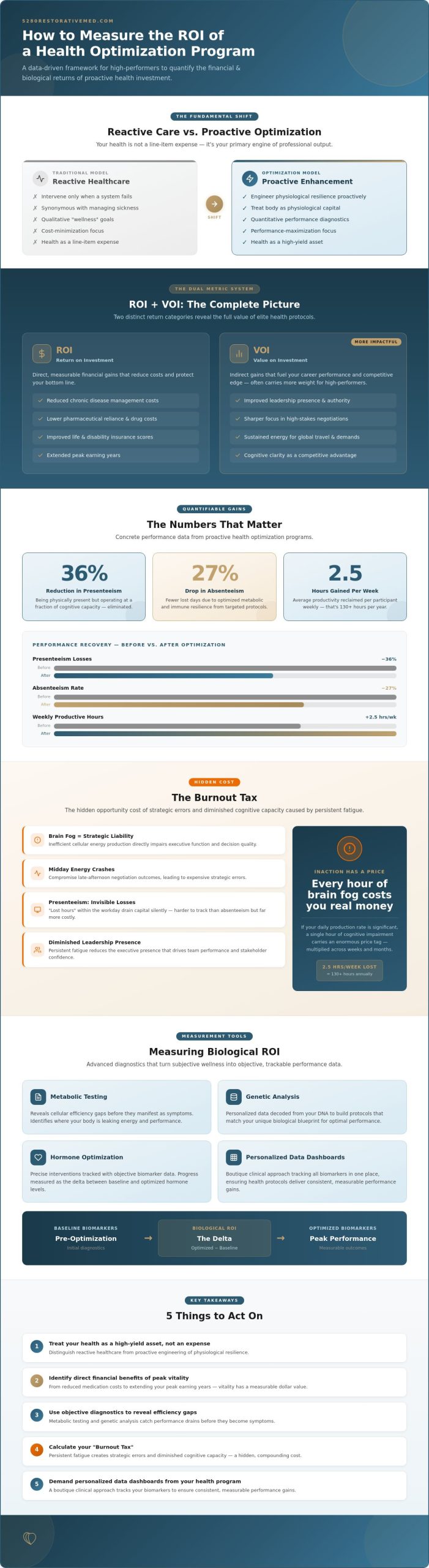
You probably agree that your cognitive clarity and physical stamina are your greatest competitive advantages, yet quantifying their value remains elusive. We promise to provide you with a clear framework to quantify your gains, moving beyond vague improvements to concrete data. This article previews the dual metric system of cost avoidance and biological enhancement, exploring how to track everything from a 36% reduction in presenteeism related losses to the 2.5 hours of productivity gained each week. You’ll finish this guide with the confidence to select a data driven program that treats your health as a high yield asset.
Key Takeaways
- Learn to distinguish between traditional reactive healthcare and engineering physiological resilience by treating your health as a high-yield asset.
- Identify the direct financial benefits of peak vitality, ranging from reduced long-term medication costs to the extension of your peak earning years.
- Discover how to measure ROI of a health optimization program through objective diagnostics like metabolic testing that reveal efficiency gaps before they become symptoms.
- Calculate the “Burnout Tax,” which represents the hidden opportunity cost of strategic errors and diminished cognitive capacity caused by persistent fatigue.
- Understand how a boutique clinical approach uses personalized data dashboards to ensure your health protocols deliver consistent, measurable performance gains.
Redefining ROI: From Reactive Healthcare to Proactive Optimization
Your health isn’t a line item expense; it’s the primary engine of your professional output. In a traditional setting, healthcare is synonymous with managing sickness. This is a reactive model where you only intervene once a system begins to fail. Health optimization, conversely, is about engineering resilience. It treats your body as physiological capital that requires active management to yield a high return. As we move through the market volatility of 2026, diversifying your portfolio into your own biological longevity is the most stable investment an executive can make. Unlike a fluctuating stock index, an optimized endocrine system and a high-functioning gut microbiome provide a consistent yield in the form of mental clarity and physical stamina.
Understanding the economic principles of health helps frame this shift from cost-minimization to performance-maximization. This transition is the core of how to measure ROI of a health optimization program. We are moving away from qualitative “wellness” toward quantitative performance diagnostics. By using data-driven tools like genetic analysis and metabolic testing, we can treat health as a proactive journey rather than a reactive necessity.
The ROI vs. VOI Framework
When you analyze the impact of elite health protocols, it’s helpful to split the return into two distinct categories. Return on Investment (ROI) focuses on direct financial gains. This might include reduced long-term spending on chronic disease management or a lower reliance on pharmaceuticals. However, Value on Investment (VOI) often carries more weight for high-performers. VOI encompasses the indirect gains that fuel your career: improved leadership presence, sharper focus during high-stakes negotiations, and the sustained energy required for global travel. While ROI saves money, VOI generates it by keeping you at the peak of your professional capabilities.
The Performance-Health Correlation
The link between your metabolic health and your executive function is direct and measurable. When your cellular energy production is inefficient, brain fog isn’t just a nuisance; it’s a strategic liability. Optimizing your biology directly reduces “presenteeism,” which describes the state of being physically present at work but operating at a fraction of your cognitive capacity. Through precise interventions like hormone optimization, we can track your progress with objective data. Biological ROI is the delta between baseline and optimized biomarkers. This quantitative approach ensures you aren’t just guessing about your progress. Learning how to measure ROI of a health optimization program requires looking at these specific physiological improvements as the foundation for every decision you make.
Calculating the Financial ROI of Peak Vitality
Quantifying the financial impact of your health requires moving beyond simple medical bill reduction. For an executive, time is the most expensive resource. When you analyze calculating ROI for health programs, the focus often shifts from basic insurance claims to high-value productivity. Proactive health protocols can lead to a 27% drop in absenteeism and, more importantly, a 36% reduction in presenteeism-related losses. These aren’t just corporate statistics; they represent your ability to lead without the drag of physiological inefficiency. Reducing reliance on long-term pharmaceuticals for lifestyle-related issues creates direct cost savings, but the real financial gain lies in optimizing your health scores to influence individual life or disability policies.
Decreasing Absenteeism and Presenteeism
Lost days are easy to track, but “lost hours” within a workday are where high-performers bleed capital. If your daily production rate is significant, a single hour of brain fog carries a heavy price tag. Research shows that productivity gains from wellness initiatives can average 2.5 hours per week for each participant. Midday energy crashes often compromise late-afternoon negotiation outcomes, leading to expensive strategic errors. Utilizing functional medicine for high-performers targets the underlying metabolic causes of the “afternoon slump.” By engineering metabolic resilience, you ensure that your decision-making capacity at 4:00 PM is as sharp as it was at 8:00 AM. This consistency is a vital component of how to measure ROI of a health optimization program.
Peak Earning Longevity
The longevity dividend is perhaps the most overlooked financial metric in health optimization. Extending a high-performance career by just five to ten years can result in a massive increase in lifetime earnings. This isn’t just about working longer; it’s about maintaining mental acuity into your 60s and 70s. Health optimization acts as a strategic hedge against career-ending burnout by managing the physiological toll of high-stress environments. When you delay biological aging, you protect your most valuable asset: your experience. Investing in an Executive Health Program allows you to compound your professional influence over a longer horizon, ensuring your earning potential doesn’t plateau prematurely due to avoidable health declines.
Comparing the cost of a comprehensive program against the eventual cost of chronic disease management reveals a clear financial winner. Chronic conditions are expensive, not just in medical fees, but in the forced retirement or reduced capacity they mandate. By prioritizing hormone optimization and metabolic health today, you avoid the heavy “sickness tax” of tomorrow. This data-driven approach provides a clear path for anyone looking at how to measure ROI of a health optimization program through the lens of long-term wealth preservation.
Measuring “Biological ROI” Through Advanced Diagnostics
Objective data is the only reliable way to move beyond the subjective experience of “feeling better” and into the realm of “performing better.” While many corporate initiatives struggle to prove their worth, as seen in a Harvard study on wellness program ROI, the failure often lies in a lack of clinical specificity. Generic programs track self-reported habits, whereas elite health protocols track cellular function. Understanding how to measure ROI of a health optimization program requires a shift toward biological benchmarking. By monitoring inflammatory markers like hs-CRP (high-sensitivity C-reactive protein), you gain a leading indicator of future health costs and systemic efficiency. This data prevents you from wasting capital on generic supplement protocols by using genetic analysis to identify exactly what your unique biology requires. Metabolic testing serves as an early detection system, identifying efficiency gaps in your physiology long before they manifest as clinical symptoms.
Metabolic and Hormonal Benchmarking
Quantifying metabolic ROI begins with tracking insulin sensitivity and fasting glucose. These metrics tell us how efficiently your body turns fuel into focus. For high-performers, “normal” lab ranges provided by standard insurance-based providers are often inadequate; we target “optimal” ranges that support high-level cognitive output. Measuring the ROI of BHRT involves tracking specific improvements in sleep quality, libido, and lean muscle mass retention. When these biomarkers move toward their peak states, your ability to handle high-pressure environments increases proportionally, providing a tangible return on your physiological investment. This approach transforms a vague sense of wellness into a series of hard data points that justify your commitment to health.
Mitochondrial Efficiency and Energy ROI
Mitochondrial dysfunction is the silent root of executive fatigue, yet it’s rarely addressed in standard medical checkups. Advanced diagnostics allow us to identify efficiency gaps in how your cells produce adenosine triphosphate (ATP). We can then measure the impact of targeted interventions, such as the measurable effect of red light therapy on cellular energy production. Your mitochondrial health directly translates to mental stamina, determining how long you can maintain peak cognitive performance before fatigue sets in. This is a critical component of how to measure ROI of a health optimization program because it links your cellular biology to your daily professional output. By optimizing the engine of your cells, you ensure that your energy levels remain consistent throughout the most demanding workdays.
The Burnout Tax: Calculating the Opportunity Cost of Inaction
While previous sections focused on the gains of optimization, we must also quantify the “Burnout Tax.” This is the invisible financial levy you pay when operating at 70% capacity. For a high-performer, the price of poor decision-making is often your most significant expense. Brain fog and fatigue aren’t merely inconveniences. They lead to expensive strategic errors that can set a company back years. If you’ve ever hesitated on a high-stakes deal because your cognitive reserves were depleted, you’ve paid this tax. Calculating how to measure ROI of a health optimization program requires looking at these missed opportunities as lost revenue.
Chronic stress also creates a physiological feedback loop that erodes your resilience. Sustained high-cortisol environments can exacerbate underlying issues like mast cell activation syndrome, which acts as a hidden barrier to peak performance. When your immune system is in a state of constant hyper-vigilance, your brain cannot maintain the focus required for complex problem-solving. The opportunity cost here is immense. What projects or partnerships are you currently ignoring because you simply lack the energy to pursue them?
The Cost of Brain Fog and Cognitive Decline
Even a 10% decrease in cognitive processing speed can have a massive impact on your annual output. Chronic inflammation, often driven by poor gut health or hormonal imbalances, directly impairs the prefrontal cortex. This is the seat of executive function and impulse control. When this area is compromised, your ability to enter flow states vanishes. By restoring cognitive clarity, you aren’t just feeling better; you’re saving time. Every hour reclaimed through increased focus is an hour you can reinvest into strategic growth. This is a fundamental part of how to measure ROI of a health optimization program for anyone whose income is tied to intellectual output.
Strategic Resilience vs. Reactive Survival
There is a profound difference between leading from a state of vitality and leading from a state of reactive survival. Exhaustion forces you to make short-term choices to alleviate immediate pressure, often at the expense of long-term goals. Health optimization builds a metabolic reserve that allows you to navigate high-stakes crises without physiological collapse. The most expensive health program is the one you didn’t start until a major health event forced your hand. Proactive intervention ensures you never have to pay the full price of the Burnout Tax. If you’re ready to reclaim your cognitive edge, consider starting with a Functional Medicine Consultation to identify your specific efficiency gaps.
Engineering Your Personal ROI with 5280 Restorative Medicine
Standardized care often fails high-performers because it ignores the unique biological variables that drive elite output. At 5280 Restorative Medicine, we’ve replaced the cold, volume-based model of traditional medicine with a boutique approach that prioritizes your specific outcomes. We understand that knowing how to measure ROI of a health optimization program is essential for your peace of mind and professional justification. To provide this clarity, we integrate your genetic, metabolic, and hormonal data into a single, cohesive performance dashboard. This allows us to move beyond the “one size fits all” mentality that defines most healthcare. Our bespoke functional health and wellness protocols offer a significantly higher ROI than generic plans because they’re engineered to solve your specific efficiency gaps, not just treat an average patient’s symptoms.
The Executive Health Program Advantage
The core of our practice is the Executive Health Program. This is where clinical science meets performance coaching. Your journey doesn’t end with a lab report; instead, your personalized nutrition and supplement protocols evolve as your biomarkers shift. You’ll have direct access to Dr. Marci Catallo-Madruga for deep clinical analysis and ongoing adjustments. This high-touch relationship ensures that your protocols remain effective as your professional demands change. We focus on building sustainable energy that yields dividends across both your boardroom decisions and your personal life. When your biology is optimized, you aren’t just surviving the day. You’re leading with a sense of renewal and empowerment that exceeds your previous baseline performance.
Starting Your Optimization Journey
Moving from data collection to strategic implementation is the most critical phase of your journey. During your initial diagnostic phase, we conduct comprehensive Metabolic Testing and advanced bloodwork to establish your biological baseline. This data serves as the foundation for how to measure ROI of a health optimization program over the long term. We don’t just hand you a folder of results and wish you luck. Every 90 days, we re-evaluate your progress, tracking and reporting your Biological ROI to ensure your investment is delivering the expected gains in mental clarity and physical resilience. This rhythmic approach provides a clear path forward, allowing you to take full control of your health. Ready to transform your vitality into your most reliable asset? Schedule your consultation to define your health ROI today.
Securing Your Future Through Physiological Excellence
Treating your health as a high-yield asset is no longer a luxury; it’s a strategic necessity for those who lead. By moving beyond the reactive model of traditional healthcare, you reclaim the cognitive and physical reserves often lost to the Burnout Tax. You’ve learned that understanding how to measure ROI of a health optimization program involves a dual-metric system. This includes avoiding the massive costs of chronic decline while engineering a superior biological baseline. Advanced metabolic and genetic testing provide the objective data needed to prove that your protocols are working at a cellular level.
5280 Restorative Medicine provides the expert guidance required to navigate this journey. Through personalized protocols designed by Dr. Marci Catallo-Madruga and the convenience of nationwide virtual consultations, we ensure your health remains a driver of success rather than a liability. It’s time to stop guessing and start optimizing with precision.
Apply for our Executive Health Program and reclaim your peak performance.
Your journey toward renewal and exceeded performance starts with a single, data-driven decision. We are here to help you achieve the peak state you deserve at any stage of life.
Frequently Asked Questions
How long does it take to see a measurable ROI from a health optimization program?
You can typically expect to see measurable physiological shifts within 90 to 180 days of initiating a protocol. While subjective improvements in sleep quality and midday energy often manifest within the first 30 days, biological ROI requires time for cellular turnover and hormonal stabilization. Regular diagnostic re-testing every three months allows us to track these changes objectively. This timeline ensures that we are measuring sustained systemic improvement rather than temporary fluctuations.
Can I use my HSA or FSA to pay for these optimization programs?
You can often utilize your Health Savings Account (HSA) or Flexible Spending Account (FSA) to cover many components of a health optimization program. While 5280 Restorative Medicine operates as an out-of-network provider and does not bill insurance directly, we provide the necessary documentation for you to seek reimbursement through your plan. It’s always best to verify specific coverage with your plan administrator. This approach allows you to invest pre-tax dollars into your physiological capital.
What are the most important biomarkers to track for cognitive ROI?
Tracking inflammatory markers like hs-CRP and metabolic indicators such as fasting insulin is essential for quantifying cognitive ROI. These biomarkers directly correlate with neuroinflammation and brain fog. Additionally, optimizing levels of Vitamin D and key hormones like DHEA and testosterone supports the prefrontal cortex’s executive functions. By monitoring these specific data points, we move beyond vague feelings to understand exactly how your biology supports your mental stamina and decision-making speed.
How does functional medicine differ from the executive physicals offered by large hospitals?
Standard executive physicals primarily focus on the absence of disease, using broad lab ranges to ensure you aren’t currently sick. In contrast, functional medicine at a boutique practice seeks root-cause optimization. We analyze genetic data and metabolic efficiency to identify subtle gaps before they become symptoms. This proactive approach is a core element of how to measure ROI of a health optimization program because it engineers resilience rather than just managing reactive healthcare.
Is health optimization worth it if I already feel “fine”?
Feeling “fine” often indicates that you’ve simply adapted to a sub-optimal baseline. Health optimization is designed for the individual who wants to exceed standard performance levels and delay biological aging. We often find significant efficiency gaps in patients who believe they’re at their peak. Identifying these hidden stressors allows you to reclaim lost cognitive capacity and build a metabolic reserve that protects against future burnout or sudden health crises.
What happens if my biomarkers don’t improve after 6 months?
If your biomarkers haven’t reached target ranges within six months, we conduct a deeper clinical analysis to identify the roadblock. This may involve more granular gut health assessments or a review of your genetic analysis to uncover hidden metabolic pathways. Our protocols are bespoke and non-standardized; we pivot your strategy based on your unique data. This iterative process is essential to how to measure ROI of a health optimization program as it ensures we continue moving toward your peak state.
How much time per week is required to implement a high-performance health protocol?
Implementing a high-performance protocol typically requires less than two hours of active management per week once the initial diagnostic phase is complete. Most of the work involves integrating targeted supplement protocols and nutritional adjustments into your existing daily routine. Our virtual consultations are designed to fit the demanding schedules of high-performers, ensuring that your journey toward health renewal is efficient. The goal is to maximize your biological output without creating an additional burden on your time.