
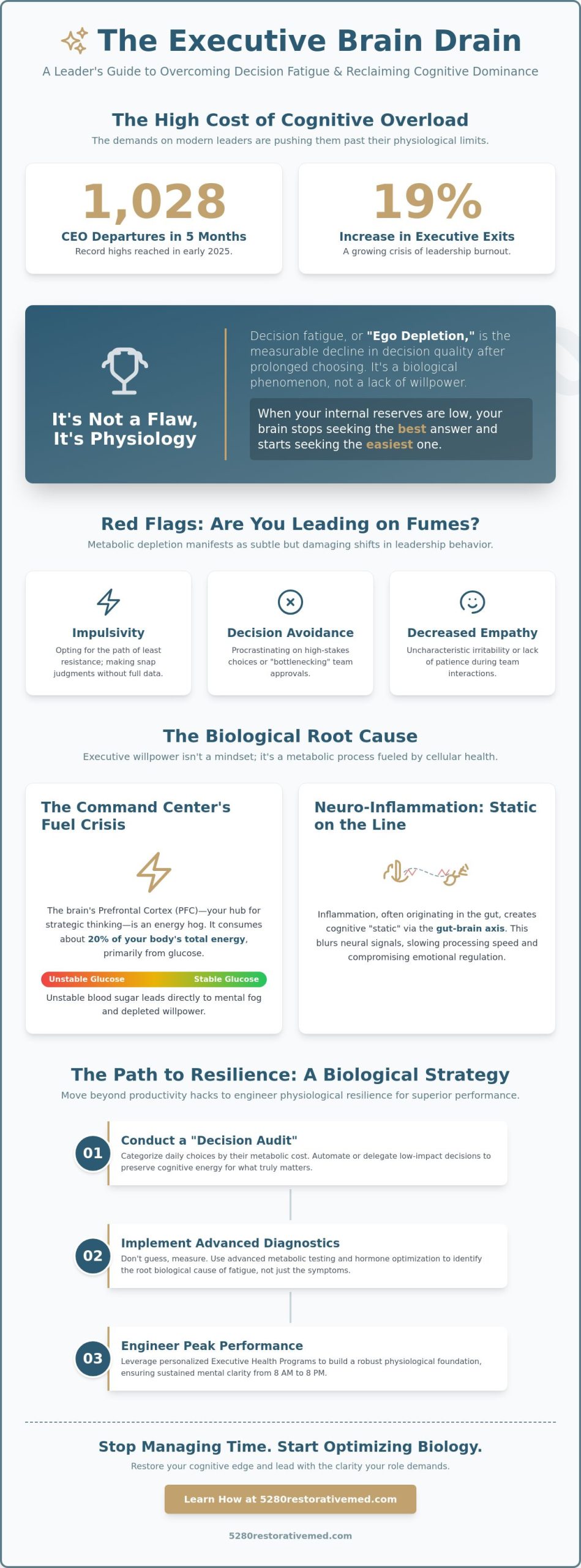
What if the mental fog that hits you at 3 PM isn’t a lack of discipline, but a physiological brownout? While most productivity gurus suggest you delegate more or color-code your calendar, the reality is that you can’t out-delegate a depleted brain. In early 2025, CEO departures reached record highs with 1,028 leaders stepping down in just five months. This 19% increase highlights a growing crisis where the sheer weight of cognitive overload is pushing even the most seasoned executives past their human limits.
You’ve likely felt the frustration of analysis paralysis on high-stakes projects or noticed an uncharacteristic irritability with your team over minor choices. It’s exhausting to feel like you’re running on fumes, relying on caffeine just to make it through the final meeting. Understanding how to overcome decision fatigue as a leader requires looking beneath the surface at your cellular health. We’ll explore how to move beyond basic hacks to address the metabolic root causes of cognitive decline. You’ll discover how a proactive approach, including metabolic testing and hormone optimization, can restore the sustained mental clarity needed to lead with confidence from 8 AM to 8 PM.
Key Takeaways
- Recognize that decision fatigue isn’t a character flaw but a biological phenomenon known as ego depletion that impacts the C-suite disproportionately.
- Identify the link between your blood glucose stability and willpower to prevent the mental fog that often derails late-afternoon strategy sessions.
- Discover how to overcome decision fatigue as a leader by diagnosing whether your exhaustion stems from an over-packed schedule or internal metabolic depletion.
- Apply tactical protocols like the “Decision Audit” to categorize daily choices by their metabolic cost and preserve your cognitive endurance.
- Learn how advanced metabolic testing and personalized executive health programs can engineer physiological resilience for superior performance.
The High Cost of Choice: What is Decision Fatigue in Leadership?
Leadership isn’t just about the actions you take. It is about the quality of the choices you make throughout the day. What is Decision Fatigue describes the measurable decline in the quality of decisions made after a long period of choosing. For those in high-stakes roles, this isn’t a minor annoyance. It is a structural threat to your organization. By 2026, the pace of AI integration and global connectivity means leaders face nearly ten times the daily decision volume of previous generations. This constant pressure leads to “Ego Depletion,” a state where your self-control and focus are literally exhausted. When your internal reserves are low, your brain stops seeking the best answer and starts seeking the easiest one.
The Prefrontal Cortex: Your Leadership Command Center
The prefrontal cortex (PFC) serves as the biological headquarters for executive function. It manages complex planning, strategic thinking, and the regulation of social behavior. While powerful, the PFC is also the most energy-hungry region of the human brain. It demands a significant portion of your body’s oxygen and glucose to maintain peak performance. Your “cognitive bandwidth” is not an abstract concept; it is a finite physiological resource. Every minor choice, from choosing a lunch spot to approving a small expense, drains the same metabolic tank you need for high-level vision. Understanding how to overcome decision fatigue as a leader begins with respecting these biological limits.
Signs You Are Leading Under Fatigue
Leading while metabolically depleted often results in subtle but damaging shifts in behavior. You might find yourself leaning into the “Status Quo Bias,” which is the tendency to stick with current protocols simply because the mental cost of change feels overwhelming. Tired leaders stop being pioneers and start being custodians. Specific symptoms often include:
- Impulsivity: You might opt for the path of least resistance or make snap judgments without checking your usual data points.
- Decision Avoidance: Procrastinating on high-stakes projects or “bottlenecking” team approvals because the act of deciding feels painful.
- Decreased Empathy: Noticing an uncharacteristic irritability or lack of patience during late-afternoon strategy sessions.
If you’ve ever felt a sense of relief when a meeting is canceled because it means one less choice to make, your brain is signaling a deficit. Learning how to overcome decision fatigue as a leader requires a shift from purely psychological tactics to a bespoke, biological strategy that allows you to exceed your baseline performance and protect your most valuable asset: your judgment.
The Biology of the “No”: Why Your Metabolism Dictates Your Choices
You have likely been told that “pushing through” a long day is a matter of mental toughness or grit. Clinical evidence suggests a different reality. Executive willpower is not an infinite psychological well; it is a physiological process inextricably linked to your metabolic state. When your internal systems are out of balance, your ability to say “no” to distractions or “yes” to complex, high-stakes strategies collapses. This isn’t a lack of character. It is a lack of cellular fuel. Understanding how to overcome decision fatigue as a leader requires a shift in perspective, moving away from time management and toward biological optimization.
Neuro-inflammation often acts like static on a radio, blurring the signals between your neurons and slowing down your cognitive processing speed. This inflammation frequently originates in the gut, where the microbiome influences the production of essential neurotransmitters like dopamine and serotonin through the gut-brain axis. If your gut health is compromised, your focus and emotional regulation will follow. A personalized Executive Health Program can often reveal why a leader feels “off” despite a perfect calendar, identifying the biological “static” that hinders clear thinking.
Glucose Homeostasis and Cognitive Endurance
The human brain accounts for approximately 20% of the body’s total energy consumption. Specifically, glucose serves as the primary metabolic fuel that the prefrontal cortex requires to execute high-level reasoning and complex problem-solving. When you experience blood sugar “spikes and crashes” from a high-carb lunch or excessive caffeine, your IQ and patience drop almost immediately. Chronic insulin resistance is even more insidious, creating a persistent brain fog that makes even simple emails feel like a chore. Learning how to overcome decision fatigue as a leader involves stabilizing these glucose levels to ensure your command center has a reliable, steady stream of energy throughout the day.
Mitochondria: The Powerhouse of the Executive Brain
Mitochondria are the organelles responsible for generating ATP, the energy currency of your cells. Because the brain is your most energy-intensive organ, mitochondrial dysfunction often manifests as mental fatigue and “brain lag” long before you feel physically tired. High levels of oxidative stress damage these powerhouses, which directly correlates to a decrease in decision-making speed and a rise in errors. Supporting mitochondrial health through targeted nutrient protocols and lifestyle shifts is essential for maintaining a sustained leadership presence. This transition from psychological management to biological optimization is the key to exceeding your baseline performance and reclaiming your cognitive edge.
Strategic vs. Physiological Fatigue: Identifying the Root Cause
Distinguishing between a calendar that is too full and a body that is too empty is the first step in reclaiming your edge. While strategic fatigue often resolves with a weekend away or a lighter meeting load, physiological fatigue is persistent. It follows you into your time off. It makes a Sunday evening feel as heavy as a Monday morning. When you are looking for how to overcome decision fatigue as a leader, you must determine if the problem is your environment or your internal chemistry. Chronic stress triggers a cascade of cortisol that, over time, can actually decrease the density of the prefrontal cortex while enlarging the amygdala. This biological shift makes you more reactive and less capable of the nuanced, long-term thinking required at the executive level.
Standard self-care advice like “getting more sleep” or “taking a walk” often fails high-performers because it doesn’t address underlying biochemical deficiencies. If your hormones are depleted or your neural pathways lack the necessary nutrients for signaling, a vacation won’t fix the fog. You aren’t just tired; your system is operating without the requisite components for high-level cognitive endurance. Identifying these root causes requires a clinical perspective that views health as a proactive journey toward peak function rather than just the absence of illness.
Hormonal Imbalance and the “Wired but Tired” Leader
Many executives experience a state of being “wired but tired,” where they feel a buzzing anxiety coupled with profound exhaustion. This is frequently a hallmark of cortisol dysregulation. When cortisol levels are chronically elevated or incorrectly timed, your brain struggles to enter the “Deep Work” states necessary for complex strategy. Additionally, low levels of testosterone or DHEA can manifest as uncharacteristic indecisiveness or a loss of “executive presence.” Restoring these levels through BHRT: A Clinical Guide to Bioidentical Hormone Replacement can provide the hormonal foundation needed for faster, more confident decision-making.
Nutrient Deficiencies That Mimic Burnout
Your brain relies on a specific cocktail of micronutrients to maintain neural signaling speed and accuracy. Magnesium, B-vitamins, and Omega-3 fatty acids are not optional; they are the literal building blocks of cognitive function. Unfortunately, “normal” blood work provided by standard healthcare providers often misses the subtle deficiencies that affect high-performers. What is considered “adequate” for the general population is rarely sufficient for a leader managing a multi-million dollar portfolio. Utilizing functional health and wellness protocols allows for the identification of these gaps, ensuring your brain has the raw materials it needs to exceed baseline performance every day.
Tactical Protocols to Reclaim Your Executive Function
Reclaiming your cognitive edge requires moving beyond basic productivity hacks like choosing a work uniform or pre-planning meals. While those tactics reduce the number of choices, they don’t address the underlying capacity of your brain to process information. True metabolic resilience is a competitive advantage. It allows you to maintain high-level judgment when your competitors are beginning to falter. Learning how to overcome decision fatigue as a leader involves a “Decision Audit,” where you categorize your daily choices by their metabolic cost. High-stakes strategic planning should be reserved for your peak physiological windows, while lower-cost administrative tasks are shifted to periods of natural recovery.
By treating your brain as a high-performance engine, you can implement biological “quick wins” that provide immediate relief from mental fog. These interventions are designed to protect your prefrontal cortex from the inevitable drain of a high-pressure environment. If you are ready to move beyond surface-level fixes, you can Schedule a Functional Medicine Consultation to begin a bespoke optimization journey.
Biological Anchors for the Workday
Your workday should begin with a “Glucose-First” protocol. This doesn’t mean a sugar spike; it means consuming a breakfast designed to stabilize blood sugar and prevent the mid-morning crash that leads to impulsive choices. This stability provides a reliable foundation for your first high-stakes meetings. You can further enhance this by using red light therapy in the morning to stimulate mitochondrial activity and “recharge” your cellular energy. Finally, implement the “90-Minute Rule.” By aligning your most taxing cognitive tasks with your body’s natural 90-minute ultradian cycles, you ensure that you are working with your biology rather than against it. This prevents the cumulative depletion that often leads to late-afternoon irritability.
The Executive Recovery Protocol
Recovery is not just about the absence of work. It is an active biological process. To truly understand how to overcome decision fatigue as a leader, you must prioritize sleep architecture over simple duration. Quality sleep, specifically the deep and REM stages, allows the prefrontal cortex to clear metabolic waste and consolidate information. Advanced tools like cold exposure can further support this by triggering neuro-genesis and building a brain that is physically more resistant to fatigue. These protocols function as a form of biological insurance, building a robust metabolic reserve that allows you to handle unexpected executive crises without compromising your cognitive integrity. When your system is optimized, you don’t just survive the workday; you lead it with clarity and purpose.
Beyond Delegation: Engineering Resilience with 5280 Restorative Medicine
Delegating tasks and color-coding your calendar are valuable administrative tools, but they don’t address the biological engine driving your choices. If you want to truly master how to overcome decision fatigue as a leader, you must move beyond these surface-level productivity hacks. High-stakes leadership requires a shift from reactive survival to proactive optimization. At 5280 Restorative Medicine, we view your health as a sophisticated engineering project. We don’t just aim for the absence of illness; we focus on exceeding your baseline performance so you can lead with clarity and decisiveness regardless of the hour.
Our approach treats cognitive endurance as a measurable, improvable metric. By addressing the physiological root causes of mental fog, we help you reclaim the executive presence that defined your early career. This isn’t about working harder. It’s about ensuring your brain has the metabolic resources to handle the demands of a 2026 leadership environment. We offer a boutique clinical experience that bridges the gap between complex science and your daily well-being.
Precision Diagnostics for the C-Suite
Understanding your unique biological blueprint is the foundation of our functional medicine for high-performers. We utilize advanced Genetic Analysis to reveal how your body processes neurotransmitters and manages stress on a cellular level. This allows us to identify your specific cognitive vulnerabilities before they manifest as burnout. Coupled with comprehensive Metabolic Testing, we pinpoint “hidden” drivers of fatigue, such as mitochondrial inefficiency or gut-brain axis disruptions. This data-driven approach removes the guesswork from your health journey, providing a clear path to renewed cognitive endurance.
Your Partnership for Peak Performance
General practitioners often operate within a model designed for standard care, which frequently fails to optimize leaders for high-stakes environments. Our Executive Health Programs provide a different level of scrutiny and personalization. We act as your expert guide, deeply invested in your individual success. Whether you visit us in person at our Denver, Colorado clinic or utilize our national virtual consultations, you receive bespoke care tailored to your demanding schedule.
Program availability is limited each quarter to ensure every client receives our full, personalized attention. However, new clients can typically be seen within one to two weeks of their initial inquiry. As an out-of-network provider, we provide the documentation necessary for you to potentially seek reimbursement from your HSA or FSA. Don’t let physiological depletion dictate your legacy. Schedule a private discovery call today to learn how to overcome decision fatigue as a leader and return to a state of superior physical and mental function.
Mastering Your Biological Command Center
Your ability to lead effectively is directly tied to your cellular health. We have explored how decision fatigue is not a management failure, but a metabolic one. By stabilizing glucose levels, optimizing mitochondrial function, and balancing essential hormones, you can transform your cognitive endurance. Understanding how to overcome decision fatigue as a leader means moving beyond temporary productivity hacks and investing in the physiological foundation of your judgment.
Led by Dr. Marci Catallo-Madruga, a Functional Medicine Expert, our practice specializes in protocols designed for high-stakes C-suite endurance. We utilize a comprehensive metabolic and genetic diagnostic review to identify the precise drivers of your fatigue. This bespoke approach ensures that your health journey is as unique as your leadership style. You don’t have to settle for 3 PM mental fog or reactive choices. Reclaim your cognitive edge with a personalized Executive Health Protocol.
The path to sustained excellence starts with a single proactive choice. Your peak mental and physical state is achievable at any stage of your career. We are here to partner with you as you exceed your baseline performance and lead with renewed clarity.
Frequently Asked Questions
Is decision fatigue a real medical condition?
While not a standalone clinical diagnosis in the DSM-5, decision fatigue is a recognized physiological and psychological phenomenon often termed ego depletion. It describes the measurable decline in the quality of choices made after a long sequence of decision-making tasks. This state involves a temporary depletion of the metabolic resources, specifically glucose, that the prefrontal cortex requires to maintain high-level executive function and self-control.
How can I tell if I have decision fatigue or just general burnout?
Decision fatigue is typically episodic and specific to the act of choosing, while burnout is a chronic state of emotional and physical exhaustion. If you feel mentally sharp in the morning but find yourself making impulsive choices or avoiding simple decisions by 4 PM, you’re likely experiencing fatigue. Burnout usually persists throughout the entire day and is accompanied by a loss of personal identity and a sense of reduced accomplishment.
Does caffeine help or hurt decision fatigue in the long run?
Caffeine provides a temporary spike in alertness by blocking adenosine receptors, but it doesn’t replenish the brain’s underlying metabolic fuel. Relying on stimulants can lead to a significant “crash” that worsens cognitive endurance later in the day. Over time, excessive caffeine intake can disrupt your natural cortisol rhythms and sleep architecture, making it much harder to maintain the mental clarity required for high-stakes leadership roles.
Can hormone optimization improve my ability to make complex decisions?
Yes, optimizing hormones like testosterone, DHEA, and cortisol can significantly enhance executive presence and decisiveness. These hormones regulate how your brain processes complex data and responds to high-pressure environments. When your hormonal profile is balanced, you’ll often notice faster processing speeds and a reduction in the “wired but tired” feeling that frequently leads to analysis paralysis during critical strategy sessions.
What is the best time of day for a leader to make high-stakes decisions?
Most leaders perform best during their biological peak in the morning, usually within the first four hours after waking. This is when your glucose levels are typically most stable and your prefrontal cortex has its highest metabolic reserve. Scheduling your most taxing strategic meetings early in the day is a fundamental tactic for anyone learning how to overcome decision fatigue as a leader and protect their judgment.
How does gut health affect my mental clarity and decision-making speed?
The gut-brain axis is a primary driver of mental clarity because the gastrointestinal tract produces a large percentage of the body’s neurotransmitters, including dopamine and serotonin. Chronic gut inflammation can trigger systemic neuro-inflammation, which acts like “static” and slows down your neural signaling. A comprehensive gut health assessment can often reveal why a leader is experiencing uncharacteristic brain fog or a decline in their usual decision-making speed.
Can metabolic testing identify why I feel mentally drained by the afternoon?
Metabolic testing is an essential tool for identifying why your energy levels may be cratering during the workday. It evaluates how efficiently your body utilizes glucose and how well your mitochondria are producing cellular energy. By understanding your unique metabolic rate and insulin sensitivity, we can create a targeted protocol to ensure your brain has a steady, reliable fuel supply from your first meeting until your last.
What are the most common nutrient deficiencies that cause executive brain fog?
Magnesium, B-vitamins, and Omega-3 fatty acids are the most frequent deficiencies that impair executive function and focus. Magnesium is required for energy production at the cellular level, while B-vitamins are vital for the synthesis of neurotransmitters that drive focus. Identifying these specific gaps through precision diagnostics is a critical step in discovering how to overcome decision fatigue as a leader and returning to a state of superior cognitive performance.