
Your “normal” blood panels are likely masking the very metabolic inefficiencies that are draining your afternoon focus and stalling your physical progress. If you’ve ever felt the frustration of staring at a multi-page lab report only to feel more overwhelmed than informed, you aren’t alone. Learning how to read an organic acids test is the vital difference between guessing at your health and executing a precision-engineered protocol for peak performance. With the global personalized nutrition market projected to reach 66.95 billion dollars by 2034, it’s clear that high-performers are no longer settling for generic advice. It’s time to stop treating your body like a black box and start viewing it as a high-performance system that requires specific, data-driven inputs.
We believe that true health is a proactive journey, not a reactive necessity. In this guide, we’ll unlock the clinical secrets hidden in your OAT results to optimize your energy, cognitive function, and metabolic resilience. You’ll gain a clear hierarchy of which metabolic issues to address first and the confidence to refine your personalized supplement protocol. We move beyond standard labs to provide a roadmap that restores your vitality and provides the mental clarity that your current “normal” results simply cannot explain.
Key Takeaways
- Discover why traditional blood panels often miss the cellular inefficiencies that cause fatigue and how urine-based markers provide a more granular metabolic snapshot.
- Master the foundational principles of how to read an organic acids test by organizing over 70 complex markers into four manageable clinical pillars for better decision-making.
- Learn to identify metabolic clusters rather than chasing individual outliers, understanding why a “low” result can often signal a more significant deficiency than a “high” one.
- Establish a clear hierarchy for your health interventions, prioritizing gut health and mitochondrial function before fine-tuning neurotransmitter balance or supplement protocols.
- Understand the critical role of clinical correlation, ensuring your lab data is always viewed through the lens of your unique symptoms, medical history, and performance goals.
Beyond Standard Bloodwork: What an Organic Acids Test (OAT) Really Measures
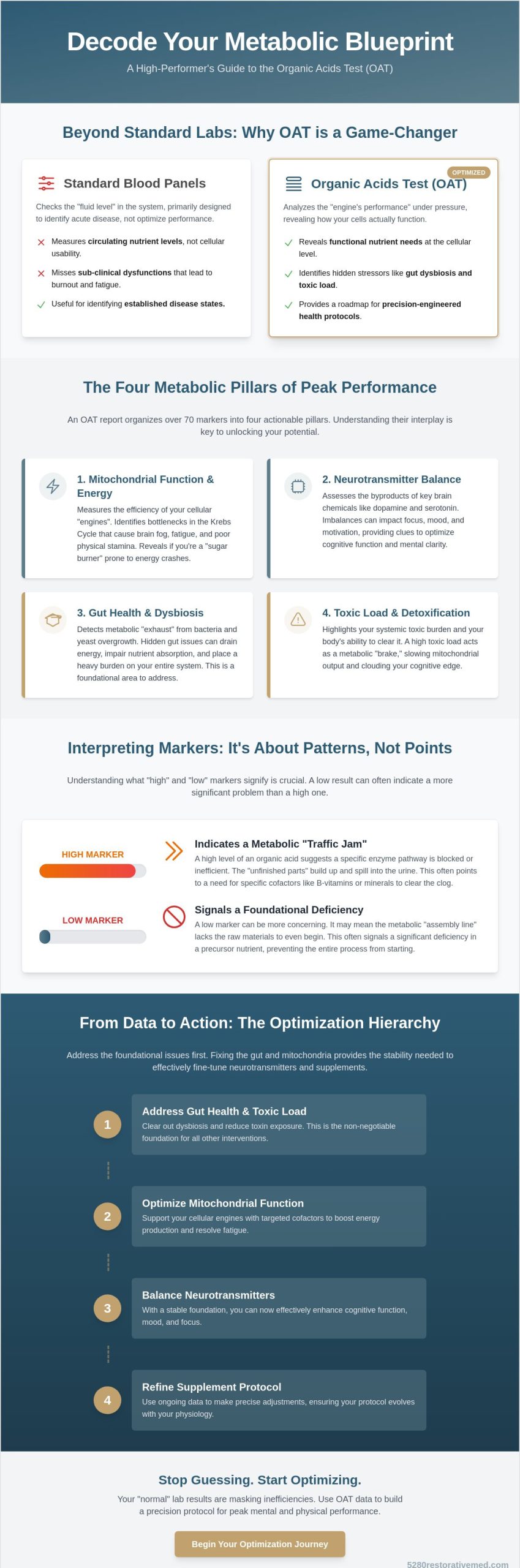
Standard bloodwork is often like checking the oil level in a parked car. It tells you if you have enough fluid, but it says nothing about how the engine performs under pressure. To truly understand your unique biochemistry, we must look deeper than systemic levels. An Urine organic acids test provides this depth by measuring metabolic intermediates; these are the chemical “exhaust” produced during your body’s central energy pathways. When your cells struggle to process nutrients or manage stress, these organic acids accumulate and spill into the urine.
Understanding how to read an organic acids test allows you to move beyond basic numbers and into the realm of functional demand. While blood tests measure the amount of a nutrient circulating in your veins, the OAT reveals whether your cells can actually use those nutrients. Learning how to read an organic acids test transforms a confusing lab report into a tactical guide for physiological enhancement. It acts as a comprehensive metabolic blueprint, offering a real-time snapshot of your mitochondrial energy production, neurotransmitter turnover, and hidden gut dysbiosis. It also highlights your systemic toxic load, providing a cellular view that standard bloodwork simply cannot capture.
The Limitations of Conventional Lab Panels
Many high-performers feel “off” despite being told their standard labs are perfect. This happens because conventional reference ranges are designed to identify acute disease rather than to optimize peak performance. You might fall within the “normal” range for B12 on a standard CBC, yet your OAT could show a massive functional need for it at a cellular level. This gap is where executive burnout often begins. By identifying these sub-clinical dysfunctions early, we can intervene before a metabolic lag becomes a chronic health crisis, ensuring you stay at the forefront of your field.
The Science of Metabolic Byproducts
Your metabolism relies on the Citric Acid Cycle, also known as the Krebs Cycle, which acts as your body’s primary engine. Think of this cycle as a complex assembly line. If a specific enzyme is missing a necessary cofactor, such as a certain B vitamin or mineral, the assembly line stalls. The unfinished parts, or organic acids, then build up and are excreted. As of June 2026, clinical practice guidelines increasingly recognize the utility of OAT for diagnosing metabolic disorders and guiding personalized nutrition. It allows us to see exactly which “clogged” pathways are hindering your vitality, providing the data necessary to build a bespoke protocol that helps you exceed your previous baseline.
The Four Metabolic Pillars: Decoding Your OAT Results
An OAT report provides a massive volume of data, often featuring over 70 distinct markers. For an executive or athlete, the goal isn’t just avoiding disease; it’s achieving peak metabolic efficiency. We simplify these complex markers into four clinical pillars: mitochondrial function, neurotransmitter balance, gut health, and toxic load. These systems are deeply interconnected. A high toxic load, for example, acts as a metabolic brake, slowing down your mitochondrial output and clouding your cognitive edge. Understanding how to read an organic acids test involves seeing how these pillars support or sabotage one another. The laboratory method of analysis for urinary organic acids ensures that these tiny metabolic signatures are captured with precision, providing the raw data we need to build your strategy.
Mitochondrial Function and Energy Production
Your mitochondria are the engines of your cells. When we analyze markers like Citramalic, Succinic, or Fumaric acids, we’re looking for stalls in the Krebs Cycle. If these organic acids are elevated, it often explains that 3:00 PM brain fog or a lack of physical stamina. We also look at how efficiently you burn fuels. Some high-performers struggle to access fat stores for energy, leading to a “sugar burner” profile that causes frequent energy crashes. Identifying these gaps allows for a metabolic testing approach that targets your specific energy bottlenecks rather than relying on generic advice.
Neurotransmitter Metabolites and Cognitive Edge
Cognitive performance depends on the balance of dopamine, norepinephrine, and serotonin. We interpret the ratios of HVA (dopamine) to VMA (norepinephrine and epinephrine) to see if your nervous system is stuck in “high gear.” A common pattern we see is the “wired but tired” state. This is often flagged by high Quinolinic acid, a marker of neuro-inflammation that can impair focus and drive. Additionally, serotonin markers like 5-HIAA provide insight into your sleep quality and emotional resilience. These are the foundations of long-term executive success.
Gut Dysbiosis: Yeast and Bacterial Overgrowth
Peak cognitive states are impossible if your brain is battling gut-derived “noise.” Markers like Arabinose, indicating Candida, or HPHPA, indicating Clostridia, reveal overgrowths that produce systemic toxins. These byproducts don’t just stay in the gut; they cross into the bloodstream and trigger inflammation. This gut-brain connection is why we prioritize clearing dysbiosis. When you learn how to read an organic acids test, you see that gut health isn’t just about digestion. It’s about removing the metabolic interference that prevents you from reaching your superior state of function.
Interpreting Highs and Lows: Pattern Recognition for Performance
Staring at a single red marker on your lab report is a common pitfall that leads to wasted resources and frustration. It’s easy to assume that a high value requires more of that specific substance, but biochemistry is rarely that linear. Mastering how to read an organic acids test requires shifting your focus from isolated data points to systemic clusters. A comprehensive metabolic pathway assessment looks for patterns across multiple markers to confirm a clinical suspicion rather than chasing single outliers. All results are normalized against Creatinine to account for urine concentration. If your Creatinine is very low, your other markers might appear artificially high, leading to incorrect conclusions about your actual metabolic state.
It’s a common misconception that “high” is always bad and “low” is always good. In the context of an OAT, a high marker often represents a metabolic block where a pathway is stalled. However, a “low” marker can be even more concerning; it may indicate that your body lacks the raw materials even to produce the byproduct, suggesting deep-seated depletion. True performance optimization relies on recognizing these subtle nuances. When you understand how to read an organic acids test through the lens of pattern recognition, you move away from “shotgunning” supplements and toward a precision-based strategy for renewal.
The Nutrient Demand Pattern
High levels of specific markers, such as Methylmalonic acid, act as a cellular alarm for B12 deficiency long before it shows up on a standard blood test. High organic acids signal a “backup” in metabolic machinery where the body cannot process a substrate due to missing co-factors. By identifying these specific backups, we can pinpoint exactly which co-factors, such as CoQ10 or Alpha-Lipoic Acid, are needed to restart the engine. This level of detail allows us to create a bespoke plan that addresses your unique cellular requirements, helping you return to health and eventually exceed your previous baseline.
The Oxidative Stress and Detoxification Profile
Your ability to recover from high-intensity training or intense executive stress depends heavily on your detoxification capacity. We monitor glutathione status through markers like Pyroglutamic and 2-Hydroxybutyric acid. If these are out of range, it suggests your primary antioxidant system is overtaxed and unable to keep up with the demands of your lifestyle. Poor detoxification creates a “ceiling” on your physical recovery and cognitive performance. When these pathways are clogged with environmental toxins or metabolic waste, your body prioritizes survival over peak performance. Identifying these clusters allows us to build a protocol that clears the path for total physiological renewal.
From Data to Optimization: How to Use Your OAT Results
Once you’ve mastered how to read an organic acids test, the challenge shifts from interpretation to strategic implementation. Most people fail at this stage because they attempt to fix every outlier simultaneously. This “shotgun” approach to supplementation is inefficient, expensive, and often counterproductive. We utilize a strict clinical hierarchy to ensure your interventions actually move the needle on your performance. By addressing the root cause in a logical sequence, we help you avoid the common trap of over-supplementation while missing the primary metabolic bottleneck.
Our intervention hierarchy begins with the gut. If your results show significant yeast or bacterial overgrowth, these organisms produce metabolic “noise” that interferes with every other system. Once the gut is stabilized, we pivot to mitochondrial support to optimize energy production. Finally, we address neurotransmitter balance to sharpen your cognitive edge. This systematic approach ensures that each layer of your health is built on a solid foundation. Learning how to read an organic acids test through this lens of priority transforms a confusing list of markers into an actionable plan for total metabolic renewal.
Designing a Targeted Supplement Protocol
Many high-performers arrive at our clinic with a cabinet full of generic supplements that provide little to no benefit. The OAT allows us to perform a clinical audit of your current regimen. We eliminate the unnecessary “maintenance” pills and replace them with precise, therapeutic doses of the co-factors your cells are actually demanding. This level of precision is a cornerstone of functional health and wellness. Instead of guessing, you’ll have a protocol designed to clear specific metabolic pathways, ensuring every dollar spent on your health provides a measurable return.
Lifestyle Adjustments Based on Metabolic Bio-Markers
Your metabolic data should dictate your daily habits. If your OAT reveals mitochondrial stalling, pushing through high-intensity interval training may actually deepen your fatigue. We might instead suggest adjusting your macronutrient ratios to better support fatty acid metabolism or integrating red light therapy for targeted mitochondrial support. These adjustments ensure your lifestyle works with your biology rather than against it. To truly dial in your performance, we recommend a Functional Medicine Consultation to bridge the gap between your lab data and your daily routine. Progress is measurable; we typically recommend re-testing every 4 to 6 months to track your evolution toward a superior state of function.
Why Professional Interpretation is Non-Negotiable for High-Performers
Having the raw data of an OAT report in your hands is a powerful first step, but data without clinical context is often just noise. While it’s tempting to use online “marker dictionaries” to decode your results, this DIY approach carries significant risks. Biochemistry is a web of feedback loops; a single elevated marker might be a primary dysfunction, or it could be a protective compensatory mechanism for a deficiency elsewhere in your system. Learning how to read an organic acids test in a vacuum often leads to “supplement chasing,” where you treat the symptoms of a metabolic backup rather than the root cause itself.
True metabolic engineering requires clinical correlation. This means viewing your lab results through the lens of your unique medical history, current symptoms, and daily performance demands. A specialized practitioner doesn’t just look at outliers; they find the “story” within the data. We identify the narrative of how your body is managing stress, producing energy, and clearing toxins. This expert interpretation ensures that your protocol is precise, safe, and effective, preventing the common mistake of over-supplementing based on a superficial understanding of how to read an organic acids test.
The 5280 Restorative Medicine Approach to Metabolic Testing
At 5280 Restorative Medicine, we believe that your health should be a proactive asset, not a reactive burden. We don’t view the OAT as a standalone diagnostic tool. Instead, we integrate these metabolic markers with genetic analysis and advanced bloodwork to create a 360-degree view of your physiology. This comprehensive strategy allows us to focus on “restorative” results that return you to a superior state of function. Our Functional Medicine for High-Performers framework is specifically designed to bridge the gap between complex clinical data and the practical needs of an executive lifestyle.
Engineering Long-Term Metabolic Resilience
The goal for any high-performer is to move beyond “fixing” problems and into the realm of long-term optimization. Your career and personal life demand a level of resilience that standard healthcare simply isn’t equipped to provide. By establishing a high-end health partnership, you gain an expert guide who is deeply invested in your individual success. We help you build a metabolic foundation that can withstand the pressures of a high-stress world, ensuring your physical and mental states remain at their peak for decades to come. It’s time to stop guessing and start reclaiming your vitality with data-driven precision.
Engineering Your Metabolic Future
Transitioning from standard health metrics to deep metabolic data is the first step toward true physiological mastery. We’ve explored how OAT provides a cellular view that traditional bloodwork misses, highlighting the critical priority of gut health and mitochondrial function. Understanding how to read an organic acids test isn’t just about identifying markers; it’s about synthesizing a narrative of your health to build metabolic resilience. Chasing isolated “highs” or “lows” without clinical context often leads to wasted resources and stagnant progress.
At 5280 Restorative Medicine, led by Dr. Marci Catallo-Madruga, we specialize in root-cause metabolic engineering. Our team creates bespoke protocols for national high-performers who refuse to settle for “normal” results. You don’t have to navigate these complex pathways alone. Apply for our Comprehensive Metabolic Interpretation and Optimization Program today to transform your lab data into a tactical advantage. Peak physical and mental states are achievable at any age, and we’re here to help you exceed your baseline performance. Your journey toward superior function starts with a single, data-driven decision.
Frequently Asked Questions
Is the Organic Acids Test (OAT) scientifically accurate?
The OAT is a scientifically grounded tool that measures metabolic byproducts with high precision. Laboratories performing these tests must be certified under the Clinical Laboratory Improvement Amendments (CLIA) to ensure quality and accuracy. New CLIA proficiency testing requirements were fully implemented on January 1, 2025, to maintain these high standards. While it’s a staple in functional medicine for assessing nutrient demand, its use for general adult diagnosis is still gaining mainstream recognition.
Can I read my own OAT results without a doctor?
You can identify high or low markers on your own, but professional interpretation is essential to understand their clinical significance. Learning how to read an organic acids test involves more than looking at a dictionary; it requires connecting data to your history and symptoms. Self-treating based on raw data often leads to improper supplement dosing or missing the actual root cause of your fatigue. We recommend a professional consultation to ensure your protocol is safe.
What are the most important markers to look at on an OAT?
The most critical markers are usually found in the mitochondrial and gut sections of the report. Markers like Citramalic or Arabinose indicate gut dysbiosis, while Succinic and Fumaric acids provide a snapshot of your energy production. We prioritize these because gut health and mitochondrial output form the foundation of your metabolic resilience. These markers influence every other system in your body, from your cognitive edge to your physical recovery.
How much does an Organic Acids Test cost and is it covered by insurance?
The cost of an OAT varies depending on the laboratory and the specific depth of the panel selected. Most medical insurance plans don’t cover this testing for adults, as it’s often categorized as not medically necessary. However, these tests are eligible for payment through Health Savings Accounts (HSA) and Flexible Spending Accounts (FSA). This allows high-performers to invest in their proactive health journey using pre-tax dollars.
How often should I repeat the OAT to see if my protocol is working?
We typically recommend repeating the test every 4 to 6 months after starting a new protocol. This window allows enough time for cellular changes to manifest in your urine metabolites. Re-testing ensures your intervention is effectively clearing the targeted metabolic pathways. It also allows us to adjust your bespoke supplement protocol for continued progress. Consistent monitoring is the key to moving beyond baseline performance and achieving long-term vitality.
What is the difference between an OAT and a DUTCH test?
An OAT focuses on metabolic intermediates, gut health, and nutrient demand, whereas a DUTCH test primarily measures sex and adrenal hormones. While both use urine samples, they provide entirely different datasets. The OAT acts as your metabolic blueprint, revealing how you produce energy. The DUTCH test serves as your hormonal roadmap. We often use them together to create a comprehensive view of your systemic function and resilience.
Can an OAT detect mold or heavy metal toxicity?
An OAT can suggest the presence of mold through specific fungal markers, but it isn’t a direct test for heavy metals. For example, elevations in certain tartaric acid markers can point toward fungal or mold exposure in the gut. If these markers are high, we may recommend a dedicated mycotoxin panel to confirm the specific toxic load. This allows us to build a more targeted detoxification strategy for your unique needs.
Why are my OAT results normal if I still feel exhausted?
“Normal” results can sometimes occur if your body is in a state of deep depletion. In these cases, you may lack the raw materials even to produce metabolic byproducts, leading to a “flat” lab report. Fatigue can also stem from hormonal imbalances or structural issues not captured by organic acids. This is why professional interpretation is vital. We look for these subtle patterns of systemic exhaustion that a standard lab reference range might miss.