
If you are tracking every metric on your wearable but still struggling with persistent fatigue, you have likely asked yourself: is genetic health testing worth the money? Most high-performers are tired of receiving “normal” blood work results that fail to explain why they feel sub-optimal. With the global market for direct-to-consumer kits hitting $4.39 billion in 2026, the noise surrounding biological data is louder than ever. You deserve to know if you are buying a legitimate roadmap to longevity or just expensive digital wallpaper.
It is understandable to feel hesitant given the 2025 bankruptcy of major providers and the new 2026 privacy regulations taking effect in states like Connecticut. You want your health data to be a secure investment in your future, not a privacy liability. This guide will help you distinguish between basic recreational DNA kits and the clinical genetic analysis required for true physiological enhancement. We will explore how to turn raw biological markers into a bespoke protocol for disease prevention and peak performance, ensuring your health investments are backed by rigorous science.
Key Takeaways
- Learn why clinical-grade whole genome sequencing provides the depth required for specialized medical interventions, while basic consumer kits often offer only recreational insights.
- Discover how to determine if genetic health testing is worth the money by evaluating its role in preventing a “burnout crash” and protecting your long-term cognitive performance.
- Understand the critical role of epigenetics and why genetic data is only valuable when it’s paired with a clear, actionable lifestyle protocol.
- Identify the specific scenarios where high-performers should move beyond standard blood work to investigate family history or resolve persistent energy plateaus.
- Explore how a comprehensive approach that combines genetic analysis with metabolic testing can transform your biological code into a roadmap for superior physical function.
Clinical vs. Direct-to-Consumer: Not All Genetic Health Testing is Equal
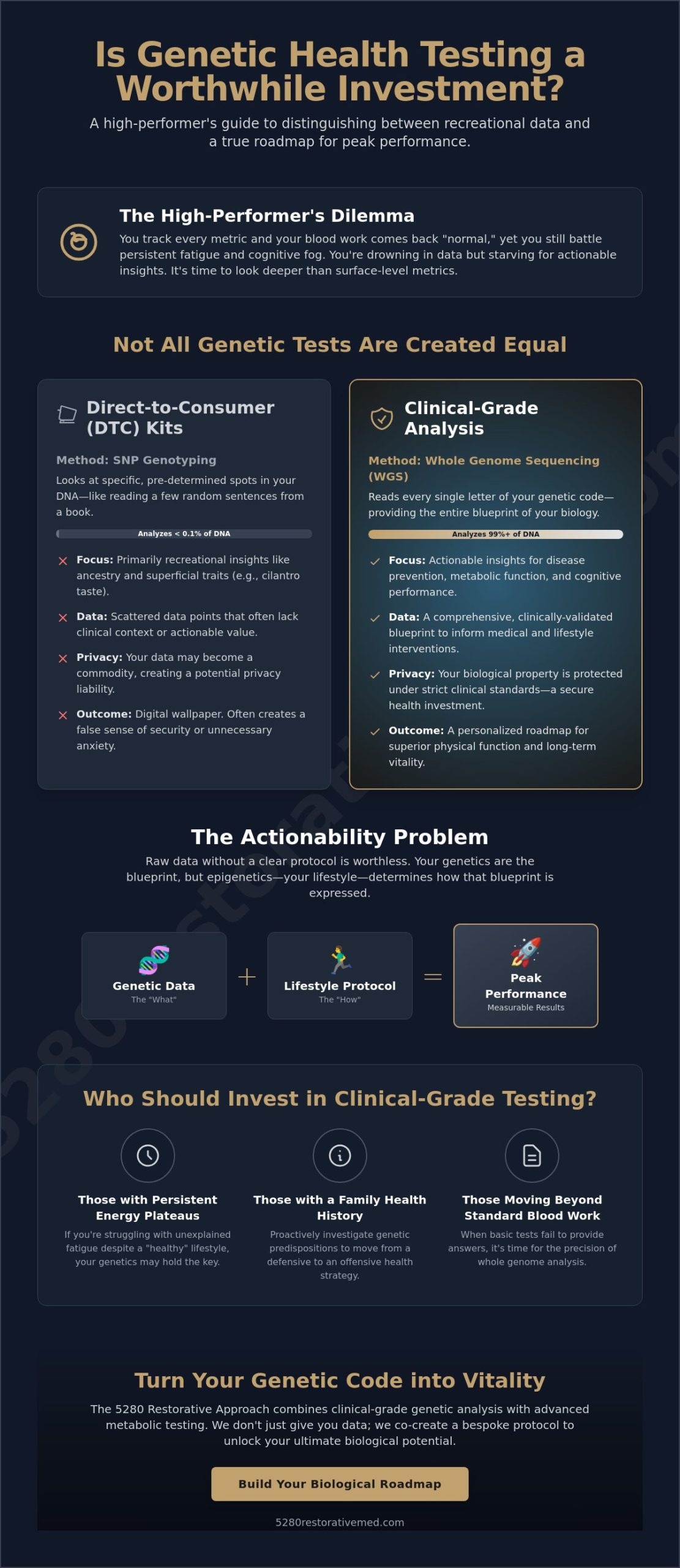
The decision to peer into your own biological blueprint is a significant step toward total optimization. When you ask if is genetic health testing worth the money, the answer depends entirely on the resolution of the lens you’re using. Most people are familiar with the $99 kits found at big-box retailers. These “recreational” tests typically use Single Nucleotide Polymorphism (SNP) genotyping. This method only looks at specific, pre-determined spots in your DNA. It’s like reading a few scattered sentences in a book and trying to guess the entire plot. In contrast, Whole Genome Sequencing (WGS) reads every single letter of your genetic code. This provides a level of detail that’s essential for high-performers who require absolute precision.
Clinically actionable genetic testing is data that directly informs a medical or lifestyle intervention. For a comprehensive overview of genetic testing and the various methodologies involved, one can see how the technology has evolved from simple observations to complex data science. Without this clinical depth, you’re simply collecting data for the sake of curiosity rather than long-term performance. Professional analysis moves beyond the “what” of your ancestry and focuses on the “how” of your daily physiological function.
The Limitations of Consumer DNA Kits
Mass-market tests are designed for the average consumer. They often prioritize ancestry and “fun” traits like whether you can smell certain chemicals or if you have a genetic predisposition for cilantro tasting like soap. While entertaining, these kits often create a false sense of security or unnecessary anxiety. They lack the clinical context needed to interpret raw data safely. They frequently miss rare but high-impact variants that could be the root cause of your unexplained fatigue or cognitive fog. For the executive looking to optimize every hour of the day, these gaps mean the test isn’t the investment it seems to be.
Privacy is another critical concern that determines if is genetic health testing worth the money for high-profile individuals. Many consumer platforms have faced scrutiny over how they handle biological samples and data ownership. Professional-grade analysis ensures your biological property is protected under strict clinical standards. Your data should be a tool for your personal health journey, not a commodity for third-party researchers. When you choose a clinical path, you’re paying for security and validity that mass-market kits simply don’t provide.
What Defines Clinical-Grade Genetic Analysis?
Professional-grade analysis happens in medical laboratories that adhere to rigorous validation standards. We focus on specific metabolic pathways, nutrient absorption, and detoxification markers that dictate how your body actually functions. This level of scrutiny ensures that the results aren’t just interesting; they’re reliable enough to base a medical protocol on. We look at how your body processes specific micronutrients or manages oxidative stress. This provides a foundation for functional health and wellness. It turns vague health goals into a targeted mission for renewal and peak performance.
Clinical testing also includes the expertise of a guide who can translate complex biological data into daily actions. Instead of receiving a confusing PDF that sits in a digital drawer, you get a clear path forward. This approach treats your health as a proactive journey. It ensures that every dollar spent on testing translates into measurable improvements in your vitality and focus. You aren’t just buying data; you’re buying a blueprint for a superior state of physical function.
Evaluating the ROI: Is Genetic Health Testing Worth the Money?
High-performers often view their health through the lens of a balance sheet. When considering whether is genetic health testing worth the money, it’s essential to look beyond the initial invoice and evaluate the long-term yield on your physical and mental capital. For an executive, a single “burnout crash” can cost far more in lost opportunities and medical intervention than a proactive diagnostic protocol. By identifying your unique biological requirements early, you shift from a defensive health posture to an offensive one. You’re no longer just avoiding illness; you’re actively compounding your vitality.
The true cost of genetic testing should be amortized over a lifetime of improved health decisions.
One of the most immediate returns on investment comes from ending the cycle of “supplement waste.” Many high-achievers spend thousands annually on high-end vitamins and adaptogens based on general health trends. However, your DNA might reveal that you don’t actually require certain fat-soluble vitamins or that your body struggles to methylate specific B-vitamins. Genetic insights allow you to curate a precision-grade supplement protocol that targets your actual deficiencies rather than perceived ones. This targeted approach saves money while ensuring your cellular health is actually being supported.
The Cost of Reactive Medicine
Traditional healthcare is often a game of catch-up. You wait for a symptom to appear, then engage in a costly period of trial-and-error to find a solution. Clinical genetic analysis eliminates much of this guesswork. By understanding the risks and benefits of direct-to-consumer testing versus professional diagnostics, you can avoid the pitfalls of inaccurate data that lead to poor health choices.
Precision testing also identifies predispositions for adverse drug reactions or metabolic bottlenecks. This foresight prevents the physical toll of chronic metabolic decline. When you weigh these long-term savings against the upfront cost, it becomes clear why is genetic health testing worth the money for those who value their time and longevity. Investing in your genetic data today means you aren’t paying for the consequences of preventable illness tomorrow.
Genetics for Performance Optimization
For those operating in high-stakes environments, mental clarity is a non-negotiable asset. Genetic testing reveals how your body handles systemic inflammation and determines your natural recovery speed after intense physical or mental exertion. If your “biological hardware” is prone to slow recovery, a generic high-intensity routine might actually be hindering your focus.
Tailoring your nutrition and exercise to your genetic markers ensures you achieve results with less wasted effort. The ROI of sustained cognitive performance and the ability to remain “on” during critical moments is immeasurable. When your lifestyle is programmed to match your code, you reach a superior state of function that standard health approaches simply cannot offer.
The Actionability Problem: Why Data Without a Protocol is Worthless
Many high-performers fall victim to “Drawer Syndrome.” They invest in a high-end DNA analysis, receive a complex 50-page report, and then promptly tuck it away because they don’t know how to apply it. If your results don’t translate into a Monday morning routine, then is genetic health testing worth the money? Likely not. Raw data is merely a collection of possibilities; it lacks the clinical context required to change your life. To move beyond curiosity, you need a professional who can bridge the gap between biological code and daily performance.
At our practice, we believe that functional medicine for high-performers uses genetics as just one piece of a much larger puzzle. We don’t look at your genes in isolation. Instead, we use them to build a bespoke health protocol that accounts for your current physiological state. Without a practitioner to translate these markers, you’re left with a map but no vehicle. The goal is to move from “knowing” your risks to “engineering” your resilience.
The Epigenetic Advantage
Your genes are the code, but your lifestyle is the programmer. It’s a common misconception that a genetic “predisposition” is a “predestination.” In reality, your environment, nutrition, and stress levels determine which genes are “silenced” and which are “activated.” This is the science of epigenetics. By identifying your specific vulnerabilities, we can implement targeted lifestyle interventions that act as a biological switch. This allows you to focus on the 20% of changes that will yield 80% of your results; it prevents the exhaustion of trying to optimize everything at once. You gain the power to influence your own biology through precise, data-driven habits.
Integrating Genetics with Metabolic Testing
Genetic data is a static snapshot of your potential, but it doesn’t tell us what’s happening in your body right now. This is why we cross-reference your DNA with current blood work and metabolic markers. For instance, your genes might suggest a predisposition for poor vitamin D absorption, but only metabolic testing reveals if you’re currently deficient. By identifying these “functional” deficiencies, we move away from population-average health advice. We create individual-specific protocols that ensure you aren’t just “within range” on a lab report, but actually reaching a superior state of physical function. This integration is what truly determines if is genetic health testing worth the money for your specific optimization goals.
Who Should Invest? Identifying the Right Candidates for Testing
While every individual possesses a unique biological code, the decision of whether is genetic health testing worth the money often depends on your current physiological baseline and long-term objectives. For many, standard medical checkups provide a clean bill of health that doesn’t match their actual experience of daily life. If you are operating at a high level but feel like you are dragging an invisible anchor, you are likely the ideal candidate for a deeper investigation. You aren’t just looking for the absence of disease; you are seeking the presence of peak vitality.
Executives and high-performers who have hit a plateau in their energy or focus often find the answers they need within their genetic markers. Standard blood work frequently misses the subtle metabolic bottlenecks that DNA analysis can reveal. Additionally, individuals with a family history of complex, multi-gene conditions, such as cardiovascular issues or cognitive decline, benefit from knowing their predispositions early. This knowledge allows for a surgical strike approach to prevention rather than a broad, less effective strategy. You deserve a health partner who listens when you say “something is off,” even if your labs look normal on paper.
Signs Your Health Needs a Genetic Deep Dive
Persistent fatigue is one of the most common indicators that it’s time for a genetic assessment. If you prioritize sleep and nutrition but still wake up feeling unrefreshed, your body might be struggling with specific methylation or detoxification pathways. Similarly, many people experience difficulty managing their body composition despite rigorous effort in the gym and kitchen. Your genes dictate how you process macronutrients and respond to different types of exercise. Chronic inflammatory symptoms or a persistent “brain fog” that lacks a clear trigger are also red flags. These symptoms often signal that your “biological hardware” is being taxed by environmental factors your code isn’t optimized to handle.
High-Performers and the Quest for Marginal Gains
Elite athletes and CEOs understand that greatness is often found in the marginal gains. Knowing your specific caffeine metabolism, for instance, can prevent late-day energy crashes that sabotage your evening focus. Understanding your circadian rhythm genes allows you to schedule your most demanding tasks during your natural cognitive peaks. This is why executive health programs are increasingly making genetics a core pillar of their protocols. It provides the ultimate personalized roadmap, removing the guesswork from your wellness routine.
When you align your lifestyle with your genetic predispositions, you stop fighting your biology and start leveraging it. This shift from reactive to proactive care is the hallmark of a sophisticated health strategy. If you are ready to move beyond “standard” care and engineer a state of superior physical function, you can schedule a comprehensive consultation to explore your options. Investing in this data today ensures that your health remains an asset rather than a liability as you age.
The 5280 Restorative Approach: Turning Genetic Code into Vitality
At 5280 Restorative Medicine, we view your DNA as a tool for empowerment rather than a source of anxiety. We understand that for an executive or high-performer, the question of whether is genetic health testing worth the money is answered by the tangible results you feel every morning. Our approach moves beyond the static reports of consumer kits. We bundle clinical-grade Genetic Analysis with comprehensive Metabolic Testing to provide a 360-degree view of your current biological state. This allows us to see not just your potential risks, but how your body is currently performing under the unique pressures of your career and lifestyle.
Our focus remains on sustainable energy and peak performance. We don’t settle for “standard” health ranges that merely indicate the absence of disease. Instead, we use your genetic code to engineer a state of superior function. This transition from a raw data report to a daily performance plan is what distinguishes a boutique clinical experience from a mass-market service. We treat your health as a proactive journey, ensuring that every intervention is tailored to your specific metabolic needs and long-term longevity goals.
Boutique Care for the High-Performer
We recognize that your time is your most valuable asset. As a boutique practice with deep roots in the community, we offer a level of personalization that larger, impersonal providers cannot match. We act as your expert health partner, interpreting complex biomarkers into clear, actionable steps that fit into a demanding schedule. Our care doesn’t end with a single consultation. We provide ongoing monitoring and adjust your protocol as your biology and goals evolve. This ensures that your investment continues to yield returns in the form of sustained mental clarity and physical resilience.
Your Path to Peak Performance
When you choose a comprehensive assessment, you are moving beyond baseline health toward optimized vitality. You can expect a deep dive into your physiological enhancement markers, followed by a bespoke roadmap for renewal. We help you navigate the science of aging with confidence, providing the depth of information expected from a high-end medical practice. If you are ready to reclaim your vitality and exceed your previous baseline, Schedule your consultation today. This is the final step in determining that is genetic health testing worth the money when it leads to a measurable transformation in how you live and lead.
Beyond the Data: Your Path to Peak Vitality
True optimization requires moving beyond the scattered insights of consumer kits and embracing a clinical standard of care. By distinguishing between recreational data and actionable whole genome sequencing, you ensure your health investments yield measurable returns in focus, energy, and longevity. You’ve learned that your genetic code is merely the blueprint; the real transformation happens when you use that code to program a lifestyle that activates your highest potential. Ultimately, deciding if is genetic health testing worth the money depends on whether that data leads to a clear, medically supervised protocol for renewal.
Led by Dr. Marci Catallo-Madruga, our practice specializes in executive health optimization through a root-cause functional medicine approach. We don’t just hand you a report; we partner with you to engineer metabolic resilience and exceed your previous baseline. It’s time to stop guessing about your biology and start mastering it. Reclaim your vitality with a bespoke performance protocol and discover what it means to operate at your absolute peak. Your journey toward a superior state of physical function begins with a single, data-driven step.
Frequently Asked Questions
Is genetic testing for health covered by insurance?
Most insurance plans don’t cover genetic health testing when it’s used for proactive optimization or wellness. Standard providers typically require a personal history of a specific disease, such as cancer, before they consider coverage. Because our practice focuses on performance and prevention through specialized medical interventions, our services are generally not billed through standard insurance. This allows us to maintain a highly personalized approach without the constraints of traditional institutional settings.
Can a genetic test tell me exactly what to eat?
A genetic test provides a blueprint of your metabolic tendencies, but it’s not a rigid menu. It identifies how you process macronutrients like fats and carbohydrates, as well as your sensitivity to things like caffeine or salt. We use these markers to build a personalized nutritional framework that supports your specific biological hardware. This data-driven approach ensures your diet aligns with your cellular needs rather than population-average advice.
What is the difference between genotyping and sequencing?
Genotyping, which is common in many recreational kits, only looks at specific “snapshots” or variants in your DNA. Sequencing, specifically Whole Genome Sequencing (WGS), reads your entire genetic code from start to finish. This comprehensive approach is necessary for high-performers because it captures rare variants that genotyping often misses. Sequencing provides the depth required for a truly bespoke health protocol and long-term disease prevention.
Will my genetic information be shared with my employer or insurance company?
Federal laws like the Genetic Information Nondiscrimination Act (GINA) prohibit health insurers and employers from using your genetic information for coverage or hiring decisions. Additionally, new 2026 privacy regulations in states like Connecticut grant consumers property rights over their biological samples. In our boutique clinical setting, your data remains strictly confidential and protected by professional-grade security protocols to ensure your biological property stays yours.
How long does it take to get results from a clinical genetic analysis?
The timeline for clinical-grade results typically ranges from three to six weeks depending on the depth of the analysis. Because we prioritize accuracy and clinical validity over mass production, the process involves rigorous laboratory validation. Once the raw data is ready, we take additional time to translate those markers into your bespoke performance protocol. This ensures that you receive a clear path forward rather than just a confusing report.
Can genetic testing help identify the cause of my chronic fatigue?
Yes, genetic analysis can reveal underlying metabolic bottlenecks or methylation issues that contribute to persistent exhaustion. By identifying these predispositions, we can determine if is genetic health testing worth the money for your specific recovery needs. When paired with metabolic testing, it helps us pinpoint exactly where your energy production is faltering at a cellular level, allowing for a targeted solution.
Is genetic testing worth it if I don’t have a family history of disease?
Absolutely, because genetics is about optimization as much as it is about prevention. Many high-performers use genetic data to fine-tune their recovery, cognitive focus, and sleep architecture. Even without a family history of illness, knowing your biological predispositions allows you to engineer a state of superior physical function. This proactive journey ensures you are reaching peak physical and mental states at every stage of life.
What happens if my genetic test shows a high risk for an incurable condition?
Discovering a high-risk marker is an opportunity for empowerment through proactive lifestyle management. While some conditions are complex, knowing your risk allows us to focus on the epigenetic changes that can influence how those genes are expressed. We provide a supportive, expert-led environment to help you navigate these insights. The goal is to focus on what you can control to maintain optimized vitality and peace of mind.