
What if your “normal” lab results are actually the very thing standing between you and your peak performance? For many high-performers, there is a frustrating disconnect between feeling fatigued or mentally foggy and being told by a doctor that everything looks fine. This happens because standard reference ranges are often based on a general population that isn’t necessarily healthy. To achieve true biological optimization, you need to look deeper. Investing in an advanced blood panel for longevity allows you to move beyond the absence of disease and toward a state of superior physical and mental function.
We understand the anxiety that comes with conflicting health advice and the fear of age-related decline impacting your career or quality of life. You deserve a clear, data-driven map of your internal health that replaces guesswork with precision. In this guide, we will explore the specific biomarkers for metabolic health, inflammation, and hormonal balance that define your healthspan. You’ll learn how to interpret these results to create actionable steps for renewal, giving you the confidence that you are effectively shielding yourself against the chronic conditions that account for 90 percent of healthcare expenditures today. It is time to stop settling for a baseline and start mastering your biology.
Key Takeaways
- Standard blood tests are designed to diagnose acute illness, while a longevity-focused approach identifies subtle physiological shifts before they become chronic conditions.
- Transition from “normal” to “optimal” by understanding how the healthiest 5% of the population defines the benchmarks for true vitality.
- An advanced blood panel for longevity provides deep insights into critical markers like ApoB and fasting insulin, offering a more accurate picture of your cardiovascular and metabolic health.
- Learn the precise preparation steps, including fasting requirements and activity restrictions, to ensure your lab results reflect your true biological state.
- Discover how to synthesize complex data into a personalized protocol through our Executive Health Program, which combines bloodwork with genetic and metabolic analysis.
Why Standard Blood Work Fails the Quest for Longevity
Most high-performers view their annual physical as a simple pass-fail test. If the results come back within the “normal” range, they assume their health is optimized. However, there’s a massive gap between the mere absence of disease and the presence of true vitality. Standard blood work, such as the Complete Blood Count (CBC) or Comprehensive Metabolic Panel (CMP), was originally designed to identify acute medical crises like kidney failure, severe infection, or advanced anemia. These tests are vital for sick-care, but they aren’t built to detect the subtle, cumulative changes that erode your healthspan over decades.
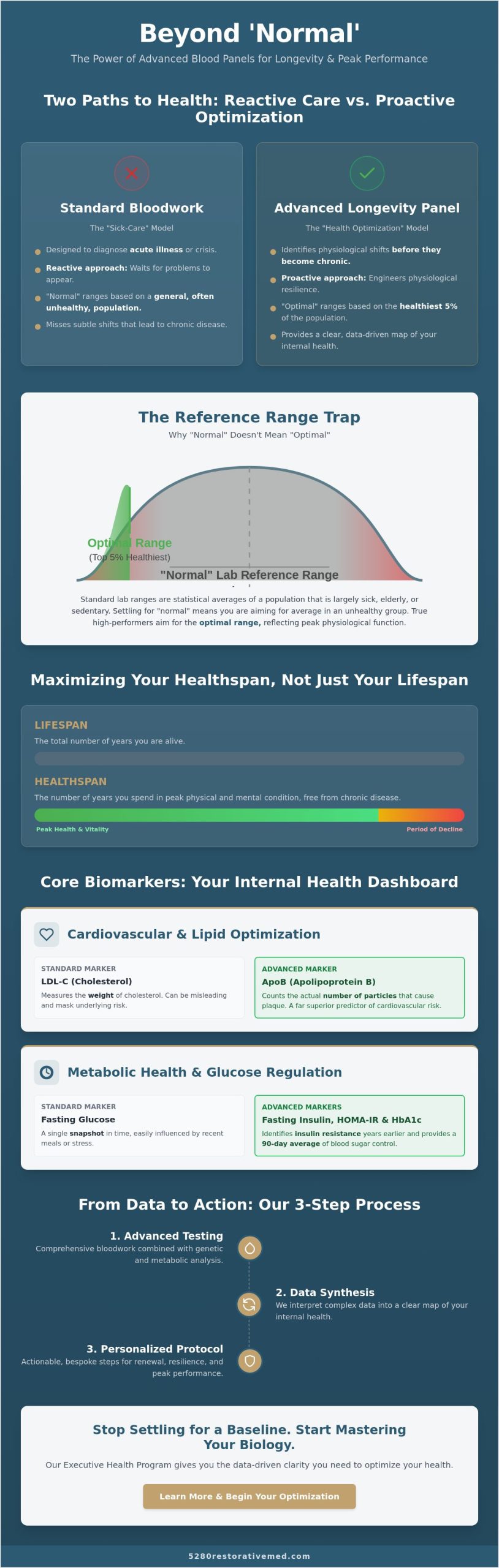
In a clinical context, lifespan is simply the total number of years you’re alive. Healthspan is the number of years you spend in peak physical and mental condition. While modern medicine is excellent at keeping people alive longer, it often fails to keep them healthy during those extra years. Functional medicine bridges this gap by identifying sub-clinical trends. These are biomarkers that haven’t reached the “danger zone” yet but are trending toward dysfunction. By utilizing an advanced blood panel for longevity, we can spot these shifts years before they manifest as chronic illness, allowing for precise, personalized interventions.
The Reactive Healthcare vs. Proactive Optimization Gap
Traditional healthcare operates on a reactive model. It waits for your system to break before suggesting a fix. For an executive or high-level athlete, waiting for a diagnosis is a risk that doesn’t align with their performance goals. The cost of waiting is high; early detection of metabolic shifts, such as rising fasting insulin or creeping inflammatory markers, is much easier to manage than a full-blown metabolic disorder. Longevity medicine is the proactive engineering of physiological resilience.
Why “Normal” Lab Results Can Be Deceptive
Lab reference ranges are statistical averages based on the population that visits that specific laboratory. Since the majority of people getting blood work are either sick, elderly, or sedentary, the “normal” range is skewed toward an increasingly unhealthy baseline. You shouldn’t settle for being average in a population that is largely struggling with metabolic dysfunction. This is why we focus on biomarkers of aging to differentiate between your chronological age and your biological age. It’s common for high-performers to have “normal” labs while still experiencing brain fog, low libido, or burnout. An advanced blood panel for longevity reveals the hidden cellular stress that standard tests simply ignore, providing a clear path back to your best self.
The Core Biomarkers of an Advanced Blood Panel for Longevity
Building a comprehensive map of your health requires moving beyond standard metrics to look at the specific drivers of cellular aging. An advanced blood panel for longevity organizes your data into specific physiological pillars, providing a holistic view of your internal environment. Leading research institutions are now identifying a panel of protein biomarkers that can more accurately determine biological age, and these clinical insights are finally available to high-performers who refuse to settle for average health.
Cardiovascular and Lipid Optimization
Standard lipid panels often mask real risk by only measuring the weight of cholesterol. Apolipoprotein B (ApoB) is a far superior predictor of cardiovascular health because it counts the actual number of particles that can lodge in your arterial walls. While standard LDL-C might look fine, a high ApoB count indicates a significant risk for plaque accumulation over time. We also assess Lipoprotein(a), a genetically determined marker that identifies individuals at higher risk for early heart disease, allowing for more aggressive, bespoke prevention strategies.
Metabolic Health and Glucose Regulation
Metabolic flexibility is the cornerstone of sustained executive performance and cognitive endurance. We move past simple fasting glucose to measure fasting insulin and calculate HOMA-IR, which identifies insulin resistance years before it shows up on standard tests. Hemoglobin A1c (HbA1c) provides a 90 day window into your average blood sugar levels and the degree of glycation in your body. High glycation levels essentially “caramelize” your proteins, accelerating the aging process and impacting everything from skin elasticity to brain function.
Inflammation and Micronutrient Status
Systemic inflammation is a silent driver of the “Four Horsemen” of chronic disease. High-sensitivity C-reactive protein (hs-CRP) acts as a systemic fire alarm, signaling when your body is under stress from diet, lack of sleep, or overtraining. Homocysteine levels offer a window into your methylation status, which is critical for DNA repair and cognitive health. To fuel these systems, we monitor foundational micronutrients:
- Vitamin D3 and B12: Essential for immune function, mood regulation, and energy production.
- Ferritin: A measure of iron stores that dictates your oxygen-carrying capacity and vitality.
- Magnesium and Zinc: Essential cofactors for over 300 enzymatic reactions, including those that regulate your nervous system.
Identifying these sub-clinical trends is the first step toward a personalized health strategy that prioritizes renewal and peak performance.
The Reference Range Trap: Normal vs. Optimal
“My doctor said my labs are fine.” This is the most frequent phrase we hear from individuals who are clearly struggling with persistent fatigue, mood swings, or cognitive decline. In the traditional medical model, “fine” simply means you are not currently in a state of acute failure. It doesn’t mean you’re thriving. Standard reference ranges are based on a statistical average of the general population. Because a large portion of that population is sedentary or metabolically unwell, being “average” is no longer the goal for a high-performer.
When we analyze an advanced blood panel for longevity, we apply a much narrower set of criteria. These optimal ranges are often derived from the healthiest 5 percent of the population. By following the standards outlined in the Biomarkers of Aging Guide, we shift the focus from merely surviving to achieving true biological excellence. Moving toward these tighter benchmarks is a core component of functional health and wellness, ensuring your internal systems run at peak efficiency.
Defining the Optimal Zone
Consider your thyroid health. A standard lab might list a Thyroid Stimulating Hormone (TSH) of 4.0 mIU/L as “normal.” However, in longevity medicine, many clinicians find that patients feel their best when TSH is closer to 1.0 or 2.0. At 4.0, you might experience a sluggish metabolism and brain fog despite being “in range.” Similarly, being “not anemic” is a low bar. For peak athletic and cognitive performance, you need optimal iron stores, measured by ferritin. These tighter ranges are not arbitrary; they are the clinical rationale for maintaining high-level output as you age.
Hormonal Balance and Peak Performance
Hormones act as the software that runs your biological hardware. Your ratios of testosterone, DHEA, and cortisol dictate your stress resilience and recovery capacity. A “normal” age-related decline is often accepted as inevitable, but for those seeking biological optimization, it’s an unacceptable baseline. Utilizing an advanced blood panel for longevity allows us to monitor these shifts in real time. When natural levels fall below the optimal threshold, BHRT can serve as a powerful tool to restore physiological baselines and maintain the vitality you had a decade ago. We treat aging as a manageable process rather than a foregone conclusion.
How to Prepare for and Interpret Your Longevity Panel
You don’t want to build a high-performance protocol on shaky data. To ensure your advanced blood panel for longevity provides a true reflection of your baseline, you must follow a strict pre-test protocol. It’s a common mistake for high-performers to rush into a blood draw after a heavy training session or a celebratory dinner, but these choices can skew critical markers and lead to incorrect clinical conclusions. Proper preparation allows us to see your biology as it truly is, not just as it responds to immediate stress.
The foundation of a successful draw is a 12-hour fast, consuming only water. This period stabilizes your blood glucose and insulin levels, providing a clear window into your metabolic health. You should also avoid alcohol for at least 48 hours prior to your appointment. Even moderate consumption can temporarily elevate liver enzymes and triglycerides, clouding the data we need for long-term planning. Hydration is equally critical; dehydration can artificially elevate markers like creatinine and impact your estimated Glomerular Filtration Rate (eGFR), leading to false concerns about kidney function.
The Pre-Test Protocol
Certain supplements can interfere with the laboratory assays themselves and should be paused. For instance, biotin (Vitamin B7) is known to cause clinically significant errors in thyroid and hormone tests, so we recommend pausing its use for three to five days before your draw. You must avoid strenuous exercise for 48 hours prior to your test to ensure accurate hs-CRP levels and prevent false elevations in muscle-related enzymes like creatine kinase. By controlling these variables, you ensure that every dollar spent on diagnostics yields actionable, high-quality information.
Synthesizing the Data into Action
Raw data is just a collection of numbers; the real value lies in the expert synthesis of those markers. A single “out of range” result rarely tells the whole story. Instead, we look for physiological patterns that define your healthspan. For example, the combination of elevated fasting insulin and high triglycerides often points toward metabolic resistance, even if your glucose levels still appear normal. This nuanced understanding is why “DIY” biohacking can be dangerous, as changing your entire life based on one marker without professional guidance often leads to nutritional imbalances.
We use these insights to pivot your strategy, refining your nutritional counseling and fine-tuning your supplement protocols based on your unique internal chemistry. Establishing a baseline is only the beginning. Semi-annual testing remains the gold standard for longevity, allowing us to track the efficacy of your interventions and make micro-adjustments before sub-clinical trends become permanent issues. To move beyond raw data and toward a masterplan for your health, explore our Executive Health Program.
Engineering Your Longevity Protocol with 5280 Restorative Medicine
Data without a directive is just noise. While an advanced blood panel for longevity provides the necessary raw numbers, true biological optimization requires an expert to synthesize those metrics into a cohesive strategy. At 5280 Restorative Medicine, we specialize in moving beyond the spreadsheet. Our Executive Health Program is designed for the high-performer who demands more than a standard checkup. We combine your bloodwork with metabolic testing and genetic analysis to build a biological profile that is as unique as your thumbprint.
Dr. Marci Catallo-Madruga leads this process, acting as your clinical partner to translate complex laboratory data into a bespoke performance roadmap. By identifying how your genetics influence your nutrient absorption and how your metabolism responds to specific stressors, we eliminate the trial-and-error approach to wellness. This high-touch, data-driven methodology ensures that your investments in health translate into measurable results: sustained cognitive clarity, deep restorative sleep, and the physical resilience required to lead at the highest levels in the Mile High City and beyond.
A Boutique Approach to High-Performance Health
The traditional insurance-based model is built for speed, often resulting in 15 minute visits that only address symptoms. Our boutique practice operates differently. We take the time to investigate hidden barriers to performance, such as mast cell activation syndrome, which standard panels frequently overlook. By addressing these root causes, we clear the path for advanced interventions. Your protocol might include targeted supplement schedules or the integration of red light therapy to support mitochondrial function and accelerate recovery. This is not standardized care; it is precision engineering for the human body.
Your Next Steps to Optimization
Reclaiming your vitality starts with a single, purposeful step. Your journey begins with a comprehensive Functional Medicine Consultation, where we review your history and goals before ordering your advanced blood panel for longevity. During the first 90 days of your program, we focus on stabilizing your baseline and initiating the micro-adjustments that lead to significant physiological shifts. You will receive continuous support as we monitor your progress and refine your protocol. Don’t wait for your performance to dip before taking action. Contact us today to schedule your consultation and start exceeding your biological baseline.
Take Command of Your Healthspan Today
You shouldn’t have to navigate the complexities of cellular health alone. We’ve explored how standard diagnostics often miss the subtle shifts that lead to chronic decline and why “normal” results aren’t enough for those who demand peak performance. By utilizing an advanced blood panel for longevity, you gain the clarity needed to transition from reactive healthcare to proactive biological engineering. This data is the foundation of a life lived with vitality rather than one spent managing symptoms.
Our approach at 5280 Restorative Medicine is centered on the expert guidance of Dr. Marci Catallo-Madruga, a dedicated Functional Medicine Expert. We don’t believe in standardized care; instead, we offer bespoke protocols informed by specialized metabolic and genetic analysis. This ensures your path to renewal is grounded in your unique physiology and lifestyle goals. It’s time to move beyond the reference range trap and reach a superior state of physical and mental function.
Apply for our Executive Health Program to begin your health optimization journey and experience the confidence that comes with a personalized roadmap. Your best years shouldn’t be behind you; they’re waiting to be engineered. We look forward to partnering with you on this journey toward peak biological performance.
Frequently Asked Questions
Is an advanced longevity blood panel covered by insurance?
Insurance providers typically don’t cover an advanced blood panel for longevity because they categorize these diagnostics as preventative rather than medically necessary for treating an acute illness. Traditional insurance is built for a reactive “sick-care” model. By investing in these tests out-of-pocket, you maintain full autonomy over your health strategy and access biomarkers that standard insurance-billing codes simply do not recognize.
How often should I get an advanced blood panel done for longevity?
We generally recommend scheduling your testing semi-annually to monitor the efficacy of your personalized protocols. Testing every six months allows us to catch sub-clinical trends before they manifest as symptoms or performance dips. Once you have reached your “optimal” zones, an annual draw may be sufficient for maintenance, provided your lifestyle factors and performance goals remain consistent.
Can I do a longevity blood test at home, or do I need a clinic?
While at-home finger-prick kits are available, they often lack the depth and accuracy required for a comprehensive advanced blood panel for longevity. A clinic-based venous draw allows for a much larger set of markers, including delicate proteins that require immediate laboratory processing. More importantly, a clinic environment provides the expert synthesis needed to turn raw numbers into a functional performance roadmap.
What is the most important biomarker for predicting long-term health?
There isn’t a single “silver bullet” marker, but Apolipoprotein B (ApoB) and fasting insulin are among the most predictive for long-term healthspan. ApoB provides a precise count of atherogenic particles that drive heart disease, while fasting insulin reveals your underlying metabolic flexibility. Together, these markers help us screen for the primary drivers of age-related decline long before they become chronic issues.
What happens if my longevity panel shows high inflammation?
High inflammation, often measured via hs-CRP, serves as a systemic “fire alarm” that requires a deeper investigation into root causes. We look at lifestyle factors, gut health, and potential triggers like mast cell activation to find the source of the stress. Once identified, we implement targeted nutritional changes and supplement protocols to dampen the inflammatory response and restore your physiological balance.
How does metabolic testing differ from a standard blood panel?
A standard blood panel provides a static snapshot of your current nutrient and hormone levels, whereas metabolic testing measures how your body actually utilizes energy. Metabolic testing often involves analyzing your oxygen consumption or cellular efficiency during rest or activity. Combining both diagnostics gives us a complete picture of your biological hardware and the “software” that runs your daily energy production.
Can these tests really help me live longer?
These tests extend your healthspan by identifying the early markers of the “Four Horsemen” of disease: heart disease, cancer, neurodegeneration, and type 2 diabetes. By catching these shifts in the sub-clinical stage, we can implement interventions that significantly reduce your risk. While no test guarantees a specific lifespan, data-driven optimization ensures you spend more years in a high-performing, vital state.
Do I need to stop taking my supplements before the blood draw?
Yes, you should pause certain supplements to ensure your results are accurate and actionable. Biotin (Vitamin B7) is particularly notorious for interfering with hormone and thyroid assays and should be stopped at least 72 hours before your draw. We provide a specific cessation list during your pre-test consultation to ensure your data is clean and reflects your true biological baseline.