
Why does your primary care physician insist your blood work is “perfect” when you feel like you’re operating at half capacity? If you’re struggling with a relentless afternoon slump or noticing unexpected belly fat despite your best efforts in the gym, you aren’t imagining the decline. Identifying adrenal fatigue symptoms in men is often difficult because these signs are frequently dismissed as normal aging or the inevitable cost of a high-stakes career. However, what you’re experiencing isn’t a failure of your willpower; it’s a strategic “power-down” of your body’s internal stress response system.
We understand the frustration of waking up unrefreshed after eight hours of sleep and the quiet anxiety that comes with a fluctuating libido. You deserve a clinical explanation that goes deeper than standard lab ranges. In this guide, we’ll move beyond the buzzwords to examine the science of HPA axis dysregulation and how it impacts your metabolic health. You’ll learn how to measure your stress response objectively through functional testing and discover a clear, clinical roadmap to reclaiming the executive-level energy and physical vitality you need to perform at your best.
Key Takeaways
- Shift your perspective from “adrenal fatigue” to HPA axis dysregulation, which describes a functional breakdown of the body’s internal stress response system.
- Learn to distinguish common adrenal fatigue symptoms in men from age-related decline or low testosterone to pinpoint the true root cause of persistent exhaustion.
- Discover why standard morning blood tests often fail to detect metabolic dysfunction and how more comprehensive testing provides a clearer picture of your health.
- Identify where you sit on the three-stage stress continuum to ensure your recovery efforts match your specific level of physiological depletion.
- Move beyond the “push through” mentality with a clinical framework that prioritizes metabolic resilience through personalized nutrition and targeted supplementation.
Beyond “Just Tired”: Re-Defining Adrenal Fatigue for Men
The term “adrenal fatigue” is widely used by patients, yet it often meets skepticism in conventional medical settings. This disconnect happens because most doctors are trained only to recognize Addison’s Disease, a rare and life-threatening condition where the adrenal glands physically fail. Functional dysregulation is fundamentally different. It isn’t a physical disease of the glands, but a sophisticated breakdown in communication. For the high-performing executive, this manifests as a biological “safety mode.” Your body isn’t broken; it’s simply prioritizing immediate survival over long-term peak performance. This protective mechanism shifts resources away from functions like deep sleep and metabolic efficiency to prioritize immediate survival.
The HPA Axis: Your Internal Thermostat for Stress
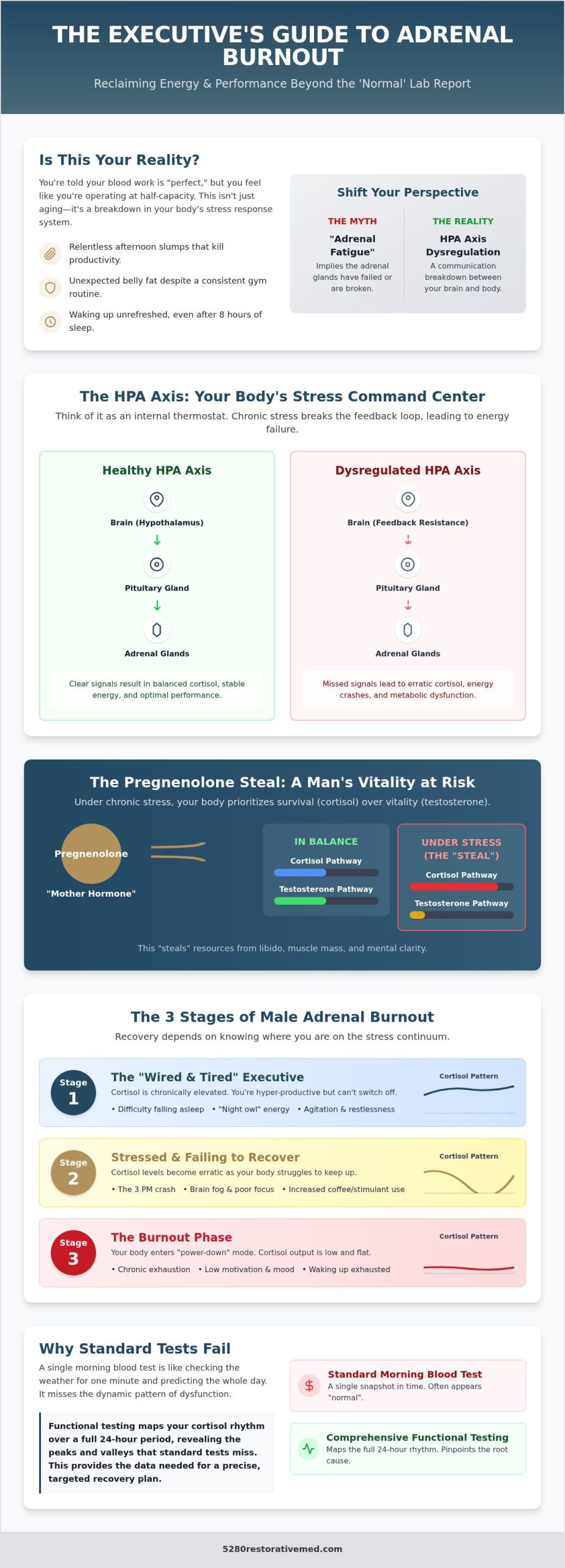
Think of your stress response as a sophisticated thermostat. The Hypothalamic-Pituitary-Adrenal (HPA) Axis acts as the command center for your metabolic resilience, coordinating how you react to every deadline and workout. When stress becomes chronic, the brain sends a constant “on” signal to the adrenals. Over time, your system develops feedback resistance. The brain’s receptors become less sensitive to cortisol, much like a thermostat that no longer recognizes the room is already hot. The signals get ignored, and your energy production stalls. This communication failure is the core reason why identifying adrenal fatigue symptoms in men requires looking at the brain-body connection rather than just the glands themselves.
Why Men Experience Adrenal Dysfunction Differently
Men face unique physiological consequences when the HPA axis falters. One major factor is the “pregnenolone steal.” Your body uses the same raw materials to create both cortisol and testosterone. When you’re under constant pressure, your system prioritizes cortisol, literally “stealing” the resources meant for your libido, vitality, and muscle mass. Many men attempt to mask these adrenal fatigue symptoms in men with excessive caffeine, pre-workouts, or other stimulants. This provides a temporary boost but ultimately deepens the depletion, pushing the body further into a state of metabolic debt. This cycle doesn’t just affect energy; it erodes cardiovascular resilience and makes it harder to maintain a lean physique. We believe in moving beyond these temporary masks toward a restorative approach that honors your body’s complex biology.
The 3 Stages of Male Adrenal Burnout
Physiological health exists on a continuum rather than as a simple on/off switch. Your body doesn’t move from peak performance to total exhaustion overnight. Instead, it transitions through distinct phases of adaptation and eventual depletion. Recognizing where you fall on this “stress continuum” is the first step toward effective recovery. Because the body’s needs change at each level of dysregulation, recovery protocols must be stage-specific to be successful. Identifying these shifts through functional health and wellness assessments allows us to target the root cause of your fatigue with clinical precision.
Stage 1: The “Wired and Tired” Executive
In the initial stage of HPA axis dysregulation, cortisol levels remain chronically elevated. You might feel hyper-productive, yet you find it increasingly difficult to relax or “turn off” your brain at the end of the day. This state is often characterized by sleep onset issues and “night owl” tendencies, where you get a second wind of energy late in the evening. While you’re still performing at a high level, the metabolic cost is significant. High cortisol at night interferes with deep, restorative sleep, setting the stage for more serious hormonal imbalances. Many men in this stage don’t realize they’re experiencing the early adrenal fatigue symptoms in men, often attributing their agitation to a high-pressure workload.
Stage 2: Stressed and Failing to Recover
As chronic stress persists, your body struggles to maintain high cortisol production. You enter a transitional phase where cortisol levels begin to fluctuate erratically throughout the day. This is the stage of the infamous 3 PM crash. You likely find yourself relying on a third or fourth cup of coffee just to make it through afternoon meetings, and “brain fog” starts to impede your decision-making. This erratic cortisol pattern begins to disrupt other systems, specifically impacting thyroid function and sex hormone balance. Understanding the physiology of the stress response reveals that when your system is stuck in this cycle, it can no longer prioritize repair, leading to slower recovery from workouts and increased systemic inflammation.
Stage 3: Advanced HPA Exhaustion
In the final stage, the HPA axis essentially “flat-lines.” Your body can no longer mount an appropriate stress response, and cortisol levels remain low regardless of the demands placed upon you. This stage is marked by chronic, soul-crushing exhaustion that isn’t helped by sleep. You may notice a significant drop in libido, a loss of motivation, and a sense of apathy toward goals that used to excite you. These advanced adrenal fatigue symptoms in men signal a system in survival mode. At this point, “pushing through” is no longer an option. True restoration requires a comprehensive executive health program that addresses metabolic testing, gut health, and personalized hormone optimization to rebuild your vitality from the ground up.
Adrenal Fatigue Symptoms in Men: The Warning Signs
Many clinical institutions argue that no scientific proof exists to support adrenal fatigue as a discrete medical condition. However, this semantic debate doesn’t change the physiological reality of the decline many high-performers experience. When your system is taxed by chronic pressure, the resulting HPA axis dysregulation presents a specific cluster of symptoms that often go ignored or misdiagnosed. These warning signs aren’t just inconveniences; they’re biological signals that your body is shifting resources away from performance to prioritize basic survival.
These symptoms are frequently dismissed as the inevitable byproduct of “getting older” or misattributed solely to “low T.” While testosterone levels often drop alongside adrenal function, treating the hormones without addressing the underlying stress response is a reactive approach that fails to provide long-term resolution. Recognizing the specific adrenal fatigue symptoms in men is the key to moving from a state of mere survival back to peak performance. Identifying these red flags early allows for a proactive intervention before the dysfunction becomes debilitating.
Physical Red Flags: From Belly Fat to Salt Cravings
One of the most visible indicators of adrenal dysfunction is the development of a “stress belly.” Chronic cortisol elevation triggers the body to store fat around the abdominal organs, a process that resists even the most disciplined exercise routines. You might also notice intense cravings for salt or sugar. These aren’t failures of willpower; they’re signs of electrolyte and glucose mismanagement as your body struggles to maintain blood pressure and energy levels. For many men, the most telling signs are a loss of morning erections and a noticeable lag in exercise recovery. When your adrenals are taxed, your body deprioritizes reproductive health and tissue repair, making your usual gym sessions feel draining rather than energizing.
Cognitive and Emotional Indicators
Beyond the physical, adrenal burnout manifests as “Executive Brain Fog.” This is the loss of mental clarity and the rapid decision-making ability that likely defined your career success. You might find yourself re-reading the same report multiple times or struggling to maintain focus during high-stakes meetings. This cognitive decline often pairs with a “short fuse” behavior. A man who was once composed and strategic may become uncharacteristically irritable or reactive under pressure. Ultimately, HPA dysregulation erodes the internal “drive” and ambition essential for high-level performance, making once-simple tasks feel like insurmountable hurdles. We see this as a call to restore your metabolic foundation so your cognitive edge can return.
Why Standard Blood Tests Miss Adrenal Dysfunction
Many men experience a frustrating paradox: they feel completely depleted, yet their primary care physician insists their lab results are “perfect.” This happens because conventional medicine typically relies on a single morning serum cortisol draw. Think of this blood test as a single photograph of a high-speed race. It tells us where you were at 8:00 AM, but it says nothing about your pace, your endurance, or whether you crashed by noon. To truly understand your health, we need the “movie” of your hormonal fluctuations throughout the 24-hour cycle.
Standard “normal” ranges are also part of the problem. These ranges are designed to identify extreme pathology, such as total adrenal failure, rather than to optimize the performance of a high-level executive. Being at the bottom of a “normal” range might not qualify as a disease, but it’s often the root cause of the adrenal fatigue symptoms in men that prevent them from reaching their full potential. We also look at the critical distinction between total and free cortisol. Your body can only use the “free” portion of the hormone; if it’s bound up by proteins, it’s effectively useless for your metabolism.
Advanced Testing: The DUTCH Test and Salivary Maps
We move beyond snapshots by utilizing advanced diagnostics like the DUTCH test (Dried Urine Test for Comprehensive Hormones) or multi-point salivary mapping. These tools allow us to see your diurnal cortisol rhythm in detail. By measuring your levels at four or five points throughout the day, we can see if you’re waking up with enough energy and how quickly you’re clearing those hormones from your system. Seeing your cortisol metabolites is equally vital. It helps us determine if your body is struggling to produce enough cortisol or if it’s simply processing it too fast. This level of clinical data is why functional medicine for high-performers is the only way to identify the specific metabolic bottlenecks holding you back.
The Interplay with Other Hormones
Adrenal health never exists in isolation. When your HPA axis is under chronic stress, it sends signals that suppress other vital systems. For instance, high-stress levels often inhibit the conversion of thyroid hormones from their inactive to active states, leaving you with “normal” labs but a sluggish metabolism. It’s also essential to evaluate the adrenals when considering BHRT. If we optimize your testosterone without addressing underlying adrenal fatigue symptoms in men, your body may lack the “reserve” needed to handle the increased metabolic demand. We also measure DHEA-S, a protective hormone that acts as a barometer for your overall adrenal resilience and longevity.
If you’re ready to look beneath the surface of “normal” labs, exploring our framework for functional medicine for high-performers is the first step toward reclaiming your edge.
The Recovery Protocol: Engineering Metabolic Resilience
Reclaiming your edge isn’t about a weekend of rest; it’s a calculated engineering of metabolic resilience. For high-performers, the instinct is often to grit your teeth and work harder when energy dips. However, in the context of advanced HPA axis dysregulation, this “push through” mentality is often the quickest path to total system failure. Recovery requires a shift from high-intensity output to high-quality input. This strategic process honors the biological reality that your body needs specific resources to exit “safety mode.” It is a journey that moves you from reactive survival back to a state of proactive optimization.
Lifestyle Interventions for the High-Performer
Circadian alignment is the non-negotiable foundation of our recovery framework. Without restorative sleep, the adrenal glands cannot recalibrate, making “Sleep First” a clinical mandate for anyone struggling with the decline. We also utilize advanced modalities like red light therapy to support mitochondrial function and accelerate cellular repair at a foundational level. Movement must also shift during this phase. Instead of grueling sessions that worsen adrenal fatigue symptoms in men, we advocate for “work-ins.” These are restorative movements, such as walking or mobility work, that lower the systemic stress load while maintaining physical integrity and blood flow.
Precision Nutrition and Supplementation
Precision nutrition focuses on replenishing the specific minerals and micronutrients depleted by chronic stress. “Adrenal cocktails” containing sodium, potassium, and Vitamin C are essential for maintaining electrolyte balance and supporting the adrenal cortex in its daily functions. Supplementation must be data-driven rather than speculative to be effective. We utilize adaptogens like Ashwagandha to lower elevated evening cortisol or Rhodiola to support daytime energy, but these are only applied after mapping your specific diurnal rhythm through advanced testing. This targeted approach ensures we are nourishing your system rather than just masking the underlying adrenal fatigue symptoms in men. By providing the body with the exact building blocks it lacks, we can systematically rebuild your metabolic reserve.
True restoration is a strategic process that replaces guesswork with clinical certainty. If you’re ready to move beyond temporary fixes and build a foundation for long-term vitality, we invite you to begin with a professional consultation to develop your bespoke roadmap to recovery.
Reclaim Your Metabolic Resilience and Performance
You don’t have to accept a “new normal” of persistent exhaustion and diminished drive. We’ve explored how adrenal fatigue symptoms in men are actually the result of a sophisticated HPA axis dysregulation, a protective “power-down” that shifts your body from peak performance to survival mode. By moving beyond the limitations of standard blood work and utilizing multi-point metabolic testing, you can finally identify the specific stage of burnout you’re in and address it with clinical precision. Recovery isn’t about pushing through the pain; it’s about providing your system with the exact biological building blocks it needs to thrive again.
Under the expert guidance of Dr. Marci Catallo-Madruga, we provide root-cause analysis that looks far beyond “normal” lab results to find the true source of your depletion. Our data-driven protocols are designed specifically for high-performing executives who require sustainable energy and cognitive clarity. It’s time to move from reactive guesswork to a proactive journey of renewal. Reclaim Your Edge with a Precision Metabolic Assessment and start engineering your return to superior physical and mental vitality. Your most productive years are still ahead of you.
Frequently Asked Questions
Is adrenal fatigue a real medical condition recognized by doctors?
Adrenal fatigue is not a recognized clinical diagnosis in conventional medicine, which typically only acknowledges total adrenal failure like Addison’s Disease. However, functional medicine recognizes HPA axis dysregulation as a legitimate physiological state. This condition involves a communication breakdown between the brain and adrenal glands. While the glands themselves aren’t diseased, their output is poorly regulated, leading to the debilitating symptoms many high-performing men experience daily.
How long does it typically take for a man to recover from adrenal burnout?
Recovery typically ranges from six to eighteen months depending on the severity of your dysregulation. Stage 1 “wired and tired” individuals might see significant improvements within three months. Advanced Stage 3 exhaustion requires a longer, more strategic approach to rebuild metabolic reserves. Consistency with nutrition, sleep, and targeted supplementation is essential. We focus on sustainable progress rather than overnight fixes to ensure your energy levels remain stable long-term.
Can low testosterone be caused by adrenal fatigue?
Yes, chronic stress directly impacts testosterone production through a process often called the pregnenolone steal. Your body uses the same precursor hormone to create both cortisol and testosterone. When survival demands high cortisol, testosterone production is deprioritized. This is why many adrenal fatigue symptoms in men, such as low libido and loss of muscle mass, overlap with symptoms of low testosterone. Addressing the stress response is often necessary to restore hormonal balance.
What is the best type of exercise for someone with adrenal exhaustion?
The best exercise depends on your current stage of burnout. For those in advanced exhaustion, restorative “work-ins” like walking, tai chi, or gentle yoga are most beneficial. High-intensity interval training or heavy lifting can actually trigger further cortisol depletion and stall your recovery. We recommend keeping heart rates below 120 beats per minute during the initial healing phase to prevent overtaxing your already strained and sensitive nervous system.
Are there specific foods I should avoid if I have high cortisol?
You should prioritize avoiding high-sugar foods and refined carbohydrates that cause rapid blood glucose fluctuations. These spikes force the adrenals to work harder to stabilize your system. Excessive alcohol and inflammatory seed oils also increase the internal stress load. Instead, focus on high-quality proteins, healthy fats, and mineral-rich vegetables. Stabilizing your blood sugar through consistent, nutrient-dense meals is a cornerstone of engineering metabolic resilience and reducing systemic inflammation.
Can I use caffeine while I am trying to heal my adrenals?
We generally recommend eliminating or significantly reducing caffeine during the recovery process. Caffeine acts as a chemical “loan” that your body eventually has to pay back with interest. It forces the adrenal glands to release cortisol and adrenaline when they are already struggling to maintain baseline levels. If you can’t quit immediately, limiting intake to one small cup before noon can help minimize the disruption to your natural circadian rhythm.
What happens if I leave adrenal fatigue untreated?
Leaving HPA axis dysregulation untreated usually leads to a progression through the three stages of burnout, ending in total exhaustion. Over time, chronic stress-response failure can suppress thyroid function and increase your risk for cardiovascular issues or insulin resistance. Many men also experience a significant decline in cognitive performance and emotional resilience. Proactively identifying adrenal fatigue symptoms in men allows you to intervene before these metabolic shifts become more difficult to reverse.
Does insurance usually cover the advanced functional testing for adrenals?
Most traditional insurance providers don’t cover advanced functional tests like the DUTCH test or comprehensive salivary mapping. These diagnostics are considered specialized and fall outside the scope of “standard of care” for acute illness. While this requires an out-of-pocket investment, the data provided is far more detailed than basic serum draws. This precision allows us to create a bespoke protocol that saves you time and resources by targeting the actual root cause.