
What if the lab results your physician calls “normal” are actually the very thing standing between you and your peak performance? You have likely felt the weight of persistent fatigue or the frustration of brain fog during critical meetings, even when your standard medical checkups suggest everything is fine. It is a common dilemma for high-performers who sense that chronic stress is causing invisible biological damage that basic testing fails to capture. Naturally, you might find yourself asking, are executive health programs worth it, or are they simply a more expensive version of the status quo?
The reality is that traditional healthcare is designed to find disease, not to optimize vitality. In this 2026 guide, you will learn how to distinguish between a basic screening and a true executive health partnership that prioritizes metabolic resilience and mitochondrial health. We provide a data-backed blueprint for biological optimization that goes far beyond the surface. You will discover how early detection of silent risks and bespoke protocols can transform your health into a high-stakes performance asset; this ensures you have the sustainable energy required to lead effectively for decades to come.
Key Takeaways
- Learn why the distinction between a standard diagnostic physical and true health optimization is the key to determining if executive health programs are worth it for your specific goals.
- Identify the “Big Three” advanced markers including metabolic, genetic, and hormonal analysis to reveal the root causes of fatigue and cognitive decline.
- Compare the pros and cons of institutional hospital programs versus boutique functional medicine models to find the right fit for your schedule and health needs.
- Use our professional checklist to evaluate potential health partners, ensuring they offer bespoke protocols and hormone optimization based on functional ranges.
- Understand how a personalized, restorative approach can transform your biology from “normal” to superior, providing the sustainable energy needed for high-stakes leadership.
What is an Executive Health Program and Why Does the Definition Matter?
Your health is the engine of your career. For the modern leader, it isn’t merely the absence of a clinical diagnosis; it’s the presence of peak vitality. Executive health is a specialized tier of medicine tailored for high-stress, high-responsibility lifestyles where cognitive clarity and physical resilience are non-negotiable assets. While some see these programs as a perk, the real question is whether you can afford the hidden cost of diminished performance. When asking are executive health programs worth it, you must first recognize that not all clinical models are built for the same outcome.
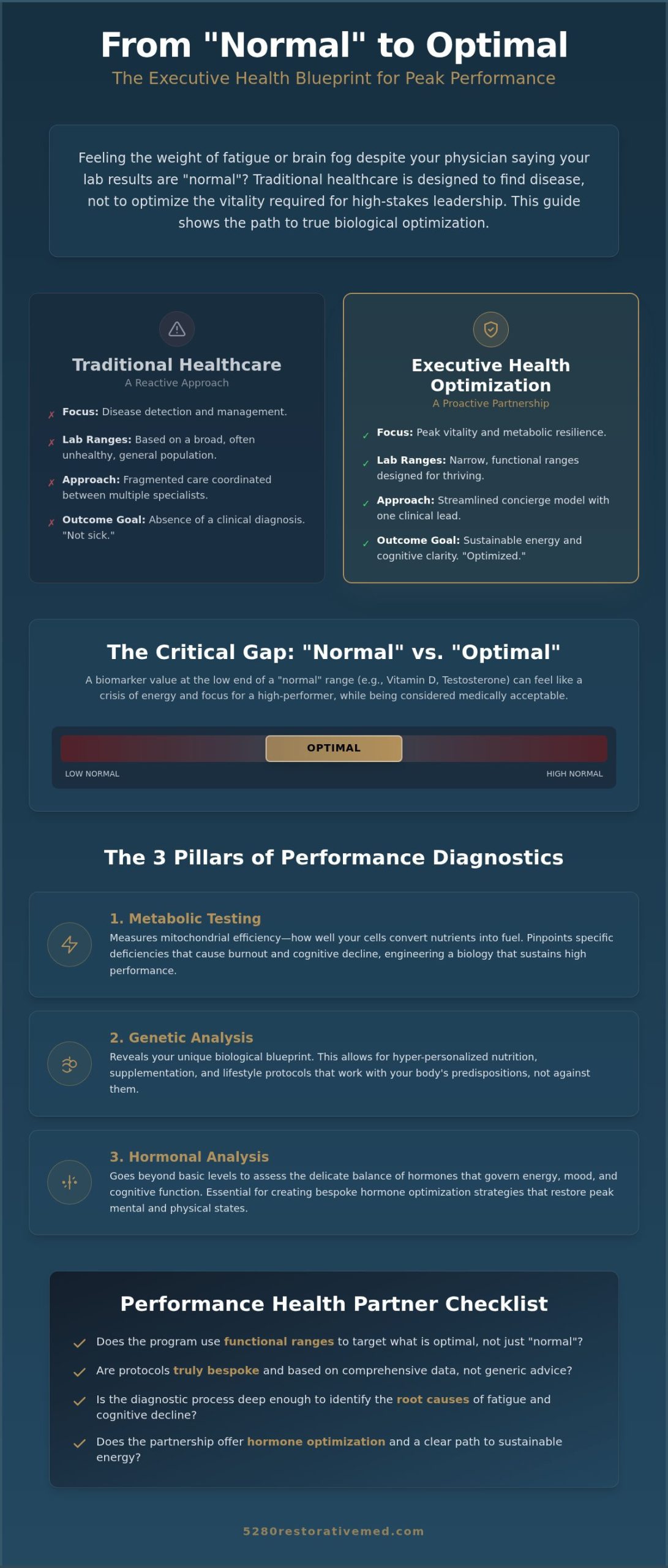
Most people associate these services with a traditional “Executive Physical.” This is a concentrated burst of preventive healthcare designed to catch existing diseases like cancer or heart disease early. While valuable, this model is fundamentally reactive. In contrast, “Executive Health Optimization” uses a functional medicine lens to identify where your biology is underperforming before a disease ever develops. A top-tier program is a diagnostic-led roadmap for cognitive and physical stamina.
The Gap Between ‘Normal’ and ‘Optimal’ Lab Results
Standard medical reference ranges are often based on a bell curve of the general population. This includes individuals who are sedentary, elderly, or chronically ill. If your results fall within these “normal” parameters, your primary care physician might tell you that you’re fine. However, “normal” is rarely the same as “optimal.” For a high-performer, having a Testosterone or Vitamin D level at the bottom of a standard range can feel like a total crisis of focus and energy.
Functional ranges are much narrower. They are designed to define what it looks like to thrive, not just survive. We look at biomarkers like Ferritin for oxygen transport and metabolic markers to ensure your mitochondria are actually producing energy at a high level. Sub-clinical issues, such as minor thyroid dysregulation or systemic inflammation, often manifest as burnout or brain fog long before they trigger a traditional medical diagnosis.
Why Time-Efficiency is the Executive Gold Standard
Time is your most finite resource. Traditional healthcare systems force you to coordinate between multiple specialists, often waiting weeks for appointments and months for a cohesive plan. Executive health programs solve this through a concierge model. You get a single clinical lead who synthesizes complex data from genetic, metabolic, and hormonal tests into one actionable strategy.
This streamlined approach is a significant factor when deciding if are executive health programs worth it. With national virtual consultation availability, you can access elite clinical care without the logistical burden of constant travel. It’s about moving from a fragmented, reactive system to a personalized, proactive journey that treats your health as your most valuable investment.
The Essential Diagnostics of the Best Executive Health Programs
The value of a high-end health evaluation isn’t found in a standard treadmill test or a basic blood panel. To truly understand if are executive health programs worth it, you have to look at the depth of the data being collected. While traditional checkups often face criticisms of executive physicals for being glorified versions of standard care, a performance-focused program utilizes the “Big Three” of advanced diagnostics: Metabolic, Genetic, and Hormonal analysis. This triad allows us to see how your body is actually functioning at a cellular level, rather than just checking if your organs are failing.
Metabolic Testing: Identifying the Fuel for Performance
Your energy isn’t a mystery; it’s a direct result of mitochondrial efficiency. We use metabolic testing to measure how well your cells convert nutrients into the fuel needed for high-stakes decision-making. Through organic acid testing, we can pinpoint specific nutrient deficiencies that lead to cognitive decline or executive burnout. This isn’t about general wellness. It’s about engineering a biology that can sustain long days without the inevitable crash. Developing a proactive plan starts with a comprehensive consultation to assess your current state.
Genetic analysis, specifically nutrigenomics, allows us to stop guessing which supplements or diets might work for your unique makeup. We analyze your markers to tailor nutrition protocols that align with your DNA. We also look at advanced bloodwork, specifically cardiovascular markers like ApoB and Lp(a). These provide a much more accurate picture of heart health than simple cholesterol numbers, allowing for the early detection of silent risks that standard tests often miss. When you consider the cost of a major health event, the question of whether are executive health programs worth it becomes much clearer.
Gut Health and the Brain-Body Connection
The best programs recognize that the gut acts as the second brain. We prioritize comprehensive gut health assessments because systemic inflammation often starts in the microbiome. If your gut lining is compromised, it can trigger an immune response that manifests as brain fog or persistent fatigue. Maintaining high microbiome diversity is essential for mental focus and emotional regulation, two critical traits for any effective leader. By addressing these “software” issues, we ensure your biological foundation is as strong as your professional ambition.
Comparing the Top 3 Models of Executive Healthcare
Selecting the right clinical environment is just as essential as the diagnostics themselves. When you’re evaluating whether are executive health programs worth it, you’ll generally encounter three distinct models: the institutional “big box” hospitals, the tech-heavy longevity clinics, and boutique restorative practices. Each serves a different purpose. The right choice depends on whether you’re seeking to manage a known illness or optimize an already healthy baseline for superior performance.
Institutional Models: Mayo and Cleveland Clinic
Mayo Clinic and Cleveland Clinic represent the gold standard for diagnostic prestige and “all-under-one-roof” capability. These institutions are unparalleled when a leader faces complex, multi-organ diseases that require a massive team of coordinated specialists. They’re built to find disease with incredible accuracy. However, for an executive who is technically “healthy” but feels sub-optimal, these programs can sometimes feel like an assembly line. They often rely on standardized protocols that prioritize finding pathology over enhancing daily function.
Tech-longevity programs, on the other hand, focus heavily on cutting-edge hardware like whole-body MRIs and AI-driven diagnostics. While these offer impressive data points, they can be prohibitively expensive. They often provide the “what” but struggle with the “how,” sometimes lacking the deep clinical follow-through required to implement sustainable lifestyle changes. They’re excellent for data enthusiasts but can leave a gap in the actual restoration of vitality.
Boutique Restorative Medicine: The Personalized Performance Partner
A boutique functional medicine approach acts as the high-tech, high-touch middle path. This model treats health as a proactive journey rather than a reactive necessity. It focuses entirely on bio-individuality. We recognize that two CEOs facing identical stress levels may have entirely different metabolic requirements or genetic predispositions. This isn’t about a one-day checkup; it’s about an iterative partnership.
The patient-clinician relationship is the cornerstone of this model. By moving away from standardized care, we can create bespoke protocols that address the root causes of fatigue and cognitive decline. This ensures your data actually translates into a measurable ROI on your energy and focus. For the high-performer who needs to exceed baseline performance, this personalized level of care is often the deciding factor when asking if are executive health programs worth it for their long-term career longevity.
How to Evaluate and Choose Your Performance Health Partner
Your choice of a clinical partner determines whether you receive a static report or a dynamic roadmap for your career longevity. To decide if are executive health programs worth it, you must look past the glossy brochures and evaluate the underlying clinical philosophy. A program is only as effective as the clinician’s ability to translate complex data into a sustainable, high-performance lifestyle. We recommend using a specific set of criteria to ensure your investment yields a measurable return on your energy and focus.
When interviewing potential providers, look for these non-negotiable elements:
- Does the program prioritize hormone optimization using narrow functional ranges rather than broad, standard population averages?
- Are nutrition and supplement protocols built on your unique genetic and metabolic markers, or are they generic templates?
- What is the specific cadence for follow-up care and laboratory re-testing to ensure your protocol remains effective as your stress levels fluctuate?
- Does the clinical lead demonstrate a deep understanding of executive-specific physiological stressors, such as circadian disruption from travel and chronic cortisol elevation?
Assessing Diagnostic Depth vs. Diagnostic Breadth
Many programs attempt to justify their cost by the sheer volume of tests they run. However, diagnostic breadth often masks a lack of diagnostic depth. For a healthy high-performer, excessive imaging like full-body CT scans can lead to unnecessary radiation and “incidental findings” that cause psychological stress without adding clinical value. Instead, look for “functional” testing. This measures how your body operates in real-time, such as your mitochondrial efficiency and systemic inflammatory markers. It’s about finding the right tests for performance, not just the most tests.
The Role of Ongoing Support and Iterative Protocols
The “one-and-done” model is perhaps the greatest weakness of traditional institutional programs. A three-day diagnostic visit is merely the starting line, not the finish line. The most effective programs utilize iterative protocols, which means your plan is adjusted based on real-world feedback and subsequent lab results. This dynamic approach ensures that your health strategy evolves alongside your professional demands. True optimization requires long-term habit integration and executive-level nutritional counseling to ensure your biology can keep pace with your ambition. If you’re ready to move beyond standardized care, consider starting with a Functional Medicine Consultation to map out your path to superior function.
Ultimately, determining if are executive health programs worth it comes down to the level of personalization you receive. You don’t need a physician who simply tells you that you aren’t sick. You need a partner who is dedicated to helping you exceed your baseline performance and reach a superior state of physical and mental function.
The 5280 Restorative Medicine Approach to Executive Health
At 5280 Restorative Medicine, we believe that health isn’t merely the absence of illness; it’s a proactive journey toward superior function. When asking are executive health programs worth it, the answer lies in the measurable shift from “getting by” to “thriving.” Our approach moves beyond the standard medical model by integrating metabolic testing, genetic analysis, and advanced bloodwork into a single, cohesive strategy. This isn’t a one-day event. It’s a bespoke clinical partnership designed to ensure your biology can keep pace with your professional ambition and personal goals.
Our protocols are built on the understanding that every executive has a unique biological blueprint. We don’t use generic templates. Instead, we use your data to engineer protocols that prioritize cognitive longevity and physical stamina. This comprehensive view ensures that are executive health programs worth it by providing a clear ROI on your most valuable asset: your health. We focus on the “metabolic software” that traditional systems often overlook, ensuring your body is optimized for the high-stakes environment you navigate daily.
Bespoke Protocols for Sustainable Energy
Dr. Marci Catallo-Madruga specializes in identifying the root causes of stalling performance. Often, what feels like “aging” is actually a decline in mitochondrial optimization or a loss of metabolic resilience. By pinpointing these cellular inefficiencies, we can create a roadmap to restore your energy at its source. Your success in the boardroom shouldn’t come at the expense of your presence at home. Our real-world applications focus on keeping you sharp during high-pressure negotiations while ensuring you have the vitality to remain engaged with your family at the end of the day.
Virtual Access for National Performance
We recognize that the nation’s top leaders don’t always have the luxury of frequent travel for clinical visits. To solve this, 5280 Restorative Medicine utilizes a national virtual consultation model. This allows high-performers across the United States to access elite functional medicine from the comfort of their home or office. Our process is streamlined and efficient:
- Remote review of advanced diagnostic data and biomarkers.
- Ongoing clinical support through secure, virtual platforms.
- Iterative protocol adjustments based on real-time feedback and re-testing.
- Bespoke supplement and nutrition plans delivered directly to you.
This high-touch, virtual approach removes the logistical barriers to elite healthcare. It provides the consistency and accountability required to achieve lasting results without disrupting your demanding schedule. If you’re ready to stop settling for “normal” and start pursuing your peak biological potential, schedule your executive health consultation today and begin your journey toward restorative health.
Secure Your Biological Edge for the Years Ahead
Your leadership capacity depends on a biological foundation that standard healthcare isn’t equipped to measure. When you ask if are executive health programs worth it, the answer is found in the transition from catching disease to optimizing daily function. By utilizing specialized metabolic and genetic diagnostic protocols, you move beyond “normal” lab results to achieve a superior state of physical and mental clarity. This expert-led functional medicine approach ensures that your health remains a proactive journey rather than a reactive necessity.
We provide comprehensive, personalized roadmaps for energy and focus that adapt to your evolving professional demands. You deserve a clinical partner who’s as invested in your long-term stamina as you are in your career success. High-performance living is achievable at any stage of life when you have the right data and a dedicated team by your side. It’s time to stop settling for the baseline and start engineering a biology that supports your highest ambitions.
Optimize Your Performance: Schedule Your Executive Health Consultation
Frequently Asked Questions
What is the difference between an executive physical and an executive health program?
An executive physical is typically a one-day diagnostic event focused on detecting existing disease through standard screenings. In contrast, a comprehensive executive health program is an ongoing optimization strategy that uses functional medicine to enhance daily performance. While a physical tells you if you’re sick, a program provides the tools and protocols to exceed your current baseline of energy and cognitive focus.
How much do top-tier executive health programs typically cost?
Industry data for 2026 shows that costs for these specialized evaluations vary based on the depth of diagnostics. General programs often range from $2,000 to $15,000 annually. Premium tiers that include advanced genetic testing, whole-body imaging, and continuous concierge support can reach $25,000 or more. These investments reflect the complexity of the data analyzed and the level of personalized clinical oversight provided.
Are executive health programs covered by standard health insurance?
Standard health insurance rarely covers the full cost of an executive health program. Most providers don’t bill insurance directly for the program premium, as these services focus on performance optimization rather than acute medical necessity. However, certain individual clinical tests or specialist consultations within the program may be claimable depending on your specific policy and out-of-network benefits. You should verify your coverage details with your provider.
How long does a comprehensive executive health assessment take?
A comprehensive initial assessment typically takes one to two days to complete. This condensed timeline allows for a wide range of advanced diagnostics, bloodwork, and specialist consultations that would otherwise take months to coordinate. The goal is to provide a deep dive into your biology with minimal disruption to your professional responsibilities. This is followed by a detailed review of the findings to build your roadmap.
What are the most important biomarkers an executive should have tested?
High-performers should look beyond standard cholesterol and glucose levels. Essential biomarkers include ApoB for cardiovascular risk, Ferritin for oxygen transport, and Vitamin D and Testosterone for hormonal health. When determining if are executive health programs worth it, ensure the testing includes advanced metabolic markers like organic acids to evaluate mitochondrial function and systemic inflammation. These provide the data needed for true biological optimization.
Can I participate in an executive health program virtually?
Yes, many boutique practices now offer national virtual consultation models for busy leaders. You can complete your diagnostic bloodwork and specialized testing at local facilities, while the clinical review and protocol development happen via secure telehealth platforms. This ensures you receive elite functional medicine expertise and ongoing support regardless of your geographic location. It’s a highly efficient way to manage your health without frequent travel.
How often should a high-performer undergo a full health optimization audit?
Most high-performers benefit from a full health optimization audit once per year. This annual deep dive allows your clinical team to adjust your protocols based on changes in your stress levels, travel demands, and biological aging. Smaller quarterly check-ins are often used to monitor specific biomarkers and ensure your energy remains at peak levels. Consistency is the key to maintaining long-term cognitive and physical stamina.
Are executive health programs tax-deductible for business owners?
Business owners often find that portions of these programs are tax-deductible as a business expense, particularly when positioned as a “key-person” health benefit. However, tax laws regarding executive health are complex and vary by jurisdiction. You should consult with a qualified tax professional to determine how these services qualify under your specific corporate structure. This can significantly impact the overall ROI of your health investment.