
What if the labs that cleared you of illness are actually the reason you’re still feeling exhausted? You’ve likely sat in a sterile office, described your brain fog and chronic fatigue, only to be told your blood work is “perfectly normal.” It leaves you wondering: are functional medicine lab tests scientifically valid, or is there a gap in how we define health? In 2026, the intersection of advanced metabolic testing and the FDA’s mandatory Quality Management System Regulation is finally bridging that gap.
We understand the frustration of feeling like a passenger in your own body. You deserve an objective framework that validates your experience and offers a clear path to peak performance. This clinical review breaks down the scientific rigor behind functional diagnostics. You’ll discover how advanced biomarkers identify subtle physiological drift long before traditional tests trigger a red flag. We’ll also examine the 2026 LDT phaseout and the latest CPT code revisions to provide a reliable framework for evaluating lab quality so you can invest in your health with absolute confidence.
Key Takeaways
- Discover how modern regulatory standards like the 2026 FDA updates ensure that functional medicine lab tests are scientifically valid by distinguishing between simple disease screening and comprehensive physiological assessment.
- Understand the statistical difference between “normal” and “optimal” reference ranges to identify health risks long before they manifest as chronic illness.
- Explore the role of peer-reviewed biomarkers, such as metabolomics and high-sensitivity C-reactive protein, in uncovering the root causes of persistent brain fog and fatigue.
- Gain a practical framework for evaluating laboratory quality, including the critical importance of CLIA and CAP certifications in modern clinical diagnostics.
- Learn how advanced metabolic testing and genetic analysis create a bespoke roadmap for moving beyond the absence of disease toward sustainable peak performance.
Understanding the Scientific Validity of Functional Medicine Labs
When patients ask, “Are functional medicine lab tests scientifically valid?” they are often seeking reassurance that their investment will yield reliable, actionable data. To answer this properly, we must distinguish between analytical validity and clinical utility. Analytical validity refers to the laboratory’s ability to accurately and consistently measure a specific biomarker, such as a hormone level or a metabolic byproduct. In 2026, the scientific community recognizes that the vast majority of functional labs meet or exceed these rigorous standards. However, the true value for a high-performer lies in clinical utility: how that data translates into a personalized protocol that actually improves your cognitive and physical output.
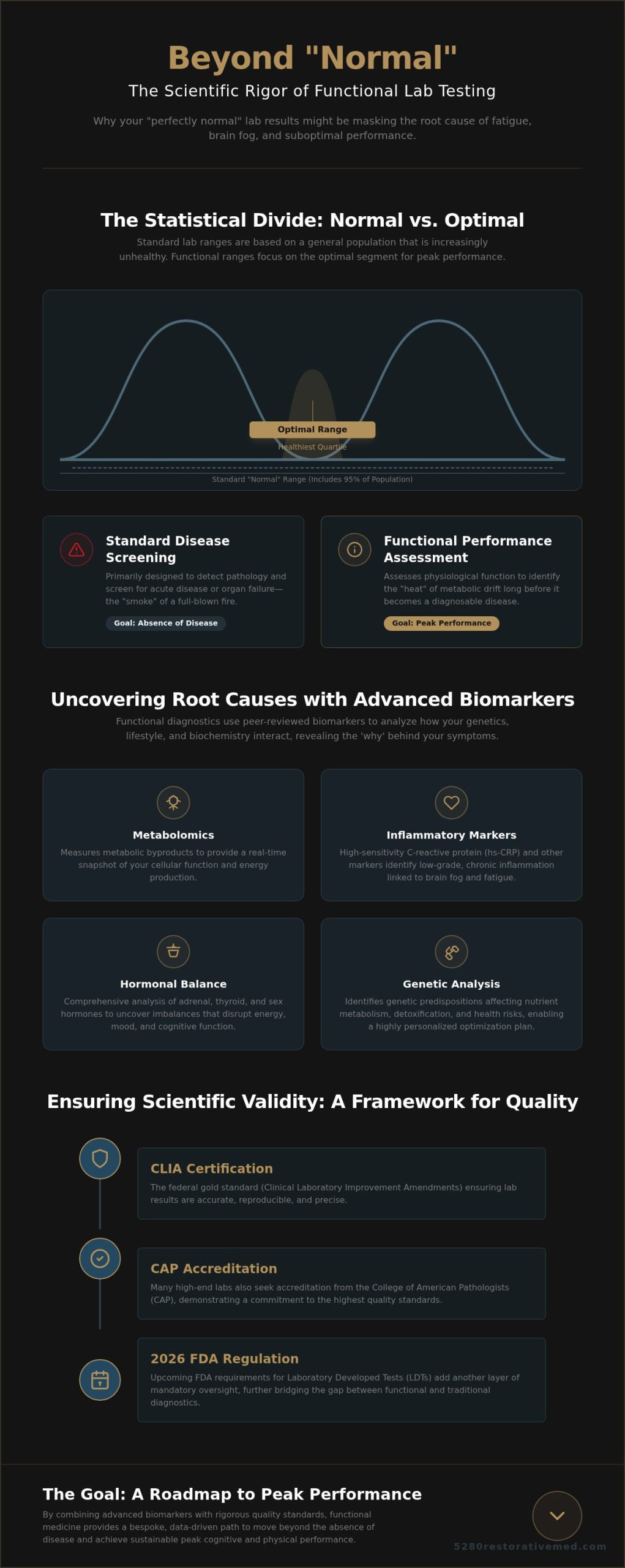
Standard hospital labs are primarily designed to screen for pathology. They look for the “smoke” of a full-blown fire, such as organ failure or acute infection. Functional diagnostics operate on a different frequency. These tests assess physiological function, identifying the “heat” of metabolic drift long before it becomes a diagnosable disease. While critics sometimes point out that these tests aren’t standardized across every local hospital, this lack of uniformity isn’t a lack of science. It’s a reflection of systems biology, a sophisticated field that views the body as an integrated web rather than a collection of isolated parts. This Scientific view of functional medicine highlights a necessary shift toward proactive, data-driven health management that exceeds the baseline of “not sick.”
The Definition of Functional Diagnostics
Functional diagnostics are not a departure from traditional biochemistry; they’re an evolution of it. These tests use the same fundamental principles of organic chemistry and molecular biology found in any clinical setting. The difference is the focus on the “why” behind your symptoms. Instead of merely noting that a marker is within a broad range, we examine how that marker interacts with your genetics and lifestyle. We view functional health and wellness as a dynamic journey where data provides the roadmap for optimization rather than just a snapshot of illness. It’s about finding the root cause of that 3:00 PM energy crash or the brain fog that’s impacting your professional performance.
Regulatory Oversight: CLIA and CAP Standards
CLIA certification serves as the federal gold standard for laboratory accuracy, ensuring that the results you receive are reproducible and precise. Most high-end functional laboratories operate within the same high-complexity facilities used by major academic hospitals and research institutions. Rigorous internal validation protocols are mandatory, especially with the 2026 FDA requirements for Laboratory Developed Tests (LDTs) now in full effect. This oversight means your results aren’t just “suggestions.” They are clinically sound data points verified by the same rigorous standards as any other medical procedure, providing a secure foundation for your restorative journey.
Standard vs. Functional Reference Ranges: The Statistical Divide
Standard reference ranges are calculated using a Gaussian distribution, often called a bell curve, of the population tested by a specific laboratory. By definition, “normal” includes the middle 95% of that group. While this is an effective tool for identifying acute disease or organ failure, it creates a significant hurdle for those pursuing peak performance. If you’re comparing your health to a general population that is increasingly sedentary and metabolically compromised, being “normal” is a dangerously low bar. To understand why so many high-performers ask, “are functional medicine lab tests scientifically valid?” we have to look at how these ranges are constructed. Functional medicine doesn’t ignore the bell curve; it simply narrows the focus to the healthiest quartile of that curve to identify risk before it becomes a permanent diagnosis.
The Bell Curve Trap in Traditional Medicine
Traditional lab ranges are constantly shifting. As the general population becomes less healthy, the “normal” range for markers like fasting glucose or liver enzymes often expands to include more individuals. You might feel symptomatic, struggling with persistent brain fog or weight gain, yet your doctor tells you everything looks fine because you haven’t crossed the threshold into pathology. This is the bell curve trap. To achieve true vitality, we often look toward hormone optimization to move markers out of the “barely passing” category and into a range that supports active living. Relying on an average derived from a sick population is a reactive strategy, whereas functional ranges provide a proactive framework for longevity.
Optimal Ranges for High-Performers
Functional medicine utilizes what we call the “Green Zone.” This is a narrower, data-driven range derived from individuals who exhibit high levels of physiological resilience and metabolic efficiency. By shifting the mathematical focus from disease detection to risk mitigation, we can spot subtle trends. For instance, a thyroid marker that is technically “normal” but trending toward the edge of the range can explain why an executive is losing their competitive edge. This methodology is rooted in evidence-based functional medicine, which prioritizes the individual’s unique biochemical needs over a generic statistical mean. For those who require a narrow margin for error in their professional and personal lives, this precision is non-negotiable. If you’re ready to see where you sit on the spectrum of health, our Functional Medicine Consultation offers a deep dive into your unique data.
The Role of Peer-Reviewed Biomarkers in Advanced Testing
Scientific validity is grounded in the peer-reviewed evidence supporting specific biomarkers. Leading academic institutions have increasingly studied the clinical utility of functional medicine, finding that this model correlates with significant improvements in quality of life. One way to determine whether functional medicine lab tests are scientifically valid is to examine the rigorous data behind markers like high-sensitivity C-Reactive Protein (hs-CRP). Functional medicine uses this gold-standard marker of systemic inflammation to assess cardiovascular and neurological risk. We also utilize metabolomics, the science of measuring small-molecule metabolites that serve as real-time indicators of your biological state. Genetic analysis of SNPs (Single Nucleotide Polymorphisms) further refines this approach, allowing us to tailor protocols to your unique DNA rather than relying on a one-size-fits-all model.
Validated Markers of Metabolic Resilience
Standard panels often overlook fasting insulin, yet it’s one of the most predictive markers for metabolic drift. We use the HOMA-IR (Homeostatic Model Assessment for Insulin Resistance) to identify early shifts in blood sugar regulation before they manifest as disease. This data is essential for engineering metabolic resilience and preventing the energy crashes that derail executive productivity. We also prioritize advanced lipid fractionation. This test doesn’t just count cholesterol particles. It analyzes their size and density to provide a precise cardiovascular risk profile that standard tests frequently miss, ensuring your preventative strategy is based on complete data.
Gut Microbiome and Immune Reactivity Science
The shift toward precision medicine has brought DNA-based stool analysis (qPCR) into the clinical spotlight. Traditional cultures often fail to detect anaerobic bacteria or subtle dysbiosis that impacts your cognitive function and immune health. By measuring markers like Zonulin, we can objectively assess intestinal permeability and its link to systemic inflammation. For patients struggling with unexplained sensitivities, mast cell activation syndrome testing provides a validated pathway to identify immune reactivity. These tests use specific, peer-reviewed markers to explain why you feel reactive to your environment. This turns vague symptoms into a clear, scientific plan for recovery and long-term vitality.
How to Evaluate the Clinical Utility of Your Lab Results
Determining if are functional medicine lab tests scientifically valid requires a systematic approach to evaluating the laboratory’s output. It isn’t enough for a test to be innovative; it must be clinically useful. You must assess specific criteria to determine if are functional medicine lab tests scientifically valid for your specific health goals. Use this four-step framework to evaluate the value of your diagnostics:
- Verify Laboratory Credentials: Confirm the facility holds CLIA (Clinical Laboratory Improvement Amendments) and CAP (College of American Pathologists) certifications. These credentials guarantee that the lab adheres to stringent federal standards for quality control and personnel training.
- Demand Symptom Integration: A lab result without a clinical narrative is just a number. Your clinician should explain how your results correlate with your brain fog, fatigue, or performance plateaus. If the labs don’t match the patient’s experience, the interpretation is incomplete.
- Prioritize Actionable Data: Valid testing must lead to a specific, measurable change in your protocol. We focus on biomarkers that influence your supplement protocols, dietary choices, or hormone optimization. If a marker is merely “interesting” but doesn’t alter your treatment, its clinical utility is limited.
- Confirm Reproducibility: Scientific validity relies on consistency. A reliable test should yield the same result if repeated under the same physiological conditions. This ensures that the shifts we see in your follow-up labs result from your protocol rather than laboratory error.
Context is King: Interpretation Matters
A valid test is merely a tool; the clinician is the architect. Automated lab interpretations or “Dr. Google” searches often lead to unnecessary anxiety or misguided supplement use because they lack the nuance of your personal health history. Dr. Marci Catallo-Madruga integrates complex lab data into bespoke protocols, ensuring every marker is viewed through the lens of your specific goals. This personalized narrative transforms raw data into a strategic plan for renewal, moving you beyond the limitations of standardized care.
The Cost-Benefit Analysis of Advanced Testing
High-performers view health as an asset to be managed rather than an expense to be minimized. While advanced diagnostics require an initial investment, the ROI is found in identifying root causes before they escalate into chronic illness. This is a cornerstone of our executive health programs, where we move beyond standard physicals to achieve bio-optimization. By fixing metabolic “leaks” early, you protect your most valuable resource: your ability to perform at your peak. If you’re ready for a precise evaluation of your health, schedule your functional medicine consultation today.
Engineering Peak Performance through Validated Diagnostics
Achieving a superior state of physical function requires more than just the absence of illness. It demands a precise understanding of your internal chemistry. Traditional diagnostics often miss the subtle performance leaks that drain your focus and stamina. By utilizing advanced bloodwork, we can identify these inefficiencies before they solidify into chronic fatigue or metabolic dysfunction. When we ask, are functional medicine lab tests scientifically valid, we’re really asking if this data provides a reliable foundation for human optimization. Standard medicine often waits for a total system crash; we look for the stall before it happens.
Metabolic testing serves as your physiological GPS, providing a definitive roadmap for sustainable energy. Instead of guessing which supplements might help, we use objective markers to see exactly where your cellular machinery is struggling. This evidence-based approach ensures that every intervention is purposeful. We don’t just want you to feel “fine.” We want you to exceed your previous baseline performance. The question of whether are functional medicine lab tests scientifically valid is resolved when we see these biomarkers move in response to targeted, data-driven protocols.
Beyond the Basics: The 5280 Restorative Medicine Approach
At 5280 Restorative Medicine, our commitment to accuracy starts with our choice of partners. We use only high-complexity, validated laboratories that meet the highest regulatory standards. Our methodology combines metabolic, genetic, and hormonal data to create a 360-degree view of your biology. This comprehensive perspective allows us to spot connections that a single-marker test would miss. We invite you to reclaim your vitality through precision diagnostics that go beyond the standardized, impersonal protocols of traditional clinics. Science-backed data is the foundation of everything we do, ensuring your path to renewal is both safe and effective.
Your Path to Clinical Clarity
A comprehensive diagnostic review is the first step toward your personal renewal. During this process, we translate complex biochemical data into a simple, actionable lifestyle plan tailored to your unique needs. You won’t leave with a stack of confusing charts and no direction. You’ll leave with a clear understanding of your body and a strategic path forward. Our goal is to provide the clinical clarity you need to take control of your health journey and achieve measurable results. To begin your transformation, schedule a consultation to review your advanced diagnostics and discover what peak performance feels like at any stage of life.
Take Command of Your Biological Potential
The transition from feeling “not sick” to achieving peak performance begins with high-quality data. We’ve explored how the distinction between pathology and physiology defines modern diagnostics. By moving beyond the bell curve of “normal” and focusing on optimal reference ranges, you can address metabolic drift before it impacts your career or quality of life. Many high-performers still ask, are functional medicine lab tests scientifically valid, and the answer lies in the rigorous CLIA-certified standards and peer-reviewed biomarkers we utilize every day.
Under the clinical oversight of Dr. Marci Catallo-Madruga, our practice provides the root-cause analysis necessary for true renewal. Our specialized protocols for executives ensure that your health is treated as a strategic asset rather than a reactive necessity. It’s time to stop settling for standard results and start engineering a superior state of physical function. You deserve the clinical clarity that only precision diagnostics can provide.
Optimize your performance with a data-driven health assessment and discover the empowerment that comes with a personalized health roadmap. Your most vibrant years are still ahead of you.
Frequently Asked Questions
Is functional medicine testing FDA approved?
Most functional diagnostics are classified as Laboratory Developed Tests (LDTs). While the FDA doesn’t approve every individual test like a drug, it regulates the laboratories that perform them under CLIA standards. As of May 6, 2026, the FDA began a phased enforcement of new requirements for LDTs to ensure greater oversight, registration, and labeling accuracy across the industry.
Why doesn’t my primary care doctor run these functional tests?
Standard medical practice is built on a reactive model designed to identify acute disease rather than optimize health. Most primary care physicians rely on insurance-based protocols that only cover testing for specific pathologies. Functional diagnostics require specialized training and significant time to interpret, which often exceeds the constraints of a traditional 15-minute office visit.
How do I know if a specific functional lab is legitimate?
You should always verify that the facility holds CLIA and CAP certifications. These federal and professional credentials ensure the lab meets the highest standards for accuracy, quality control, and personnel training. Legitimate labs also provide transparent data regarding their validation processes, helping you determine if are functional medicine lab tests scientifically valid for your specific health goals.
Can functional lab tests accurately diagnose gut issues like SIBO or leaky gut?
DNA-based stool analysis and breath testing are highly accurate when performed by high-complexity laboratories. These tests measure specific biomarkers, such as Zonulin for intestinal permeability or hydrogen and methane gases for bacterial overgrowth. When integrated with your clinical symptoms, these validated markers provide a clear, scientific explanation for chronic digestive issues that standard imaging often misses.
Are the results of genetic health testing scientifically reliable for lifestyle planning?
Genetic analysis of Single Nucleotide Polymorphisms (SNPs) is a reliable way to identify your inherited biological tendencies. While your genetic code remains constant, these tests provide a blueprint for how your body processes nutrients and handles inflammation. This data allows for bespoke lifestyle planning, ensuring your supplement and nutritional protocols align with your unique DNA rather than a generic recommendation.
What happens if my functional labs are normal but I still feel tired?
This discrepancy often occurs because your results fall within “normal” ranges that are statistically too broad. Functional medicine identifies “sub-clinical” drift, where markers are technically normal but far from optimal. If you’re still symptomatic, it’s a sign that we need to look closer at the intersections of your metabolic and hormonal data to find the root cause.
How often should I repeat functional lab testing for performance monitoring?
We typically recommend comprehensive re-testing every six to twelve months for high-performers. This cadence allows us to monitor your metabolic resilience and adjust your optimization protocol based on real-time data. Regular monitoring ensures that your path to peak performance remains precise, allowing for small adjustments before minor physiological shifts become major performance leaks.