
What if the “knockout” pill you rely on tonight is the primary reason you’ll feel cognitively sluggish tomorrow? For many high-performers, the quest for natural alternatives to sleep medication begins when the side effects of sedatives become harder to manage than the insomnia itself. Research indicates that 1 in 5 American adults now use some form of sleep aid, yet many find themselves trapped in a cycle of daytime grogginess and 3 AM racing thoughts. It’s exhausting to rely on a pharmaceutical crutch that often leaves you feeling less than your best during the hours that matter most.
You deserve to wake up feeling genuinely restored, not just “awake.” This guide will show you how to transition from pharmaceutical dependency to a state of restorative, biology-backed sleep by addressing the metabolic and hormonal root causes of your restlessness. We will examine the science of nervous system regulation and how bespoke, non-standardized protocols can help you achieve peak physical function without the fear of long-term cognitive decline. By understanding the “why” behind your sleeplessness, you can finally move beyond the pill and return to a superior state of performance.
Key Takeaways
- Learn why pharmaceutical sedatives often bypass the critical REM and deep sleep stages required for high-level cognitive performance.
- Identify the metabolic root causes of sleep fragmentation, such as nocturnal hypoglycemia, that lead to frustrating middle-of-the-night wakefulness.
- Discover how to utilize clinical-grade natural alternatives to sleep medication to achieve a calm nervous system without the risk of a “hangover effect.”
- Protect your biological clock by integrating circadian bio-optimization techniques, including red light therapy and digital detox protocols.
- Understand the benefits of a functional medicine approach that treats sleep as a proactive journey toward exceeding your baseline physical and mental states.
The Problem with Pharmaceutical “Knockout”: Why Meds Fail the Brain
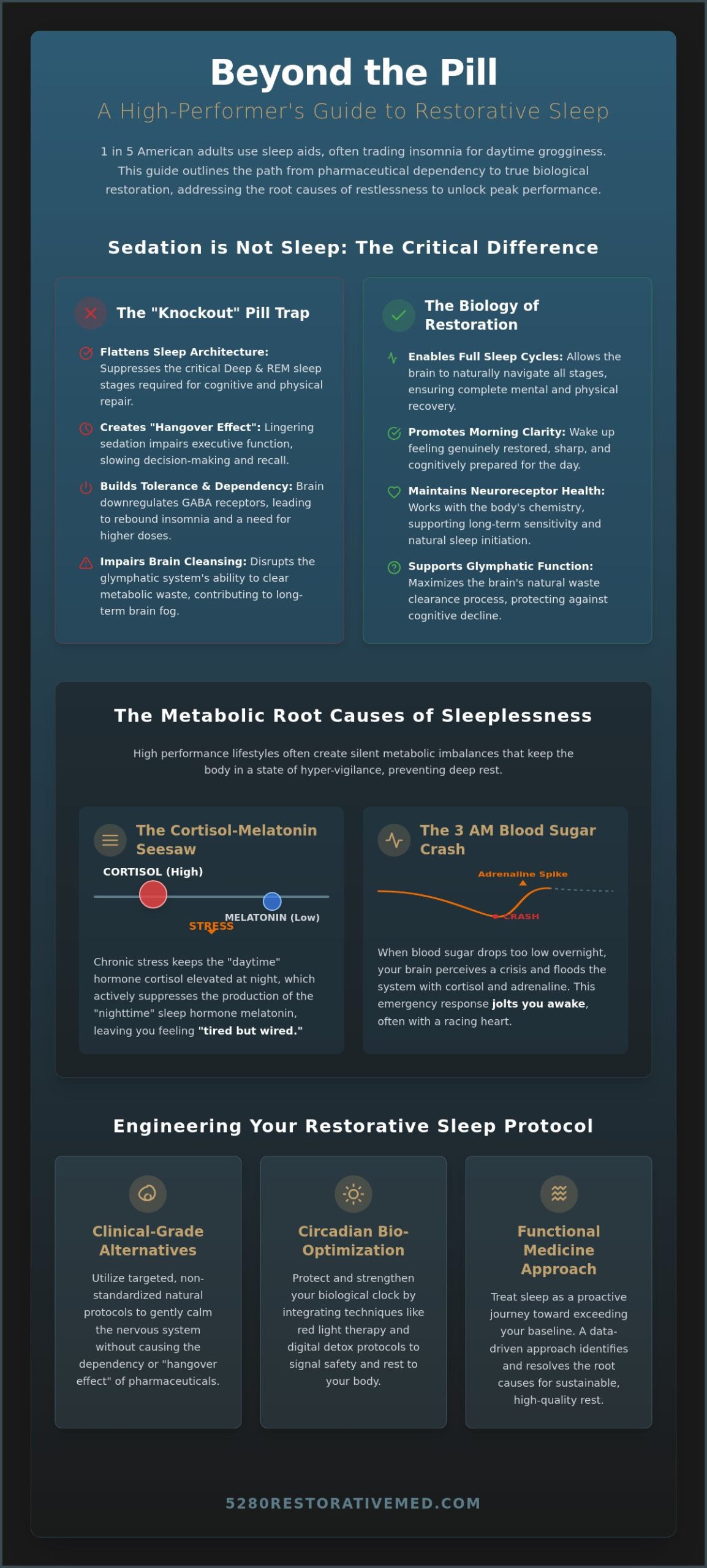
Many high-performers view sleep as a binary state: you’re either awake and productive or unconscious and recovering. This perspective often leads to the use of sedative-hypnotics to force a state of “rest” when the mind won’t quiet down. However, there’s a profound difference between being sedated and actually sleeping. While pharmaceuticals can provide a chemical “knockout,” they often fail to deliver the restorative benefits of natural sleep cycles. This discrepancy is why so many individuals are searching for natural alternatives to sleep medication that support rather than override their biology.
Sleep architecture refers to the complex cyclical pattern of light, deep, and REM sleep stages that the brain must navigate to achieve full restoration. Pharmaceuticals often flatten this architecture, specifically suppressing the deep NREM (Non-Rapid Eye Movement) sleep required for physical repair and the REM sleep essential for emotional processing and memory consolidation. When you bypass these stages, you aren’t truly resting; you’re simply unconscious.
The “hangover effect” is a common consequence for those relying on medications with a long half-life. These substances remain in your system long after your alarm goes off, impairing the prefrontal cortex and slowing executive function. For a leader or athlete, even a slight reduction in cognitive speed can be the difference between a breakthrough and a blunder. Over time, the brain also develops a tolerance, requiring higher doses to achieve the same sedative effect as neuroreceptors become less sensitive to the drug.
The GABA Receptor Trap
Conventional sleep aids, specifically benzodiazepines and “Z-drugs,” work by binding to GABA receptors to inhibit neural activity. While effective in the short term, the brain eventually compensates by downregulating these receptors, making it nearly impossible to fall asleep naturally without the drug. This leads to rebound insomnia, a frustrating state where sleep quality becomes worse than before you started the medication. Choosing natural alternatives to sleep medication involves working with these receptors to gently encourage relaxation without causing permanent desensitization.
The Cognitive Cost of Long-Term Sedative Use
Chronic use of sedatives has been linked to significant memory impairment and long-term brain fog. During natural sleep, the glymphatic system acts as a waste-clearance mechanism, “washing” the brain of metabolic debris like beta-amyloid. Sedatives can disrupt this vital process, potentially contributing to cognitive decline over several years. High-performers simply cannot afford this “sedative tax” on their mental clarity, which often manifests as:
- Reduced processing speed during high-stakes decision-making
- Decreased verbal fluency and recall
- Diminished emotional resilience and increased irritability
Prioritizing foundational sleep hygiene and metabolic health is a more sustainable path to peak performance. By moving away from heavy sedatives, you allow your brain to perform its essential nightly maintenance, ensuring you remain at the forefront of your field.
Identifying the Metabolic Root Causes of Sleep Fragmentation
High-performers often attribute their sleeplessness to a high-pressure career or an “overactive” brain. While these are factors, the underlying cause is frequently a metabolic imbalance that keeps the body in a state of hyper-vigilance. When you seek natural alternatives to sleep medication, the goal is to shift from temporary sedation to resolving these biological disruptions. True rest occurs only when your internal chemistry aligns with your circadian rhythm.
The cortisol-melatonin seesaw is the most common victim of executive stress. In a healthy system, cortisol peaks in the morning to provide energy and drops to its lowest point at night, allowing melatonin to rise. Chronic stress flips this biological clock. If your cortisol remains elevated at 10 PM, it actively suppresses melatonin production, leaving you “tired but wired.” This hormonal mismatch makes it nearly impossible to enter the deep stages of sleep without chemical intervention.
Another silent disruptor is nocturnal hypoglycemia. If your blood sugar drops too low during the night, your brain perceives a crisis. It triggers a surge of cortisol and adrenaline to signal the liver to release glucose. This metabolic emergency usually happens around 2 AM or 3 AM, causing a sudden, alert wakeup accompanied by racing thoughts. Research published in the Journal of Clinical Endocrinology & Metabolism indicates that insulin resistance is significantly associated with sleep fragmentation and a higher risk of sleep apnea, creating a metabolic loop that prevents deep rest. Addressing these triggers through functional health and wellness protocols allows for a more sustainable recovery than any sedative can offer.
The Executive Stress Response and 3 AM Wake-ups
HPA-axis dysfunction occurs when your body loses the ability to regulate the stress response effectively. At this stage, your physiology treats a missed deadline like a predator at the door. Metabolic testing often reveals that these “anxious” wake-ups are driven by specific nutrient deficiencies, such as magnesium or B6, which are depleted by high-stress lifestyles. Additionally, for some, mast cell activation syndrome can cause nighttime histamine spikes, which act as a powerful wakefulness signal to the brain. Understanding your unique biological markers is the first step toward a personalized sleep recovery plan.
Hormonal Imbalance: The Silent Sleep Stealer
Hormones like progesterone and testosterone play critical roles in neuro-calming. Progesterone, in particular, acts as the “Valium of the brain” by stimulating GABA receptors. As levels decline during perimenopause or andropause, insomnia is often the first symptom to appear. Standard sleep hygiene, while useful, often fails to address these shifts. You can find more evidence-based tips from Harvard on sleep hygiene, but clinical interventions like BHRT are often necessary to restore the hormonal foundation required for uninterrupted rest.
Clinical-Grade Natural Alternatives to Sleep Medication
For those operating at the highest levels, generic advice like drinking warm milk or using essential oils is rarely sufficient to overcome deep-seated insomnia. Integrating natural alternatives to sleep medication requires a focus on bioavailability and specific physiological targets rather than just “knocking out” the central nervous system. Most off-the-shelf supplements fail because they use low-quality forms of nutrients, such as magnesium oxide, which has an absorption rate as low as 4%. To achieve measurable results, you must prioritize clinical-grade compounds that cross the blood-brain barrier and address your specific metabolic needs.
Magnesium is frequently cited as the “Master Relaxer,” but the form you choose determines its efficacy. Magnesium Glycinate is excellent for systemic muscle relaxation and calming the peripheral nervous system. However, Magnesium Threonate is the only form proven to effectively penetrate the brain, enhancing synaptic plasticity and calming an overactive mind. When you combine these with Phosphatidylserine, a phospholipid that blunts evening cortisol spikes, you create a biological environment conducive to rest. This targeted approach is a cornerstone of professional Supplement Protocols designed to restore rather than replace your natural sleep-wake cycle.
L-Theanine and Apigenin offer a sophisticated way to engineer a calm mind without the risk of daytime sedation. L-Theanine, an amino acid found in green tea, promotes alpha-wave brain activity, which is associated with a state of “relaxed alertness.” Apigenin, a bioflavonoid, binds to specific GABA receptors in the brain to reduce anxiety. Combining L-Theanine with Magnesium creates a synergistic effect that lowers the threshold for sleep onset while improving the overall density of deep sleep stages. You can explore a variety of Natural sleep aids through resources like Johns Hopkins Medicine, though high-performers often require more concentrated, clinical-grade doses.
The Melatonin Myth: Why Less is Often More
Many people mistakenly treat melatonin as a sedative, taking doses as high as 5mg or 10mg. A 2023 JAMA study found that 22 out of 25 sampled melatonin products contained significantly different amounts than what was listed on the label, with some containing undeclared ingredients. High doses can suppress your body’s own production and lead to vivid nightmares or a “melatonin hangover.” A more effective strategy involves micro-dosing (0.3mg to 1mg) for circadian resetting or using precursors like 5-HTP and Tryptophan to support your body’s natural serotonin-to-melatonin conversion.
Botanical Anxiolytics for the Racing Mind
When your mind won’t stop auditing the day’s decisions, botanical anxiolytics can provide the necessary nervous system “brake.” Ashwagandha, a powerful adaptogen, helps balance the HPA axis and reduce the physiological impact of chronic stress. Magnolia Bark contains honokiol, a compound that interacts with GABA receptors to induce deep relaxation without the dependency risks of Z-drugs. Passionflower further supports this process by increasing the levels of GABA in your brain, helping to quiet the mental chatter that prevents the transition into sleep.
Bio-Optimization Strategies for Circadian Resilience
Achieving elite-level rest requires more than just high-quality supplements; it demands an environment that respects your evolutionary biology. While many seek natural alternatives to sleep medication, they often overlook the powerful environmental cues that dictate the sleep-wake cycle. Your suprachiasmatic nucleus, the master clock in your brain, relies on specific light and temperature signals to orchestrate the transition from high-stakes performance to deep recovery. When these signals are misaligned, even the most potent nutrients cannot fully restore your sleep architecture.
Morning sunlight acts as the primary anchor for your internal clock. By exposing your retinas to full-spectrum light within 30 minutes of waking, you trigger a hormonal countdown that ensures melatonin release approximately 16 hours later. Conversely, the blue light emitted by digital devices after sunset acts as a biological “false dawn.” This light exposure suppresses melatonin and keeps your brain in a state of high-alert alertness. Protecting your circadian rhythm involves a strict blue light detox after 8 PM, allowing your natural neurochemistry to take the lead without pharmaceutical interference.
Advanced tools like red light therapy provide a clinical edge by stimulating mitochondrial function and natural melatonin production without the side effects of sedatives. When you combine light management with precise temperature regulation, the results are often transformative. Research suggests that a room temperature of approximately 65 degrees Fahrenheit is the “sweet spot” for deep sleep. This cool environment facilitates the necessary drop in core body temperature required for the brain to enter the most restorative NREM stages.
Mitochondrial Health and Sleep Efficiency
It is a biological paradox that the brain requires cellular energy, or ATP, to actually “switch off” and enter deep sleep. Mitochondrial dysfunction often creates a cycle of chronic fatigue and insomnia where the body is too exhausted to initiate the complex processes of repair. Our functional medicine denver protocols focus on optimizing these cellular pathways. By repairing the “biological batteries” of your cells, we ensure your system has the energy necessary to facilitate a seamless transition into rest.
Vagus Nerve Stimulation for Instant Relaxation
High-stress individuals often remain trapped in a sympathetic “fight or flight” state long after the workday ends. Tactical tools like vagus nerve stimulation can flip the switch to the parasympathetic “rest and digest” system in minutes. The “Military Sleep Method,” which involves systematic muscle relaxation and specific breathwork, is highly effective for quietening a racing mind. We encourage using wearable tech to validate these interventions, providing the data needed to refine your bespoke protocol. To begin engineering your own path to peak recovery, consider a Functional Medicine Consultation to address your unique circadian needs.
Engineering a Restorative Sleep Protocol with Functional Medicine
High-level performance isn’t just about what you do during your waking hours; it’s defined by how effectively you recover while you sleep. This is why elite executive health programs place sleep at the very foundation of their protocols. While traditional medicine often stops at a standard sleep study to rule out apnea, our approach at 5280 Restorative Medicine digs deeper into the metabolic and hormonal drivers of your rest. By identifying natural alternatives to sleep medication that align with your unique biochemistry, we help you move away from the “tired but wired” cycle that plagues so many high-achievers.
Transitioning from a life fueled by caffeine to one powered by natural biological energy requires a systematic overhaul of your internal environment. We utilize advanced bloodwork and Genetic Analysis to understand how your body processes neurotransmitters and manages stress. This data allows us to craft a roadmap that moves you beyond pharmaceutical dependency toward a state where deep, restorative sleep becomes your new baseline performance level. You don’t have to settle for the brain fog that comes with standard sedative use.
Bespoke Supplementation vs. Guesswork
Most people waste significant resources on supplements that their bodies don’t actually need or can’t absorb. Through Metabolic Testing, we eliminate the guesswork and identify the precise nutrient deficiencies keeping you awake. Your nighttime stack should be as unique as your DNA, tailored to your specific genetic “sleep type” and metabolic rate. Clinical oversight is also vital when tapering off prescription sedatives. This ensures your nervous system remains balanced while you integrate natural alternatives to sleep medication into your daily routine.
Your Blueprint for Sustainable High Performance
Investing in your biological recovery provides a long-term ROI that far exceeds any short-term productivity hack. Restoring your natural sleep architecture unlocks measurable benefits, including accelerated weight loss, enhanced cognitive speed, and superior emotional resilience. It’s the difference between merely surviving the day and dominating your field with clarity and focus. We treat health as a proactive journey rather than a reactive necessity. If you’re ready to stop guessing and start optimizing, the next step is a comprehensive sleep-metabolic audit. We invite you to schedule a Functional Medicine Consultation to begin engineering your bespoke blueprint for health and performance.
Reclaiming Your Edge through Biological Restoration
True high performance is impossible without the nightly deep-cleaning and hormonal balancing that only natural sleep provides. By addressing metabolic triggers like nocturnal hypoglycemia and aligning your environment with your circadian rhythm, you can finally break the cycle of pharmaceutical dependency. Shifting toward natural alternatives to sleep medication isn’t just about avoiding a “hangover effect”; it’s about optimizing your brain’s waste-clearance systems and long-term emotional resilience.
At 5280 Restorative Medicine, led by Dr. Marci Catallo-Madruga, we specialize in helping executives and high-performers exceed their baseline health. We replace generic advice with customized protocols built on advanced metabolic testing and genetic analysis. You don’t have to settle for surviving on caffeine and sedatives when a state of peak physical and mental function is within reach. Optimize Your Sleep and Performance: Schedule Your Functional Medicine Consultation. Your journey toward renewal starts with a personalized blueprint for health.
Frequently Asked Questions
Is it safe to stop taking prescription sleep medication cold turkey?
No, stopping prescription sedatives abruptly can lead to severe rebound insomnia and potentially dangerous withdrawal symptoms. You should always work with a clinical professional to develop a gradual tapering schedule that allows your neuroreceptors to recalibrate safely. This transition often involves introducing natural alternatives to sleep medication to support your nervous system and minimize disruption to your executive function during the weaning process.
How long does it take for natural sleep aids to start working?
While some botanical extracts provide immediate relaxation, most biological interventions require several weeks to achieve their full effect. Correcting underlying nutrient deficiencies or resetting a disrupted circadian clock is a cumulative process that demands consistency. You should expect to see measurable improvements in your sleep architecture and daytime energy levels within 14 to 21 days of adhering to a bespoke protocol.
Can magnesium actually replace my current sleep pill?
Magnesium is a highly effective tool that can replace pharmaceutical sedatives once the underlying metabolic drivers of your insomnia are identified. It regulates neurotransmitters and calms the nervous system without the “knockout” effect or the cognitive tax associated with drugs. For many high-performers, switching to natural alternatives to sleep medication like magnesium results in significantly better mental clarity and emotional resilience the following day.
Why do I wake up at 3 AM every night even if I take a sedative?
Middle-of-the-night wakefulness is typically a metabolic signal, such as a blood sugar drop or a cortisol spike, rather than a lack of sedation. Sedatives merely mask the symptoms of sleeplessness without addressing the physiological trigger that rouses your brain from deep rest. Resolving nocturnal hypoglycemia or HPA-axis dysfunction is essential to staying asleep until your alarm sounds without relying on chemical intervention.
Is melatonin safe for long-term use in high doses?
High-dose melatonin is not recommended for long-term use because it can downregulate your body’s natural production and cause persistent morning grogginess. Relying on doses that exceed 3mg for extended periods may also disrupt other delicate hormonal pathways. A more sustainable strategy involves using micro-doses for circadian resetting or focusing on precursors like 5-HTP to support your body’s natural serotonin-to-melatonin conversion.
What is the best type of magnesium for sleep and anxiety?
Magnesium Threonate is the superior choice for addressing both sleep and anxiety because it is the only form that effectively crosses the blood-brain barrier. While Magnesium Glycinate is excellent for systemic muscle relaxation, the Threonate form directly supports brain health and synaptic plasticity. Many successful protocols combine these two forms to address both physical tension and the mental chatter that prevents a peaceful transition into rest.
How does red light therapy help with insomnia?
Red light therapy stimulates the natural production of melatonin and protects your mitochondria from the disruptive effects of blue light exposure. It signals to the master clock in your brain that the day is ending, which helps anchor your biological rhythm. Consistent evening use can significantly decrease the time it takes to fall asleep by reinforcing the natural environmental cues your body needs for recovery.
Can hormone replacement therapy improve sleep quality in men and women?
Bioidentical hormone replacement therapy can dramatically improve sleep quality by restoring levels of progesterone and testosterone, which have natural neuro-calming effects. For many aging executives, chronic insomnia is a primary symptom of hormonal decline that standard sleep hygiene protocols cannot resolve. Restoring these levels to their optimal state often eliminates the need for pharmaceutical sedatives and returns you to a superior state of performance.