
What if the “superfoods” fueling your morning routine are actually the hidden triggers behind your persistent brain fog and joint stiffness? You’ve likely optimized your sleep and followed every standard health protocol, yet you’re still battling a level of fatigue that doesn’t match your daily effort. This gap between your lifestyle and your results is often caused by silent, immune-mediated stress. Utilizing food sensitivity testing for chronic inflammation allows us to move past generic wellness trends and pinpoint the exact biological stressors that are holding you back from peak performance.
It’s frustrating to feel like you’re doing everything right while your body continues to signal distress through digestive discomfort or systemic inflammation. You deserve a sophisticated, data-driven approach that treats your health as a proactive investment rather than a reactive necessity. In this guide, you’ll discover how advanced diagnostic tools can create a bespoke map of your nutritional needs, helping you restore your metabolic resilience. We’ll show you how to replace guesswork with a personalized protocol designed to eliminate hidden triggers and return you to a state of superior physical and mental function.
Key Takeaways
- Identify how low-grade immune responses to “healthy” foods can create a persistent performance plateau and drain your executive energy.
- Understand why food sensitivity testing for chronic inflammation is essential for detecting delayed-onset triggers that standard allergy tests frequently miss.
- Evaluate the scientific differences between IgG, MRT, and Alcat methodologies to choose the most accurate diagnostic path for your unique biology.
- Learn the two-step process of precision elimination and systematic reintroduction to build a sustainable, anti-inflammatory nutrition protocol.
- Discover how a personalized clinical interpretation within an Executive Health Program transforms lab results into a clear map for metabolic renewal.
The High-Performer’s Silent Stall: Understanding Chronic Inflammation
High performance requires a biological engine that runs without friction. When you experience a “stall”—that inexplicable dip in cognitive speed or physical resilience—it’s rarely a lack of discipline. Instead, it’s often chronic inflammation. Unlike the acute swelling of an injury, this is a persistent, low-grade immune response. Your body remains in a state of high alert, diverting energy away from your brain and muscles to manage a perceived internal threat. This systemic friction prevents you from reaching the peak physical and mental states that define your potential.
We often view food through the narrow lens of macronutrients and calories, but every bite is actually a complex chemical signal. For many, even “healthy” staples can trigger the release of inflammatory cytokines. This is distinct from a food intolerance, which primarily affects digestion; a sensitivity involves a systemic immune activation. Utilizing food sensitivity testing for chronic inflammation helps identify these specific triggers, ensuring your diet supports your biology rather than sabotaging it. When your immune system isn’t busy fighting your lunch, it can focus on repair and performance.
Signs Your Diet is Fueling Systemic Inflammation
You might notice joint stiffness in the morning or skin flares that seem to appear without cause. One of the most common indicators is the post-meal energy crash, where your focus evaporates after a “clean” lunch. These symptoms often stem from increased gut permeability. When the intestinal barrier is compromised, food particles enter the bloodstream, triggering a cascade of inflammatory markers. Standard blood work often misses these shifts because it’s designed to find disease, not to optimize performance. You’re left feeling “fine” on paper but exhausted in reality.
The Performance Cost of Ignoring Sensitivities
Chronic inflammation is an energy thief. It directly impairs mitochondrial function, the cellular power plants responsible for your stamina. When these factories are under siege, you feel a deep, cellular lethargy that caffeine can’t fix. This inflammation also crosses the blood-brain barrier, disrupting neurotransmitter balance and leading to the brain fog and irritability characteristic of the “Executive Stall.” High-performers are often more susceptible because their high-stress environments already tax the immune system. This makes food sensitivity testing for chronic inflammation a critical tool for anyone looking to exceed their current baseline and maintain a competitive edge.
The Science of Sensitivity: Why Standard Tests Often Miss the Mark
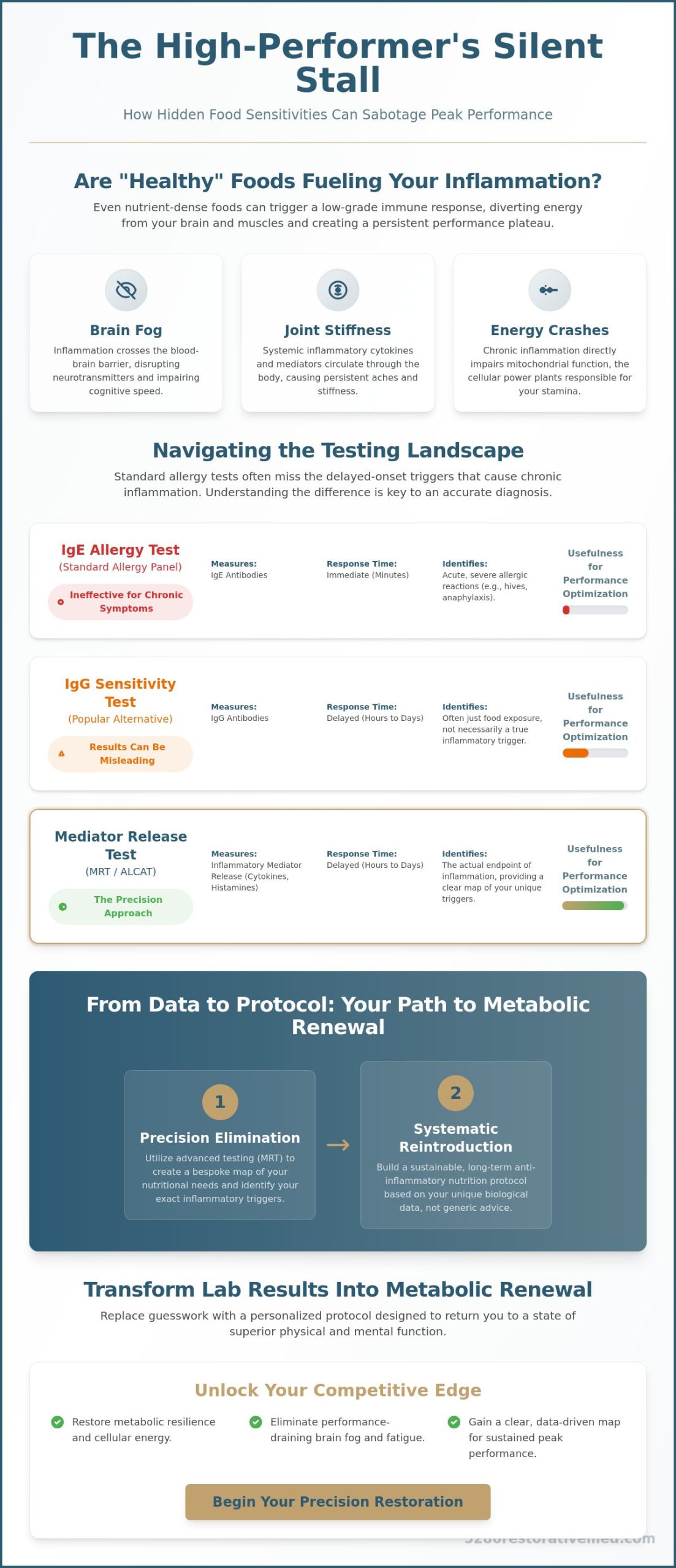
Many high-performers are surprised when their standard allergy panels return perfectly normal results despite feeling clearly inflamed. This happens because traditional testing focuses almost exclusively on IgE-mediated responses, which are immediate and often severe. Food sensitivities, however, involve a non-IgE, delayed-onset immune reaction that can take hours or even days to manifest. Because the symptoms don’t appear instantly, it’s nearly impossible to identify the culprit through intuition alone. In 2026, food sensitivity testing serves as a precision diagnostic tool for identifying cellular-level immune triggers that drive systemic dysfunction.
When your immune system identifies a food as a threat, it triggers a “mediator release.” This process involves the liberation of chemicals like histamines, prostaglandins, and cytokines into your bloodstream. These mediators are the actual drivers of the pain and fatigue you experience. By shifting the focus from simple antibody counts to the actual release of these inflammatory chemicals, we can gain a much clearer picture of your internal landscape. Utilizing food sensitivity testing for chronic inflammation allows us to see exactly which substances are causing your white blood cells to react and release these performance-draining compounds.
IgE vs. IgG vs. Mediator Release
Standard IgE tests are designed to find acute allergies, like a peanut or shellfish reaction. If you don’t have an anaphylactic response, these tests will likely tell you that you’re “fine.” IgG testing has gained popularity as an alternative, but it has notable limitations. Many clinical experts argue that a high IgG score might simply reflect frequent exposure to a food rather than a true inflammatory sensitivity. To achieve real recovery, we prefer methodologies that measure actual cellular volume changes or the release of inflammatory mediators. This provides a functional look at how your white blood cells behave when they encounter specific substances, offering a level of detail that simple antibody testing cannot match.
The Role of the Innate Immune System
Your innate immune system is your body’s first line of defense. When food chemicals interact with your white blood cells in a negative way, it creates a cascade of systemic stress. This “delayed reaction” problem is why someone might eat a “healthy” meal on Monday but not feel the brain fog or joint stiffness until Wednesday. Transitioning to an anti-inflammatory diet is a great start, but without specific data, you’re still guessing. This is where functional medicine bridges the gap. By moving beyond surface-level symptoms, we address the biological root causes of your fatigue. If you’re ready to stop the guesswork, a Functional Medicine Consultation can help you decode these silent signals and reclaim your vitality.
IgG vs. MRT vs. Alcat: Navigating the Testing Landscape
Choosing the right diagnostic path is critical for high-performers who cannot afford the downtime of trial and error. While the market is flooded with at-home finger-prick kits, these often lack the precision required for a clinical-grade recovery plan. A simple at-home test might offer convenience, but it rarely provides the depth of data found in a clinical blood draw processed by a CLIA-certified laboratory. For those seeking food sensitivity testing for chronic inflammation, the goal isn’t just to gather data but to find a clear, actionable map for metabolic renewal.
The scientific community continues to debate the validity of food sensitivity tests that rely solely on IgG antibodies. Many experts argue that IgG is actually a marker of immunological tolerance rather than a sign of sensitivity. This means a high IgG score could simply indicate that you eat a specific food frequently, leading to unnecessary and restrictive diets. To avoid this pitfall, sophisticated practices look beyond antibodies to measure the actual functional response of your immune cells. A standalone test is rarely enough; it must be part of a comprehensive metabolic review to ensure the results align with your unique physiology.
Choosing the Right Diagnostic Tool
The Mediator Release Test (MRT) is often considered a gold standard for symptomatic relief because it quantifies the release of inflammatory chemicals from white blood cells. This provides a direct look at the “end-stage” of the inflammatory process. The Alcat test takes a different approach by measuring changes in cellular size and volume when exposed to various substances. While IgG testing can be a useful piece of the puzzle, it’s most effective when used as a secondary screen rather than the sole basis for a nutritional protocol.
What to Look for in a Clinical-Grade Test
Precision matters when you’re engineering a bespoke health protocol. A high-quality panel should test for more than just whole foods; it must include common food chemicals, additives, and colorings that often hide in “clean” products. Testing a broad spectrum of 150 or more items ensures that no hidden trigger is left behind. This level of detail, combined with physician review and clinical interpretation, transforms raw lab data into a strategic tool for reducing systemic stress and returning you to peak vitality.
From Data to Protocol: Implementing an Anti-Inflammatory Lifestyle
The transition from raw laboratory data to a sustainable high-performance lifestyle is where true recovery begins. Having the results of your food sensitivity testing for chronic inflammation is only half the battle; the other half is engineering a protocol that fits your professional demands. We view this process as a strategic recalibration of your biology. It isn’t about restriction for the sake of discipline. It’s about removing the specific chemical signals that are currently stalling your metabolic engine and replacing them with inputs that drive vitality.
Your recovery protocol typically follows a five-step progression designed to quiet the immune system and restore cellular function:
- Step 1: The Phase 1 Elimination. For 4 to 6 weeks, you remove all highly reactive triggers identified in your report. This period allows systemic inflammation to subside and gives your immune system a much-needed rest.
- Step 2: Systematic Reintroduction. Once you reach a baseline of improved energy, we test individual foods with precision. This helps us differentiate between a permanent sensitivity and a temporary reaction caused by a compromised gut.
- Step 3: Gut Restoration. Simply avoiding triggers isn’t enough. We utilize targeted supplements to repair the intestinal lining and address underlying issues like mast cell activation.
- Step 4: Quantitative Monitoring. We track objective biomarkers such as Heart Rate Variability (HRV) and deep sleep quality. These metrics often improve significantly as the inflammatory burden lifts.
- Step 5: Long-term Maintenance. The goal is a flexible, resilient framework. You’ll learn which foods are your “performance fuel” and which ones are “occasional treats” that require extra recovery support.
The Executive Elimination Strategy
Navigating travel and high-stakes business dinners is often the biggest concern for our clients. We focus on identifying a robust list of “Safe Foods” that maintain your energy levels during the transition. You don’t have to sacrifice your professional social life to heal. By understanding your specific triggers, you can make informed choices at any restaurant without feeling deprived. Metabolic efficiency is the ultimate goal, and that requires a protocol that works in the boardroom as well as it does at home.
Beyond Food: Addressing Co-Factors of Inflammation
Diet is a primary driver of health, but it doesn’t exist in a vacuum. We often see a powerful synergy between nutrition and hormone optimization. High cortisol from chronic stress or poor sleep can mimic the symptoms of food sensitivities by increasing gut permeability. By using data to differentiate between a “food problem” and a “lifestyle problem,” we ensure your recovery is comprehensive. If you’re ready to build a nutrition plan that actually accounts for your high-demand lifestyle, our Nutritional Counseling services provide the clinical expertise needed to turn your test results into a performance-driven reality.
Precision Restoration: The 5280 Restorative Medicine Approach
A laboratory report is merely a collection of data points until it’s viewed through the lens of your unique clinical history. At 5280 Restorative Medicine, we don’t simply hand you a list of foods to avoid. Instead, we integrate food sensitivity testing for chronic inflammation into a comprehensive Executive Health Program that targets the root causes of your performance plateau. Dr. Marci Catallo-Madruga provides a personalized clinical interpretation of your results, ensuring that every dietary adjustment is backed by a deep understanding of your metabolic health. This approach moves you beyond the frustration of standard care and toward a state of active metabolic repair and mitochondrial support.
Our commitment to non-standardized care means your protocol is as unique as your biology. We recognize that high-performers require more than just the absence of illness. You need an optimized system that can handle the rigors of your professional and personal life. By focusing on data-driven insights, we help you transition from a state of reactive symptom management to a philosophy of proactive health engineering. This ensures that your body is not just surviving, but thriving at every stage of life.
Your Blueprint for Performance
Your journey begins with a deep dive into your current physiological state. During your initial Functional Medicine Consultation, we review your symptoms, lifestyle, and health goals to determine the most effective diagnostic path. We often pair food sensitivity testing for chronic inflammation with advanced Genetic Analysis to refine your nutritional needs even further. This allows us to identify hereditary predispositions that might influence how you process specific nutrients or respond to inflammatory stressors. It’s a sophisticated way to build a health blueprint that is entirely bespoke to you.
Achieving Sustainable Vitality
The goal of our partnership is to achieve a state of sustainable vitality that lasts long after your initial protocol is complete. We provide long-term support and adjustment to your custom health plan, ensuring it evolves alongside your changing needs. The results of this precision approach are measurable. Clients frequently report improved cognitive focus, steady energy throughout the day, and a significant return of physical resilience. You don’t have to settle for persistent fatigue or unexplained discomfort when the tools for recovery are available. If you’re ready to reclaim your peak state, schedule your consultation to identify your inflammatory triggers today.
Engineering Your Peak State Through Precision Nutrition
Reclaiming your edge starts with understanding that your body is a sophisticated system of chemical signals. You’ve learned that chronic inflammation isn’t just a buzzword; it’s a measurable biological stall that drains your cognitive and physical reserves. By moving beyond standard allergy panels and utilizing food sensitivity testing for chronic inflammation, you can finally identify the specific triggers that are sabotaging your performance. This shift from reactive management to proactive health engineering allows you to stop guessing and start healing.
At 5280 Restorative Medicine, we specialize in executive performance optimization. Led by functional medicine expert Dr. Marci Catallo-Madruga, our practice utilizes comprehensive metabolic and genetic diagnostic panels to build your unique blueprint for success. You don’t have to accept persistent fatigue as a byproduct of a high-demand career. Reclaim your vitality with a bespoke metabolic health protocol. Your journey to superior physical and mental function is within reach, and we’re here to guide you toward a state of lasting renewal.
Frequently Asked Questions
How is food sensitivity testing different from a standard allergy test?
Standard allergy tests look for IgE antibodies that cause immediate, sometimes life-threatening reactions like hives or swelling. Food sensitivity testing for chronic inflammation identifies delayed, non-IgE responses that manifest hours or even days after consumption. These sensitivities involve the release of inflammatory mediators like histamines and cytokines from white blood cells. By measuring these functional responses, we pinpoint the specific triggers that drain your daily vitality and disrupt your metabolic baseline.
Can food sensitivity testing help with chronic joint pain or migraines?
Yes, identifying and removing specific immune triggers often provides significant relief for these conditions. Chronic joint pain and migraines are frequently systemic manifestations of a low-grade, persistent immune response. When you eliminate foods that cause mediator release, you lower the overall inflammatory load on your nervous and musculoskeletal systems. This reduction in systemic friction often leads to improved mobility and a measurable decrease in the frequency of neurological flares.
How long does it take to see results after changing my diet based on testing?
Most high-performers notice a measurable shift in energy and mental clarity within the first 10 to 14 days of a precision protocol. However, it typically takes 4 to 6 weeks of consistent elimination for systemic inflammation to subside fully. This timeframe allows the intestinal lining to begin its repair process and the immune system to exit its state of high alert. Full metabolic restoration is a progressive journey rather than an overnight fix.
Is an at-home food sensitivity kit as accurate as a clinical blood draw?
Clinical blood draws are significantly more accurate because they allow for sophisticated analysis of live cellular volume changes and mediator release. Many at-home kits rely on dried blood spots and only measure IgG antibodies, which can be misleading markers of exposure rather than true sensitivity. Our clinical-grade testing is performed in CLIA-certified laboratories to ensure the highest standards of precision for your bespoke health protocol and performance goals.
Why do my sensitivity results change over time?
Your immune system is dynamic and reacts to your current biological environment. Results may change as you heal your gut lining or as your overall stress levels fluctuate. As gut permeability decreases, your body stops identifying certain food particles as threats. This evolution is a positive sign that your metabolic resilience is returning. Periodically re-evaluating your sensitivities ensures your nutrition plan remains aligned with your improving physiology and cellular health.
Can I ever eat my “reactive” foods again after the protocol?
Many individuals can successfully reintroduce reactive foods once their gut health is restored and systemic inflammation is under control. The goal of our protocol is to build a resilient, flexible system, not to impose permanent restrictions. After a period of healing, we use a systematic reintroduction process to test your current tolerances. This allows you to maintain peak performance while enjoying a diverse and sustainable diet that fits your lifestyle.
How does chronic inflammation affect my ability to lose weight or build muscle?
Chronic inflammation creates significant metabolic hurdles, including insulin resistance and elevated cortisol levels. These hormonal shifts signal the body to store fat, particularly in the abdominal region, while simultaneously breaking down muscle tissue for energy. By utilizing food sensitivity testing for chronic inflammation, we address these underlying biological roadblocks. Reducing systemic stress allows your mitochondria to function efficiently, making it easier to achieve your body composition and strength goals.
Does insurance typically cover advanced food sensitivity testing?
Advanced functional testing is typically a fee-for-service model and is rarely covered by standard insurance plans. Most high-end clinical practices operate outside the traditional insurance framework to provide the personalized, in-depth care required for root-cause recovery. We recommend checking with your specific plan or using a Health Savings Account (HSA) to fund these diagnostic tools. Investing in precision data ensures you aren’t wasting time on generic, one-size-fits-all solutions.