
What if your “perfect” clinical blood work is actually hiding the specific reason you’re hitting a wall by 3:00 PM? It’s exhausting to hear your labs are normal when your daily vitality tells a completely different story. You’ve likely spent years on a trial-and-error approach to diet and expensive supplements, yet you still feel the looming shadow of age-related decline. At 5280 Restorative Medicine, we know that guessing is the enemy of excellence. Research indicates that up to 75% of your long-term health outcomes are driven by the specific way your lifestyle interacts with your unique DNA, a factor that standard medical checkups often overlook.
You deserve a strategy that respects your individual biology rather than a generic template. This guide shows you how genetic testing for personalized health provides the precise biological blueprint you need to optimize your metabolic function and achieve sustainable high performance. We’ll examine how decoding your genomic markers allows us to build a data-driven roadmap for your longevity, ensuring you can stop reacting to symptoms and start mastering your health journey.
Key Takeaways
- Move beyond reactive healthcare by utilizing genetic testing for personalized health to decode your definitive biological blueprint for longevity.
- Gain insight into how Single Nucleotide Polymorphisms (SNPs) and methylation processes influence your DNA repair and daily energy production.
- Identify your unique nutrigenomic profile to tailor your macronutrient intake and optimize your metabolic response to caffeine.
- Implement a strategic 5-step framework designed to align your sleep architecture and recovery protocols with your specific circadian rhythm genes.
- Explore how 5280 Restorative Medicine synthesizes genomic data with metabolic and hormonal markers to create a comprehensive roadmap for peak performance.
What is Genetic Testing for Personalized Health?
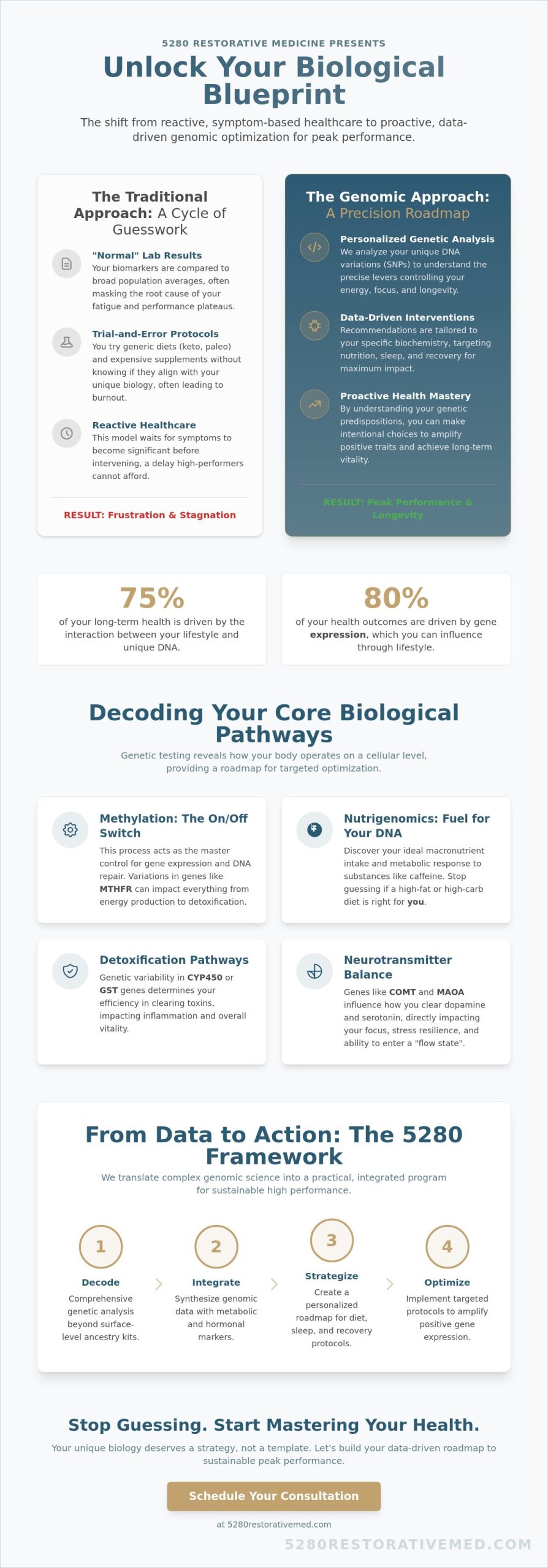
Traditional medicine often operates on a reactive model, waiting for symptoms to manifest before initiating a treatment plan. For the high-performer, this delay is unacceptable. Genetic testing for personalized health represents a fundamental shift from this defensive posture to proactive genomic optimization. Instead of comparing your biomarkers to a broad population average, we analyze your specific DNA to identify the precise levers that control your energy, focus, and longevity.
There is a critical distinction between clinical diagnostic tests and performance-based genetic analysis. While a hospital might use genetics to screen for rare diseases, we utilize What is Genetic Testing for Personalized Health? to examine Single Nucleotide Polymorphisms (SNPs). These are small variations in your DNA that dictate how you metabolize fats, clear toxins, and respond to oxidative stress. A “one-size-fits-all” ketogenic diet or high-intensity interval training protocol often fails because it ignores these unique SNPs. Your genetic code determines whether a specific health intervention will propel you forward or lead to burnout.
You aren’t a prisoner of your biology. The field of epigenetics proves that your lifestyle choices, environment, and nutrition act as chemical switches for your genes. Research indicates that while your DNA is fixed, up to 80% of your health outcomes are driven by gene expression. By understanding your predispositions, you can make intentional choices that “silence” negative traits and “amplify” those associated with peak performance.
Beyond Ancestry: The Evolution of Health-Focused Genomics
Recreational DNA kits are popular for tracing heritage, but they provide insufficient data for clinical health planning. These consumer-grade reports often lack the raw data depth required for a functional medicine practitioner to make meaningful interventions. Personalized health genomics is a roadmap for cellular restoration. It requires a sophisticated analysis of raw genetic data to uncover how your body handles methylation, inflammation, and vitamin absorption. At 5280 Restorative Medicine, we move past the surface-level insights of ancestry to focus on the biological data that impacts your daily output.
The Role of Genetic Markers in Chronic Vitality
Metabolic resilience isn’t a matter of willpower; it’s a matter of biochemistry. Genetic markers such as FTO or MC4R influence your satiety signals and metabolic rate, while variations in the COMT gene can determine your cognitive resilience under high-pressure environments. If your body clears dopamine too slowly or too quickly, your “flow state” will remain elusive without targeted support. This level of precision is the future of functional health and wellness. With the global genomics market projected to reach $54.4 billion by 2026, the transition toward root-cause optimization is becoming the standard for anyone serious about long-term vitality. Our Denver-based practice bridges the gap between complex genomic science and the practical requirements of a high-performance lifestyle.
The Mechanism of Genomic Optimization: How the Science Works
Understanding your biological blueprint starts with Single Nucleotide Polymorphisms (SNPs). These are tiny variations where a single building block of your DNA differs from the norm. While humans share 99.9% of their genetic code, that remaining 0.1% contains roughly 10 million SNPs. These variations dictate how you process caffeine, how quickly your muscles recover, and how you respond to environmental stressors. Using genetic testing for personalized health allows us to identify these specific markers rather than relying on generalized population averages.
The science of genomic optimization centers on several critical pathways:
- Methylation: This biochemical process occurs billions of times every second, acting as the “on/off” switch for your genes and DNA repair.
- Detoxification: Your body processes toxins through Phase I (activation) and Phase II (elimination) pathways. Genetic variability in the CYP450 or GST genes can determine if you’re prone to toxin buildup.
- Neurotransmitter Balance: Genes like COMT and MAOA influence how quickly you clear dopamine and serotonin, directly impacting your focus and stress resilience.
Methylation and the MTHFR Gene
The MTHFR gene provides instructions for making an enzyme critical for processing folate. If you carry the C677T variant, your ability to convert folate into its active form may drop by 30% to 70%. This deficiency stalls your cellular engine, leading to brain fog and reduced longevity. Efficient methylation is the primary driver behind cellular energy and plays a vital role in hormone optimization, as it ensures the body metabolizes estrogens and maintains a stable internal environment.
Inflammation and Oxidative Stress Markers
High performers often push their physical and mental limits, making recovery a non-negotiable metric for sustained success. Genes like SOD2 (Superoxide Dismutase) and CAT (Catalase) serve as your body’s primary defense against oxidative stress. A variation in SOD2 can reduce mitochondrial protection, meaning a standard high-intensity workout might cause more systemic damage in one individual than another. Genetic testing for personalized health helps identify these triggers before they manifest as chronic issues. This data is essential for managing complex conditions like mast cell activation syndrome, where the immune system remains in a state of hyper-reactivity.
By analyzing these markers, we move away from guesswork. You don’t have to wonder why a specific supplement or diet isn’t working. Instead, you gain a clear, data-driven path to restoration. If you’re ready to stop guessing and start optimizing, a personalized genomic assessment can provide the clarity you need to reach your next level of performance.
Nutrigenomics: Tailoring Your Fuel to Your DNA
You don’t eat just to satisfy hunger; you eat to signal your cells. Genetic testing for personalized health reveals why a ketogenic diet might leave one executive energized while another feels cognitively sluggish. Your DNA dictates how you process macronutrients, specifically your sensitivity to saturated fats and carbohydrates. For instance, individuals with specific variants in the TCF7L2 gene have a 25% higher risk of insulin resistance when consuming high-glycemic carbohydrates. Knowing your status allows you to adjust your carb threshold before metabolic dysfunction sets in.
Caffeine metabolism is another area where genetic data provides immediate ROI. The CYP1A2 gene determines the speed at which your liver clears caffeine. About 50% of the population carries the “slow” metabolizer variant. For these high-performers, that 2:00 PM espresso lingers in the system, spiking cortisol and disrupting restorative sleep cycles. Fast metabolizers, conversely, may see cardiovascular benefits from caffeine that slow metabolizers do not experience.
Micronutrient absorption isn’t uniform across the population. You might consume a “perfect” diet but still face deficiencies due to your genetic makeup:
- Vitamin D: VDR gene polymorphisms can reduce receptor efficiency by up to 30%, necessitating higher supplemental doses.
- Omega-3s: Variations in the FADS1 gene impact how effectively your body converts plant-based ALA into active EPA and DHA.
- Iron: HFE gene mutations can lead to iron overload, a condition that causes oxidative stress and fatigue if left unmanaged.
Cardiovascular health is equally tied to these markers. The ACE gene determines your salt sensitivity; for those with the “D” allele, high sodium intake leads to significant arterial tension. Similarly, ADH1B gene variants dictate how quickly you clear acetaldehyde. If you’re a slow metabolizer, even moderate alcohol consumption can trigger systemic inflammation that undermines your recovery.
Personalizing Your Diet for Metabolic Resilience
The “perfect” diet is a myth because it ignores your APOE status. Individuals with the APOE ε4 allele often see a sharp rise in LDL cholesterol when following high-fat, ketogenic protocols, making these diets potentially counterproductive for their long-term brain health. We also use genetic data to determine the optimal fasting window for your biology. Variations in the CLOCK gene help us identify whether a 16:8 fasting schedule supports your metabolic rate or simply spikes your morning cortisol. Nutrigenomics eliminates the guesswork from executive nutrition by replacing generic dietary trends with a precise biological blueprint.
Performance Supplements Based on Genetic Data
It’s time to move away from “expensive urine” and toward targeted, gene-based supplementation. Your COMT gene, which governs the breakdown of dopamine and stress hormones, dictates which support you actually need. “Slow” COMT individuals often feel “tired but wired” and benefit from magnesium and calming amino acids rather than stimulatory adaptogens. Integrating these genetic insights with functional medicine for high-performers allows our team to engineer a supplement protocol that targets your specific biochemical bottlenecks. This ensures every capsule you take serves a documented physiological purpose.
Turning Genetic Data into Actionable Performance Protocols
Raw data is a blueprint, but a blueprint doesn’t build the house. At 5280 Restorative Medicine, we transform genomic sequences into high-precision roadmaps. Utilizing genetic testing for personalized health allows us to move past trial and error. We follow a 5-step framework to ensure your data translates into measurable vitality:
- Genomic Mapping: Identifying specific SNPs (Single Nucleotide Polymorphisms) related to metabolism and recovery.
- Biometric Correlation: Cross-referencing genetic predispositions with current bloodwork and hormone levels.
- Protocol Design: Creating a custom schedule for nutrition, supplementation, and workload.
- Implementation: Integrating these changes into your existing executive routine.
- Iterative Monitoring: Re-testing biomarkers every 90 days to validate the protocol’s efficacy.
Your ACTN3 gene, often called the “sprint gene,” determines if your muscle fibers are optimized for power or endurance. If you’re training for a marathon but your genetics favor explosive strength, you’ll likely face chronic inflammation. We pair these insights with advanced metabolic testing, such as VO2 max and RMR assessments, to ensure your exercise volume matches your body’s specific recovery speed.
Circadian Biology and Sleep Optimization
The CLOCK gene governs your internal rhythm and dictates when your cognitive focus peaks. For high-performers, understanding this gene is the difference between struggling through a 2:00 PM slump and maintaining peak executive function. When you travel across three or more time zones, your genetic profile determines how quickly your mitochondria resynchronize. We leverage the synergy between your DNA and red light therapy to accelerate this process. Clinical observations suggest that targeted light exposure can reduce jet lag recovery time by up to 48 hours for those with specific circadian variants.
Stress Management for the Executive Brain
The COMT gene reveals your “Warrior vs. Worrier” profile by showing how quickly your brain clears dopamine. “Warriors” break down dopamine three to four times faster than “Worriers.” This means they excel under high-pressure deadlines but may feel unmotivated during routine operations. Conversely, “Worriers” possess superior complex memory and attention to detail but are prone to burnout under chronic stress. We use these neurotransmitter insights to build data-driven recovery protocols. Instead of generic advice, we provide specific mindfulness and supplementation strategies that protect your brain from the physiological tax of leadership.
It’s time to stop guessing and start optimizing. If you’re ready to see how genetic testing for personalized health can redefine your performance ceiling, schedule a consultation with 5280 Restorative Medicine today.
The 5280 Approach: Integrating Genomics into a Restorative Program
Genetic testing for personalized health serves as a high-precision map, but a map is useless without a skilled navigator. At 5280 Restorative Medicine, we don’t treat your DNA report as a final destination. We view it as a foundational layer of data that must be cross-referenced with your current physiological state. Our methodology synthesizes your genomic markers with real-time metabolic panels and hormonal assays to create a 360-degree view of your biology. This ensures your treatment plan addresses both your inherited predispositions and your present-day health requirements.
Beyond the Report: Clinical Expertise Matters
Relying on “DIY” genetic interpretation apps often leads to unnecessary anxiety or misguided supplementation. These automated algorithms can’t account for the complex interplay between your genes and your environment. Our clinicians bridge this gap by translating thousands of data points into a simplified, actionable daily protocol. We focus on “epigenetic hacks” that actually move the needle for high-performers. For instance, if your genes suggest a poor methylation cycle, we don’t just hand you a bottle of B-vitamins. We monitor your homocysteine levels every 90 days to verify that your protocol is actually optimizing your cellular function. This ongoing monitoring ensures your strategy evolves as your body changes.
Your Path to Restored Vitality
Peak performance isn’t a static achievement. It’s a dynamic state of being that requires constant refinement. When you enroll in our executive health program, you’re investing in a long-term strategy for longevity that prioritizes your unique biological blueprint. This genome-first approach allows us to bypass the trial-and-error phase of traditional medicine. You’ll experience the benefits of precision care through increased cognitive clarity, stabilized energy levels, and faster physical recovery times. We analyze over 50 specific biomarkers alongside your genetic data to ensure every recommendation is backed by hard evidence. This level of detail is what separates a generic wellness plan from a true restorative program.
Your journey toward restoration starts with a single, data-driven step. Don’t leave your vitality to chance or generic health advice that isn’t built for your specific needs. Schedule a consultation with 5280 Restorative Medicine today to unlock your biological blueprint and begin your transition from baseline health to peak optimization.
Mastering Your Biological Blueprint for Peak Performance
You’ve moved beyond the limitations of general wellness into the era of precision medicine. Your DNA represents a 3 billion base-pair manual for your highest self, offering insights that traditional diagnostics simply can’t reach. By leveraging genetic testing for personalized health, you stop guessing which supplements or recovery protocols might work and start following data-driven science. Our approach at 5280 Restorative Medicine translates these complex genomic markers into a boutique clinical experience designed specifically for the modern high-performer.
Led by Dr. Marci Catallo-Madruga, an expert in functional medicine and health optimization, our protocols look past the standard 15-marker blood panel to analyze the specific SNPs governing your cellular health and longevity. We focus on the 1 percent gains in mental clarity and physical output that separate the elite from the average. This isn’t just about avoiding illness; it’s about a proactive journey toward lasting vitality. You’re ready to stop reacting to symptoms and start owning your biological future through a program that’s as unique as your genetic code.
Apply for our Executive Health Program and unlock your genomic potential
Your most vibrant years are waiting for you to claim them.
Frequently Asked Questions
Is genetic testing for personalized health the same as 23andMe?
No, clinical-grade genetic testing for personalized health is significantly more sophisticated than consumer kits like 23andMe. While consumer tests often focus on ancestry or basic traits, our clinical approach analyzes specific SNPs that impact your metabolic pathways and cellular function. At 5280 Restorative Medicine, we look at functional markers that dictate how you process nutrients or manage stress. This provides 100% actionable data for your performance optimization.
Can genetic testing predict exactly when I will get a disease?
Genetic testing provides a blueprint of your predispositions rather than a fixed timeline for disease onset. It identifies vulnerabilities, such as a 30% higher risk for specific cardiovascular issues, but it doesn’t set a calendar date. We use these insights to create a proactive strategy. By understanding your genetic architecture, you can implement targeted interventions that may delay or prevent the expression of those specific genes entirely.
How much of my health is determined by my genes vs. my lifestyle?
Research from the Centers for Disease Control suggests that genetics account for roughly 25% of health outcomes, while lifestyle and environmental factors influence the remaining 75%. This concept, known as epigenetics, means your daily choices act as the switches for your DNA. We focus on that 75% to help you master your biology. Your genetic code isn’t your destiny; it’s a precise guide for your lifestyle choices.
What is the most important gene to test for high-performers?
The MTHFR gene is often considered the most critical for high-performers because it governs methylation, a process essential for DNA repair and neurotransmitter production. Approximately 40% of the population carries a mutation in this gene that can impair energy levels and mental clarity. Identifying your MTHFR status allows us to optimize your B-vitamin intake. This ensures your brain and body function at peak capacity during high-stress demands.
Will my health insurance cover performance-based genetic testing?
Most private insurance carriers, such as UnitedHealthcare or Cigna, don’t cover genetic testing for personalized health when the primary goal is optimization or performance enhancement. Coverage is usually reserved for diagnostic purposes after a symptom is present. Because our focus is proactive restoration, these tests are generally an out-of-pocket investment in your longevity. We provide the documentation if you choose to seek reimbursement through your HSA or FSA account.
How long does it take to see results after changing my lifestyle based on my genes?
Most patients report measurable improvements in energy and focus within 21 to 30 days of implementing gene-based lifestyle changes. Cellular turnover and hormonal stabilization take time to manifest physically. For example, adjusting your vitamin D intake based on a VDR gene variation can show improved blood serum levels in about 4 weeks. Consistency is the key to moving from baseline health to a state of total optimization.
Is my genetic data kept private and secure?
Yes, we adhere to strict HIPAA regulations and the Genetic Information Nondiscrimination Act of 2008 to ensure your data remains confidential. This federal law protects you from discrimination by health insurers and employers based on genetic information. We use encrypted laboratory portals to handle your results. Your genomic profile is your private property, and we only use it to tailor your specific restorative treatment plan.
Can genetic testing help me lose weight more effectively?
Genetic testing identifies specific markers like the FTO gene, which influences satiety and fat storage, allowing for a more precise weight loss strategy. A study published in the British Medical Journal found that individuals using DNA-based diets lost 33% more weight than those on standard programs. Instead of guessing, we use your data to determine if your body responds better to high-intensity intervals or endurance-based movement for fat oxidation.