
What if the “normal” lab results your doctor handed you are actually the reason you still feel exhausted? It’s a frustrating paradox many high-performers face; your bloodwork looks fine on paper, yet you’re struggling with persistent brain fog, stubborn weight gain, and energy crashes that no amount of caffeine can fix. Standard medical ranges are often designed to detect disease rather than optimize performance. This is why comprehensive hormone imbalance testing is the essential first step toward reclaiming your edge. By looking beyond the baseline, we can identify the specific physiological friction points that are stalling your cognitive and physical potential.
We understand that your symptoms are real and measurable, even if they’ve been dismissed in the past. In this guide, you’ll learn how advanced diagnostics identify the root causes of executive burnout and why the 2026 removal of FDA “black box” warnings has transformed the safety landscape of hormone therapy. We’ll also examine the shift toward treating conditions like PMOS, formerly known as PCOS, as metabolic priorities. You’ll discover how a personalized health protocol, built on clear and actionable data, can move you past a simple absence of illness and back into a state of peak vitality.
Key Takeaways
- Understand why standard laboratory reference ranges often overlook the “optimization gap,” leaving high-performers feeling depleted despite “normal” results.
- Discover how advanced hormone imbalance testing utilizes multiple modalities to capture a complete picture of your physiological state rather than a single snapshot.
- Learn to identify the specific performance markers that matter most, including the full thyroid panel and DHEA-S, to resolve persistent cognitive decline.
- Explore the critical link between your gut microbiome and hormonal clearance to ensure your metabolic systems support sustainable energy.
- Gain insight into the data-driven Executive Health Program approach, where we prioritize systemic optimization as the foundation for long-term vitality.
Why ‘Normal’ Hormone Imbalance Testing Often Fails High-Performers
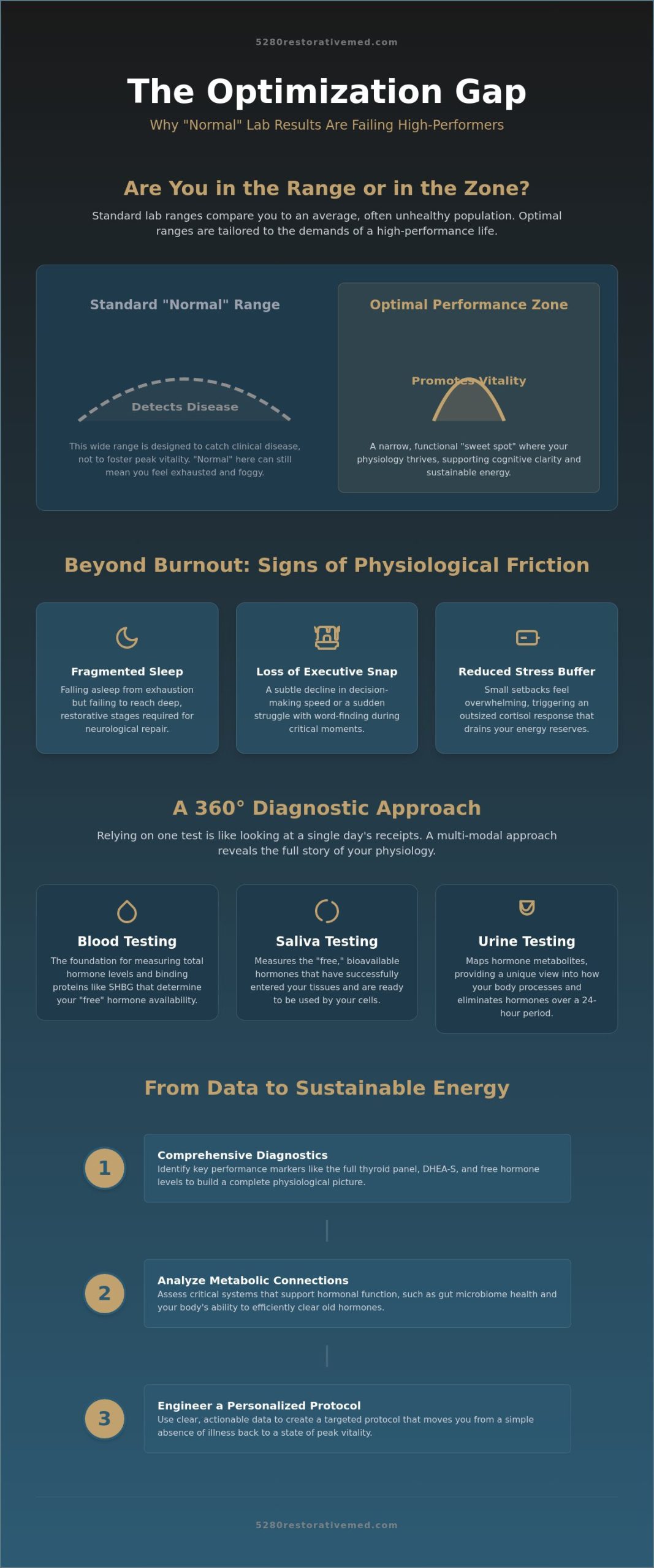
You step into a clinical setting with a clear list of symptoms that are sabotaging your professional edge. You’re met with the phrase “your labs are normal.” For an executive responsible for high-stakes decisions and bottom-line results, “normal” is often a failing grade. Standard hormone imbalance testing relies on reference ranges derived from the average population. This 95% bell curve includes individuals of all ages, activity levels, and health statuses. It effectively compares a high-performing leader to a sedentary, often unhealthy, demographic. We call this the “Optimization Gap.”
The problem with the “Average Patient” model is that it only identifies a problem once you have reached a state of clinical disease. High-performers operate at a higher metabolic cost. Your body requires more precise hormonal support to maintain cognitive speed and physical stamina. When your levels begin to drift toward the edges of those broad “normal” ranges, your performance begins to stall. You haven’t crashed yet, but the friction in your physiology is palpable. To maintain peak vitality, you need narrower, more aggressive target ranges that reflect health rather than the mere absence of illness.
The Difference Between Normal and Optimal
Lab ranges are calculated based on a statistical average, not a functional ideal. For example, most Thyroid function tests are interpreted through a lens of disease avoidance. If your TSH is 4.2, you might be told you’re fine, even if you’re struggling with cold intolerance and mental fatigue. In a functional model, we search for the “sweet spot” where your systems thrive. Achieving levels that support deep cognitive clarity and physical resilience requires a more nuanced interpretation of hormone imbalance testing data. We don’t just want you in the range; we want you in the optimal zone for your specific biological needs.
Symptoms of Sub-Clinical Imbalance
What many professionals dismiss as “Executive Burnout” is frequently a measurable physiological shift. This sub-clinical imbalance creates a specific set of hurdles that caffeine and willpower can’t overcome:
- Fragmented Sleep Architecture: You might fall asleep from sheer exhaustion but fail to reach the deep, restorative stages required for neurological repair.
- Loss of Executive Snap: A subtle decline in the speed of your decision-making or a sudden struggle with word-finding during meetings.
- Reduced Stress Buffer: Small setbacks that you once handled with ease now feel overwhelming or trigger an outsized cortisol response.
When these symptoms are met with “normal” test results, it leads to a form of medical gaslighting. You know your body is underperforming, yet the data suggests otherwise. By focusing on sub-clinical markers, we validate your experience with measurable evidence and create a path back to superior function.
Testing Modalities: Comparing Blood, Saliva, and Urine
High-performers often require more than a single data point to understand why their energy is flagging. Relying solely on one testing method is like trying to assess a complex business strategy by looking at a single day’s receipts. For comprehensive hormone imbalance testing, we integrate multiple modalities to see the full story of your physiology. You can refer to this guide to hormone tests for a foundational look at how these different sample types provide unique clinical insights.
A multi-modal approach is the only way to solve complex cases where symptoms persist despite “normal” bloodwork. By combining these methods, we build a 360-degree view of your health. This ensures we aren’t just guessing at your hormone levels but accurately mapping your metabolic pathways.
Blood Work: The Foundation of Diagnostics
Blood testing remains the essential starting point for measuring total hormone levels. However, hormones in the blood are often bound to proteins like Sex Hormone Binding Globulin (SHBG) and albumin. If your clinician doesn’t measure these proteins, they can’t accurately calculate your “free” hormones. These are the hormones actually available for your cells to use. Timing is everything. Testosterone, for instance, naturally peaks in the early morning. If you draw blood at 3:00 PM, your results won’t reflect your actual capacity. Blood has limits, especially with adrenal health. It provides a static snapshot but cannot tell us how your cortisol fluctuates throughout a high-pressure workday.
Advanced Urine and Saliva Analysis
Saliva testing excels at capturing the bioavailable fraction of hormones. It’s particularly useful for measuring the Cortisol Awakening Response (CAR). This is the sharp rise in cortisol that occurs within 30 minutes of waking. For an executive, a flat CAR often explains that morning sluggishness that caffeine no longer fixes. As of January 2026, many prominent health insurance providers across the nation have updated policies to recognize the clinical validity of late-night salivary cortisol testing for specific conditions, signaling a broader medical acceptance of this modality.
Urine testing, specifically the Dried Urine Test for Comprehensive Hormones (DUTCH), is the gold standard for metabolic pathways. It shows how your body breaks down estrogen and testosterone. Are you clearing estrogen safely, or is it recycling in your system? This data is vital for preventing long-term health risks and ensuring your hormone imbalance testing leads to a safe, effective protocol. If you’re ready for a deeper look at your biology, our Executive Health Program can help identify the right testing strategy for your specific performance goals.
Key Biomarkers for Executive Performance and Vitality
Standard lab panels usually stop at the surface, providing a cursory glance at your health that misses the nuances of high-level performance. To truly understand your physiological capacity, comprehensive hormone imbalance testing must move beyond basic markers like TSH or Total Testosterone. We focus on the “Thyroid Trio,” which includes Free T3, Free T4, and Reverse T3. While TSH is merely a signal from the brain, Free T3 is the active hormone that drives your cellular metabolism and mental clarity. If your Reverse T3 is elevated, it acts as a physiological brake, slowing your metabolic engine even if your other levels appear normal.
Adrenal health is another critical pillar for the modern executive. We prioritize tracking DHEA-S, a vital “performance” hormone that serves as a precursor to your sex hormones and a primary indicator of your stress resilience. In men, we look closely at Dihydrotestosterone (DHT), which influences drive and focus, while in women, we evaluate the precise Estrogen-to-Progesterone ratio. An imbalance here often explains why you might feel “wired but tired” or experience sudden shifts in mood and sleep quality during high-stakes quarters. Identifying these markers through hormone imbalance testing provides the data needed to engineer a return to peak function.
The Stress-Energy Connection
Chronic high cortisol doesn’t just make you feel stressed; it actively “steals” the raw materials your body needs to produce sex hormones. This process often begins with Pregnenolone, known as the “mother hormone.” Pregnenolone is essential for cognitive function and memory, but when your body is in a state of constant survival, it diverts this precursor to produce more cortisol. Adrenal markers are often the first to shift during intense professional projects, signaling that your body is beginning to prioritize immediate survival over long-term vitality and hormonal health.
Metabolic Gatekeepers
Your hormones cannot function effectively if your metabolic foundation is unstable. Insulin and glucose act as the gatekeepers of your endocrine system. When you develop insulin resistance, your cells become “deaf” to hormonal signals, blunting the impact of even optimal hormone levels. We also monitor systemic inflammation through high-sensitivity C-reactive protein (hs-CRP), as inflammation can damage hormone receptors and disrupt communication pathways. Understanding these factors is a core component of Functional Health and Wellness. Metabolic resilience is the capacity to maintain hormonal homeostasis under intense professional pressure.
The Metabolic Connection: Why Hormones Don’t Work in a Vacuum
Hormones are messengers, but they require a clear channel and a functional destination to be effective. If your underlying metabolism is compromised, even the most precise hormone therapy will fail to deliver the results you expect. At 5280 Restorative Medicine, we prioritize Functional Health and Wellness because we know that hormones operate within a complex biological ecosystem. Comprehensive hormone imbalance testing is incomplete if it doesn’t account for how your body processes, detoxifies, and responds to those chemical signals.
One often overlooked factor is the “estrobolome,” a collection of bacteria in your gut dedicated to metabolizing estrogen. If your microbiome is out of balance, your gut can produce an enzyme called beta-glucuronidase. This enzyme uncouples “spent” estrogen that was destined for excretion, allowing it to be reabsorbed into your bloodstream. This recycling process can lead to estrogen dominance, manifesting as sudden mood swings, water retention, and cognitive fog. Integrating gut repair into your protocol is often the missing piece in restoring true hormonal equilibrium.
Genetic Predispositions
Your genetic blueprint also dictates how efficiently you clear hormones from your system. Specific Single Nucleotide Polymorphisms (SNPs), such as variations in the COMT and MTHFR genes, can significantly impact your hormonal health. The COMT gene, for instance, influences how you break down catecholamines and estrogens. If you have a “slow” COMT variant, you may be more prone to anxiety and estrogen-related issues under stress. By identifying these genetic markers, we can personalize your supplement protocol to bypass these metabolic bottlenecks. This level of precision is why we specialize in Functional Medicine for High-Performers: Engineering Metabolic Resilience.
Nutrient Deficiencies and Building Blocks
Your body cannot manufacture hormones from nothing. It requires specific building blocks, such as cholesterol, vitamins, and minerals, to maintain production. Magnesium, zinc, and Vitamin D are not just general wellness supplements; they are essential cofactors for endocrine function. If you’re deficient in these areas due to high-stress professional demands or a restrictive diet, your hormone imbalance testing will reflect the resulting deficit. We identify these gaps to ensure your body has the raw materials it needs to thrive.
If you’re ready to stop chasing symptoms and start engineering a more resilient physiology, we invite you to book a Functional Medicine Consultation to begin your personalized journey.
Engineering Your Protocol: From Data to Sustainable Energy
Data without a plan is just noise. Once your hormone imbalance testing is complete, the focus shifts to lifestyle engineering and clinical precision. Our Executive Health Program doesn’t rely on generic templates. Instead, we use your unique metabolic signature to build a roadmap for sustainable energy. This is a proactive journey where we address the root causes of decline rather than just masking symptoms with a script. We treat your health as a high-stakes investment that requires constant, data-driven management.
Many clinics rush to prescribe Bioidentical Hormone Replacement Therapy (BHRT) as the first line of defense. We take a different view. BHRT is often the final piece of the puzzle, not the first. If your body’s stress response is dysregulated or your gut is inflamed, introducing exogenous hormones can be like pouring premium fuel into a broken engine. We first stabilize your metabolic foundations through nutritional counseling and supplement protocols. This ensures your body can actually utilize the support we provide without creating further imbalances.
Beyond the Prescription
Optimizing your environment is just as critical as any clinical intervention. We often incorporate advanced modalities like Red Light Therapy to support mitochondrial health and natural hormone production. By optimizing light exposure and sleep hygiene, we help reset your circadian rhythm. This supports the natural release of growth hormone and cortisol at the correct times. Strategic supplementation fills the specific gaps identified in your bloodwork, while high-intensity recovery periods help maintain the sensitivity of your hormone receptors. It’s about creating a biological environment where your hormones can thrive naturally.
Your Journey to Optimization
Transformation doesn’t happen overnight, but it is measurable. During the first 90 days of a functional hormone protocol, we closely monitor your progress. We look at both objective clinical data and subjective performance markers like mental “snap,” libido, and morning energy levels. This isn’t a one-and-done solution. Maintaining “Steady-State” performance requires regular re-testing to adjust for the changing demands of your professional and personal life.
Your physiological state is dynamic. As you hit new milestones in your career, your metabolic needs will evolve. Regular hormone imbalance testing ensures your protocol remains as agile as your business strategy. If you’re ready to move past baseline and into a state of superior function, the next step is a comprehensive metabolic assessment. This is where we turn data into a bespoke strategy for your long-term vitality and success.
Reclaiming Your Edge Through Physiological Precision
We’ve explored why standard lab ranges often fail to capture the “optimization gap” that stalls executive performance. Effective hormone imbalance testing requires a multi-modal approach; looking at blood, saliva, and urine to map your unique metabolic pathways. By addressing root causes like gut health and genetic predispositions, you move beyond simple symptom management and into the realm of lifestyle engineering. This proactive strategy ensures your body has the resilience to meet the demands of a high-stakes professional life.
At 5280 Restorative Medicine, Dr. Marci Catallo-Madruga leads our boutique clinical practice with a focus on advanced metabolic and genetic analysis. We design bespoke protocols specifically for the unique stressors high-performers face every day. Our goal is to bridge the gap between complex science and your daily well-being, ensuring you achieve a superior state of physical function. Stop guessing and start optimizing; schedule your Functional Medicine Consultation today. Peak physical and mental states are achievable at any stage of life. Your journey to renewal starts with data you can trust.
Frequently Asked Questions
What is the best time of day to test for a hormone imbalance?
Early morning, typically between 7:00 AM and 9:00 AM, is the clinical standard for blood-based hormone imbalance testing. This specific window captures peak testosterone levels and the morning cortisol surge before the day’s stressors begin to skew the data. For salivary testing, we require multiple collections throughout a 24-hour period to accurately map your diurnal rhythm and stress response.
Why are my hormone levels ‘normal’ if I have all the symptoms of an imbalance?
Traditional lab ranges are designed to detect disease states rather than peak performance. These broad “normal” ranges are based on a statistical average of the general population, which often includes individuals with varying health statuses. We focus on narrower, “optimal” ranges that reflect the physiological state of a high-performer. This approach often identifies sub-clinical friction points that standard diagnostics miss.
Does insurance cover functional hormone imbalance testing?
Insurance coverage for advanced diagnostics varies by provider and the specific intent of the test. While some major insurers like Blue Cross and Blue Shield of Illinois updated policies in early 2026 to cover late-night salivary cortisol for certain symptoms, many optimization-focused panels are considered elective. We recommend checking with your provider; however, many high-performers choose to invest in these tests out-of-pocket to ensure comprehensive analysis.
What is the difference between a standard hormone panel and a DUTCH test?
A standard blood panel provides a static snapshot of the hormones circulating in your system at one moment. The DUTCH test uses dried urine to measure hormone metabolites, showing how your body actually breaks down and clears those hormones. This metabolic map is essential for understanding if you’re processing estrogen safely or if your testosterone is converting into less desirable byproducts like DHT.
Can stress alone cause a significant hormone imbalance?
Stress is a primary driver of hormonal disruption through a process often called “pregnenolone steal.” When you are under constant professional pressure, your body prioritizes cortisol production for survival, diverting the raw materials needed for sex hormones like progesterone and testosterone. Over time, this survival mechanism can lead to significant exhaustion and cognitive decline, even if your nutrition and exercise are perfect.
How often should high-performers have their hormone levels tested?
We typically suggest an initial comprehensive assessment followed by a re-test after 90 days of starting a new protocol. This allows us to verify that your body is responding correctly to the interventions. Once you reach a steady state of optimization, testing every six to twelve months is usually sufficient to maintain your edge and adjust for changing life stressors.
Will I need to be on hormone replacement therapy forever if I start?
Not everyone who undergoes hormone imbalance testing requires long-term replacement therapy. Our primary goal is to identify and fix the root causes, such as nutrient deficiencies or gut dysfunction, to restore your natural production. While some individuals choose long-term support for its performance benefits, many find they can maintain their results through lifestyle engineering and targeted supplementation after an initial reset.
What role does gut health play in hormone imbalance testing?
Your gut is the final gatekeeper for hormone clearance, particularly for estrogen. If your microbiome is imbalanced, specific enzymes can “uncouple” hormones destined for excretion, allowing them to be reabsorbed into your bloodstream. We assess gut health because a compromised digestive system can lead to estrogen dominance and mood instability, regardless of how well your endocrine glands are functioning.