
What if your organization could secure a six-to-one return on investment simply by ensuring its leadership is operating at peak biological capacity? If you are searching for how to convince my boss to pay for a health program, the secret lies in shifting the conversation from a lifestyle perk to a high-yield business asset. You likely already feel that midday energy crashes and persistent brain fog aren’t just personal frustrations. They’re physiological bottlenecks that hinder your ability to lead with precision and executive clarity.
Data indicates that for every dollar invested in wellness, medical costs fall by approximately $3.27 and absenteeism costs drop by about $2.73. This guide provides a clear framework to frame a bespoke Executive Health Program as a strategic necessity that protects the company’s most valuable capital. We’ll explore how to present data-backed arguments that position your health optimization as a critical driver for corporate stability and sustained performance.
Key Takeaways
- Understand the vital distinction between standard “sick care” insurance and performance-driven health optimization that targets the root causes of executive burnout.
- Discover a structured, five-step framework on how to convince my boss to pay for a health program by presenting metabolic health as a primary driver for decision-making clarity.
- Learn to neutralize cost objections by highlighting the high price of “presenteeism” and the significant expense of replacing a high-level leader.
- Gain insights into identifying the right corporate stakeholder to ensure your pitch resonates with the specific financial or operational goals of your organization.
- Explore why a bespoke, metabolic-first protocol provides the analytical rigor and personalized care necessary to exceed your current performance baseline.
The Shift from Wellness Perks to Performance Optimization
Corporate wellness has historically been viewed as a soft benefit, a collection of gym discounts or fruit baskets meant to boost morale. However, the paradigm is shifting toward something more rigorous: performance optimization. While Workplace wellness programs have traditionally focused on general population health, elite organizations are now treating executive health as a form of Human Capital Risk Management. This approach views the biology of leadership as a critical business asset that requires proactive maintenance rather than reactive repair.
Standard health insurance serves a specific purpose, which is “sick care.” It’s designed to manage disease once it has already manifested. For a high-level leader, waiting for a diagnosis is a failed strategy. When you’re looking into how to convince my boss to pay for a health program, you must frame the request as a tool for sustainable leadership. It’s not about a medical necessity in the traditional sense; it’s about ensuring the person at the helm has the biological resilience to handle high-stakes pressure without burning out. This is a shift from offering perks to protecting the company’s most vital human assets.
Why Traditional Healthcare is Not Enough for High-Performers
High-performers often operate in a state of sub-clinical dysfunction. You might feel exhausted, foggy, or irritable, yet your standard blood work comes back as “normal.” These reference ranges are based on the average population, which is often sedentary and unwell. For an executive, being average isn’t the goal. This is where functional health and wellness becomes a proactive strategy. By identifying root-cause imbalances before they become chronic issues, you can reclaim the cognitive edge that traditional medicine often ignores. Reactive medicine focuses on the absence of illness, while optimization focuses on the presence of vitality.
The Executive Health Advantage
The link between metabolic resilience and high-stakes decision-making is undeniable. When your blood sugar is unstable or your cortisol rhythms are disrupted, your prefrontal cortex, the part of the brain responsible for complex logic and emotional regulation, suffers. Bio-optimization leads to better cognitive endurance, allowing you to remain sharp during a ten-hour day of negotiations. When considering how to convince my boss to pay for a health program, compare the cost of a comprehensive protocol to the cost of executive turnover. Replacing a senior leader often costs significantly more than their annual salary in recruitment and lost momentum. Investing in a program that prevents burnout is a calculated financial safeguard for the organization’s stability.
Building the Business Case: The ROI of Metabolic Health
To build a compelling case, you must translate biological markers into the language of the boardroom. Executives don’t just need to be “well”; they need to be effective. When you consider how to convince my boss to pay for a health program, start by addressing the hidden cost of presenteeism. This isn’t about absenteeism, or being away from the desk. It’s about being physically present while your cognitive output is throttled by systemic inflammation or metabolic instability. Research from UC Berkeley provides critical evidence on wellness program ROI, showing that health interventions directly impact organizational efficiency by reducing this mental drag.
The biological foundation of this efficiency is mitochondrial efficacy. Your mitochondria are the engines of your cells, and when these engines are sluggish, your mental bandwidth shrinks. Implementing functional medicine for high-performers ensures your cellular energy is optimized. This translates to sharper focus and faster processing during high-stakes meetings. This proactive engineering reduces long-term disability risk and minimizes the subtle “micro-sick days” that accumulate when a leader is underperforming due to poor metabolic health. It’s a strategy that turns your biology into a competitive advantage for the firm.
Quantifying Productivity Gains
Stabilizing your hormones and blood sugar is a high-yield productivity strategy. It eliminates the predictable afternoon slump that forces many leaders to rely on stimulants to survive a 3:00 PM strategy session. Improved sleep quality, another cornerstone of a specialized protocol, acts as a force multiplier for executive cognitive function. You can frame your Heart Rate Variability (HRV) or deep sleep metrics as leading indicators of your leadership capacity. If your recovery is low, your decision-making quality will inevitably follow. Presenting these metrics to a supervisor demonstrates that you’re treating your performance with the same analytical rigor as a quarterly financial report.
Health as a Retention and Recruitment Tool
In a competitive market for talent, top-tier executives look for more than just a base salary. They want an environment that supports their longevity and prevents the physical toll of high-pressure roles. Offering a boutique Executive Health Program acts as a powerful recruitment tool, signaling that the company is deeply invested in your long-term success. It functions essentially as a “Key Person” insurance policy. By providing specialized health protocols, the organization protects itself against the sudden loss of a leader due to preventable burnout. If you’re ready to start this journey, a personalized metabolic assessment can provide the baseline data needed to justify this investment to your board or CFO.
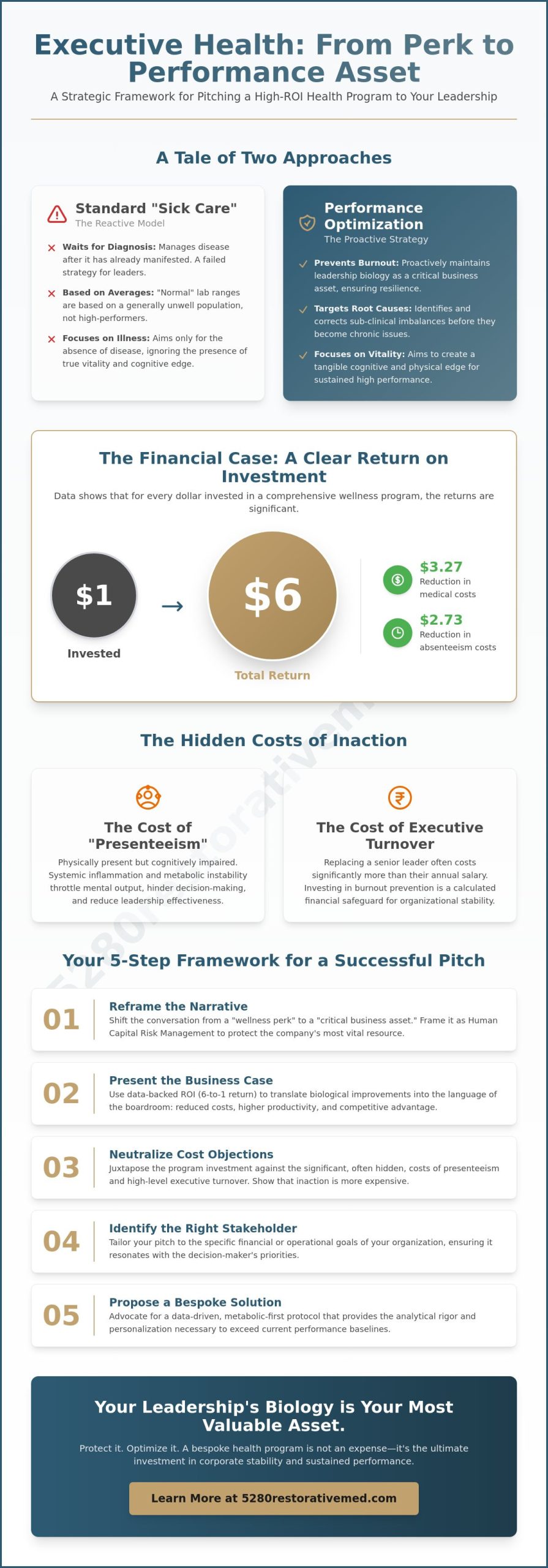
How to Pitch Your Health Program: A 5-Step Framework
Securing corporate funding for a specialized health protocol requires a tactical shift in how you communicate your needs. This is not a request for a personal favor; it is a professional negotiation aimed at enhancing your operational output. To master how to convince my boss to pay for a health program, you must present a solution that addresses specific business risks. Start by identifying the most influential stakeholder. While HR departments manage broad benefits, your direct supervisor or the CFO often controls the discretionary budgets reserved for high-level leadership development and performance coaching.
When framing the ask, position the protocol as “Performance Support” rather than “Medical Treatment.” This distinction is vital for internal buy-in. You aren’t asking the company to fix an illness; you’re asking them to invest in a comprehensive Executive Health Program that serves as a performance engine. Citing Harvard Medical School research on wellness program ROI can add significant weight to your proposal. Their findings suggest that while broad wellness initiatives often struggle with measurable data, targeted interventions for high-impact roles provide the most direct organizational benefit by managing expectations and focusing on high-return health outcomes.
Step 1: Audit Your Current Performance Gaps
Before the meeting, conduct a rigorous self-audit. Identify exactly where your current physiological state is creating a bottleneck for the company. Perhaps your recovery after international travel has slowed, or your focus wanes during the final hour of board meetings. Write a concise statement linking these gaps to specific company goals. For instance, if your goal is to lead a complex merger, explain how the metabolic resilience provided by a specialized program ensures you maintain the mental clarity required for high-stakes due diligence. This “problem-solution” summary makes the investment feel logical and necessary.
Step 2: Connect the Program to Company Values
Align the proposal with existing corporate pillars such as “Innovation,” “Resilience,” or “Excellence.” Most organizations already claim to value these traits; your pitch simply shows them how to support those values at the biological level. Highlight that an optimized executive is a more stable leader. Because our protocols are bespoke and turnkey, you can reassure leadership that the program will not create an administrative burden for HR. It’s a high-impact, low-friction way to protect the company’s most valuable asset. To close the pitch, propose a six-month pilot period with specific performance-linked check-ins to demonstrate the tangible return on their investment.
Addressing Common Objections: Cost vs. Value
Anticipating objections is a critical part of any successful negotiation. When you’re refining your strategy for how to convince my boss to pay for a health program, you’ll likely face questions about why standard insurance isn’t enough or why this investment should be prioritized over other corporate perks. It’s vital to clarify that traditional insurance is designed for “sick care,” meaning it manages symptoms once a clinical diagnosis is reached. In contrast, our protocols focus on “peak performance,” identifying sub-clinical issues like hormonal imbalances or gut dysfunction before they lead to a functional crisis. This is a proactive investment in leadership continuity, not just a reactive medical expense.
The “fairness” objection is another common hurdle. Leadership may worry that providing specialized care to one executive creates an expensive precedent for the entire staff. You can neutralize this by framing the program as a risk mitigation strategy for “key persons.” Just as a company prioritizes the maintenance of its most critical infrastructure or proprietary software, it must protect the biological stability of the individuals responsible for high-stakes decision-making. It’s a strategic move to protect the roles that carry the most significant organizational weight and liability.
The Replacement Cost Argument
Replacing a high-level leader is a massive financial burden, with executive search fees often reaching five figures before a single day of salary is paid. Investing in a health protocol is a fraction of that cost and serves as “preventative maintenance” for the company’s most essential human capital. Just as a firm wouldn’t neglect the upkeep of its primary manufacturing machinery, it shouldn’t ignore the biological engines of its leadership. There are also potential tax advantages for the company, as these programs can often be categorized as a legitimate business expense rather than a simple taxable benefit, though you should always encourage your CFO to verify this with their tax advisor.
Evidence-Based Confidence
The most effective way to overcome skepticism about the “science” of optimization is to emphasize the role of comprehensive metabolic testing. This data-driven approach removes the guesswork often associated with generic wellness initiatives. By using genetic analysis and advanced blood markers, we create a bespoke roadmap that ensures the company isn’t wasting funds on generalized “perks” that don’t yield results. Under the clinical authority of Dr. Marci Catallo-Madruga, our protocols are grounded in measurable physiological improvements. This clinical rigor provides the board with the confidence that their investment is tied to verifiable health outcomes. If you’re ready to present a data-backed case to your leadership team, explore our Executive Health Program to see how we engineer metabolic resilience.
Choosing the Right Partner: The 5280 Restorative Medicine Approach
Selecting the right clinical partner is the final step in securing corporate support. At 5280 Restorative Medicine, we’ve designed our Executive Health Program to function as a comprehensive performance engine. We understand that your time is your most limited resource. Our metabolic-first approach aligns perfectly with the analytical mindset of high-level leaders, using data to move beyond the “normal” ranges of standard medicine and into the “optimal” zone of peak function. Whether you’re in Denver or managing a global team, our virtual consultations ensure that your health optimization fits seamlessly into a busy schedule.
Learning how to convince my boss to pay for a health program becomes much simpler when you have a partner who provides the clinical rigor required by HR and the CFO. We don’t just offer advice; we provide a structured, multi-month support system that treats your health as a proactive journey. Our team is deeply invested in your individual success, bridging the gap between complex biological science and your daily professional well-being. This isn’t just about avoiding illness. It’s about achieving a superior state of physical function that protects your leadership longevity.
Our Clinical Methodology for High-Performers
Our methodology is grounded in precision. We integrate Genetic Analysis with Hormone Optimization to create a biological blueprint that’s unique to you. Instead of generic wellness advice, we develop bespoke Nutritional Counseling and Supplement Protocols designed to address your specific metabolic needs. This focus on Gut Health Assessments and Metabolic Testing ensures that your energy is sustainable throughout the day. We don’t just want you to feel better; we want you to reach a state of metabolic resilience that allows you to exceed your previous baselines and maintain cognitive clarity under pressure.
Getting Started: The Path to Corporate Sponsorship
We recognize that the administrative side of corporate sponsorship can be a hurdle. To assist you in how to convince my boss to pay for a health program, we provide the documentation and clinical rationale needed for HR approval. This includes explaining the business value of metabolic resilience and the long-term cost savings associated with preventing executive burnout. Our enrollment process is straightforward, leading you into a multi-month support system that ensures lasting results. If you’re ready to take control of your health and secure the backing of your organization, schedule a consultation to build your executive health business case.
Secure Your Leadership Longevity
Optimizing your biology is the most strategic way to ensure your leadership remains sharp, resilient, and sustainable. You now understand that health is not a luxury perk but a critical business asset. By shifting the conversation toward metabolic ROI and using a structured, data-driven framework, you have the tools for how to convince my boss to pay for a health program. This proactive approach protects your personal well-being while safeguarding the company’s most valuable capital.
Under the guidance of functional medicine expert Dr. Marci Catallo-Madruga, we provide bespoke metabolic and genetic-based protocols tailored to your unique physiology. Our practice offers national virtual support to ensure high-performing leaders maintain their edge, no matter where their work takes them. It’s time to move beyond standard reference ranges and reach a superior state of physical and mental function.
Download our Executive Health ROI Pitch Deck and start your journey to peak performance. You are ready to reclaim your vitality and lead with renewed purpose.
Frequently Asked Questions
Will my company get a tax break for paying for my health program?
Companies can often deduct the cost of employee health programs as a necessary business expense, though specific tax treatment depends on the program’s structure. If the protocol is framed as professional development or a wellness benefit, it may reduce the company’s taxable income. We recommend your finance team consult with a tax professional to determine if it qualifies under section 162 of the Internal Revenue Code.
How do I explain functional medicine to my HR department?
When discussing functional medicine with HR, describe it as a root-cause approach to health that focuses on biological optimization rather than just managing symptoms. Explain that it uses advanced diagnostics to identify physiological bottlenecks that standard care might miss. This perspective helps HR see the program as a tool for sustainable leadership and performance enhancement rather than an unconventional medical request.
What is the difference between an executive physical and a functional health program?
A standard executive physical is a one-day diagnostic snapshot designed to catch existing diseases. In contrast, a functional health program is an ongoing, multi-month protocol aimed at engineering peak performance. While the physical tells you what is wrong today, our program uses metabolic and genetic data to proactively improve your cognitive endurance and energy for the future.
Can I use my HSA or FSA to pay for an executive health program?
You can often use Health Savings Account (HSA) or Flexible Spending Account (FSA) funds for many components of an executive health program. While we operate on an out-of-network basis, we provide the necessary documentation and clinical rationale that your plan administrator requires for reimbursement. This is a common way to bridge the gap if you are still learning how to convince my boss to pay for a health program directly.
How do I prove the ROI of a health program to my CFO?
To prove ROI to a CFO, present the investment as a form of “Key Person” risk mitigation. Compare the program’s cost to the significant expense of executive recruitment and the hidden costs of presenteeism, where health issues degrade daily decision-making quality. Highlight that for every dollar invested in wellness, companies often see an average return of $1.50 through reduced medical and absenteeism costs.
Is it better to ask for a health program as part of a salary negotiation?
Including a health optimization protocol in your salary negotiation is an excellent strategy, especially when cash compensation is capped. It signals that you are committed to long-term performance and leadership stability. Since these programs are often viewed as a professional development tool, they can be a more attractive, lower-tax alternative for the company compared to a standard bonus.
What happens if my boss says no to paying for the full program?
If a full sponsorship is declined, propose a pilot period or a cost-sharing model. You might ask the company to cover the advanced diagnostic testing while you handle the ongoing supplement or coaching costs. This lower-risk entry point allows you to demonstrate tangible performance improvements, making it easier to secure full funding for the complete protocol in the next budget cycle as you refine how to convince my boss to pay for a health program.
Do companies usually pay for health optimization for all employees or just executives?
While many organizations offer basic wellness perks to all staff, bespoke health optimization is frequently reserved for executives due to the high organizational impact of their roles. Protecting the decision-making capacity of leadership is a prioritized business strategy. This tiered approach helps manage costs while ensuring that those with the most significant responsibilities have the biological resilience to lead effectively.