
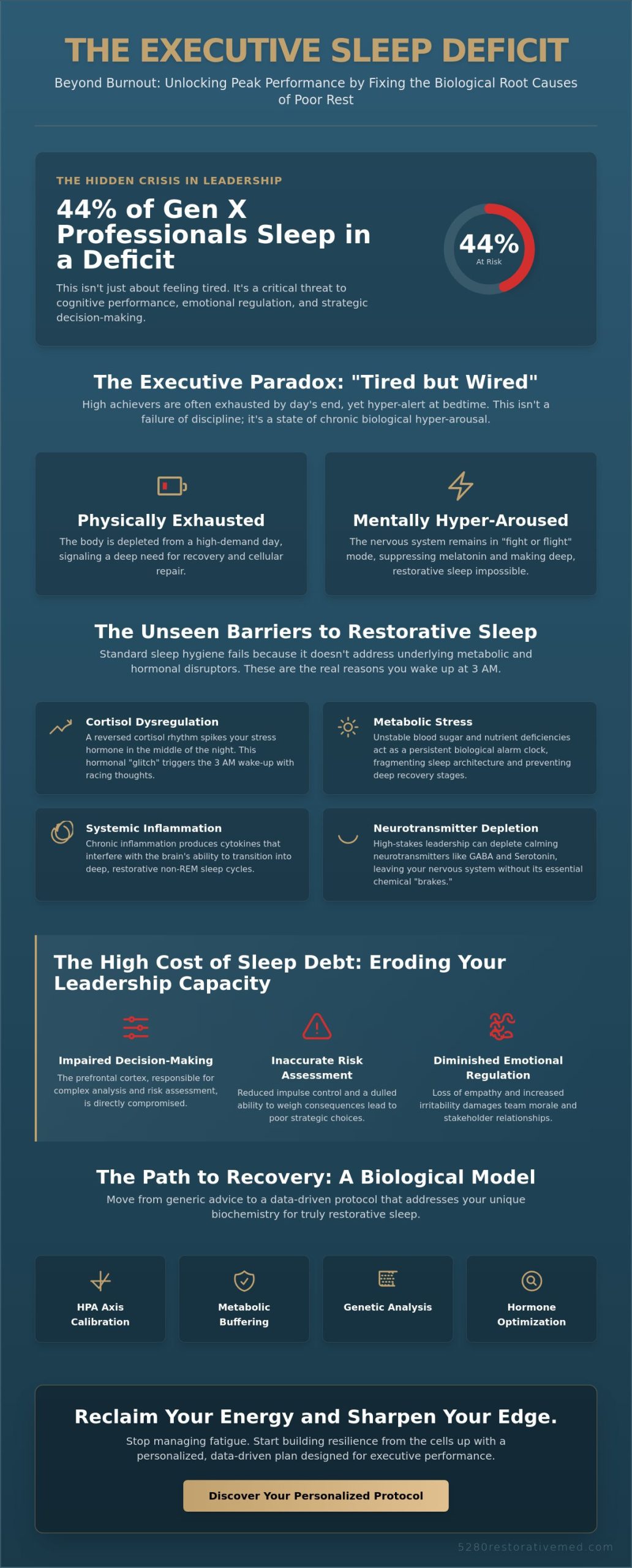
What if the cognitive fog and midnight ruminations you’ve accepted as part of the executive lifestyle are actually solvable metabolic imbalances? While June 2026 data shows that 44% of Gen X professionals sleep less than seven hours per night, the real crisis isn’t just the duration of rest but the underlying biological quality of it. If you’re searching for how to improve sleep quality for executives, you’ve likely already realized that standard advice like “avoid screens” doesn’t touch the root cause of your evening anxiety or your reliance on caffeine to function. You’ve built a career on high performance, yet your body’s recovery system is operating in a state of constant deficit.
It’s frustrating to lead a boardroom during the day only to feel powerless against your own racing thoughts at 2:00 AM. We believe that peak physical and mental states are achievable at any stage of your career, provided you have the right clinical data. This guide moves beyond the surface to show you how to address the hormonal and metabolic triggers of burnout for truly restorative rest. We’ll explore a personalized functional medicine protocol, from hormone optimization to advanced metabolic testing, designed to help you exceed your baseline performance and return to a state of spontaneous morning energy.
Key Takeaways
- Identify the physiological cost of sleep debt on critical leadership functions like risk assessment and emotional regulation.
- Discover how to improve sleep quality for executives by rebalancing the cortisol awakening response to stop midnight racing thoughts.
- Learn why standard sleep hygiene often increases performance anxiety and how to pivot toward a biological recovery model.
- Implement targeted strategies for HPA axis calibration and metabolic buffering to prevent nocturnal energy crashes.
- Understand the role of genetic analysis in creating a personalized sleep-wake architecture that supports long-term executive vitality.
The Executive Sleep Paradox: Why High-Performers Struggle to Recharge
Many high-achievers find themselves in a frustrating loop. They’re exhausted by the time they leave the office but suddenly alert the moment their head hits the pillow. This is the “Tired but Wired” phenomenon. It’s a state of chronic hyper-arousal where the body remains in “fight or flight” mode long after the day’s battles are over. For those researching how to improve sleep quality for executives, understanding this paradox is the first step toward recovery. You aren’t failing at sleep hygiene; your biology is simply stuck in high gear.
Standard advice often suggests sticking to a rigid schedule, but this ignores the reality of high-stakes leadership where global time zones and late-night crises are common. There’s a profound difference between “unconscious time” and true “restorative sleep.” Many leaders rely on a glass of wine or a prescription sedative to “turn off,” but these methods merely sedate the brain. They don’t facilitate the biological recovery or the glymphatic drainage required to clear metabolic waste. If you want to know how to improve sleep quality for executives, you must look past the bedroom curtains and start looking at your internal biochemistry. When your sympathetic nervous system is constantly activated, your body treats rest as a luxury it can’t afford, leading to a shallow, non-restorative version of sleep that leaves you feeling depleted by mid-morning.
The Biology of the ‘Tired but Wired’ State
Chronic stress keeps the Hypothalamic-Pituitary-Adrenal (HPA) axis in a state of perpetual hyper-vigilance. This survival mechanism disrupts your circadian rhythm, often leading to a paradoxical “second wind” around 9:00 PM. This late-evening surge in cortisol suppresses the natural production of melatonin, making it nearly impossible to enter deep REM cycles. Without these cycles, your brain can’t process the emotional data of the day, leaving you susceptible to chronic cognitive fatigue and irritability.
Leadership Consequences of Suboptimal Sleep
Suboptimal sleep directly impairs the prefrontal cortex, the area of the brain responsible for complex decision-making and impulse control. When you’re operating on a significant sleep debt, your ability to assess risk accurately and maintain empathy during high-pressure meetings diminishes. This isn’t just about feeling tired; it’s about the erosion of your leadership capacity. Executive sleep quality is a critical business asset for 2026, serving as the foundation for sustainable high-performance and long-term organizational health.
Biological Barriers: How Metabolic Stress Disrupts Your Circadian Rhythm
While many leaders focus on blackout curtains or cooling mattresses, the true obstacles to rest often lie within your metabolic chemistry. If you’ve been searching for how to improve sleep quality for executives, you must address the internal “noise” that overrides your body’s natural desire for stillness. This noise is frequently a result of metabolic stress, which acts as a persistent biological alarm clock, fragmenting your sleep architecture and preventing you from reaching the deep, restorative stages of recovery.
Beyond simple exhaustion, chronic inflammation and neurotransmitter depletion often play silent roles in executive insomnia. When your body is in a state of systemic inflammation, it produces cytokines that interfere with the brain’s ability to transition into deep sleep. Simultaneously, the high-demand nature of leadership can deplete essential calming neurotransmitters like GABA and Serotonin. Without these chemical “brakes,” your nervous system remains stuck in an active state. Even when following standard sleep tips for high performers, many executives find their internal rhythm remains fractured due to these unseen biological barriers.
Cortisol Dysregulation and the Midnight Wake-up
The Cortisol Awakening Response (CAR) is designed to peak in the morning to provide you with energy for the day. However, in high-pressure environments, this rhythm can shift, causing cortisol to spike at 2:00 or 3:00 AM. This “glitch” in your hormonal timing triggers a fight-or-flight response while you’re still in bed, leading to racing thoughts and an inability to return to sleep. Through specialized metabolic testing, we can identify these specific hormonal misfires and create a targeted plan to realign your HPA axis. Understanding these patterns is the first step toward a bespoke recovery plan, often starting with a comprehensive Functional Medicine Consultation to map your unique metabolic profile.
Blood Sugar Stability and Sleep Architecture
Blood glucose instability is another common culprit behind the executive “3:00 AM wake-up call.” Late-night working paired with inconsistent nutrition can lead to nocturnal hypoglycemia, where your blood sugar drops too low during the night. To protect the brain, your body releases a surge of adrenaline and glucagon to raise glucose levels. This emergency response forces you into an alert state, effectively ending your restorative sleep cycle. Stabilizing your metabolic function through nutritional counseling and strategic “metabolic buffers” ensures your body stays in a fed, calm state throughout the night, allowing for uninterrupted 7-8 hour sleep cycles.
Hygiene vs. Biology: Why Your Sleep Routine Isn’t Enough
You’ve likely optimized your bedroom temperature, invested in high-end linens, and perhaps even tried the latest wearable trackers, yet the restorative rest you crave remains elusive. This disconnect happens because standard advice focuses almost entirely on your external environment while ignoring your internal biochemistry. If you are struggling with how to improve sleep quality for executives, you must recognize that sleep is a biological outcome of metabolic health, not just a result of a dark room or a quiet house. Environmental comfort is merely the stage; your physiology is the lead actor.
Many high-performers approach sleep like a quarterly KPI: they try to “force” it through sheer willpower or rigid adherence to standardized routines. This often leads to a specific type of performance anxiety known as “orthosomnia,” where the stress of trying to achieve perfect sleep metrics actually keeps the nervous system in a state of high alert. When you treat sleep as another task to master, your brain remains in an analytical, “always-on” mode. Relying on over-the-counter aids or a nightly glass of wine only compounds the issue. These substances might induce a state of unconsciousness, but they frequently disrupt your natural sleep architecture. You might be “out,” but your brain isn’t actually recovering, which is why you still wake up feeling unrefreshed despite eight hours in bed.
The Sleep Hygiene Myth for High-Performers
Standard sleep hygiene assumes your nervous system is already in a state of relative calm. For an executive managing high-stakes decisions and global teams, a simple pair of blue-light glasses isn’t enough to override a physiological surge of adrenaline. True recovery requires building “Metabolic Resilience,” the ability of your body to transition smoothly between high-output stress and deep-recovery rest. Contrast the standard approach with a functional optimization model below:
- Standard Hygiene (External): Blackout curtains and white noise machines.
- Functional Optimization (Internal): Cortisol rhythm alignment and HPA axis support.
- Standard Hygiene (External): Avoiding screens 60 minutes before bed.
- Functional Optimization (Internal): Neurotransmitter balance (GABA and Serotonin) to calm the mind.
- Standard Hygiene (External): Keeping the room at 65 degrees.
- Functional Optimization (Internal): Blood glucose stability to prevent nocturnal adrenaline spikes.
Data Over Guesswork: The Role of Advanced Bloodwork
Precision is the hallmark of a successful executive strategy, and your health should be no different. We use comprehensive metabolic testing to identify the specific biological “brakes” that are failing in your system. For example, magnesium is a critical cofactor for over 300 enzymatic reactions, including those that regulate your nervous system’s ability to downregulate. If your levels are even slightly suboptimal, your brain will struggle to “unplug.” Our functional medicine denver protocols move beyond standard lab ranges to engineer metabolic resilience, transforming your sleep from a nightly struggle into a reliable foundation for your leadership performance.
The High-Performance Sleep Protocol: Actionable Strategies for 2026
Transforming your recovery requires a shift from passive rest to active biological optimization. If you’re investigating how to improve sleep quality for executives, you need a protocol that respects your high-stakes schedule while correcting underlying physiological imbalances. This isn’t about general advice; it’s about engineering a system where deep sleep becomes a reliable outcome of your daily habits. By focusing on five specific pillars, you can move from a state of chronic depletion to one of sustained vitality.
First, calibrate your HPA axis by exposing yourself to ten minutes of direct morning sunlight. This anchors your circadian rhythm and sets the timer for melatonin production later that evening. Second, implement a metabolic buffer. To prevent the nocturnal glucose drops mentioned earlier, consume a small, protein-rich snack thirty minutes before bed. This keeps your blood sugar stable and prevents adrenaline surges. Third, leverage 2026 technology to manage your environment. Devices like the Eight Sleep Pod 5 allow for precise temperature regulation, while the Oura Ring 4 or Whoop 5.0 provide the data necessary to monitor your Heart Rate Variability (HRV) and recovery trends. Finally, address the mental load through structured cognitive offloading. Spend five minutes writing down your priorities for the next day to clear the ruminative loops that often trigger midnight waking.
Mitochondrial Optimization for Better Rest
Your ability to enter deep sleep is directly tied to cellular energy production. When your mitochondria are under-functioning, your brain lacks the “fuel” required to maintain the complex transitions between sleep stages. Clinical tools like red light therapy can support mitochondrial health and strengthen circadian signaling. For the busy professional, even fifteen minutes of targeted light exposure in the late afternoon can enhance cellular resilience, making it easier for the body to downregulate as the evening progresses. It’s a proactive way to build the biological capacity for rest.
Precision Supplementation for Executive Recovery
Generic sleep aids often mask symptoms rather than fixing the cause. High-performance recovery requires moving beyond standard melatonin to utilize targeted compounds like L-theanine and adaptogens. Specifically, the magnesium benefits for a “wired” brain are immense, as this mineral acts as a natural calcium channel blocker to quiet the nervous system. We recommend professional-grade, bespoke supplement protocols tailored to your specific deficiencies rather than over-the-counter options that may contain fillers or suboptimal dosages. To begin your path toward superior rest, consider a tailored Executive Health Program designed for your unique physiology.
Precision Sleep Optimization: Restoring Vitality through Functional Medicine
General wellness programs often fail high-performers because they rely on standardized advice that ignores your unique biological blueprint. When you’re looking for how to improve sleep quality for executives, a one-size-fits-all approach is insufficient. True restoration requires a deep dive into your genetic analysis to understand your specific sleep-wake architecture. Some individuals are genetically predisposed to slower caffeine metabolism or higher baseline cortisol sensitivity due to specific enzymatic variations. Without this data, you’re essentially guessing at which interventions will actually stick. Precision medicine removes that guesswork, allowing us to build a recovery strategy that works with your DNA rather than against it.
By moving beyond the symptoms of fatigue and addressing the root causes, you shift your daily experience from merely surviving the workday to thriving with elite-level recovery. This transition isn’t just about feeling better; it’s about reclaiming the cognitive edge that defined your early career. We treat health as a proactive journey where peak physical and mental states are achievable at any stage of life. High-quality sleep isn’t a luxury you’ve outgrown; it’s a biological state we can restore through clinical precision and personalized care protocols.
Hormonal Balance and the Sleep-Wake Cycle
For many leaders over 40, declining hormone levels are the hidden disruptors of sleep continuity. Progesterone acts as a natural sedative in the brain by interacting with GABA receptors, while testosterone helps regulate the body’s circadian rhythm and overall energy balance. When these levels drop, you might find yourself waking frequently or struggling to reach deep, restorative stages. Utilizing BHRT can often be the missing link in restoring the biological foundations of rest. By optimizing these messengers, we address the root cause of age-related sleep decline, providing systemic support that external hygiene alone cannot match.
Engineering Your Bespoke Health Roadmap
Restoring your vitality requires more than a single consultation; it demands a comprehensive strategy. Our executive health programs integrate advanced testing, wearable technology data, and ongoing clinical expertise to refine your protocol in real-time. This isn’t about rigid rules. It’s about having an expert guide to help you fine-tune a high-performance lifestyle that remains sustainable amidst the pressures of leadership. If you’re ready to learn how to improve sleep quality for executives through a data-driven health plan, it’s time to reclaim your vitality. Address the root cause of your fatigue today and return to the superior state of function you deserve.
Reclaim Your Edge Through Precision Restoration
Mastering your recovery isn’t found in a darker room or a more expensive mattress; it’s found in the delicate balance of your internal biochemistry. You’ve discovered that elite rest is a biological outcome of metabolic health and hormonal harmony. By addressing the root causes of executive burnout, such as cortisol dysregulation and glucose instability, you can finally silence the midnight racing thoughts that compromise your leadership. Understanding how to improve sleep quality for executives requires moving beyond generic hygiene and into the realm of clinical data and personalized care.
Dr. Marci Catallo-Madruga specializes in creating these personalized protocols, utilizing advanced genetic and metabolic testing to engineer sustainable, high-performance vitality. We invite you to Apply for the Executive Health Program to Optimize Your Performance and experience a bespoke health roadmap designed for your unique physiology. Your leadership shouldn’t come at the cost of your health. It’s time to exceed your baseline and return to the superior state of physical and mental function you deserve. We’re here to guide you toward a future of restorative rest and enduring energy.
Frequently Asked Questions
Why do I wake up at 3:00 AM every night with my mind racing?
Waking up in the early hours is typically the result of a nocturnal blood sugar drop or a shifted cortisol rhythm. When your glucose levels dip too low, your body releases adrenaline and cortisol to protect the brain, which snaps you into an alert, “fight-or-flight” state. This biological response is often misinterpreted as simple anxiety, but it’s actually a metabolic event that requires physiological stabilization rather than just mental relaxation.
Is it safe for executives to take melatonin every night?
Melatonin is a hormone, not a simple supplement, and chronic use can signal your brain to downregulate its own natural production. While it’s useful for resetting a rhythm after international travel, relying on it nightly masks the root cause of why your body isn’t producing enough on its own. We prefer to identify the specific nutrient deficiencies or stress patterns that are inhibiting your natural melatonin synthesis.
How does alcohol actually affect my sleep quality if it helps me fall asleep faster?
Alcohol acts as a sedative that induces a state of unconsciousness but prevents the brain from entering restorative REM cycles. It fragments your sleep architecture, leading to frequent micro-awakenings that you may not even remember. While you might drift off quickly, you miss the essential cognitive processing and glymphatic drainage that happen during deep, natural sleep, leaving you with the “fog” often felt the next morning.
Can metabolic testing really find out why I’m tired all the time?
Yes, comprehensive metabolic testing provides a data-driven look at the specific biomarkers that govern your energy and recovery. By measuring HPA axis function, nutrient status, and glucose regulation, we can pinpoint exactly where your system is failing to recharge. This clinical precision is essential for anyone investigating how to improve sleep quality for executives, as it moves the conversation from guesswork to targeted biological repair.
How many hours of sleep do high-performing CEOs actually need?
Most high-performers require seven to eight hours of high-quality sleep to maintain the cognitive speed and emotional resilience required for leadership. While some claim to function on less, June 2026 data indicates that 44% of Gen X professionals are getting under seven hours, which significantly impairs risk assessment and decision-making over time. Quality is as vital as quantity; seven hours of restorative sleep outperform nine hours of sedated sleep.
What is the best temperature for restorative executive sleep?
The optimal clinical range for deep sleep is between 65 and 68 degrees Fahrenheit. A cool environment facilitates the necessary drop in your core body temperature, which serves as a biological trigger for the brain to initiate sleep cycles. If your room is too warm, your body spends energy trying to thermoregulate instead of focusing on cellular repair and memory consolidation.
How does HRT or BHRT affect sleep quality in men and women?
Bioidentical Hormone Replacement Therapy (BHRT) restores the declining levels of progesterone and testosterone that often cause mid-life sleep disruption. Progesterone, in particular, has a calming effect on the brain’s GABA receptors, while balanced testosterone supports a healthy circadian rhythm. For many executives over 40, hormone optimization is the “missing link” that allows them to return to a state of spontaneous, high-energy mornings.
Can I improve my sleep without taking prescription sleep medication?
You can achieve restorative rest without prescriptions by addressing the underlying metabolic and inflammatory triggers of insomnia. By optimizing your internal biochemistry and using targeted, professional-grade supplements, you can restore your body’s natural ability to downregulate. This functional approach is the most sustainable way to learn how to improve sleep quality for executives, as it builds long-term resilience rather than creating a dependency on sedatives.