
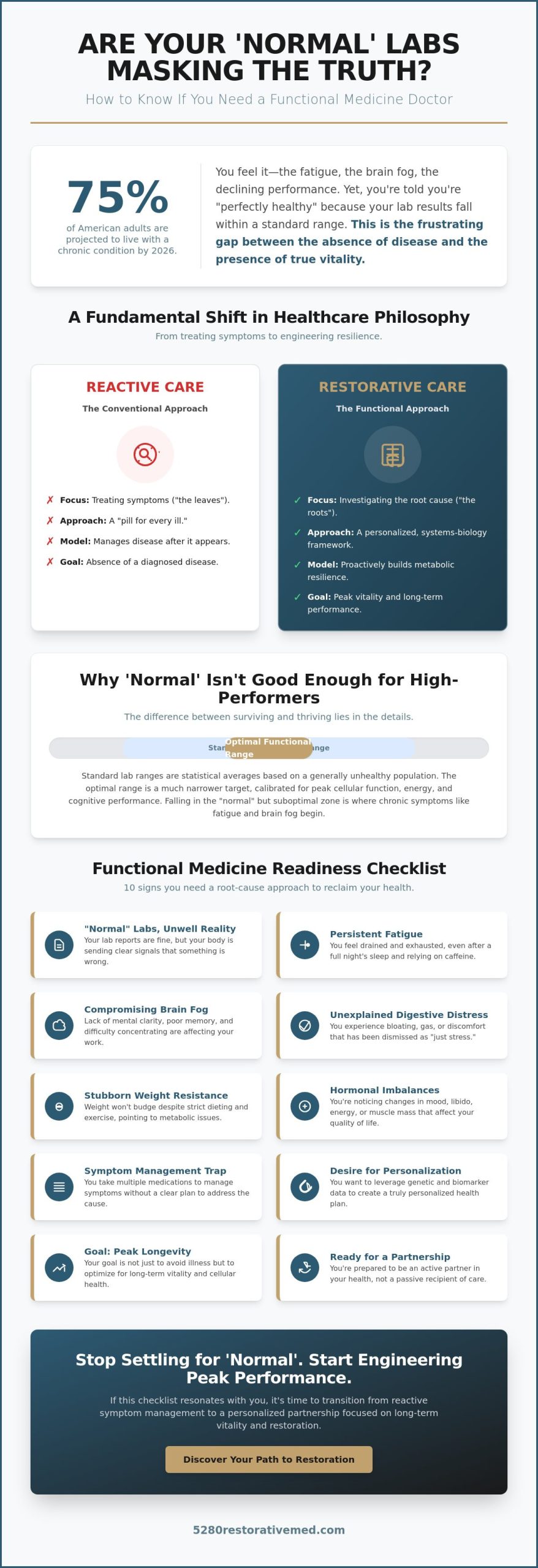
Why does your body feel like it’s failing when your medical charts insist you’re perfectly healthy? If you’re one of the 75% of American adults living with a chronic condition in 2026, you’ve likely been told that your persistent fatigue or brain fog is “normal” simply because your labs fall within standard reference ranges. It’s frustrating to live in the gap between a clean bill of health and the physical reality of declining performance. Learning how to know if you need a functional medicine doctor starts with recognizing that “normal” is a statistical average, not a blueprint for your individual vitality.
At 5280 Restorative Medicine, we agree that you shouldn’t have to settle for just the absence of disease when peak performance is within reach. You deserve a sophisticated health partner who looks beyond the surface. This article provides a clear framework to help you transition from reactive care to proactive optimization. You’ll discover the specific physiological signs that require a root-cause approach and explore the 2026 readiness checklist to help you decide if functional medicine is the right path to restore your metabolic resilience.
Key Takeaways
- Identify the 10 specific signs that your health requires a systems-biology investigation rather than just another prescription.
- Gain clarity on how to know if you need a functional medicine doctor by assessing if your current care addresses the root causes of your symptoms.
- Discover why standard “normal” bloodwork ranges often mask underlying imbalances and how aiming for “optimal” levels can restore your energy.
- Uncover the science of metabolic stalling and neuroinflammation to understand why high-performers often struggle with brain fog and weight resistance.
- Learn the steps to transition from reactive symptom management to a personalized partnership focused on long-term vitality and restoration.
Understanding the Shift from Reactive to Restorative Medicine
Modern medicine excels at crisis management, but it often falters when it comes to long-term vitality. If you’ve been searching for how to know if you need a functional medicine doctor, the answer usually lies in your results. Most conventional models follow a “pill for every ill” approach. This is inherently reactive. Instead of waiting for a diagnosis to appear, functional medicine uses a systems-biology framework. It views your body as an interconnected web rather than a collection of independent organs. At 5280 Restorative Medicine, we focus on restoration. This means returning your body to its optimal physiological baseline; we don’t just suppress a symptom until the next one appears.
The standard 15-minute appointment is designed for acute care, like treating an infection or a broken bone. It isn’t built for the complexity of chronic fatigue or metabolic dysfunction. Chronic diseases now account for 90% of the $4.9 trillion in annual healthcare spending in the United States. Despite this massive investment, many patients feel unheard. A functional approach requires time to peel back the layers of your health history. We find where the system broke down and why. This deep investigation is the only way to move from managing a condition to actually resolving it.
The Core Philosophy of Root-Cause Analysis
Think of your health as a tree. Conventional medicine often focuses on the leaves, which represent your symptoms. If a leaf turns brown, you might paint it green with a prescription. A functional approach looks at the roots. We examine how your lifestyle, genetics, and environment intersect to create your current state. When you prioritize functional health and wellness, you build long-term resilience. This often involves Understanding Alternative and Functional Medicine as a bridge between high-tech diagnostics and personalized healing protocols. We don’t guess; we use data to map your unique path to recovery.
Why High-Performers Require a Different Standard of Care
For an executive or a high-achiever, “not being sick” isn’t the goal. There’s a massive gulf between the absence of disease and peak vitality. Executive stress can accelerate biological aging and cause metabolic dysfunction that standard labs simply won’t catch. You need a model that engineers metabolic resilience. This is about more than just surviving the work week. It’s about hormonal optimization and cellular health. If your goal is longevity and sustained mental clarity, understanding how to know if you need a functional medicine doctor becomes a strategic decision for your most valuable asset: your body.
The Functional Medicine Readiness Checklist: 10 Signs You Need a Root-Cause Approach
Identifying the right time to pivot your healthcare strategy is a critical step toward long-term vitality. It requires moving past the frustration of unresolved symptoms and toward a clinical partnership. If you’re wondering how to know if you need a functional medicine doctor, consider this your diagnostic starting point. True readiness isn’t just about having a symptom; it’s about being prepared to engineer a superior state of health through lifestyle modification and data-driven protocols. This shift is necessary because 3 in 4 American adults now live with at least one chronic condition, often managed but rarely resolved.
Use the following 10-point checklist to evaluate your current state of health and care:
- Your laboratory results are “normal,” but your physical reality is anything but.
- Fatigue remains your baseline despite eight hours of sleep and caffeine.
- Brain fog consistently compromises your professional performance and mental clarity.
- You’ve been told your digestive distress is “just stress” without further investigation.
- Weight resistance persists even with a strictly managed caloric intake.
- You’re experiencing hormonal shifts that impact mood, libido, and muscle mass.
- You take multiple medications to manage symptoms but haven’t addressed the underlying causes.
- You’re interested in using genetic data to personalize your nutritional and supplement protocols.
- You want to move beyond the “absence of disease” toward peak longevity and cellular health.
- You’re ready to commit to the 2025-2030 Dietary Guidelines that emphasize minimally processed, whole foods.
The Symptoms Checklist: What Your Body is Telling You
Persistent fatigue that isn’t resolved by sleep is often a signal of mitochondrial dysfunction or adrenal imbalances. Similarly, digestive issues that conventional workups label as “just stress” usually point to deeper gut microbiome disruptions. These “invisible” symptoms are your body’s way of asking for restoration. When hormonal shifts begin affecting your body composition and mood, it’s a sign that your internal systems are no longer in sync. As the Cleveland Clinic explains functional medicine, the goal is to treat the whole person rather than an isolated set of symptoms.
The Care Comparison: Evaluating Your Current Medical Support
Ask yourself if you feel like a collection of symptoms rather than a whole person during your appointments. If your treatment plan is generic instead of being specifically tailored to your genetic data, you’re receiving reactive care. High-performers shouldn’t wait until something is already broken to seek an intervention. If you’re ready to move from a “pill for every ill” to a comprehensive strategy, a Functional Medicine Consultation can provide the depth of analysis you’ve been missing. This is how to know if you need a functional medicine doctor: when your goal is not just survival, but superior performance.
Recognizing the ‘Invisible’ Symptoms of Metabolic Stalling
High-performers often mistake declining mental clarity for the inevitable tax of aging. It isn’t. What many dismiss as “brain fog” is frequently a clinical state of neuroinflammation. When the brain’s immune cells, or microglia, become overactive, they produce inflammatory cytokines that slow down neural transmission. This isn’t just a minor inconvenience; it’s a physiological barrier to your professional performance. Understanding how to know if you need a functional medicine doctor begins with identifying these “invisible” symptoms that standard blood panels fail to capture. If your decision-making speed has slowed or your focus wavers by mid-morning, your system is signaling a need for restoration.
Metabolic stalling is another hallmark of systemic imbalance. You might be following the 2026 Dietary Guidelines by limiting added sugars to 10 grams per meal and maintaining a high protein intake of 1.2 grams per kilogram, yet the scale won’t budge. This weight resistance often stems from a disrupted gut-brain axis. Your microbiome influences everything from neurotransmitter production to how you store fat. In some cases, mast cell activation syndrome acts as a hidden driver of this stalling, triggering a cycle of chronic inflammation that makes fat loss biologically impossible despite your best efforts.
The Cognitive Performance Connection
Your mental output is directly tied to mitochondrial health. These cellular powerhouses dictate your decision-making speed and emotional resilience. When mitochondria are compromised by systemic inflammation, your cognitive reserve shrinks. This leads to a “tired but wired” feeling that caffeine cannot fix. Mitochondrial optimization is the key to sustained cognitive output and long-term neuroprotection.
When Your ‘Engine’ Stalls: Hormonal and Metabolic Burnout
High-stress environments in Denver’s fast-paced executive world often lead to HPA-axis dysfunction. This adrenal imbalance can mask itself as early-stage insulin resistance, which conventional fasting glucose tests often miss until the damage is significant. At 5280 Restorative Medicine, we look for these subtle shifts in metabolic flexibility before they become chronic diseases. This is how to know if you need a functional medicine doctor: when your body no longer responds to the efforts that once kept you fit and focused. Integrating bhrt can be a vital component in restoring hormonal equilibrium, allowing your metabolism to function with the efficiency it had a decade ago.
Why ‘Normal’ Lab Results Aren’t Enough for High-Performers
You’ve likely sat in a sterile exam room while a provider skimmed your bloodwork and announced everything was “normal.” For someone seeking peak performance, this is a hollow victory. This specific frustration is a primary indicator of how to know if you need a functional medicine doctor. Standard reference ranges are designed to identify pathology, not to engineer vitality. They represent a statistical average of the population that visited that specific laboratory over the last year. Since chronic diseases account for 90% of the $4.9 trillion in annual healthcare spending in the United States, that “average” is a baseline of poor health rather than a target for optimization.
Deciphering the Lab Range Trap
Being “in range” can still leave you operating at 50% of your potential. For example, conventional labs often flag Vitamin D only when it drops below 30 ng/mL. However, for robust immune function and mood regulation, an optimal range is often between 60 and 80 ng/mL. Similarly, a Thyroid Stimulating Hormone (TSH) reading of 4.0 is frequently called normal, yet many high-achievers feel sluggish and foggy unless that number is under 2.0. We look at lab trends over time. A single snapshot can’t tell the story of your declining metabolic resilience; only a series of data points can reveal where your system is heading.
The Power of Advanced Metabolic and Genetic Testing
Functional medicine utilizes sophisticated diagnostics that go far beyond standard annual physicals. Genetic analysis allows us to move past generic advice and create supplement protocols tailored to your unique DNA. We use organic acid testing and comprehensive stool analysis to uncover hidden stressors in your gut microbiome and cellular metabolism. These tools identify nutrient deficiencies at the intracellular level before they manifest as a clinical diagnosis. Our executive health programs integrate these advanced labs to provide a roadmap for sustained excellence. By identifying these gaps early, we can restore your system to its highest possible state of function.
If you’re tired of being told you’re “fine” while you feel subpar, it’s time to demand a higher standard of data. You can book a Functional Medicine Consultation to begin deciphering what your body actually needs to thrive.
Engineering Peak Performance: Your Path to Restoration
Understanding how to know if you need a functional medicine doctor is the first step toward a total health recalibration. Once you recognize the signs of metabolic stalling or the frustration of “normal” lab results, the process shifts from investigation to clinical engineering. This isn’t a passive experience where you receive a prescription and leave. It’s a high-level partnership. At 5280 Restorative Medicine, we view your health as a proactive journey. This model requires a shift in mindset; you’re moving away from managing symptoms and toward optimizing your entire physiological system for long-term vitality.
Restorative medicine is a marathon, not a sprint. While acute care focuses on immediate relief, root-cause resolution takes time. Comprehensive programs in the functional medicine field often span six to 12 months to achieve measurable cellular changes. This timeline allows for the gradual tapering of unnecessary interventions and the implementation of sustainable lifestyle shifts. We integrate advanced nutritional strategies with cutting-edge tools like red light therapy to support mitochondrial recovery. By the time you finish your initial protocol, your body should function with a level of resilience that standard reactive care cannot provide.
What to Expect in Your First Consultation
Your journey begins with a deep-dive health history that often goes back to childhood. We explore environmental exposures, past traumas, and genetic predispositions that shaped your current health status. This 60 to 90 minute session is a collaborative goal-setting process. We don’t just look at your current complaints; we define what peak performance looks like for your specific lifestyle. This first visit is the beginning of a diagnostic journey that uses data to remove the guesswork from your care. It establishes the clinical authority and empathy needed for a successful long-term partnership.
Building Your Personalized Vitality Protocol
We translate complex lab data into actionable lifestyle shifts. Your protocol might include specific supplement schedules, hormonal optimization, and dietary adjustments that align with the 2025-2030 Dietary Guidelines. We use continuous monitoring to ensure your system is responding correctly to the interventions. If a marker doesn’t improve as expected, we pivot. This level of precision is how to know if you need a functional medicine doctor: you’re looking for a plan that evolves with your biology. The restorative journey is a proactive investment in your future self that pays dividends in mental clarity and physical strength.
Take Command of Your Biological Future
Your health is the foundation of your professional success and personal fulfillment. Settling for “normal” laboratory results when you feel subpar is no longer a necessity in 2026. You’ve learned that persistent fatigue and cognitive stalling are clinical signals of underlying imbalances that require a systems-biology approach. By recognizing these signs, you’ve mastered how to know if you need a functional medicine doctor to bridge the gap between your current state and your peak potential.
At 5280 Restorative Medicine, we specialize in high-performance health engineering. Our protocols for executives and high-performers utilize advanced metabolic and genetic testing to move beyond symptom management toward true restoration. We don’t just treat; we partner with you to build sustainable vitality at a cellular level. This is an investment in your most valuable asset: your long-term resilience.
Ready to stop guessing and start optimizing? Apply for a Comprehensive Health Assessment with 5280 Restorative Medicine today. You have the power to redefine how you age and perform. Let’s begin the journey toward your most vital self.
Frequently Asked Questions
Is functional medicine covered by standard health insurance?
As of May 2026, major providers like Aetna and UnitedHealthcare have begun covering some functional medicine services through specific nationwide networks. However, most boutique practices don’t utilize standard insurance billing for extended consultations or advanced specialty labs. You should expect that advanced diagnostics, genetic analysis, and personalized supplement protocols will likely remain out-of-pocket investments for the foreseeable future.
What is the difference between an integrative doctor and a functional medicine doctor?
An integrative doctor focuses on combining conventional treatments with alternative therapies like acupuncture or massage to treat the whole person. A functional medicine doctor uses a systems-biology approach to identify the root cause of symptoms at a cellular level. While both seek to move beyond a “pill for every ill,” functional medicine is more focused on the physiological “why” behind metabolic stalling or hormonal imbalances.
How long does it take to see results with a functional medicine approach?
Most patients begin to feel shifts in energy and mental clarity within the first 30 to 60 days of a protocol. However, comprehensive restoration of metabolic and hormonal systems typically requires a 6 to 12 month commitment to see lasting change. This timeline ensures that we aren’t just masking symptoms but are actually re-engineering your body’s baseline for long-term vitality and performance.
Do I have to stop seeing my regular primary care physician?
No, you should maintain your relationship with your primary care physician for acute urgent care and standard screenings. Functional medicine is a specialized model of care that works alongside conventional medicine to provide deeper insights into chronic issues. We act as your high-end health partner, focusing on optimization while your PCP handles reactive medical needs and emergency situations.
What kinds of conditions does functional medicine treat most effectively?
This approach is exceptionally effective for chronic conditions like autoimmune disorders, gut health issues, and metabolic dysfunction. It’s also the best framework for how to know if you need a functional medicine doctor when dealing with hormonal shifts or treatment-resistant weight gain. We specialize in resolving the complex, interconnected issues that conventional 15-minute appointments often overlook due to time constraints.
Can functional medicine help even if I don’t have a specific diagnosis?
Yes, functional medicine is designed specifically for individuals who feel unwell but lack a formal diagnosis from a conventional provider. We focus on sub-clinical imbalances, such as neuroinflammation or HPA-axis dysfunction, before they progress into a disease state. Identifying these early markers is the core of engineering peak performance and preventing future chronic conditions that affect 75% of American adults.
How much should I expect to invest in functional medicine testing?
Advanced specialty lab testing typically ranges from $200 to over $2,000 depending on the complexity of the analysis required. These tests go far beyond standard bloodwork to examine genetic data, gut microbiome health, and intracellular nutrient levels. While this is a significant upfront cost, it provides the precise data needed to create a non-generic, highly effective treatment plan that saves money long-term.
What happens if my lab tests all come back ‘normal’ again?
We don’t just look for “normal” results; we look for “optimal” levels. If your labs fall within standard reference ranges but you’re still exhausted, it’s how to know if you need a functional medicine doctor who understands the discrepancy. We analyze your results through a narrower lens to find the physiological gaps that are preventing you from reaching peak vitality and mental clarity.