
What if the persistent fatigue you feel at 3:00 PM isn’t a lack of caffeine, but a structural failure of your biological engines? You’ve likely prioritized eight hours of sleep and clean eating, yet you still notice your cognitive sharpness slipping during high-stakes decision making. It’s frustrating to feel your edge dull when you need it most. Understanding how to optimize mitochondrial function for energy is the essential shift from managing symptoms to mastering your internal biology.
At 5280 Restorative Medicine, we believe your vitality shouldn’t be left to chance. This guide reveals the clinical protocols and bio-optimization strategies high-performers use to achieve a measurable 20% to 30% increase in cellular efficiency. You’ll learn how to restore your metabolic resilience and sustain peak mental clarity without the inevitable crash. We’ll walk you through the precise science of cellular restoration and optimization, providing a clear roadmap to ensure your energy levels finally match your ambition.
Key Takeaways
- Understand why your mitochondria act as the essential “power plants” of your cells and how their efficiency directly dictates your systemic energy and mental clarity.
- Identify the specific “bio-costs” of high-performance, including how chronic stress and blue light exposure degrade cellular membranes and disrupt your internal recovery cycles.
- Discover how to optimize mitochondrial function for energy by utilizing advanced functional testing that looks beyond standard blood panels to pinpoint precise metabolic deficiencies.
- Explore the science of mitochondrial biogenesis and the clinical role of NAD+ precursors in physically “recharging” your cellular battery for lasting resilience.
- Shift from generic wellness to clinical precision with the 5280 approach, focusing on personalized restoration protocols designed to achieve your peak metabolic edge.
What is Mitochondrial Function and Why Does It Dictate Your Energy Levels?
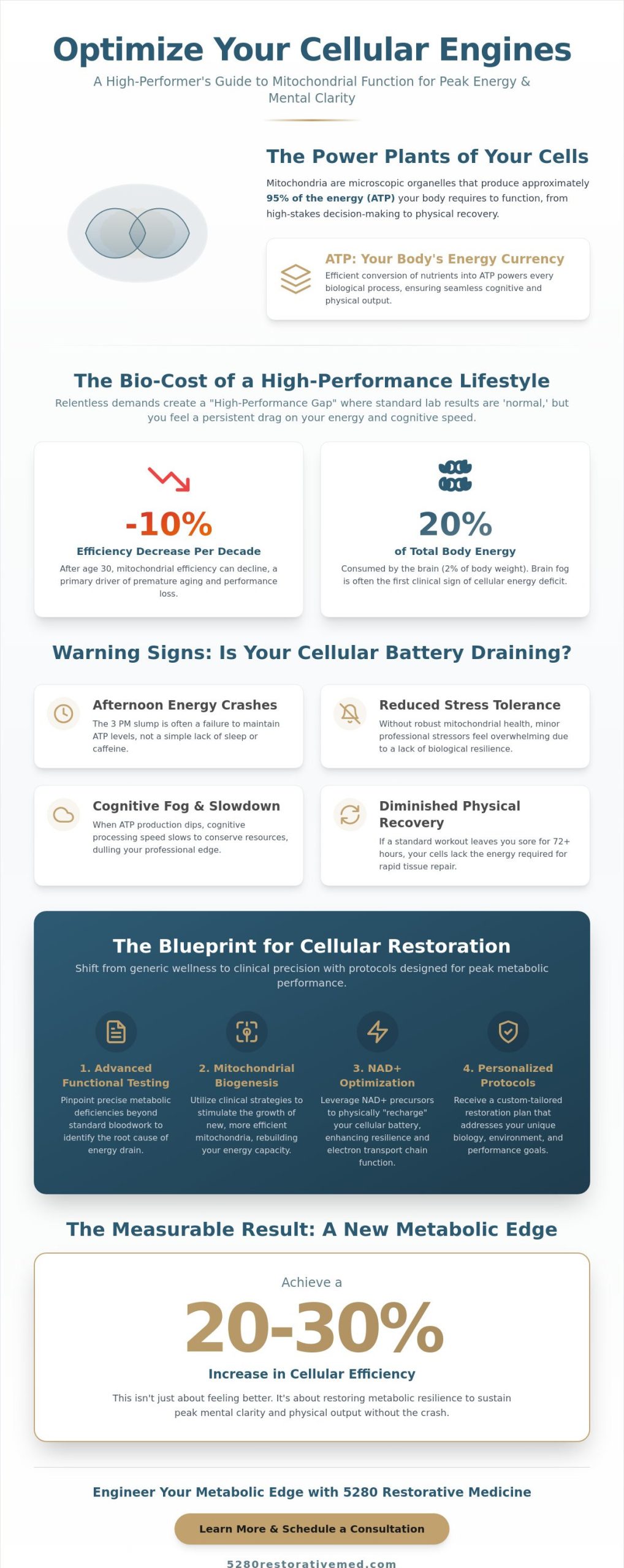
You wake up after seven hours of sleep, yet the mid-morning slump feels inevitable. This isn’t a lack of willpower or a need for more caffeine; it’s often a breakdown at the cellular level. To understand how to optimize mitochondrial function for energy, we must look at the organelles acting as your body’s internal power plants. These microscopic structures produce approximately 95% of the energy your body requires to function. Understanding What is a mitochondrion? is the first step in reclaiming your vitality and professional edge.
When these power plants operate at peak efficiency, you experience a steady stream of systemic energy that supports both physical movement and cognitive processing. However, a process known as mitochondrial decay can begin as early as your 30s, leading to a measured 10% decrease in production efficiency every decade. This decline is a primary driver of premature aging. It doesn’t just affect your muscles. It impacts the high-demand tissues of your heart and brain, which contain the highest concentrations of mitochondria in the human body.
The ATP Cycle: Your Body’s Energy Currency
Adenosine triphosphate, or ATP, is the primary molecule used by your cells to store and transfer energy for every biological process. Efficiently converting nutrients like fats and glucose into ATP prevents the buildup of metabolic sludge, which consists of oxidative byproducts that damage your cellular membranes. This conversion happens within the electron transport chain, a series of protein complexes that move electrons to generate the electrochemical gradient needed for ATP synthesis. High-performing individuals require a seamless electron flow to maintain the relentless cognitive and physical output their professional lives demand.
Symptoms of Mitochondrial Dysfunction in High-Performers
The human brain accounts for only 2% of total body weight but consumes roughly 20% of the body’s total energy supply. Because of this disproportionate demand, brain fog is often the first clinical warning sign that your cellular engines are struggling. When ATP production dips, your cognitive processing speed slows down to conserve resources. You might also notice several other key indicators of cellular fatigue:
- Afternoon energy crashes: These 3:00 PM slumps are frequently a cellular failure to maintain ATP levels rather than a simple caloric deficit or lack of sleep.
- Reduced stress tolerance: Robust mitochondrial health provides the biological resilience needed to handle cortisol spikes; without it, minor professional stressors feel overwhelming.
- Diminished physical recovery: If a standard workout leaves you sore for 72 hours instead of 24, your cells likely lack the energy liquidity required for rapid tissue repair.
At 5280 Restorative Medicine, we view these symptoms as data points. Learning how to optimize mitochondrial function for energy is about moving beyond basic survival and reaching a superior state of health where your biology actively supports your highest ambitions.
The Bio-Cost of Success: Why High-Performers Struggle with Mitochondrial Decay
High-performers often operate within the “High-Performance Gap.” This is the invisible space between standard lab results that appear “normal” and the vibrant, limitless energy required to lead an organization. You might not have a diagnosable disease, yet you feel a persistent drag on your cognitive speed and physical recovery. This decline isn’t a character flaw; it’s a physiological response to the relentless demands of an executive lifestyle. Understanding how to optimize mitochondrial function for energy starts with identifying what is currently draining your cellular battery.
Mitochondria are more than power plants; they’re environmental sensors. When they sense the “exhaust” of constant energy production without adequate recovery, they prioritize survival over performance. This shift creates a state of cellular friction where every task feels twice as demanding as it did five years ago. At 5280 Restorative Medicine, we view this decay not as an inevitability of aging, but as a reversible consequence of modern environmental stressors.
Stress, Cortisol, and Cellular Burnout
Chronic stress keeps the body in a high-cortisol state, which triggers the Cell Danger Response (CDR). During CDR, mitochondria stop producing ATP and instead harden their membranes to protect the cell from perceived threats. It’s a state of mitochondrial hibernation. Executive burnout is often just a prolonged CDR where your cells have forgotten how to switch back to “growth” mode. This process rapidly depletes critical cofactors like Magnesium, Zinc, and CoQ10. Without these nutrients, the mechanisms of mitochondrial function become sluggish, leading to a 20% to 30% drop in energy efficiency before you even finish your morning meetings.
Environmental Toxins and Mitochondrial Interference
Our modern environment is a minefield for cellular health. Blue light toxicity from late-night screen use disrupts the circadian rhythms that govern mitochondrial repair. When your internal clock is misaligned, your cells can’t clear out oxidative stress, the metabolic “exhaust” that damages the very engine producing your energy. This buildup leads to systemic inflammation and can even trigger mast cell activation syndrome, a hidden driver of brain fog and fatigue that many traditional providers overlook.
- Oxidative Stress: When free radicals outnumber antioxidants, they “rust” the mitochondrial DNA.
- Detoxification Lag: If your liver and lymphatic systems are sluggish, toxins recycle back into the bloodstream, inhibiting key mitochondrial enzymes.
- Circadian Mismatch: Artificial light exposure after 8:00 PM suppresses melatonin, the primary antioxidant that protects mitochondria during sleep.
If you’re ready to bridge the gap between baseline health and peak vitality, it’s time to look deeper than a standard physical. You can begin your journey toward cellular restoration and optimization by addressing these hidden drains on your performance.
Learning how to optimize mitochondrial function for energy requires a proactive strategy that addresses both the fuel you provide and the environment you inhabit. We don’t just aim for the absence of fatigue; we aim for the presence of power.
Beyond Standard Bloodwork: How to Measure Mitochondrial Health with Precision
Standard blood panels like the CBC or CMP are designed to identify pathology, not to fine-tune human performance. They tell you if your organs are failing, but they don’t reveal why you feel sluggish by 2:00 PM. To truly understand how to optimize mitochondrial function for energy, you must look at the metabolites and genetic markers that dictate cellular throughput. At 5280 Restorative Medicine, we move past the basics to analyze the specific chemical signals your cells send when they’re underpowered.
Diagnostic Tools for Cellular Optimization
Advanced metabolic testing, such as Organic Acids Testing (OAT), acts as a stress test for your biochemistry. By measuring organic acid levels in urine, we can pinpoint specific blocks in the Krebs cycle. For example, elevated glutaric acid often points to a riboflavin deficiency, while low levels of CoQ10 and L-carnitine indicate that your mitochondria can’t effectively transport fuel into the cellular furnace. These aren’t just numbers; they’re a roadmap for restoration.
- Genetic Analysis: Identifying SNPs like MTHFR or COMT reveals how your body handles methylation and neurotransmitter clearance, which directly impacts energy levels.
- Oxidative Stress Markers: We measure 8-hydroxy-2′-deoxyguanosine (8-OHdG), a premier marker for DNA damage. A study published in 2022 showed that individuals with high 8-OHdG levels experience a 30 percent faster decline in mitochondrial efficiency.
- Nutrient Panels: Checking intracellular levels of magnesium and B vitamins ensures the cofactors for energy production are actually present inside the cell, not just circulating in the blood.
Why ‘Normal’ Labs Aren’t Enough for Peak Performance
The reference ranges you see on standard lab reports are based on a bell curve of the general population. Since 60 percent of adults live with at least one chronic condition, being normal isn’t the goal for an executive or high-achiever. At 5280 Restorative Medicine, we focus on optimal ranges that represent the top 5 to 10 percent of healthy individuals. This functional medicine approach shifts the focus from avoiding disease to engineering resilience.
Longitudinal tracking is the final piece of the puzzle. A single lab test is just a snapshot in time. By monitoring these markers every four to six months, we create a biological map of your progress. This allows us to adjust your protocol based on real-time data rather than generic templates. Understanding how to optimize mitochondrial function for energy requires this level of clinical precision to ensure your biological age stays well below your chronological one. It’s about moving from reactive care to proactive mastery of your own biology.
5 Proven Strategies to Optimize Mitochondrial Biogenesis and ATP Production
Restoring your vitality requires more than just maintaining existing cellular structures; it involves the active creation of new ones. Mitochondrial biogenesis is the biological process where your cells increase their mitochondrial mass. This isn’t just a theoretical concept. It’s a measurable shift in your cellular architecture that directly impacts your daily stamina. When you learn how to optimize mitochondrial function for energy, you transition from managing fatigue to cultivating a surplus of cellular power.
Advanced Supplementation: NAD+, CoQ10, and PQQ
Your cellular batteries require specific molecular precursors to maintain a high state of charge. NAD+ (Nicotinamide Adenine Dinucleotide) is central to this process, yet research shows that NAD+ levels can drop by 50% by the time you reach age 50. This decline impairs DNA repair and slows down the electron transport chain. Supplementing with NAD+ precursors helps bridge this gap. While CoQ10 serves as a vital electron carrier, PQQ (Pyrroloquinoline quinone) is unique for its ability to stimulate the spontaneous growth of new mitochondria. A clinical protocol often includes 200mg of Ubiquinol (CoQ10) paired with 400mg of Magnesium glycinate to support the ATP synthesis cycle.
Bio-Optimization Technologies
Modern clinical interventions offer direct pathways to cellular restoration. One of the most effective tools is red light therapy, which uses specific wavelengths to stimulate Cytochrome c oxidase, the enzyme responsible for final ATP production. Beyond light, Pulsed Electromagnetic Field (PEMF) therapy influences cellular voltage, helping to “recharge” the transmembrane potential of your cells. For those seeking efficiency, High-Intensity Interval Training (HIIT) acts as a powerful biological signal. Short, 15 minute bursts of intense activity trigger mitochondrial turnover, clearing out damaged units and replacing them with high-performing versions.
Circadian Biology and Sleep Architecture
Your mitochondria operate on a strict internal clock. During deep sleep, your body initiates autophagy, a critical “cellular cleanup” that removes metabolic waste. If you eat within three hours of bedtime, you redirect energy away from this cleanup process, leading to mitochondrial sluggishness the next morning. Aligning your light exposure by seeking sunlight within 30 minutes of waking helps set these rhythms. At 5280 Restorative Medicine, we view this alignment as a cornerstone of longevity. By protecting your sleep architecture, you ensure your mitochondria have the downtime necessary for peak performance. Understanding how to optimize mitochondrial function for energy is as much about rest as it is about activity.
Ready to move beyond basic wellness and achieve true cellular peak performance? Contact 5280 Restorative Medicine today to develop your personalized optimization plan.
Engineering Your Metabolic Edge with 5280 Restorative Medicine
Generic wellness advice often fails because it treats every patient like a statistical average. At 5280 Restorative Medicine, we reject the “one size fits all” model in favor of a sophisticated, two-step philosophy: Restoration first, then Optimization. Understanding how to optimize mitochondrial function for energy requires more than just adding a few supplements to your morning routine; it requires clearing the biological debt accumulated from years of high-stakes stress, poor sleep, or age-related decline. Once we restore your cellular baseline, we move toward optimization, pushing your metabolic systems to their absolute peak potential.
Our approach replaces the guesswork of the traditional healthcare system with precision medicine. We don’t just look for the absence of disease; we look for the presence of vitality. By focusing on the intricate machinery of your cells, we help you build a body that’s resilient enough to handle the demands of executive leadership and an active life. It’s a proactive journey that transforms your health from a reactive necessity into a strategic advantage.
The 5280 Clinical Process
Your experience begins with a deep-dive consultation that functions as a high-level diagnostic audit. We analyze specific metabolic biomarkers, hormonal balance, and micronutrient levels that standard physicals often overlook. This data-driven foundation allows our clinicians to design custom nutrition and supplement protocols tailored to your unique biochemistry. We don’t leave your progress to chance. Our team provides ongoing clinical support, monitoring your metabolic response every 90 days to ensure your plan evolves alongside your physiological improvements. This continuous feedback loop ensures your cellular engines are always running at maximum efficiency.
Your Path to Sustained Vitality
True peak performance is never a one-time fix. It’s a continuous, proactive commitment to your future self. For those who demand the highest level of care, our Executive Health Program provides a comprehensive roadmap that goes beyond the physical to ensure long-term cognitive and metabolic resilience. We guide you through the transition from persistent cellular fatigue to a state of total metabolic flexibility. Our clinicians teach you how to optimize mitochondrial function for energy by aligning your lifestyle with your internal data, allowing you to move from simply surviving your schedule to thriving in every arena of life. You’ve spent your career building a legacy; we provide the biological foundation to help you sustain it.
Secure Your Metabolic Edge
Your cellular health shouldn’t be left to chance. Understanding how to optimize mitochondrial function for energy is the definitive boundary between chronic burnout and sustained executive performance. Since mitochondria generate 90% of the chemical energy your cells need to survive, according to data from the Cleveland Clinic, protecting these powerhouses is a non-negotiable investment. You’ve learned that standard bloodwork often misses the nuances of ATP production and that true resilience requires a targeted, diagnostic-led approach.
At 5280 Restorative Medicine, we move beyond generic wellness. Led by Dr. Marci Catallo-Madruga, a functional medicine expert, our practice uses comprehensive metabolic and genetic diagnostics to map your unique physiology. We’ve developed specialized protocols that address the specific stressors high-performers face every day. It’s time to stop managing symptoms and start engineering a more vibrant, capable version of yourself.
Reclaim your vitality with a personalized Executive Health Program and experience the clarity that comes with true cellular restoration. You have the power to redefine your peak years starting today.
Frequently Asked Questions
How long does it take to improve mitochondrial function?
You can begin to see measurable shifts in your cellular efficiency within 4 to 12 weeks of consistent intervention. While immediate energy boosts can occur from specific clinical treatments, the biological process of mitochondrial biogenesis typically requires 60 days of sustained stimuli. Research published in the Journal of Physiology indicates that just 6 weeks of high intensity interval training can increase mitochondrial capacity by 50% in healthy adults.
Can I optimize my mitochondria through diet alone?
Diet provides the essential raw materials for energy, but it’s rarely enough to reach peak performance in a high stress executive environment. While nutritional strategies like the ketogenic diet or intermittent fasting trigger mitophagy, environmental toxins and age related decline often require more targeted interventions. At 5280 Restorative Medicine, we find that combining a nutrient dense diet with clinical protocols is the most effective way to learn how to optimize mitochondrial function for energy.
What is the best supplement for mitochondrial energy?
Coenzyme Q10 in its active ubiquinol form remains the gold standard for supporting the electron transport chain. When you pair 200 mg of Ubiquinol with 20 mg of PQQ, you stimulate the growth of new mitochondria rather than just repairing old ones. Clinical trials show this specific combination can improve cognitive function and reduce fatigue scores by 25% over a 12 week period. We personalize these dosages based on your specific cellular requirements and blood chemistry.
Is there a specific test to see if my mitochondria are working?
We utilize the Organic Acids Test to analyze 75 different urinary markers that reflect your internal metabolic processing. This diagnostic tool measures specific metabolites like citrate and malate to pinpoint exactly where your energy production is stalling. By identifying these biochemical bottlenecks, we move beyond generalized wellness and create a precise roadmap for your restoration and optimization. This data allows us to treat the root cause of your fatigue rather than just the symptoms.
How does stress actually kill my energy at the cellular level?
Chronic stress triggers a sustained release of cortisol, which shifts your mitochondria from energy production to a cellular defense mode. This transition increases the production of Reactive Oxygen Species that damage mitochondrial DNA. When 20% or more of your oxygen intake is diverted toward creating these inflammatory byproducts, your ATP production drops significantly. You’ll feel this as the afternoon slump or persistent mental fog that resists caffeine and sleep.
What is NAD+ and do I really need it for mitochondrial health?
NAD+ is a critical coenzyme that acts as the primary electron carrier in the production of ATP. Your natural levels of NAD+ can drop by as much as 50% by the time you reach age 50, which directly impacts your cellular stamina. Without sufficient NAD+, your mitochondria can’t effectively convert fuel into usable energy. Replenishing these levels through precursors or IV therapy is a cornerstone of how to optimize mitochondrial function for energy and long term cellular longevity.
Can red light therapy actually boost my energy levels?
Red light therapy at wavelengths of 660nm and 850nm directly stimulates cytochrome c oxidase, a key enzyme in the mitochondrial respiratory chain. This process increases ATP production and reduces systemic inflammation simultaneously. A 2015 study in Photomedicine and Laser Surgery demonstrated that 10 to 20 minute sessions can significantly improve muscle recovery and baseline energy levels. It’s a non-invasive way to recharge your cellular batteries and improve your daily resilience.
Is mitochondrial dysfunction reversible?
Mitochondrial dysfunction isn’t a permanent state because your body is designed for constant renewal. Through a process called mitophagy, your cells identify and recycle damaged mitochondria to make room for healthy, high performing ones. By implementing a structured plan that includes cold exposure, targeted supplementation, and hormonal balance, you can begin reversing cellular decline in as little as 10 days. Our goal at 5280 Restorative Medicine is to guide you through this transformation toward superior vitality.