
Why can you navigate a high-stakes boardroom negotiation with ease, yet find yourself sidelined by the complexity of a morning supplement stack or a specific metabolic timing window? It’s a common frustration for high achievers who expect the same level of precision in their biology that they demand in their business operations. You’ve likely felt the weight of executive decision fatigue after a long day, making even the most sophisticated health protocol feel like an unwelcome burden rather than a roadmap to vitality. Understanding how to stick to a personalized health plan isn’t about finding more discipline; it’s about re-engineering your environment and your biology to reduce friction.
When your routine is disrupted by travel or back-to-back meetings, willpower often fails before the systems do. This guide identifies the clinical and psychological strategies required to bridge the gap between receiving a protocol and achieving peak metabolic performance. We will explore how to turn complex data into sustainable habits through metabolic testing and real-time feedback loops. By the end, you’ll have a framework to transform your health journey from a reactive necessity into a proactive, automated path toward renewal and superior physical function.
Key Takeaways
- Bridge the “Performance Gap” by reframing your clinically-derived protocol as a tool for metabolic optimization rather than a logistical burden.
- Master how to stick to a personalized health plan by identifying “Executive Friction” and implementing automation strategies that reduce the mental energy required for daily adherence.
- Use metabolic testing to gain “Objective Truth,” providing the immediate psychological feedback needed to stay committed to your long-term health trajectory.
- Deploy the “Minimum Effective Dose” strategy and specialized travel protocols to ensure your health routines remain intact during high-stress cycles or business travel.
- Learn why delegating your health management to a boutique clinical partner can eliminate the cognitive load of self-monitoring and accelerate your results.
What Is a Personalized Health Plan and Why Does Adherence Often Stall?
A personalized health plan is far more than a collection of general wellness tips; it’s a clinically-derived roadmap built on the bedrock of your unique metabolic markers and genetic data. While standard advice tells you to “get more sleep” or “eat more greens,” a precision protocol tells you exactly which nutrients your body lacks and how your specific hormones respond to stress. This level of Personalized medicine ensures that every action you take is backed by biological evidence rather than guesswork. It’s about reaching a superior state of physical function, not just avoiding illness.
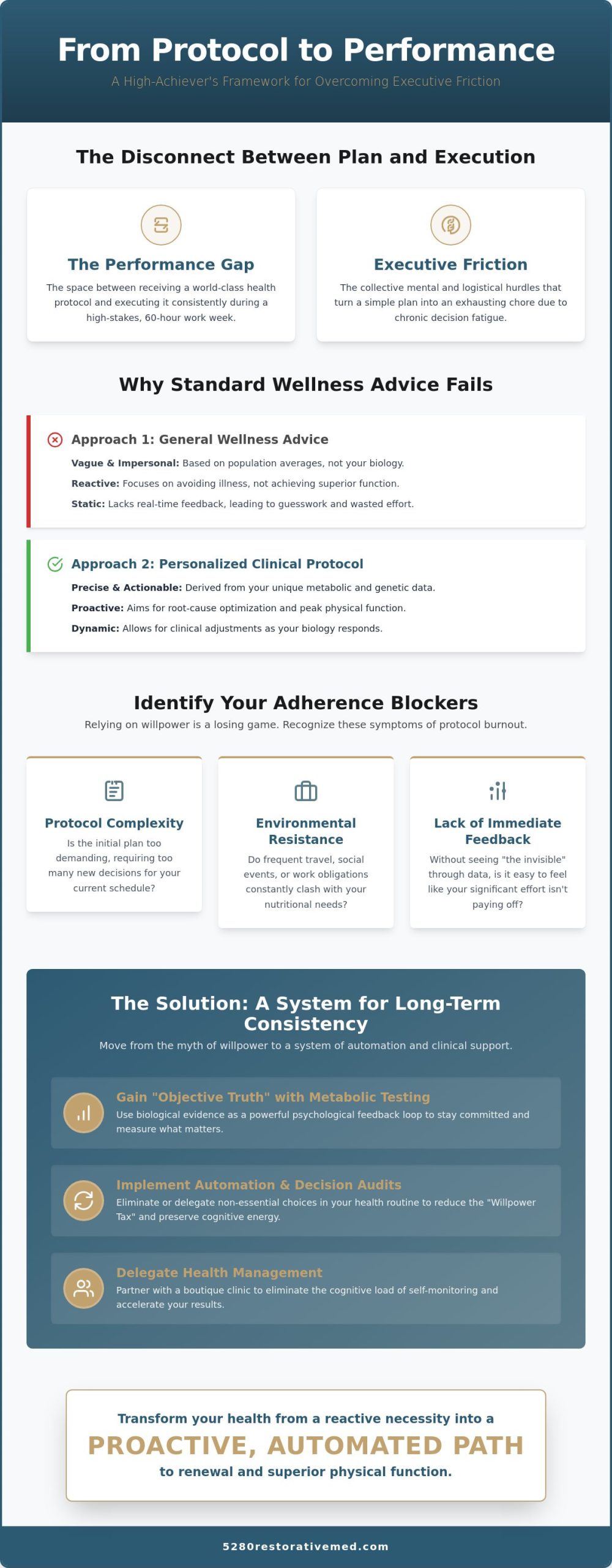
Despite having this data, many high-performers encounter the “Performance Gap.” This is the psychological and logistical space between receiving a world-class protocol and executing it during a 60-hour work week. If you’ve wondered how to stick to a personalized health plan while managing a company, you aren’t alone. Adherence often stalls because of decision fatigue. When you spend your day making high-stakes choices, your brain lacks the “activation energy” to weigh the merits of a complex supplement stack at 9:00 PM. The plan isn’t the problem; the friction is.
We must shift the internal narrative. Success isn’t about restriction or “dieting.” It’s about the restoration of your baseline function and the optimization of your mental clarity. When you view your protocol as a performance enhancer rather than a list of rules, the mental resistance begins to dissolve. This transition from a reactive necessity to a proactive journey is what defines our community’s approach to long-term vitality.
The Difference Between General Wellness and Clinical Protocols
Generic health advice often fails because it lacks the precision required for a high-output lifestyle. A strategy rooted in functional health and wellness moves beyond the absence of disease to focus on root-cause optimization. Clinical oversight allows for real-time adjustments. As your biology shifts in response to the protocol, your partner in health fine-tunes the requirements. This ensures you never plateau or waste effort on ineffective interventions that don’t move the needle on your specific biomarkers.
Identifying the ‘Friction Points’ in Your Current Routine
Relying on mental strength is a losing game. This “Willpower Tax” is the reason many executives abandon their health goals. If your environment doesn’t support your plan, you’re fighting an uphill battle every day. Recognizing the symptoms of protocol burnout early is essential for long-term success. Ask yourself if these common blockers are slowing your progress:
- Protocol Complexity: Is the initial phase too demanding for your current schedule?
- Environmental Resistance: Do your social or travel obligations constantly clash with your nutritional needs?
- Lack of Immediate Feedback: Without seeing “the invisible” through data, it’s easy to feel like the effort isn’t paying off.
By identifying these friction points, we can move toward a system of automation and clinical support that makes adherence the path of least resistance.
Overcoming ‘Executive Friction’ to Secure Long-Term Consistency
High performers rarely fail due to a lack of discipline. Instead, they fall victim to “Executive Friction,” the collective mental and logistical hurdles that turn a simple protocol into an exhausting chore. When you manage complex organizations, your cognitive resources are a finite currency. If your health strategy requires you to make twenty new decisions every morning, you’re essentially taxing your own productivity. Understanding how to stick to a personalized health plan requires moving away from the willpower myth and toward a system of biological automation.
To secure long-term consistency, you must conduct a “Decision Audit.” This process involves identifying every non-essential choice in your health routine and either eliminating it or delegating it. Just as you wouldn’t manually manage every line item in a corporate budget, you shouldn’t have to debate which nutrients to take or what time to exercise. By aligning your health plan with your existing professional systems, such as your digital calendar or executive assistant’s workflow, you treat your physical optimization with the same operational rigor as a board meeting.
Automating the Basics to Preserve Mental Bandwidth
Success in any protocol begins with reducing the “activation energy” required to start a task. If your supplements are tucked away in a cupboard, the friction is high. If they’re pre-staged in daily travel packs on your desk, the friction is near zero. Decision Fatigue in the context of health management is the gradual depletion of self-control due to high-stakes professional demands. To combat this, leverage high-end meal automation and professional Executive Health Program support to remove the “what to eat” question entirely. Standardizing a morning “Power Hour” that includes hydration and light therapy ensures your baseline is met before the first email arrives.
Designing an Environment for Automatic Success
Your environment acts as a silent architect of your behavior. By placing visual cues in your office and home, you trigger protocol adherence without conscious effort. This is a critical part of the various stages of changing your health habits, specifically the maintenance phase. If your desk setup encourages movement or your kitchen only stocks protocol-compliant fuel, you’ve utilized the “Path of Least Resistance” principle. The healthy choice becomes the easiest, most logical choice.
Managing social friction is equally vital. Business dinners and travel shouldn’t be “cheat days” that derail your progress. Instead, establish a pre-defined “Travel Protocol.” This might include a specific menu selection strategy or a portable supplement kit. When you have a predetermined plan for social settings, you eliminate the need for mid-dinner negotiations with yourself. This systematic approach ensures your metabolic performance remains high, regardless of your geographic location or social obligations.
The Role of Metabolic Testing in Maintaining Motivation
Seeing the “invisible” through clinical data is a powerful psychological lever. While the bathroom scale might fluctuate due to hydration or muscle gain, metabolic testing provides the objective truth of your physiological state. It reveals exactly why your energy dips at 3:00 PM or why your cognitive recovery lags after a high-stress week. This data transforms your health journey from a guessing game into a strategic performance initiative. If you want to know how to stick to a personalized health plan, look at the numbers. High-performers thrive on KPIs; your health should be no different. By framing your biology through functional medicine for high-performers, you begin engineering metabolic resilience at a cellular level.
Tracking specific biomarkers creates a gamified experience. Instead of a vague goal of “getting healthy,” you’re now focused on optimizing your fasting insulin or balancing your lipid profile. This shift in perspective is vital for long-term adherence. When you can correlate your daily habits to measurable improvements in your bloodwork, the protocol stops being a chore. It becomes a vital component of your professional edge.
Quantifying Your Progress Beyond the Surface
Surface-level metrics often hide the most important shifts in your biology. We focus on key biomarkers like insulin sensitivity, inflammatory markers, and cortisol rhythms to provide a clear picture of your internal health. These micro-wins in your bloodwork sustain effort during weight-loss plateaus or periods of high professional stress. Quarterly assessments serve as a “re-test” to recalibrate your approach, ensuring your energy remains high and your metabolic function stays sharp. This rhythm of testing and adjusting provides the constant feedback loop necessary to maintain momentum.
Bio-Individual Feedback vs. Subjective Feeling
“Feeling fine” is a dangerous metric for the high-achiever. You’re likely accustomed to pushing through fatigue and ignoring subtle physical cues. Data removes this subjectivity. It allows us to identify hidden stalling points, such as mast cell activation syndrome, which can mimic general stress or burnout. When you understand the physiological cause of your symptoms, you’re more likely to stay committed to the solution. Your health plan is no longer a set of rules; it’s a bespoke blueprint for exceeding your baseline performance.
Strategic Integration: Systems for Daily Protocol Adherence
Successful optimization doesn’t rely on the absence of chaos; it depends on the strength of your systems when chaos arrives. For the high-performer, the question of how to stick to a personalized health plan isn’t answered in the quiet moments of a Sunday morning. It’s answered at 4:00 PM on a Tuesday when a meeting runs long and your pre-planned meal is miles away. By integrating your health requirements into your existing professional architecture, you move from a state of constant negotiation to one of effortless execution. This requires a “Resilience Toolkit” designed to keep your metabolic trajectory on track even when your schedule breaks.
Habit stacking is a cornerstone of this integration. By attaching a new protocol requirement to a non-negotiable routine, like taking your morning supplement stack immediately after checking your first-quarter projections, you bypass the need for a separate “health” reminder. Your professional habits become the anchor for your physiological renewal. This systematic approach ensures that your health journey remains a proactive priority rather than a reactive afterthought.
The MED Strategy: Keeping the Chain Unbroken
On high-stress days, 100% adherence might be impossible. This is where the Minimum Effective Dose (MED) strategy becomes essential. You must define your “Tier 1” habits, the non-negotiable actions that keep your biological foundation stable. Doing 20% of your plan is infinitely better than doing 0%. If you can’t complete a full training session, a ten-minute focused movement window still signals to your body that the protocol is active. This prevents the psychological weight of failure and allows you to quickly “reset” without losing the momentum you’ve built through your clinical interventions.
The High-Performer’s Travel and Social Framework
Travel is often where health plans go to die, but it doesn’t have to be that way. Pre-travel preparation, such as vetting restaurant menus and packing portable supplement kits, removes the stress of on-the-road decision-making. If you are currently utilizing bhrt or other hormone optimization strategies, maintaining consistency while traveling is vital for stabilizing your mood and energy levels. Navigate social dining by establishing clear boundaries; tell peers you’re on a specific performance protocol to avoid “awkward” explanations. This transparency often earns respect rather than scrutiny.
Building these systems ensures your metabolic performance never takes a backseat to your professional obligations. Schedule a Functional Medicine Consultation to build your bespoke integration strategy and secure your long-term vitality.
The Boutique Advantage: Why Partnership Beats Self-Management
High-performers understand the value of leverage in every other area of their lives. You delegate legal, financial, and operational tasks to experts to ensure precision and prevent errors. Your biology deserves the same level of professional oversight. Trying to figure out how to stick to a personalized health plan while managing a demanding career often leads to failure because it adds another layer of “work” to an already full plate. A boutique clinical partnership removes the cognitive load of self-monitoring. It replaces the stress of “guessing” your next steps with the confidence of data-driven guidance. This isn’t about adding more to your schedule; it’s about optimizing the time you already spend on your health.
In this model, you aren’t just a patient seeking to fix a problem. You’re a high-performance client investing in your most valuable asset. The accountability found in a high-stakes, boutique medical environment provides the structural support necessary for long-term consistency. When you have a partner tracking your biomarkers and adjusting your protocol in real-time, adherence becomes a shared mission rather than a solitary burden. This relationship fosters a sense of hope and empowerment, emphasizing that peak physical and mental states are achievable at any stage of life. We treat health as a proactive journey, ensuring you always have a clear path forward toward superior function.
Delegating Your Health Strategy to Experts
Even the most disciplined executives benefit from external clinical guidance. Life is rarely static; your health plan shouldn’t be either. The true value of a partnership lies in “Just-in-Time” adjustments. When a merger or a global travel circuit increases your stress levels, your partner pivots your protocol to protect your metabolic baseline. We move beyond standard care by offering executive health programs that prioritize peak performance over mere symptom management. This high-end approach ensures that your protocol remains relevant and effective, regardless of the professional demands placed upon you. You don’t have to be the expert in clinical nutrition or endocrinology when you have a partner who is.
Your Next Step Toward Restorative Excellence
Your journey toward sustainable optimization begins with a comprehensive metabolic and genetic assessment. This initial deep dive provides the “Objective Truth” required to build your bespoke roadmap. It’s the difference between following a generic trend and executing a strategy designed for your specific DNA. Starting a conversation about a sustainable, high-performance protocol is the first step toward exceeding your current baseline. You’ve already mastered the systems for business success. Now, it’s time to apply that same strategic rigor to your longevity and physical renewal. The path to peak metabolic performance is open. It simply requires the right partner to guide the way.
Securing Your Future Through Biological Precision
Sustainable health optimization isn’t a matter of willpower; it’s a matter of architecture. By reducing executive friction and utilizing objective metabolic data, you can transform a complex clinical protocol into an automated part of your high-performance routine. You now understand that how to stick to a personalized health plan depends on the strength of your systems and the quality of your clinical partnership. This shift from reactive care to proactive renewal ensures your physical and mental states remain at their peak regardless of professional demands.
It’s time to bridge the gap between receiving data and achieving results. Through Advanced Metabolic & Genetic Testing and the boutique clinical oversight of Dr. Marci Catallo-Madruga, we provide the expert leverage you need to exceed your baseline performance. Whether you are local or one of our many national clients, we offer the tailored protocols required for lasting restoration. Reclaim your vitality with a bespoke Executive Health Program and take command of your longevity today. You’ve built a legacy of success in business; now is the time to build a legacy of health that allows you to enjoy it for decades to come.
Frequently Asked Questions
How long does it take for a personalized health plan to become a habit?
It typically takes an average of 66 days for a new health behavior to become automatic, though this timeframe can vary based on the complexity of the protocol. For high-performers, the key is to focus on the first 21 days where “activation energy” requirements are highest. By the third month, the biological feedback loop from your improved metabolic function often provides the internal motivation needed to sustain the routine without conscious effort.
What should I do if I miss several days of my health protocol?
You should immediately implement your pre-defined “Reset” strategy rather than attempting to “make up” for lost time with extreme measures. A lapse is simply a data point, not a failure of discipline. Re-engage with your Tier 1 habits first to stabilize your metabolic baseline. Once you’ve completed 24 hours of successful adherence, you can resume the full complexity of your clinical protocol without the psychological weight of a perceived setback.
Is it possible to stick to a personalized plan while traveling for business?
It’s entirely possible to maintain your results on the road by utilizing a specific Travel Protocol that accounts for hotel environments and restaurant dining. Success depends on pre-travel preparation, such as vetting local menus and packing portable supplement kits. Learning how to stick to a personalized health plan during travel involves shifting your environment to favor the path of least resistance, ensuring your metabolic performance doesn’t suffer during high-stakes business trips.
How often should my personalized health plan be updated?
Your protocol should generally be updated every 90 days following a comprehensive metabolic re-assessment. As your biology shifts and your biomarkers improve, the interventions required to exceed your baseline performance will also evolve. Quarterly updates allow your clinical partner to fine-tune your supplement stacks and nutritional targets, ensuring you don’t plateau. This rhythmic recalibration keeps the plan aligned with your current physiological needs and professional stress cycles.
Can I maintain a personalized plan without constant clinical supervision?
While you can maintain a baseline routine independently, achieving peak metabolic optimization usually requires ongoing clinical partnership to interpret complex data. High-performers benefit from delegating the cognitive load of health management to experts who can make “Just-in-Time” adjustments. Professional oversight ensures that your protocol stays safe and effective as your life circumstances change, preventing the “guessing” that often leads to protocol abandonment or diminished results.
Why do I lose motivation even when my health plan is tailored to me?
Motivation often wanes due to “Executive Friction” and a lack of immediate, visible feedback loops. Even a tailored plan can feel like a burden if it hasn’t been integrated into your daily professional systems. When the initial excitement fades, relying on willpower alone becomes a failing strategy. Re-engaging with your metabolic data through testing can provide the “Objective Truth” needed to reignite your commitment by showing you the cellular progress you can’t yet feel.
What are the most common mistakes people make when starting a new health protocol?
The most frequent error is attempting to implement 100% of a complex protocol on day one, which quickly leads to burnout. Many high-achievers also fall into “all-or-nothing” thinking, abandoning the plan entirely after a single missed dose. Instead, focus on mastering the Minimum Effective Dose first. Another mistake is failing to audit your environment, which forces you to use finite willpower to make healthy choices instead of relying on automated systems.
How do I balance a high-stress career with a demanding health plan?
You balance these competing demands by treating your health as a strategic performance initiative rather than an outside hobby. Integrating how to stick to a personalized health plan into your existing workflow, such as habit stacking protocol tasks with non-negotiable meetings, reduces mental friction. When you view your protocol as the fuel that powers your professional output, it stops being a distraction and becomes an essential tool for maintaining your competitive edge.