
What if your standard blood panel is actually obscuring the truth about your cognitive fatigue? Many high-performers find themselves staring at “perfect” lab results while struggling with persistent brain fog and recovery times that feel increasingly sluggish. It’s a common frustration to invest heavily in premium supplements without any objective proof that they’re optimizing your biology. You deserve to know exactly how your cellular machinery is performing.
Understanding how to test nad levels is the first step in moving from reactive health to proactive cellular engineering. By measuring your intracellular fuel, you can establish a clear baseline and finally validate whether your NMN or NAD+ therapy is delivering results. This clinical guide explores the latest diagnostic standards for 2026, including LC-MS/MS panels and at-home intracellular kits. You’ll learn how to turn raw data into a bespoke protocol that ensures your executive stamina remains your greatest competitive advantage.
Key Takeaways
- Identify cellular energy depletion before symptoms like brain fog become debilitating by moving beyond standard blood panels.
- Evaluate the differences between at-home finger-prick kits and advanced clinical diagnostics to determine exactly how to test nad levels for your specific goals.
- Understand why the NAD+/NADH ratio serves as a more precise indicator of your metabolic flexibility than a single data point.
- Transition from “clinically normal” results to “physiologically optimal” levels that support the high-stakes demands of executive leadership.
- Learn how to integrate your diagnostic results into a bespoke performance protocol that validates and optimizes your longevity strategy.
Why Testing NAD+ Levels is the New Benchmark for High-Performers
You might notice that your cognitive edge isn’t quite what it was five years ago. Perhaps you’re relying on an extra espresso to clear the mid-afternoon haze, or you’ve found that travel recovery takes days instead of hours. While many dismiss these shifts as the inevitable tax of a high-stakes career, they’re often the first visible signs of a deeper biological decline. At the center of this transition is Nicotinamide adenine dinucleotide (NAD), a critical coenzyme found in every living cell. It serves as the primary engine for cellular energy and DNA repair, yet its availability is finite.
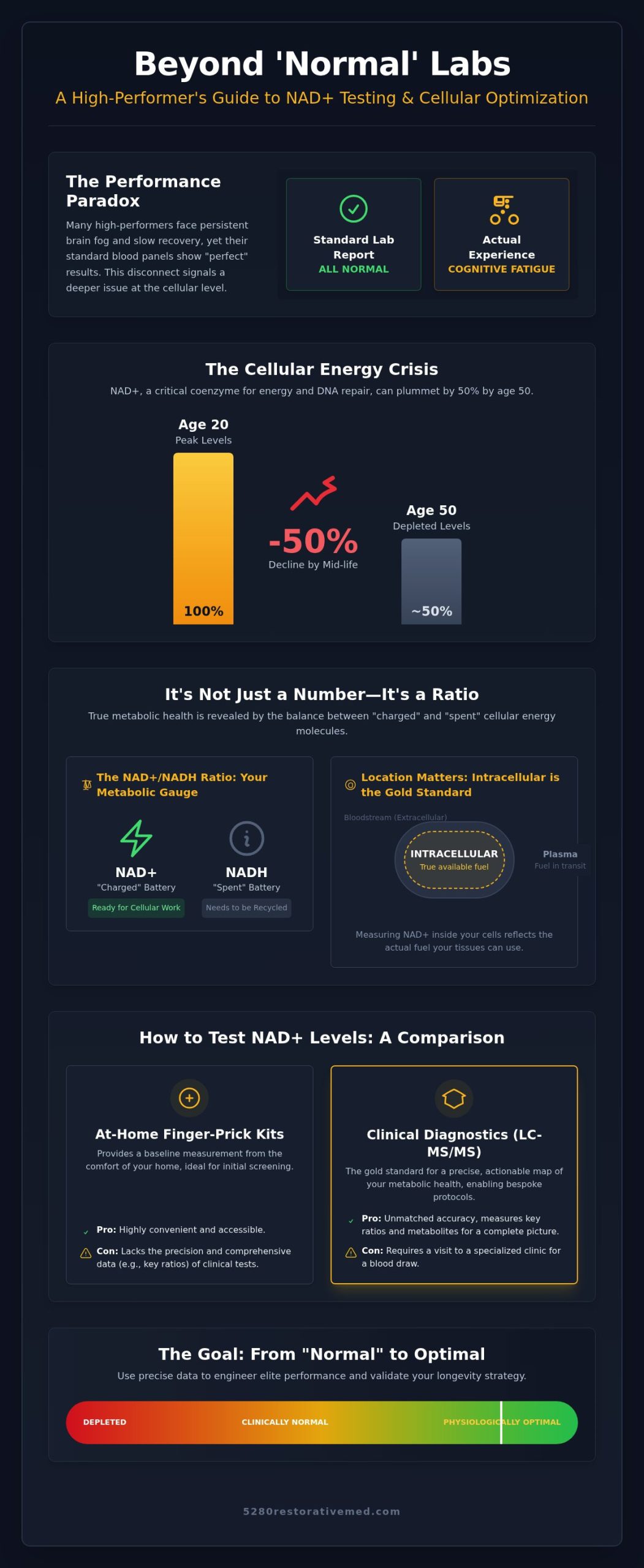
By the time most executives reach age 50, their internal NAD+ levels have typically plummeted by 50% compared to their 20s. This isn’t just a number on a lab report; it’s a massive reduction in the fuel available for your brain and body to maintain peak function. Waiting until you feel “burnt out” to address this is a reactive mistake. Persistent fatigue is actually a late-stage symptom of cellular energy depletion that has been occurring for years. Learning how to test nad levels allows you to move beyond the guesswork of generic supplementation and start bio-engineering your health with clinical precision.
The Executive Energy Crisis: Beyond Basic Fatigue
High-stress environments are notorious for accelerating the consumption of your cellular resources. When your body is under constant pressure, it prioritizes immediate survival over long-term repair, rapidly burning through NAD+ to manage oxidative stress. This depletion manifests as a noticeable drop in cognitive processing speed and mental resilience. Shifting your focus toward functional health and wellness provides a strategic framework to build metabolic resilience. Testing ensures your protocol is tailored to your unique burn rate, preventing the energy “crashes” that derail leadership performance.
NAD+ as a Proxy for Mitochondrial Health
Your mitochondria are the power plants of your cells, and they cannot produce ATP, the body’s primary energy currency, without sufficient NAD+. When you understand how to test nad levels, you gain a transparent window into your overall metabolic capacity. Low levels often indicate that your mitochondria are struggling to keep up with your lifestyle demands. This diagnostic data is invaluable when choosing targeted interventions. For instance, many of our clients use their test results to guide the frequency of red light therapy sessions, ensuring they provide the precise mitochondrial support needed to exceed their previous baseline performance.
The Science of NAD+ Testing: Biomarkers and Metabolic Indicators
Precision medicine requires more than a single data point; it requires a map of your metabolic terrain. When you investigate how to test nad levels, you quickly realize that the total amount of NAD+ is only half the story. To understand your true performance capacity, we must look at the relationship between NAD+ and its reduced form, NADH. Think of NAD+ as a charged battery ready to perform work, while NADH is the spent version. The ratio between these two molecules is a primary indicator of your metabolic flexibility. A high-performance state depends on your body’s ability to rapidly cycle between these forms to meet the cognitive and physical demands of your day.
We also monitor secondary metabolites like Nicotinamide (NAM). These molecules are essential components of the “salvage pathway,” the internal recycling system that rebuilds NAD+ from its broken-down parts. If your NAM levels are elevated while your NAD+ remains low, it suggests your recycling machinery is failing. This is particularly relevant for executives facing high cortisol levels from chronic stress, which can actively disrupt these pathways. Understanding the science of NAD+ supplements becomes much more powerful when you know whether your body can actually process the precursors you’re ingesting.
Intracellular vs. Extracellular Testing
Accuracy depends entirely on where the sample is drawn from. While some laboratories test NAD+ in the plasma (extracellular), this only reveals what is circulating in the “delivery trucks” of your bloodstream. The real work of energy production happens inside your cells. Measuring intracellular NAD+ within red blood cells is the gold standard because it reflects the actual fuel available to your tissues. Intracellular testing is the only way to obtain the granular, actionable data needed to adjust a high-level performance protocol.
The Role of LC-MS/MS Technology
To achieve clinical-grade results in 2026, we rely on Liquid Chromatography-Tandem Mass Spectrometry (LC-MS/MS). This sophisticated technology allows us to separate and quantify molecules that look nearly identical under less advanced methods. It provides a level of diagnostic rigor that ensures your results aren’t just an estimate, but a precise measurement of your cellular health. For those seeking to exceed their previous baseline, this level of detail is non-negotiable. If you’re ready to move beyond generic wellness, a professional metabolic testing consultation can provide the clarity you need to optimize your internal chemistry.
Comparing NAD+ Testing Methods: At-Home Kits vs. Clinical Diagnostics
You lead a complex life, and your diagnostic strategy should reflect that sophistication. When you’re deciding how to test nad levels, the choice usually falls between the convenience of a home-based kit and the comprehensive depth of a clinical venous draw. Both methods utilize advanced technology, but they serve different strategic purposes in a high-performance longevity protocol. Understanding the nuances of each ensures you aren’t just collecting data, but gaining the specific insights required to move the needle on your daily performance.
The primary trade-off involves convenience versus context. While a quick result is helpful, it often lacks the surrounding metabolic markers that explain why your levels are where they are. We recommend looking for laboratories that carry CLIA (Clinical Laboratory Improvement Amendments) or CAP (College of American Pathologists) certifications. These labels ensure the facility meets rigorous federal standards for accuracy and reliability, providing the clinical-grade certainty that high-stakes leadership demands.
At-Home Testing: Speed and Accessibility
At-home kits typically use a Dried Blood Spot (DBS) method. You perform a simple finger prick, place several drops of blood onto a specialized collection card, and mail it to a certified lab. Modern collection cards are designed to stabilize the sample during transit, which preserves the integrity of the metabolites even if shipping takes a few days. These kits are an excellent tool for monthly monitoring once you’ve already established a protocol. They allow you to track the impact of a new NMN dosage or lifestyle change without needing to visit a clinic, making them a practical choice for maintaining a steady baseline.
Clinical Lab Panels: The Comprehensive View
For those seeking a total biological reset, clinical testing via a venous blood draw remains the superior option. This method allows for a much larger sample size, which is necessary when you want to run concurrent checks on hormones, inflammatory markers, and nutrient deficiencies. Many executive health programs prioritize these integrated panels because NAD+ doesn’t exist in a vacuum. By viewing your cellular fuel alongside your cortisol levels and mitochondrial markers, we can identify the root cause of depletion rather than just treating the symptom. Clinical oversight also ensures that the sample is handled with immediate precision, which is vital for the most sensitive LC-MS/MS diagnostics. If you’re wondering how to test nad levels in a way that provides a true 360-degree view of your health, the clinical route is the most reliable path forward.
Interpreting Your Results: From Baseline to Bio-Optimization
Receiving your lab report is the moment where speculative wellness ends and bio-engineering begins. However, a “normal” lab range often simply means you don’t have a clinical deficiency. For a high-performer, “normal” is rarely the objective. We look for physiologically optimal levels that support the intense cognitive and physical demands of your leadership role. When you investigate how to test nad levels, the real value lies in the interpretation of the data rather than the raw numbers themselves. We analyze how your body actually utilizes its fuel to ensure your internal environment supports peak function.
A significant “red flag” on a report is a high NADH level paired with low NAD+. This pattern often suggests a metabolic blockage. It means your cells are failing to convert spent energy back into a usable form, pointing toward deeper mitochondrial dysfunction. These results indicate that your cellular machinery is struggling under your current workload. Simply increasing your supplement intake won’t fix a recycling problem; it requires a targeted strategy to restore your metabolic flexibility. If you want to ensure your data leads to a measurable transformation, a professional metabolic testing review is the most effective way to engineer your path forward.
Setting Your Performance Baseline
It’s tempting to start NMN or other precursors immediately, but testing *before* you begin is critical for long-term success. Without an accurate baseline, you can’t calculate the true “ROI” of your supplement protocol. You wouldn’t manage a business without a balance sheet, and your health deserves the same rigor. We typically recommend an initial diagnostic test followed by a re-test after 90 days of consistent therapy. This three-month window allows your cellular machinery to adjust and provides clear evidence of whether your specific dosage is actually reaching your tissues and improving your baseline.
The Synergy of NAD+ and Hormones
Low cellular energy often mirrors the symptoms of other systemic imbalances. The brain fog and sluggish recovery you feel might be low NAD+, but these symptoms can also be mistaken for thyroid dysfunction or declining testosterone. This is why we prioritize checking BHRT markers in conjunction with your energy precursors. NAD+ is a powerful piece of the performance puzzle, but it’s not a silver bullet. If your hormones are unbalanced, even the highest NAD+ levels won’t fully restore your stamina. When you understand how to test nad levels within the context of your broader endocrine health, you can build a truly comprehensive protocol for sustained executive performance.
Beyond the Test: Integrating Results into a Bespoke Performance Protocol
Data without a strategy is simply expensive information. While learning how to test nad levels provides the necessary visibility into your cellular health, the real value emerges when that data is translated into a precise lifestyle blueprint. At 5280 Restorative Medicine, we don’t just hand you a lab report; we use it to engineer a state of metabolic resilience that supports your highest ambitions. We believe that your biological data should serve as a dynamic roadmap for exceeding your current baseline, not just a static snapshot of your status.
A sophisticated approach to functional medicine allows us to move beyond generic recommendations. For example, if your testing reveals a high rate of NAD+ consumption, we might adjust your NMN or NR dosages to better match your biological burn rate. We also look at the support systems for your cellular energy, such as the inclusion of methyl donors like Trimethylglycine (TMG). These compounds are vital for supporting the NAD+ salvage pathway; they ensure that as you increase your precursors, your body has the necessary resources to process them without creating new metabolic imbalances.
Engineering Your Cellular Resilience
Your test results inform far more than just your supplement cabinet. We use this data to calibrate specific lifestyle shifts that maximize your natural energy production. If your intracellular levels are low, we might recommend adjustments to your sleep hygiene, targeted intermittent fasting, or specific exercise intensities that stimulate mitochondrial biogenesis. For high-performers facing high-demand periods like mergers or product launches, we can design “booster” protocols. These temporary intensifications of your regimen ensure your cognitive processing speed remains sharp when the stakes are highest. This bespoke approach is essential because your unique genetic profile dictates how you respond to these interventions.
The Boutique Clinical Experience
Standard healthcare often relies on a 15-minute physical that barely scratches the surface of your true health potential. In contrast, our boutique clinical practice offers a deep-dive metabolic consultation that treats your health as a proactive journey. We move you away from the frustration of self-experimentation and toward professional health management. By providing continuous monitoring and protocol adjustments based on how to test nad levels over time, we ensure you stay at the forefront of medical innovation. Our goal is to provide the clinical authority and personalized care required to help you return to a state of peak function and then exceed it, ensuring your health remains an asset rather than a liability.
Engineering Your Future State
Precision medicine has redefined what’s possible for executive endurance. You’ve seen that moving beyond standard blood panels is essential to uncovering the root causes of cognitive fatigue. By understanding how to test nad levels using advanced cellular diagnostics, you can transition from self-experimentation to a data-driven strategy. This journey isn’t just about avoiding decline; it’s about exceeding your previous baseline and maintaining a superior state of physical and mental function.
Your cellular health is too critical to leave to generic advice. We specialize in turning complex lab data into bespoke metabolic protocols designed specifically for the high-stakes environment of executive leadership. Our focus on advanced cellular diagnostics ensures that every intervention is validated by your unique biology. We invite you to move from reactive health to a proactive journey of renewal.
Take the first step toward sustained metabolic resilience and executive performance focus today. Apply for a Comprehensive Health Program Consultation and begin your journey toward peak performance. You have the power to take control of your biological future and achieve measurable results at any stage of life.
Frequently Asked Questions
Is an at-home NAD+ test as accurate as a clinic blood draw?
At-home tests using Dried Blood Spot technology are highly reliable for monitoring trends, but clinical venous draws remain the gold standard for absolute precision. Venous draws allow for larger sample volumes and immediate processing, which minimizes the risk of metabolite degradation. If you’re establishing your initial baseline for a high-performance protocol, we recommend a clinical draw to ensure the highest diagnostic rigor.
How often should I test my NAD+ levels if I am taking NMN?
We typically recommend testing every 90 days during the initial optimization phase of NMN or NR therapy. This three-month window allows your cellular machinery to stabilize at a new dosage and provides clear evidence of your biological response. Once you’ve reached your physiologically optimal range, semi-annual maintenance checks are usually sufficient to ensure your protocol still matches your lifestyle demands.
What is the best time of day to collect a sample for NAD+ testing?
Consistency is more important than the specific hour, but morning collection is generally ideal. Your NAD+ levels follow a natural circadian rhythm, so you should aim to collect your sample at the same time for every subsequent test. This ensures that your longitudinal data remains comparable and isn’t skewed by daily metabolic fluctuations or activity levels.
Do I need to fast before taking an NAD+ test?
Yes, a 10 to 12-hour fast is required for the most accurate results. Consuming food or caffeine can trigger metabolic shifts that temporarily alter your NAD+/NADH ratio. By testing in a fasted state, we obtain a clear view of your resting cellular energy capacity without interference from recent caloric intake, providing a cleaner data set for protocol adjustments.
Can I test my NAD+ levels if I am currently ill or under high stress?
You should wait until you’ve recovered from an acute illness, though testing during high stress can provide valuable data on your metabolic resilience. Acute inflammation from a virus can temporarily deplete your resources as the body prioritizes DNA repair. If you’re curious about how to test nad levels to measure your performance under pressure, testing during a high-stakes work period can reveal how well your current protocol protects your cellular fuel.
What is a “good” NAD+ level for an executive in their 40s or 50s?
While standard lab ranges vary, we aim for “physiologically optimal” levels rather than just the absence of deficiency. Industry benchmarks often suggest that levels above 40 µM represent an optimal state for cellular repair and energy. Many executives in their 50s naturally fall below 20 µM, so our goal is to return your levels to the range typically seen in a healthy 20-year-old.
Does insurance typically cover advanced NAD+ metabolic testing?
Insurance rarely covers these diagnostics as they’re classified as specialized wellness and performance assessments rather than treatments for acute illness. Most high-performers view this as a direct investment in their long-term executive stamina and cognitive longevity. We provide detailed receipts if you wish to apply for HSA or FSA reimbursement, but you should check with your provider for specific eligibility.
What is the difference between testing NAD+ and testing for mitochondrial DNA damage?
NAD+ testing measures the “fuel” available for energy production and repair, while mitochondrial DNA damage tests measure the structural integrity of your cellular power plants. Understanding how to test nad levels gives us a window into your current energy potential. Testing for DNA damage reveals the cumulative impact of oxidative stress. Both markers together provide a 360-degree view of your metabolic health and resilience.