
How can a patient feel completely depleted when their standard blood work comes back “normal” year after year? You’ve likely experienced the frustration of reactive healthcare where symptoms are managed but never truly resolved. It’s exhausting to feel like your vitality is slipping away while being told everything looks fine on paper. This disconnect often leads to a pivotal question: is functional medicine a legitimate medical practice or simply an expensive alternative to traditional care?
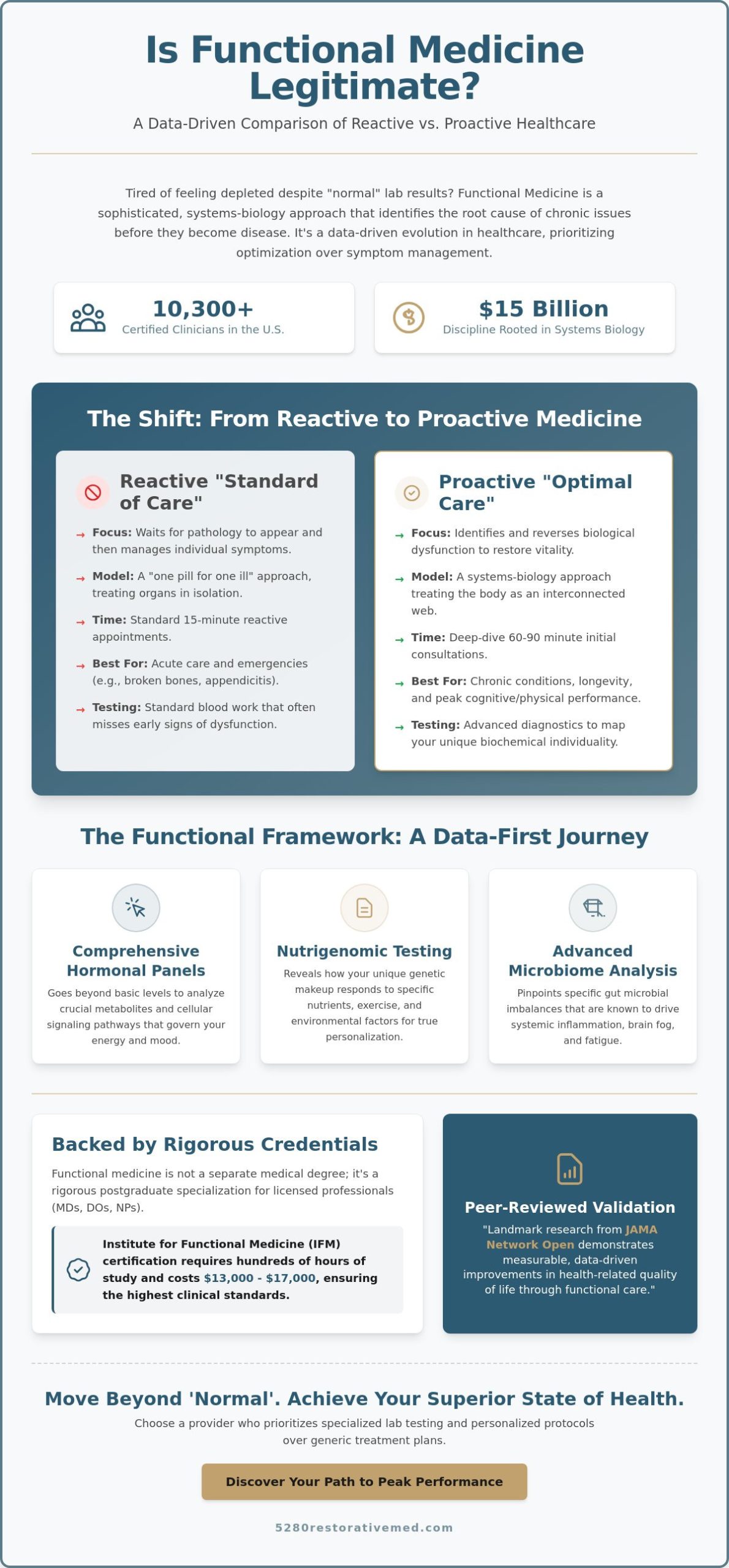
At 5280 Restorative Medicine, we believe your health deserves a data-driven evolution. With over 10,300 certified clinicians now practicing in the U.S., functional medicine has matured into a $15 billion discipline rooted in systems biology. This review provides the clinical evidence and peer-reviewed validation you need to feel confident in this rigorous approach. We’ll explore how modern diagnostics identify biological dysfunction before it becomes pathology. You’ll discover a path toward peak performance that prioritizes restoration and optimization over the mere absence of disease.
Key Takeaways
- Learn how a systems-biology approach identifies the biological root causes of chronic fatigue rather than simply suppressing individual symptoms.
- Understand why is functional medicine a legitimate medical practice by examining the clinical credentials and rigorous certifications required for licensed MDs and NPs.
- Review landmark research from JAMA Network Open that demonstrates measurable, data-driven improvements in health-related quality of life through functional care.
- Distinguish between reactive “standard of care” and a proactive “optimal care” model designed to restore your vitality and long-term peak performance.
- Master a data-first vetting process to choose a provider who prioritizes specialized lab testing and personalized protocols over generic treatment plans.
Defining Functional Medicine: A Systems-Biology Approach to Health
At its core, Functional medicine represents a sophisticated evolution of clinical practice. It moves away from the traditional “one pill for one ill” model toward a systems-biology approach. This methodology views the human body as a complex, interconnected web of biological processes rather than a collection of isolated organs. When individuals ask, “is functional medicine a legitimate medical practice,” they’re often seeking a bridge between rigorous science and personalized care. The answer lies in the data. By focusing on biochemical individuality, we can identify why two people with the same symptom might require entirely different treatments.
The traditional medical model is often reactive, waiting for a pathology to appear before intervening. Functional medicine is different. We prioritize metabolic resilience, which is the body’s ability to maintain equilibrium under stress. For the high-performers we see here at 5280 Restorative Medicine, this means optimizing cellular health to ensure peak cognitive and physical function. We don’t just look for the absence of disease; we look for the presence of vitality and long-term longevity.
The Shift from Reactive to Proactive Medicine
Conventional medicine is the gold standard for acute care and emergency interventions. If you have an appendicitis or a broken leg, the reactive model is exactly what you need. However, this system wasn’t designed to address the complexities of chronic optimization. With an estimated 60 million U.S. adults currently seeking help for chronic conditions, the need for a proactive approach is clear. We identify physiological dysfunction long before it reaches a diagnosable disease state. This early detection is vital for executives and athletes who demand peak performance. It allows us to restore balance before permanent damage occurs.
Core Principles of the Functional Framework
The functional framework is built on a patient-centered model that prioritizes your unique genetic expression. Your DNA isn’t a fixed destiny; it’s a dynamic script influenced by your environment, nutrition, and stress levels. We use advanced diagnostic tools to map these influences, filling the gap left by standard blood work. These tools include:
- Comprehensive Hormonal Panels: We look beyond basic TSH or testosterone levels to analyze metabolites and cellular signaling pathways.
- Nutrigenomic Testing: This reveals how your specific genes respond to nutrients, exercise, and environmental toxins.
- Advanced Microbiome Analysis: Identifying the specific microbial imbalances that drive systemic inflammation and brain fog.
By integrating these data points, we move past generic, non-generic treatment plans. This level of analytical specificity is why many consider functional medicine the future of legitimate medical practice. It’s a disciplined, data-first journey toward achieving your superior state of health.
The Credentials: Who Are Functional Medicine Providers?
Many patients wonder what sets a functional practitioner apart from a traditional primary care doctor. It’s essential to understand that functional medicine isn’t a separate medical degree; it’s a rigorous postgraduate specialization. Licensed professionals, including Medical Doctors (MDs), Doctors of Osteopathic Medicine (DOs), Nurse Practitioners (NPs), and Doctors of Physical Therapy (DPTs), use this framework to deepen their clinical impact. To ensure high standards, the Institute for Functional Medicine (IFM) provides a certification process that can cost between $13,000 and $17,000. This intensive training ensures that when you ask, “is functional medicine a legitimate medical practice,” the answer is backed by hundreds of hours of additional clinical study and peer-reviewed case analysis.
Medical Education and Specialized Training
These practitioners don’t abandon their traditional medical foundations. Instead, they build upon them to address the complexities of modern chronic illness. In 2026, staying at the forefront of healthcare requires a deep understanding of rapidly evolving genomic science and cellular health. By the time a clinician completes their certification, they’ve mastered the art of deep-dive case analysis. This often involves spending 60 to 90 minutes on an initial consultation, which is a sharp contrast to the 15-minute reactive appointments found in conventional systems. This multi-disciplinary approach, blending the biomechanical precision of Physical Therapy with the systemic view of internal medicine, allows for a more holistic restoration of the body. You can reference the NCCIH definitions of complementary and alternative medicine to see how these integrative models are defined within the broader U.S. healthcare landscape.
The Role of the Functional Medicine Practice
A legitimate clinical setting should feel like a high-end health partnership rather than a cold hospital wing. A functional medicine practice is a sophisticated partnership between clinician and patient, where data-driven insights replace guesswork. This isn’t about the generic, non-generic health protocols you might find in a standard clinic. It’s about sophisticated, personalized strategies that prioritize hormonal optimization and longevity. At 5280 Restorative Medicine, we believe your health journey should be as unique as your genetic code. This personalized approach is why over 10,300 clinicians in the U.S. have now pursued these advanced credentials. If you’re ready to move beyond simple symptom management, you might consider how a personalized restoration plan can transform your daily energy and cognitive clarity.
Evidence-Based Results: What the Research Says
The skepticism surrounding new medical paradigms usually evaporates when the data becomes undeniable. For those questioning if functional medicine is a legitimate medical practice, the answer is increasingly found in high-impact, peer-reviewed literature. A landmark 2019 study published in JAMA Network Open by the Cleveland Clinic demonstrated that patients treated within a functional model reported significantly higher Health-Related Quality of Life (HRQoL) scores than those in traditional primary care. This wasn’t just a subjective feeling of well-being. The improvements were measurable, sustained, and clinically relevant across a cohort of 7,252 patients. It proves that a systems-biology approach offers a superior state of health that standard reactive models often miss.
We move past the traditional “wait and see” approach by utilizing objective data points that standard medicine often overlooks. By the time a condition appears on a basic metabolic panel, the underlying dysfunction has likely existed for years. We use advanced bloodwork and genetic analysis to catch these shifts early. This data-driven precision is why 60 million Americans are now turning to this model for chronic disease management. When you have the data, you no longer have to guess about the root cause of your fatigue or cognitive decline.
Clinical Studies on Chronic Disease Reversal
Recent outcomes in autoimmune and metabolic health show that addressing root causes leads to more than just symptom management. In cases of metabolic syndrome, protocols that prioritize cellular health have shown significantly higher rates of reversal compared to standard dietary advice alone. These results are particularly vital for high-performers who cannot afford the brain fog or lethargy associated with systemic inflammation. Sustainable energy isn’t a mystery; it’s the result of optimizing physiological pathways based on your specific biochemical markers. As more clinicians adopt this model, the peer-reviewed validation of the functional framework continues to grow, providing a clear path toward peak performance.
The Power of Advanced Diagnostics
True optimization requires looking beneath the surface of “normal” lab results. We utilize metabolic testing to analyze how your body processes energy at the cellular level. This isn’t a generic screening. It’s an investigation into your unique genetic markers, which inform every nutritional and lifestyle choice we recommend. This level of specificity allows us to identify the exact biological triggers for your symptoms.
For example, when we track progress toward bhrt and other optimization goals, we don’t just measure total hormone levels. We look at metabolites and receptor sensitivity. This ensures that every intervention is evidence-based and tailored to your body’s current state. By using biomarkers to track real-time changes, we provide the validation that your symptoms have a biological root cause and a measurable path to recovery. This rigorous, data-first methodology is what defines a legitimate clinical practice in 2026.
Why Functional Medicine is Often Misunderstood
Confusion often arises when a discipline is both scientifically rigorous and yet excluded from traditional insurance models. You might wonder: if this is a legitimate medical practice, why doesn’t every provider accept my insurance card? The answer lies in the fundamental design of the U.S. healthcare billing system. Traditional insurance is built on the “Standard of Care,” which is a reactive model designed to manage acute pathology. It’s excellent for treating a broken bone or a sudden infection, but it’s not structured to fund the deep-dive, 90-minute analysis required for root-cause optimization. This creates a disconnect between what insurance covers and what your body actually needs to thrive.
The 15-minute insurance-based appointment is simply insufficient for a comprehensive metabolic or genomic review. When a clinician is forced to see 30 patients a day to stay profitable, they can only address surface-level symptoms. Functional medicine rejects this superficiality. We prioritize the detailed time required to analyze your entire biological history, from your genetic predispositions to your environmental exposures. This thoroughness is the hallmark of a legitimate clinical practice, even if it doesn’t fit the current insurance-mandated mold.
The Insurance Dilemma and the Value Gap
The current U.S. healthcare system prioritizes acute intervention over long-term prevention. This creates a significant value gap that patients are increasingly filling themselves. In 2024, Americans spent $556.6 billion out-of-pocket on healthcare, averaging $1,632 per person. While a significant shift occurred in April 2026 when some national providers began accepting major insurance for functional visits, many boutique practices remain cash-pay. This choice isn’t about avoiding regulation; it’s about maintaining the autonomy to provide non-generic, high-touch care. By stepping outside the insurance model, we can focus on your cellular health and hormonal optimization rather than insurance-mandated diagnosis codes. It’s an investment in your future vitality rather than a payment for past illness.
Distinguishing Legitimacy from ‘Standard’ Practice
A common myth suggests that functional medicine is unscientific because it deviates from standard protocols. In reality, it’s often more data-heavy than conventional care. The misunderstanding often stems from how we interpret “normal” lab results. Standard lab ranges are statistical averages based on the general population, many of whom are already dealing with chronic dysfunction. We focus on “optimal” ranges, which are the specific levels required for peak performance and longevity. This proactive strategy integrates seamlessly with conventional care. We don’t ignore traditional diagnostics; we expand upon them with advanced tools like gut microbiome sequencing and organic acid testing. If you’re tired of being told your labs are “fine” while you continue to struggle with fatigue, it’s time to explore a more precise framework. You can partner with 5280 Restorative Medicine to begin a data-driven journey toward your superior state of health.
Choosing a Legitimate Practice for Health Optimization
Finding the right clinical partner is the final step in your journey toward peak performance. While the data confirms that is functional medicine a legitimate medical practice, the quality of your results depends heavily on the practitioner’s training and the clinic’s methodology. A legitimate practice won’t rely on generic advice or superficial assessments. It utilizes a data-first approach where every recommendation is backed by advanced diagnostics. You should look for a boutique environment that balances clinical authority with a deeply personalized, empathetic touch. This ensures your health is treated as a proactive journey rather than a reactive necessity.
For those pursuing lifestyle medicine certification in 2026, the final deadline to register for the exam is September 30, 2026. This date serves as a reminder of the rigorous academic standards that define the field. When vetting a clinic, you’re looking for an expert guide who integrates these evolving standards into your daily well-being. At 5280 Restorative Medicine, we prioritize a sophisticated clinical experience that bridges the gap between complex science and the human experience of aging.
Vetting Your Practitioner
You deserve a provider who invests as much in their education as you do in your health. Before committing to a program, use this checklist to ensure clinical legitimacy:
- Verify Core Credentials: Ensure the practitioner is a licensed MD, DO, NP, or DPT with board certifications in their primary field.
- Specialized Functional Training: Look for certifications from the Institute for Functional Medicine (IFM) or similar accredited bodies.
- Diagnostic Reputation: Confirm the practice uses reputable, advanced laboratories for genetic, hormonal, and metabolic testing.
- Executive Focus: If your goal is professional longevity, look for a focus on executive health programs that prioritize cognitive and metabolic resilience.
The Path Toward Restoration and Optimization
Your journey begins with an initial comprehensive consultation that typically lasts 60 to 90 minutes. During this time, we move past the “why I’m tired” phase and begin the work of engineering metabolic resilience. This transition is where the pairing of restoration and optimization becomes your signature philosophy. We don’t just want to return you to a baseline; we want to help you reach a superior state of health that sustains you for decades to come.
Reclaiming your vitality is a proactive choice that requires a high-end health partner. By choosing a practice that values personalized, non-generic treatment plans, you take control of your biological destiny. We invite you to partner with a clinical expert at 5280 Restorative Medicine to reclaim your vitality and achieve the peak performance you deserve. It’s time to move beyond the absence of disease and step into a life of true longevity.
Your Path to Superior Health and Longevity
The evidence is clear: the transition from reactive care to proactive optimization is the most significant shift in modern healthcare. By moving beyond the “one pill for one ill” model, we’ve demonstrated how a systems-biology approach addresses the root causes of fatigue and dysfunction. This data-driven methodology confirms that is functional medicine a legitimate medical practice, providing a rigorous framework for those who refuse to settle for the status quo. You’ve learned that legitimate care requires specialized credentials, advanced diagnostics, and a commitment to your biochemical individuality.
At 5280 Restorative Medicine, we bridge the gap between complex science and your daily well-being. Led by Dr. Marci Catallo-Madruga, an IFM Certified Practitioner, our clinic utilizes advanced metabolic and genetic testing protocols to create a roadmap for your success. We specialize in tailored strategies for high-performers and executives who demand excellence from their bodies and minds. It’s time to shift your focus from the absence of disease to the presence of peak vitality. Reclaim your vitality with a science-backed Executive Health Program and experience the difference that personalized restoration makes. Your journey toward a superior state of health begins today.
Frequently Asked Questions
Is functional medicine considered ‘alternative’ or ‘complementary’ medicine?
Functional medicine is best defined as an integrative, systems-biology approach that works in tandem with conventional care. The National Center for Complementary and Integrative Health (NCCIH) notes that integrative health brings together conventional and complementary approaches in a coordinated way. It’s not a replacement for traditional medicine; it’s a data-driven evolution of it that focuses on the complex interactions between genetics and lifestyle.
Do functional medicine doctors have the same medical degrees as conventional doctors?
Yes, practitioners in this field are licensed medical professionals who have completed standard medical school and residency. They hold degrees such as MD, DO, or NP. To specialize, they undergo hundreds of hours of postgraduate training through accredited bodies like the Institute for Functional Medicine. This ensures that when patients ask, “is functional medicine a legitimate medical practice,” they can trust the rigorous clinical foundation of their provider.
Why doesn’t my primary care physician use a functional medicine approach?
Most conventional primary care physicians are constrained by an insurance-based billing system that prioritizes high-volume, reactive care. The average 15-minute appointment doesn’t allow for the deep-dive analysis required to map out a patient’s entire biochemical history. Functional medicine requires a time-intensive, proactive model that is often incompatible with the current US healthcare billing codes designed for acute symptom management.
Is there scientific evidence that functional medicine actually works?
Substantial evidence supports this model, including a 2019 study in JAMA Network Open involving 7,252 patients that demonstrated significantly better health-related quality of life outcomes compared to standard care. Beyond this, the field utilizes peer-reviewed research from genomics and nutritional science to inform clinical decisions. It relies on objective biomarkers and advanced diagnostics to track measurable physiological improvements in metabolic and hormonal health.
What is the difference between integrative medicine and functional medicine?
Integrative medicine is an umbrella term that focuses on the whole person and combines various therapeutic approaches, while functional medicine is the specific methodology used to identify root causes. Think of integrative medicine as the “what” and functional medicine as the “how.” Functional medicine provides the specific systems-biology framework to map out exactly where a patient’s metabolic or cellular pathways have lost their equilibrium.
Why is functional medicine often not covered by standard health insurance?
Traditional insurance is built on a “standard of care” model that only reimburses for the diagnosis and treatment of established diseases. Most plans don’t cover the extended consultation times or the specialized preventive testing required for health optimization. While some national providers began accepting major insurance plans in April 2026, many boutique practices remain cash-pay to ensure they can provide highly personalized, non-generic care without carrier-imposed limitations.
Can functional medicine practitioners prescribe medication if necessary?
Yes, because these practitioners are licensed MDs, DOs, or NPs, they hold full prescriptive authority in their respective states. They utilize pharmaceutical interventions when clinically necessary but often aim to restore the body’s natural function to reduce long-term dependency on medication. This balanced approach ensures that you receive the most effective treatment, whether it’s a targeted drug, a nutritional protocol, or a hormonal optimization strategy.
How do I know if a functional medicine provider is legitimate?
Verification is essential when choosing a clinical partner. You should check for an active state medical license and a certification from a reputable organization like the Institute for Functional Medicine (IFM). A legitimate practice will always prioritize a data-first approach, using specialized metabolic or genetic testing before suggesting a treatment plan. They should provide a clear, transparent path forward that focuses on restoration and measurable optimization.