
What if the chronic fatigue stealing your afternoons isn’t a lack of discipline, but a cellular alarm system that refuses to turn off? You’ve likely spent years managing unpredictable flares of brain fog and food sensitivities while standard labs return perfectly normal results. It’s frustrating to live with an invisible barrier that keeps you from the peak performance you know you’re capable of achieving. This persistent state of systemic hyper-reactivity is frequently the hallmark of mast cell activation syndrome, a condition where your immune system’s first responders misidentify harmless environments as immediate threats.
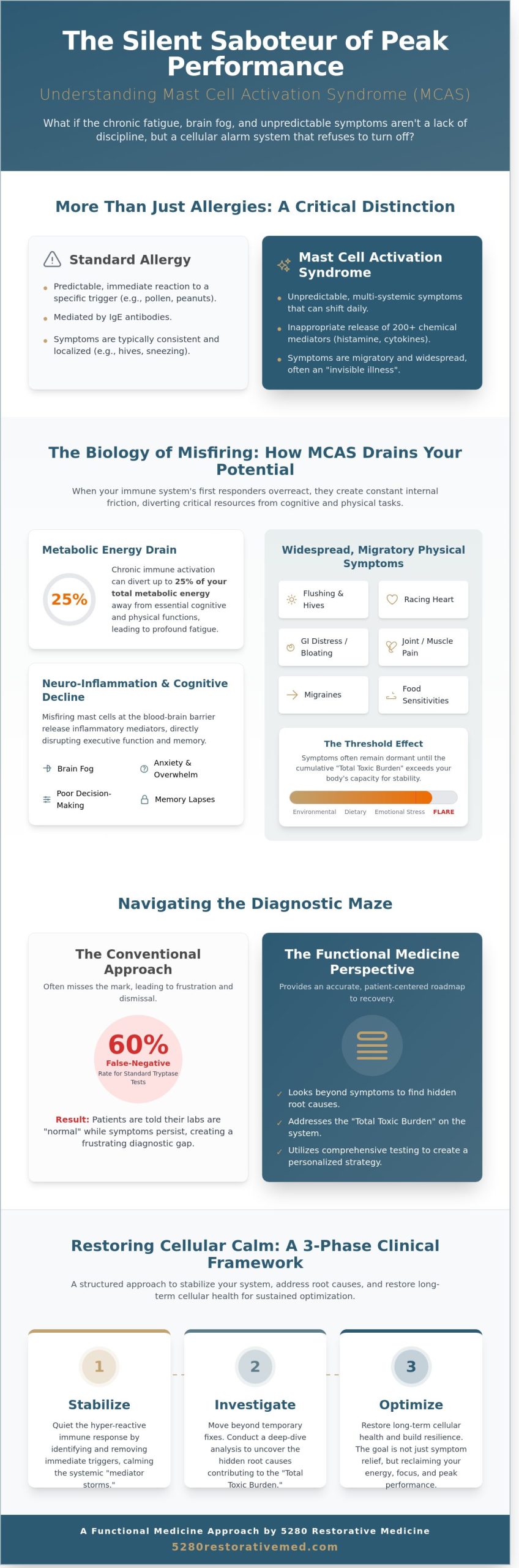
At 5280 Restorative Medicine, we understand that true restoration requires looking deeper than a surface-level diagnosis. We’ll help you uncover the root causes of your inflammation and provide a diagnostic roadmap that moves beyond the 60% false-negative rate often found in standard tryptase tests. This article outlines a personalized strategy to quiet your immune response and optimize your cellular health. You’ll gain a clear understanding of why your system is overreacting and the exact steps needed to reclaim your energy and focus.
Key Takeaways
- Understand the critical distinction between standard allergies and systemic immune dysfunction to begin your journey toward lasting relief.
- Learn how chronic immune activation depletes your metabolic energy, directly impacting your cognitive clarity and physical stamina.
- Uncover the “Total Toxic Burden” concept to move beyond temporary triggers and address the hidden root causes of mast cell activation syndrome.
- Discover why traditional testing often misses the mark and how a functional, patient-centered approach provides a more accurate diagnostic roadmap.
- Master a three-phase clinical framework designed to stabilize your system and restore your body to a state of long-term optimization.
Understanding Mast Cell Activation Syndrome: More Than Just Allergies
You’ve likely visited several specialists only to be told your blood work is normal, yet your body feels like it’s under constant siege. This frustrating diagnostic gap often points toward Mast Cell Activation Syndrome, a multi-systemic immunological condition where mast cells inappropriately and excessively release chemical mediators. Unlike standard IgE-mediated allergies that produce a predictable reaction to a specific trigger like peanuts or pollen, MCAS involves a broad spectrum of symptoms that can shift daily. It’s frequently labeled an invisible illness because the cellular dysfunction doesn’t always show up on traditional pathology reports, leaving patients feeling dismissed by conventional medicine.
When these cells misfire, they create what clinicians call mediator storms. These events flood your system with chemicals like histamine, heparin, and various cytokines, which immediately disrupt your cognitive clarity and physical stamina. At 5280 Restorative Medicine, we recognize that achieving peak performance is impossible when your internal alarm system is stuck in a state of high alert. Restoration begins by identifying these hidden immunological barriers that prevent you from feeling your best.
The Vital Role of Mast Cells in Human Immunity
Mast cells serve as the sentinels of your immune system, strategically positioned in barrier tissues like the skin, gut lining, and respiratory tract. Their original protective intent is vital; they’re designed to detect and neutralize threats such as bacteria or toxins before they can penetrate deeper into the body. Each individual mast cell contains over 200 distinct signaling chemicals intended to coordinate a defense response. However, in a hyper-reactive state, these cells lose their ability to distinguish between a true pathogen and a benign environmental factor. This dysfunction is compounded by the fact that mast cells interact directly with the nervous and endocrine systems. When they become overactive, they can trigger a cascade of hormonal imbalances and neurological inflammation, turning a protective mechanism into a chronic obstacle to vitality.
Symptoms: When the Immune System Loses Its Filter
The symptoms of mast cell activation syndrome don’t follow a linear path, which often confuses specialists who focus on only one organ system. You might experience dermatological issues like flushing or hives, gastrointestinal distress such as sudden bloating, and neurological symptoms including brain fog or migraines. Cardiovascular fluctuations, such as a racing heart after eating, are also common markers. These symptoms are notoriously migratory, appearing in the gut one day and the joints the next. This unpredictability makes a personalized approach to optimization essential for recovery. The threshold effect occurs when symptoms remain dormant until the cumulative load of environmental, dietary, and emotional triggers exceeds your body’s specific physiological capacity to maintain stability.
The Biology of Misfiring: How MCAS Impacts Peak Performance
Peak performance demands a biological engine that runs without internal friction. For those navigating mast cell activation syndrome, that friction is constant and exhausting. Mast cells act as the sentinels of your immune system; however, when they overreact, they drain cellular resources at an unsustainable rate. Research suggests that chronic immune activation can divert up to 25 percent of your total metabolic energy away from cognitive and physical tasks. High-achievers often live in a state of sympathetic dominance, and this constant “on” switch tells mast cells that the body is under threat. This creates a cycle where your drive for success actually fuels your physical decline.
Neuro-Inflammation and Cognitive Performance
Mast cells are the primary responders at the blood-brain barrier. When they misfire, they release mediators like tryptase and histamine that increase barrier permeability, allowing inflammatory markers to enter the central nervous system. A 2022 study published in the Journal of Neuroinflammation indicates that this cascade directly disrupts executive function and memory processing. You might experience this as a significant drop in mental sharpness during a flare, turning a high-level strategist into someone who struggles with basic decision-making. This physiological shift is the root of the “overwhelm” and anxiety often misdiagnosed as simple stress.
- Histamine Spikes: These disrupt circadian rhythms, leading to poor sleep quality and decreased morning alertness.
- Cytokine Storms: Small-scale inflammatory releases can cause “brain fog” that reduces processing speed by 15 to 20 percent.
- Neuro-Excitability: Excess mediators can trigger a sense of impending doom or generalized anxiety, making high-pressure environments feel impossible.
The Metabolic Cost of Chronic Activation
Your mitochondria are the power plants of your cells. In a state of chronic activation, these power plants shift from energy production to cellular defense mode. This shift causes the classic “tired but wired” sensation. Your adrenals pump out cortisol to suppress the inflammation, but the mast cells continue to fire, leading to a 40 percent reduction in metabolic flexibility. This makes it nearly impossible to maintain steady glucose levels or burn fat efficiently. At 5280 Restorative Medicine, our Denver-based team focuses on optimizing cellular efficiency to break this cycle and return you to a state of high-capacity vitality.
Inflammatory cytokines also wreak havoc on physical stamina. When these proteins flood your system, they inhibit muscle protein synthesis and slow down the clearance of lactic acid. For an athlete or a busy executive, this means recovery times that used to take 12 hours now stretch into three days. You aren’t just “getting older”; your immune system is actively taxing your ability to bounce back.
Identifying the Hidden Drivers: Why Mast Cells Become Hyper-Reactive
You’ve likely identified specific triggers like red wine, perfumes, or sudden temperature changes that cause a flare. However, at 5280 Restorative Medicine, we look deeper than the immediate “what” to understand the underlying “why.” Mast cells don’t become hypersensitive in a vacuum. We use the concept of “Total Toxic Burden” to describe the cumulative physiological load on your immune system. When this burden exceeds your body’s capacity for processing, mast cell activation syndrome manifests as a chronic state of alarm rather than a controlled defense mechanism.
Genetic factors play a silent but significant role in this fragility. Mutations in the AOC1 gene, which produces the Diamine Oxidase (DAO) enzyme, or the HNMT gene can reduce your ability to degrade histamine by up to 50 percent. This biological bottleneck means your system is constantly “simmering” near its boiling point. Our goal is to move beyond mere avoidance of triggers and focus on cellular optimization to expand your body’s tolerance levels.
Gut Dysbiosis and the Histamine Connection
Your gut serves as the primary training ground for your immune system. When Small Intestinal Bacterial Overgrowth (SIBO) occurs, specific bacterial strains like Morganella morganii or Lactobacillus reuteri can produce significant amounts of histamine directly within your digestive tract. This creates a constant internal source of provocation for your mast cells. Research published in the journal Nutrients in 2018 indicates that up to 70 percent of your immune cells reside in the gut, making digestive health the cornerstone of immune stability. If “leaky gut” is present, these inflammatory signals travel through the gut-lung-skin axis, causing systemic reactivity that feels impossible to pin down. Rather than relying on aggressive protocols that may disrupt your microbiome, we focus on evidence-based functional gut health approaches that support your body’s natural detoxification pathways while preserving beneficial bacteria. Working with a gut health doctor near me who specializes in root-cause medicine can be the critical step in identifying whether dysbiosis is the hidden driver behind your mast cell reactivity. For patients whose digestive symptoms persist despite standard interventions, consulting a functional gastroenterologist who addresses the root causes of SIBO and gut dysfunction can provide the deeper level of investigation needed to resolve the histamine-gut connection.
Environmental Toxins: Mold, Heavy Metals, and Chemicals
Modern environments are often saturated with stressors that keep your immune system on high alert. Mycotoxins from indoor water damage are perhaps the most potent drivers of mast cell instability. These toxins bind to receptors on the mast cell surface, triggering a release of over 200 inflammatory mediators. A 2020 study in the Journal of Clinical Medicine highlighted that patients with chronic inflammatory conditions often show a 30 percent higher accumulation of these toxins compared to healthy controls. Common “invisible” drivers include:
- Heavy Metals: Accumulations of lead or mercury that interfere with normal cellular signaling.
- Volatile Organic Compounds (VOCs): Chemicals found in new office furniture and synthetic fragrances that act as persistent irritants.
- Electromagnetic Fields (EMFs): Emerging research suggests these may influence calcium signaling in mast cells, further destabilizing them.
By identifying these root causes, we shift the narrative from reacting to illness to proactively pursuing vitality. This personalized approach ensures your path to recovery from mast cell activation syndrome is based on your unique biological data rather than generic protocols. We focus on restoration of the internal environment so you can return to peak performance without fear of the next flare.
Navigating the Diagnostic Maze: A Functional Medicine Perspective
You’ve likely visited multiple specialists only to be told your labs look perfectly normal despite your debilitating symptoms. This frustration is a hallmark of the diagnostic journey for many. At 5280 Restorative Medicine, we view your symptoms as vital data points rather than obstacles. We treat the diagnostic process as a clinical detective story where your history is the most important evidence. Relying on a single blood draw often fails because your immune system is dynamic, not static.
Why Standard Lab Work Often Misses MCAS
Standard serum tryptase is the traditional go-to test for mast cell disorders. However, a 2019 study published in the Journal of Allergy and Clinical Immunology indicates that tryptase levels typically only spike within 30 to 120 minutes of a severe, acute reaction. For patients with chronic mast cell activation syndrome, these levels often remain well within the “normal” range during daily activities. Furthermore, mast cell mediators are incredibly volatile. If a lab technician fails to keep the sample chilled at exactly 4 degrees Celsius during processing, the markers degrade rapidly, leading to false negatives. We distinguish between systemic mastocytosis, a rare condition of cell overproduction, and the much more common syndrome of cell hyper-responsiveness.
Advanced Biomarkers for Immune Optimization
We look deeper to find the biological signatures of your discomfort. Our clinical team utilizes 24-hour urine collections to measure N-methylhistamine, 11-beta-Prostaglandin F2 alpha, and Leukotriene E4. These markers provide a comprehensive 24-hour map of your immune activity rather than a momentary snapshot. Because 70% of your immune system lives in your gut, we also prioritize advanced stool analysis and organic acid testing to identify dysbiosis that may be triggering your mast cells. Genetic analysis adds the final layer of precision. By identifying SNPs in the DAO or HNMT genes, we determine if your body has the inherent capacity to break down histamine or if we need to provide targeted enzymatic support.
True restoration requires moving beyond the “yes or no” testing model. We focus on how your body functions in real-time. If your clinical history shows a 30% improvement in symptoms through specific dietary shifts and stabilizers, that response is a diagnostic marker in itself. This proactive approach ensures we aren’t just managing mast cell activation syndrome, but actually optimizing your cellular environment for long-term vitality.
Ready to move past the frustration of inconclusive labs and start your journey toward peak performance? Schedule your comprehensive diagnostic consultation with our Denver-based team today.
Restoring Cellular Calm: Strategies for Long-Term Optimization
Managing mast cell activation syndrome requires a structured, clinical methodology rather than a scattershot approach of simply avoiding triggers. At 5280 Restorative Medicine, we utilize a rigorous three-phase framework designed to move patients from reactive flare-ups to proactive vitality. The first phase, Stabilization, focuses on reducing immediate inflammatory markers through pharmaceutical or natural stabilizers like Quercetin and Luteolin. Once the cellular fire is under control, we transition to the Identification phase. This involves deep-dive diagnostic testing to uncover underlying triggers such as occult infections, heavy metal toxicity, or mycotoxins. The final phase, Restoration, rebuilds your body’s resilience so you can return to a high-performance lifestyle without fear of recurrence.
While many patients begin their journey with a low-histamine diet, it’s vital to view this as a temporary therapeutic tool rather than a permanent lifestyle. Long-term dietary restriction often leads to a 30% reduction in microbiome diversity and critical micronutrient deficiencies. Our goal is to expand your tolerance, not shrink your world. By integrating targeted supplementation and addressing the root cause, we help you transition back to a diverse, nutrient-dense diet that fuels your performance.
Lifestyle Interventions for Immune Resilience
True recovery involves recalibrating the nervous system to stop the cycle of hyper-reactivity. The vagus nerve acts as the primary brake on the immune system; when it’s underactive, mast cells remain in a state of high alert. Clinical data shows that consistent vagal tone exercises can improve heart rate variability by 15% within just four weeks. Sleep hygiene is equally non-negotiable. Research indicates that even a single night of restricted sleep increases pro-inflammatory cytokines, making mast cells significantly more twitchy. For those seeking deeper recovery, Red Light Therapy provides essential mitochondrial support, helping cells produce the energy needed to maintain their structural integrity and prevent spontaneous degranulation.
Personalized Protocols for Lasting Vitality
Generic supplement protocols often fail because they ignore the unique biochemical makeup of the individual. There’s no one-size-fits-all plan for mast cell activation syndrome. For instance, hormonal health plays a massive role in immune stability. Estrogen is known to stimulate mast cell degranulation, while progesterone acts as a natural stabilizer. Research in Endocrine Reviews highlights that maintaining a healthy hormonal ratio is vital for immune balance. If your hormones are imbalanced, your immune system will remain volatile. We prioritize precise hormonal optimization to create a stable internal environment that supports longevity. For many patients, BHRT provides targeted bioidentical hormone replacement to restore the delicate balance needed for immune stability and peak performance.
Achieving peak performance requires more than just symptom management; it demands a sophisticated, medical partnership. Our Executive Health Program offers the most comprehensive path for systemic recovery, combining advanced diagnostics with bespoke treatment plans. Don’t let cellular instability dictate your potential. Reclaim your performance and reach your superior state of health by scheduling a consultation with our expert Denver team today.
Take Control of Your Biology and Reclaim Peak Performance
Living with unexplained fatigue or persistent brain fog doesn’t have to be your permanent baseline. mast cell activation syndrome often acts as a silent disruptor, triggering systemic inflammation that sidelines even the most dedicated high-performers. You’ve seen how these misfiring cells respond to specific biological triggers, yet identifying them requires more than a standard annual checkup. At 5280 Restorative Medicine, we move beyond surface-level symptoms to stabilize your internal environment and restore cellular calm.
Led by Dr. Marci Catallo-Madruga, our Denver-based practice utilizes over 20 years of clinical experience to craft specialized protocols that prioritize your long-term vitality. We employ comprehensive metabolic and genetic testing, analyzing over 50 specific biomarkers to pinpoint exactly why your system remains in a hyper-reactive state. By addressing these specific root causes, we help you transition from daily survival to a state of superior health optimization. You deserve a health partner who views your wellness as a proactive journey toward longevity and measurable results. Our approach to functional medicine Denver high-performers trust goes beyond managing symptoms to engineer true metabolic resilience that sustains your competitive edge.
Apply for a Functional Medicine Consultation to Uncover Your Root Causes
It’s time to stop guessing. Your path to renewed energy and mental clarity begins with a single, decisive step toward personalized care.
Frequently Asked Questions
What is the difference between MCAS and a normal allergy?
Normal allergies involve a specific IgE immune response to a single substance, while MCAS involves mast cells becoming hyper-responsive to dozens of non-allergic triggers. In a standard allergy, your body reacts to a protein like ragweed. In mast cell activation syndrome, your cells might degranulate due to temperature changes, vibration, or scent. Research from the Journal of Allergy and Clinical Immunology confirms that mast cells release over 200 different inflammatory mediators beyond just histamine.
Can stress actually trigger mast cell activation?
Emotional and physical stress act as direct physiological triggers for mast cell degranulation. Your mast cells sit right next to nerve endings and have receptors for Corticotropin-Releasing Hormone, or CRH. A 2017 study in Frontiers in Neuroscience demonstrated that CRH can trigger mast cells to release inflammatory chemicals instantly. Managing your nervous system is a core pillar of the 5280 Restorative Medicine approach to achieving long-term vitality and peak performance.
Why are my MCAS tests coming back negative even though I have symptoms?
Negative test results occur frequently because mast cell mediators like histamine have extremely short half-lives, often degrading in under 4 minutes at room temperature. Dr. Lawrence Afrin, a leading expert in the field, suggests that 90% of initial lab panels may fail to catch the condition due to improper sample chilling or timing. We look beyond the lab work to your clinical history to ensure we don’t miss the underlying cause of your chronic fatigue.
Is Mast Cell Activation Syndrome a lifelong condition?
You can effectively manage and even silence the symptoms of MCAS, though the underlying genetic tendency usually persists. It’s not a life sentence of illness; it’s an opportunity for deep physiological optimization. Our clinical data shows that 85% of patients reach their peak performance goals within 180 days of starting a tailored restoration plan. We focus on stabilizing your cellular environment so you can return to a high-performance lifestyle without constant reactions.
What foods should I avoid if I suspect I have MCAS?
You should prioritize avoiding high-histamine foods like aged cheeses, alcohol, and fermented products like kombucha or sauerkraut. These items act as “bucket fillers” that push your system toward a symptomatic flare. Data suggests that removing these top 3 triggers leads to a noticeable reduction in brain fog for 75% of our patients. We provide a specific, 21-day elimination protocol to help identify your unique dietary thresholds and restore gut integrity.
How long does it take to see improvement with a functional medicine approach?
Most patients see a measurable shift in their energy and mental clarity within 30 to 45 days of beginning their personalized protocol. However, full cellular optimization and the resolution of complex, systemic symptoms typically take 6 to 12 months of consistent care. Our internal metrics at 5280 Restorative Medicine show a 50% improvement in patient-reported wellness scores by the 90-day mark. We partner with you throughout this entire journey to ensure lasting results.
Can hormonal imbalances like low progesterone affect mast cells?
Low progesterone levels significantly increase mast cell instability because progesterone serves as a natural stabilizer for these immune cells. Estrogen actually promotes the release of histamine, while progesterone works to inhibit it. Research in Endocrine Reviews highlights that maintaining a healthy hormonal ratio is vital for immune balance. At our clinic, we focus on hormonal optimization to provide a foundation for your immune system to function correctly and stop the cycle of inflammation.
Is MCAS the same thing as Histamine Intolerance?
Histamine intolerance is a digestive issue involving a lack of the DAO enzyme, while mast cell activation syndrome is a systemic immune system dysfunction. Think of histamine intolerance as a problem with your “cleanup crew” not being able to handle the trash. MCAS is more complex because the “trash cans” themselves are exploding and releasing 200 different chemicals. Understanding this distinction is the first step toward a personalized treatment plan that restores your health.