
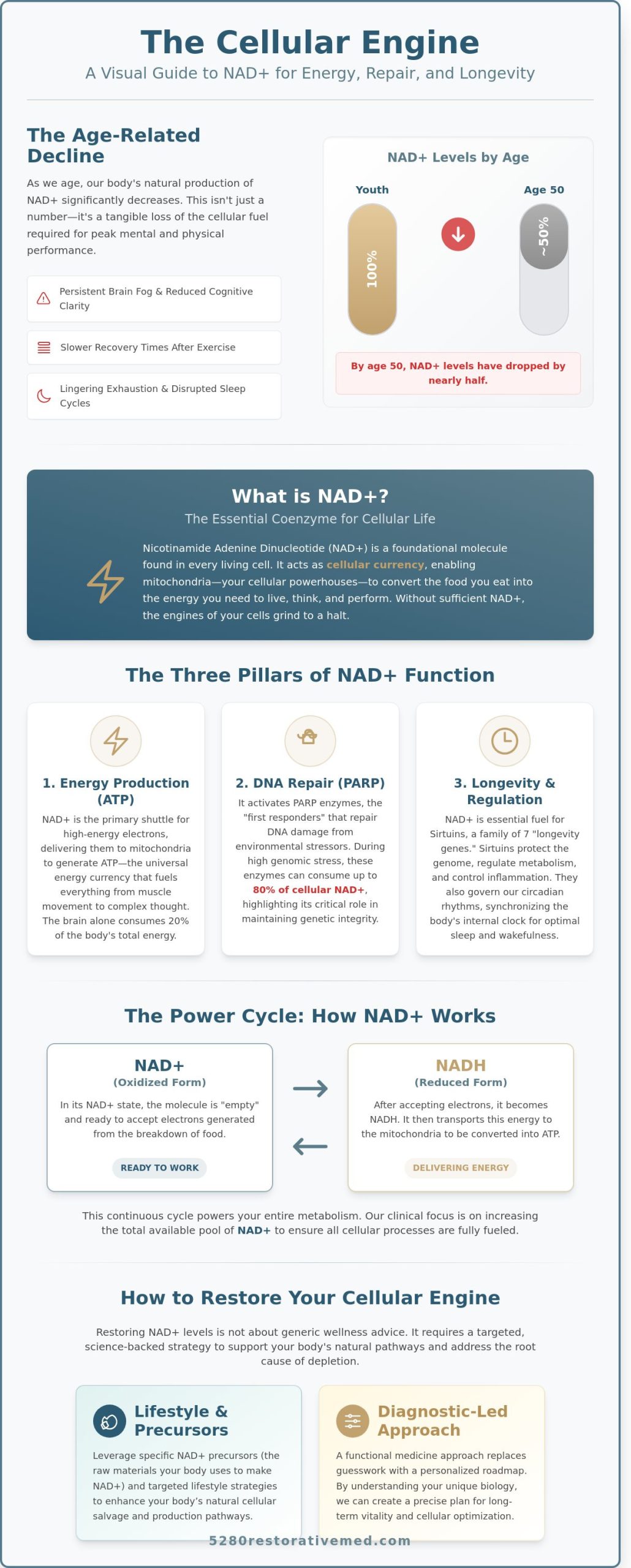
What if the persistent brain fog that clouds your 3:00 PM meetings isn’t an inevitable part of aging, but a measurable 50% decline in your cellular fuel? By the time we reach age 50, most of us have lost nearly half of the nad levels we enjoyed in our youth. This leaves our mitochondria struggling to keep pace with our daily ambitions. You’ve likely felt this shift. It shows up as slower recovery times after a weekend workout or a lingering exhaustion that a standard cup of coffee can no longer fix. It’s frustrating when your cognitive clarity feels just out of reach despite your best efforts at sleep and nutrition.
At 5280 Restorative Medicine, we believe that peak performance is a proactive journey rather than a stroke of luck. This guide will show you exactly how Nicotinamide Adenine Dinucleotide functions as the primary engine for your energy and long-term metabolic resilience. We’ll move beyond generic wellness advice to provide a clear, scientifically validated path for restoring your internal vitality. You’re about to learn how targeted cellular optimization can bridge the gap between feeling baseline and achieving a superior state of health.
Key Takeaways
- Understand how Nicotinamide Adenine Dinucleotide functions as the essential engine for cellular energy, cognitive clarity, and metabolic resilience.
- Discover the biological link between your nad reserves and the mitochondria’s ability to generate ATP and facilitate essential DNA repair.
- Identify why high-performance lifestyles and natural aging can deplete your cellular currency by half, and how to recognize the signs of depletion.
- Learn how to leverage specific precursors and lifestyle strategies to effectively restore your body’s natural cellular salvage pathways.
- Explore how a diagnostic-led functional medicine approach replaces generic guesswork with a personalized roadmap for long-term vitality and optimization.
What is NAD+? Understanding the Molecule of Cellular Life
You feel the decline in your daily performance long before a clinical diagnosis ever appears. Nicotinamide Adenine Dinucleotide, or NAD+, is the foundational coenzyme that makes life possible. It exists in every living cell, acting as the primary vehicle for energy transfer. Think of it as cellular currency. Just as a business requires liquid capital to operate, your mitochondria require NAD+ to convert nutrients into adenosine triphosphate (ATP). Without this molecule, the engines of your cells simply stop running.
The biology of aging is often a story of scarcity. While your body produces this coenzyme naturally, it’s a finite resource. Clinical data shows that by the time you reach age 50, your systemic levels are roughly 50% of what they were in your youth. This reduction explains why recovery takes longer and mental clarity feels more elusive than it did a decade ago. At 5280 Restorative Medicine, we view this decline not as an inevitability, but as a biological hurdle that we can address through precise optimization.
The Distinction Between NAD and NAD+
We often use the term nad as a shorthand for the entire family of these molecules. However, the plus sign in NAD+ is vital for understanding its function. It signifies the oxidized state of the molecule, meaning it’s ready and waiting to accept electrons. Once it picks up an electron, it becomes NADH, the reduced form. This constant cycling between forms is what powers your metabolism. Our clinical focus remains on the NAD+ form because it’s the specific catalyst needed for DNA repair and the activation of longevity pathways.
Why NAD+ is Essential for Human Survival
NAD+ does more than just move energy; it acts as a critical helper molecule for sirtuins. These are a group of seven enzymes often called longevity genes. Sirtuins protect your genome and regulate cellular health, but they are dependent on nad to function. They cannot perform their repair work without a steady supply of this coenzyme. This molecule also governs your circadian rhythms. It synchronizes your internal clock with the 24 hour day, ensuring your body knows when to power up for peak performance and when to enter deep, restorative sleep. Optimization isn’t just about feeling better; it’s about maintaining the basic biological signaling required for survival.
The Biological Role of NAD+: From ATP Production to DNA Repair
Every physiological process in your body relies on a coenzyme called Nicotinamide Adenine Dinucleotide. Without sufficient nad levels, your cells simply cannot produce the energy required for basic survival. It acts as a shuttle; it carries high-energy electrons to the mitochondria, which are the powerhouses of your cells. This process generates Adenosine Triphosphate (ATP), the universal currency of biological energy that fuels everything from muscle contractions to heartbeat regulation.
Beyond energy, your body uses nad to fuel PARP (Poly ADP-ribose polymerase) enzymes. These proteins are responsible for repairing DNA damage caused by UV radiation, pollutants, and oxidative stress. Research from the Journal of Biomedical Science indicates that PARP enzymes consume up to 80% of cellular NAD+ during periods of high genomic stress. This explains why maintaining these levels is vital for long-term health and preventing the accumulation of cellular errors.
Mitochondrial Function and Cognitive Endurance
High-energy organs like your brain are the first to suffer when mitochondrial efficiency dips. Since the brain consumes about 20% of your body’s total energy, it’s incredibly sensitive to fluctuations in fuel supply. When your mitochondria function at peak capacity, you experience sharper mental clarity and sustained executive focus throughout the day. Mitochondrial respiration is the nutrient-to-fuel conversion process occurring within the cell. If you feel a persistent decline in mental sharpness, it’s often helpful to pursue cellular restoration to reclaim your cognitive edge. For those seeking additional mitochondrial support, exploring methylene blue benefits for mitochondrial optimization can provide complementary pathways to enhanced cognitive vitality.
Sirtuins and the Regulation of Cellular Aging
Sirtuins are a family of seven proteins often called “longevity genes” because they protect the genome from cumulative age-related damage. These proteins regulate metabolic health and systemic inflammatory responses, but they’re strictly NAD-dependent. They cannot function without a steady supply of this coenzyme.
A 2016 study published in Science confirmed that sirtuin activity declines as NAD+ levels drop with age, leading to decreased metabolic efficiency. By optimizing these pathways, you’re not just treating a symptom. You’re supporting the core mechanisms that keep your biological age lower than your chronological age. This proactive approach ensures your system remains resilient against the stressors of a high-performance lifestyle.
Why NAD+ Levels Decline: The Impact of Stress and High-Performance Lifestyles
The human body is an incredible machine, but its fuel efficiency changes over time. By the time you reach age 40, your internal nad levels have likely dropped by 50% compared to your teenage years. This biological decline isn’t a sudden event; it’s a steady erosion of cellular resources that accelerates under the weight of a high-performance lifestyle. While aging is the primary driver, the modern executive’s schedule acts as a catalyst for this depletion.
Chronic psychological stress forces the body to divert resources toward survival rather than maintenance. When you’re under pressure, your cells activate PARPs, which are enzymes responsible for DNA repair. These enzymes are “NAD-hungry” and will consume your reserves to fix cellular damage caused by stress hormones. Lifestyle choices further complicate this balance. Consuming alcohol or experiencing a single night of sleep deprivation can significantly shrink your available cellular pools, leaving you with less energy for cognitive processing and physical recovery.
Biological “consumers” also play a role in this decline. As we age, chronic low-grade inflammation increases the expression of CD38, a protein that destroys nad molecules before they can be used for energy production. This creates a cycle where inflammation depletes your energy, and low energy makes it harder for your body to resolve inflammation.
The Executive Burnout Connection
High cognitive load and constant decision fatigue are metabolically expensive. Your brain consumes roughly 20% of your body’s total energy, and this demand spikes during intense periods of work. Frequent travel and the resulting jet lag further disrupt the circadian clock. Because the enzymes that produce NAD+ are tied to your internal rhythm, a disrupted sleep cycle means your body misses its window for cellular restoration. Many high-performers feel “stalled” because their standard blood panels look normal, yet their cellular vitality is running on empty.
Environmental Stressors and Cellular Defense
Your environment dictates how your body spends its energy. Exposure to UV radiation and urban pollutants triggers oxidative stress, forcing your cells to prioritize immediate DNA repair over long-term energy production. This cellular triage means your body chooses survival over peak performance. Research from institutions like the Buck Institute suggests that what we call “normal aging” is often just the cumulative effect of these stressors. At 5280 Restorative Medicine, we focus on identifying these depletion points to help you reclaim your baseline vitality.
How to Increase NAD+ Naturally: Precursors and Lifestyle Strategies
You don’t have to accept declining energy as an inevitable part of aging. Supporting your body’s internal chemistry involves a dual approach of smart supplementation and strategic lifestyle shifts. While your body produces nad naturally, this production slows significantly as you age. By age 50, most individuals have roughly 50 percent less of this vital coenzyme than they did in their early 20s.
The Role of NAD+ Precursors (NMN vs. NR)
Nicotinamide Riboside (NR) and Nicotinamide Mononucleotide (NMN) are the primary building blocks used in the cellular salvage pathway. NR often requires conversion into NMN before it becomes active within the cell. A 2019 clinical trial published in Scientific Reports demonstrated that 1,000 mg of NR daily could increase blood levels by 140 percent. However, NMN is a direct precursor supporting insulin sensitivity. Recent 2021 research from the Washington University School of Medicine found that NMN supplement protocols specifically improve muscle glucose metabolism in postmenopausal women. While Vitamin B3 (Niacin) also feeds this pathway, it often causes a “flush” sensation that many patients find uncomfortable; this makes NMN and NR the preferred clinical choices for targeted cellular health.
Lifestyle Interventions for Endogenous Production
Your daily habits act as biological signals to ramp up nad production. High-intensity interval training (HIIT) is particularly effective because it stresses the cell just enough to trigger the NAMPT enzyme, which recycles spent molecules back into active ones. Physical exertion essentially forces the body to become more efficient at energy production.
- Time-Restricted Feeding: Fasting for 16 hours or more increases the NAD+ to NADH ratio, activating sirtuins that repair damaged DNA.
- Circadian Alignment: Deep sleep is critical. A 2018 study in Cell Reports showed that disrupted sleep cycles directly impair the NAMPT-mediated salvage pathway, leading to lower daytime energy.
- Cold Exposure: Brief periods of cold stress can boost metabolic rates and stimulate mitochondrial biogenesis.
Oral supplements offer convenience, but they face a significant hurdle: the digestive tract. Research indicates that a large percentage of oral precursors may be degraded by liver enzymes before reaching systemic circulation. Clinical administration, such as the protocols we use at 5280 Restorative Medicine, bypasses the gut entirely. This ensures 100 percent bioavailability and immediate cellular uptake for those seeking peak performance and rapid restoration.
Optimizing Cellular Health: The Functional Medicine Approach to Restoration
High performers often treat their bodies like precision instruments, yet many approach nad optimization with a “spray and pray” supplement strategy. This guesswork rarely yields the 20% to 30% increase in cognitive clarity or physical recovery that true precision medicine offers. Effective restoration requires a foundation of diagnostic data. Without it, you’re essentially throwing darts in the dark. At 5280 Restorative Medicine, we believe that your cellular health is too vital to be left to chance.
Beyond Supplementation: Comprehensive Metabolic Analysis
Genetic analysis reveals how your body manages the “salvage pathway,” which is the internal recycling system responsible for maintaining nad levels. For instance, specific variations in the NAMPT gene can dictate whether a standard dose of precursors will actually reach your mitochondria or simply be excreted. We look at the whole metabolic engine. This involves advanced bloodwork to measure markers like hs-CRP for systemic inflammation and fasting insulin to assess metabolic flexibility. A 2023 study published in Nature Aging highlighted that cellular depletion is rarely an isolated event; it’s frequently a downstream effect of chronic oxidative stress or mitochondrial dysfunction. For comprehensive mitochondrial support, many patients benefit from understanding methylene blue benefits for cognitive vitality and cellular energy enhancement as part of their optimization protocol. Additionally, optimizing essential minerals like magnesium benefits cellular energy production and supports the enzymatic reactions necessary for NAD+ synthesis and utilization.
Designing a Sustainable Performance Protocol
5280 Restorative Medicine moves you away from the one-size-fits-all model found on retail shelves. Our boutique clinical approach integrates tailored nutrition, pharmaceutical-grade supplements, and lifestyle modifications designed for long-term metabolic vitality. We don’t just aim for the absence of fatigue. We strive for a superior state of health where your energy levels remain consistent throughout a 12-hour workday. Our protocols focus on three primary pillars:
- Targeted Micronutrient Therapy: Supporting the specific enzymatic reactions required for cellular repair.
- Circadian Protection: Sleep hygiene protocols that align with your biological clock to maximize natural recovery.
- Synergistic Optimization: Pairing cellular treatments with bio-identical hormone therapy to ensure a holistic environment for growth.
Transitioning from reactive care to proactive health optimization is the hallmark of the elite. It’s the difference between managing a decline and engineering longevity. When you partner with 5280 Restorative Medicine, you’re choosing a path of clinical authority and personalized care. We’re here to ensure your biology keeps pace with your ambitions.
Take Control of Your Cellular Legacy
Maintaining optimal levels of nad isn’t just a biological luxury; it’s a fundamental requirement for the high-performing individual. You’ve seen how this critical molecule fuels ATP production and repairs DNA damage caused by chronic stress. Research indicates that cellular levels can drop by 50 percent by the time you reach age 50, but you don’t have to accept this as an unchangeable reality. True restoration requires moving beyond basic supplements toward a precision-based medical strategy.
Guided by Dr. Marci Catallo-Madruga, 5280 Restorative Medicine provides a boutique clinical experience that prioritizes your long-term executive longevity. We utilize comprehensive genetic and metabolic testing to build a health protocol that’s unique to your specific biological needs. This data-driven approach ensures your cellular health isn’t left to chance. It’s time to shift from a reactive mindset to a proactive journey of optimization. Optimize Your Cellular Performance; Schedule a Consultation with 5280 Restorative Medicine. You possess the power to redefine how you age and perform every single day.
Frequently Asked Questions
What is the main difference between NAD and NAD+?
NAD+ is the active, oxidized form of the molecule that accepts electrons during metabolic processes. While people often use the term nad interchangeably with NAD+, the “+” signifies the state required for sirtuin activation and DNA repair. Your body maintains a delicate balance between NAD+ and NADH, but the oxidized version is the primary driver of cellular energy production in the mitochondria.
Can I get enough NAD+ from my diet alone?
You cannot realistically consume enough precursors through diet alone to restore youthful levels. While foods like broccoli and avocado contain trace amounts of NMN, the concentrations are negligible compared to therapeutic doses. For example, a 2016 study in Cell Metabolism suggests that dietary intake provides only a fraction of the raw materials needed to offset the 1% annual decline in cellular concentrations seen after age 30.
How long does it take to feel the effects of NAD+ optimization?
Most patients report a shift in mental clarity and physical stamina within 14 to 21 days of beginning a protocol. While cellular repair begins immediately at the mitochondrial level, the cumulative benefits for focus and sleep quality typically peak after 3 months of sustained use. We monitor your progress through intracellular testing to ensure your levels reach the optimal therapeutic range for your specific physiology.
Is NAD+ supplementation safe for long-term use?
Clinical research, such as a 52-week study published in Scientific Reports in 2019, shows that daily precursor supplementation is well-tolerated without adverse effects. Doses up to 2,000 mg have been tested in human trials with high safety profiles. At 5280 Restorative Medicine, we prioritize your safety by using pharmaceutical-grade formulations and regular blood panels to track your body’s response to the therapy.
What are the symptoms of low NAD+ levels?
Low nad levels typically manifest as persistent midday fatigue, brain fog, and a noticeable decrease in exercise recovery speed. By the time you reach age 50, your natural reserves are often 50% lower than they were in your 20s. This deficiency leads to visible signs of aging and a 30% increase in DNA fragmentation, which directly impacts your overall vitality and cellular resilience.
What is the difference between NMN and NR supplements?
NMN is a direct precursor that requires one less enzymatic step than NR to become active within the cell. A 2013 study from Harvard Medical School highlighted NMN’s ability to mimic the effects of exercise on muscle tissue. While both are effective, many clinicians prefer NMN supplement protocols for their direct pathway and its observed stability in the bloodstream during human clinical trials.
How does NAD+ help with brain fog and cognitive decline?
This coenzyme resolves brain fog by fueling the SIRT1 proteins responsible for mitochondrial biogenesis in your neurons. Research indicates that optimizing these levels can lead to a 40% improvement in cognitive processing speed and memory recall. By protecting the blood-brain barrier and reducing oxidative stress, the treatment restores the sharp, decisive thinking required for high-performance professional environments.
Does exercise actually increase NAD+ levels?
High-intensity interval training and resistance coaching can boost your natural production by approximately 30% through the activation of the NAMPT enzyme. This enzyme acts as the rate-limiting step in the salvage pathway, recycling used molecules back into their active form. Combining regular physical activity with professional optimization creates a synergistic effect that maximizes your cellular energy and long-term longevity.