
Why does your doctor insist your labs are perfectly normal when you can’t make it past 2:00 PM without a caffeine crutch? It’s a common frustration for high performers who feel their cognitive clarity slipping away despite receiving a clean bill of health. The truth is that standard reference ranges are often too broad to catch the subtle nutrient deficiencies that cause fatigue before they turn into a clinical diagnosis. For example, while about 14 percent of U.S. adults have a clear iron deficiency, another 15 percent suffer from functional iron deficiency where stores appear normal but the body cannot effectively use the mineral for energy.
You shouldn’t have to settle for “fine” when you’re aiming for peak performance. We understand that your biology is unique; a one-size-fits-all approach to wellness often misses the root cause of your persistent brain fog and afternoon crashes. This article reveals the hidden nutritional gaps that traditional blood work overlooks and explains how functional metabolic testing can provide the data you need to reclaim your edge. You’ll discover how to move beyond basic supplementation toward a personalized protocol that ensures consistent energy and long-term vitality.
Key Takeaways
- Understand why “normal” lab reference ranges are designed to detect clinical disease rather than the sub-optimal levels that hinder peak executive performance.
- Uncover the specific nutrient deficiencies that cause fatigue, such as ferritin and B12, which frequently slip through the cracks of standard blood work.
- Explore the science of mitochondrial health and how essential cofactors like CoQ10 and NAD+ fuel your cellular energy production and cognitive stamina.
- Learn how functional metabolic testing provides a deeper look into your cellular health compared to the limited scope of a basic Complete Blood Count.
- Discover how to replace generic supplement routines with a data-driven, bespoke health plan built on your unique biological data.
Beyond ‘Normal’ Results: Why Your Fatigue Persists Despite Standard Labs
Many patients come to us with a stack of lab results that their primary care physician labeled as perfect. Yet, these individuals are struggling to maintain focus during board meetings or keep their energy up for family time after work. This disconnect happens because traditional medicine is designed to identify pathology, not to optimize performance. When we discuss nutrient deficiencies that cause fatigue, we aren’t just looking for the total absence of a vitamin. We’re looking at how your specific biology utilizes those nutrients to fuel your daily life. The truth is that standard medicine looks for the presence of disease, while we look for performance drain.
Every individual has a unique biochemical blueprint. This means that the amount of a specific nutrient required for one person to feel vibrant might be significantly higher than what is needed for another just to survive. Factors like genetics, gut health, and environmental stressors all play a role in how you absorb and utilize vitamins and minerals. When your labs come back “normal,” they’re often missing the nuanced reality of your biochemical individuality.
The ‘Normal’ Range Trap
Standard laboratory reference ranges are based on a bell curve of the general population. This means your “normal” result is being compared to a group that includes people who are sedentary, chronically ill, or struggling with their own undiagnosed issues. If your ferritin or B12 levels fall in the bottom 5 percent of that range, you’ll be told you’re fine, even if those levels are insufficient to support your brain’s high metabolic demand. A Mineral deficiency doesn’t happen overnight; it’s a gradual slide that begins with sub-optimal status. Sub-optimal nutrient status is a state where physiological function is impaired despite the absence of clinical disease.
Why High-Performers Need More Than the RDA
The Recommended Dietary Allowance (RDA) was established decades ago to prevent acute diseases like scurvy or rickets. It wasn’t designed to support an executive managing a multi-million dollar budget while navigating chronic stress. High cortisol levels, a hallmark of the high-performance lifestyle, act as a metabolic vacuum for B vitamins and magnesium. When you’re under constant pressure, your body prioritizes stress response over cellular repair, leading to faster nutrient depletion. This is why a functional medicine approach is essential for engineering metabolic resilience. By moving beyond the RDA, we can identify the specific nutrient deficiencies that cause fatigue before they compromise your career or your long-term health. We treat your health as a proactive journey toward renewal rather than a reactive response to illness.
The Primary Nutrient Deficiencies That Sabotage Executive Energy
You might feel like you’re running on a low battery even after a full night’s sleep. While many factors contribute to burnout, a few specific nutrient deficiencies that cause fatigue often act as the primary culprits. For instance, iron deficiency isn’t always about anemia. While 14 percent of U.S. adults have absolute iron deficiency, an additional 15 percent struggle with functional iron deficiency. In these cases, your iron stores appear normal, but your body can’t effectively transport oxygen to your tissues. Without adequate oxygen, your cellular machinery simply cannot keep up with the demands of a high-pressure career.
Vitamin D3 also plays a critical role that goes far beyond bone health. It functions as a pro-hormone that influences mitochondrial gene expression. Research indicates that nearly two-thirds of Americans have insufficient vitamin D levels, with 22 percent being moderately deficient. When these levels drop, your mitochondria lose their efficiency, leading to a persistent sense of physical heaviness. Researchers studying the main nutritional deficiencies and fatigue have highlighted how these gaps create a cascade of metabolic failures. Maintaining a delicate balance between zinc and copper is also vital; these minerals are required for the synthesis of neurotransmitters that govern focus and mood. If you’re looking to identify these gaps, a Functional Medicine Consultation can provide the clarity needed to move forward.
The B-Vitamin Complex and Methylation
Cognitive stamina relies heavily on the methylation process, which is fueled by B-vitamins like B12 and folate. Many standard supplements use cyanocobalamin, a synthetic form of B12 that the body must work to convert. We prefer methylcobalamin because it’s already in its active state. Genetic variations like MTHFR can significantly increase your B-vitamin requirements, making standard doses ineffective. Addressing these specific needs is often the key to lifting the persistent brain fog that plagues many high-performers.
Magnesium: The ATP Stabilizer
Magnesium is the essential spark for over 300 biochemical reactions, but its most critical role is “unlocking” ATP. Your body produces adenosine triphosphate for energy, but it must bind to magnesium to become biologically active. If you’re deficient, your body has energy it simply cannot use. This deficiency often manifests as poor sleep quality and slow stress recovery. Utilizing highly bioavailable forms like magnesium malate for daytime energy or magnesium glycinate for evening relaxation can help restore your metabolic rhythm. Through detailed Metabolic Testing, we can determine the exact forms and dosages your body requires to thrive.
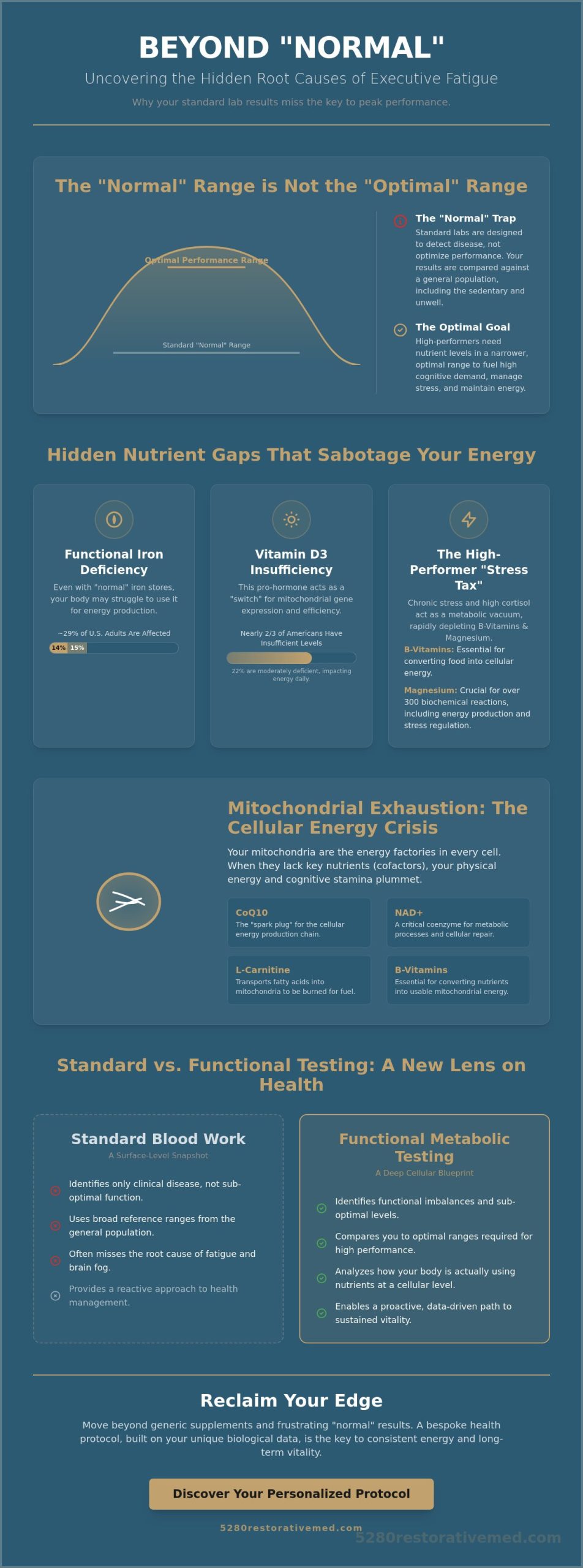
Mitochondrial Exhaustion: The Role of CoQ10, L-Carnitine, and NAD+
Think of your cells as a fleet of high-performance engines. Even if you have a full tank of fuel, the engine won’t turn over if the spark plugs are fouled or the fuel lines are blocked. This is exactly what happens at the cellular level when your mitochondria lack the necessary cofactors to produce energy. While we’ve previously discussed the importance of minerals, these specific nutrient deficiencies that cause fatigue often reside deeper within the cell’s powerhouses, where energy is actually synthesized.
Coenzyme Q10 (CoQ10) acts as a critical electron transporter within the mitochondria. Without it, the process of creating adenosine triphosphate (ATP) grinds to a halt. Similarly, L-Carnitine serves as the essential shuttle that carries long-chain fatty acids into the mitochondrial matrix to be burned for fuel. There is substantial biochemical evidence for nutrient-related fatigue showing that when these specific levels dip, physical and mental stamina follow suit. These aren’t just optional add-ons. They’re fundamental biological requirements for maintaining executive-level performance throughout a demanding day.
Optimizing the Electron Transport Chain
The electron transport chain is the final stage of cellular respiration where your body converts oxygen and nutrients into ATP. For a high-performer, mitochondrial health is the ultimate bottleneck. If your cellular engines are sluggish, no amount of caffeine will provide a sustainable lift. Beyond targeted nutrition, we often utilize red light therapy to stimulate cytochrome c oxidase, a key enzyme in this energy production process. This clinical intervention helps clear metabolic roadblocks and restores your baseline performance by supporting the very structures that power your life.
The NAD+ Revolution
Nicotinamide Adenine Dinucleotide (NAD+) is perhaps the most vital molecule for cellular repair and metabolic efficiency. Unfortunately, chronic stress and the natural aging process deplete NAD+ stores rapidly. This depletion leads to “metabolic aging,” where your cells lose their ability to bounce back from high-pressure demands. In a functional medicine context, we evaluate precursors like NMN and NR to help restore these levels. By addressing these hidden nutrient deficiencies that cause fatigue, we can enhance your cognitive endurance and ensure your brain has the energy it needs for complex decision-making during your most critical hours.
Functional vs. Standard Testing: How to Identify Hidden Cellular Gaps
Standard blood panels like a Complete Blood Count (CBC) or Comprehensive Metabolic Panel (CMP) are excellent tools for diagnosing acute illness or organ failure. However, they’re remarkably blunt instruments for detecting the subtle nutrient deficiencies that cause fatigue in high-performing individuals. A CBC might tell you that your red blood cell count is within the “normal” range, but it won’t reveal if those cells are actually efficient at energy production. You can have a perfect serum level of a nutrient while your cells are starving for it because the transport mechanisms are compromised.
Most traditional labs only provide a snapshot of what’s circulating in your blood at a single moment. This doesn’t account for how those nutrients are being utilized deep within your tissues. When you rely on standard testing, you’re essentially looking at the delivery trucks on the highway without checking if the goods ever reached the factory. To reclaim your vitality, we must look closer at the cellular level.
Intracellular vs. Extracellular Testing
Serum testing for minerals like magnesium or vitamins like B12 can be highly misleading. For example, less than 1 percent of your body’s magnesium is found in the serum; the rest is stored in your bones and soft tissues. A standard test could show “normal” levels while your cells are profoundly depleted. We prefer measuring nutrient levels within the white blood cells, which provides a more accurate reflection of your nutritional status over the previous several months. Functional testing is a method to assess how nutrients are actually performing in biochemical pathways rather than simply counting molecules in the bloodstream.
The Power of Metabolic Insight
To truly understand why your energy is lagging, we analyze metabolic markers through Organic Acids Testing (OAT). This sophisticated analysis identifies specific enzyme cofactors that are missing by measuring the byproducts of your metabolism. If your body can’t convert food into energy efficiently, OAT reveals exactly where the breakdown occurs. This data, combined with Genetic Analysis, allows us to predict your unique nutrient needs based on your inherited blueprint.
We also recognize that you aren’t just what you eat; you’re what you absorb. Chronic issues with gut health often act as a hidden barrier to nutrient uptake, rendering even the most expensive supplement protocols useless. If your gut lining is compromised, vital minerals never make it into your system to support energy production. To stop guessing and start measuring, you can schedule Metabolic Testing to uncover the precise data your body is trying to tell you.
Reclaiming Your Vitality: Custom Protocols for Sustainable High Performance
Many high-performers attempt to fix their exhaustion by “shotgunning” a handful of over-the-counter supplements based on generic internet advice. This approach is not only expensive but often counterproductive. Without precise data, you might be taking forms of nutrients your body can’t absorb or dosages that create new biochemical imbalances. When addressing the specific nutrient deficiencies that cause fatigue, the goal isn’t just to reach a “normal” baseline; it’s to achieve a state of superior physical and mental function that allows you to lead with clarity and purpose.
At 5280 Restorative Medicine, we move away from the coldness of standardized care toward data-driven, bespoke health protocols. We integrate nutritional counseling with advanced hormone optimization and lifestyle adjustments to ensure a maximum return on your health investment. This isn’t about a quick fix. It’s about a sophisticated engineering of your internal environment. By shifting the focus from simply being “not sick” to being “fully optimized,” we help you build a foundation for long-term resilience and cognitive endurance that outlasts the temporary lift of a caffeine fix.
The Boutique Clinical Experience
Our boutique clinical experience is centered on a deep, collaborative partnership between you and Dr. Marci Catallo-Madruga. We don’t believe in temporary “hacks” or a reliance on heavy stimulants to get through the afternoon. Instead, we focus on restoring the underlying biological structures that govern sustainable energy production. This personalized approach treats your health as a proactive journey rather than a reactive necessity. As your professional and personal demands evolve, we use regular monitoring to ensure your supplement protocols and health plans remain as dynamic and effective as possible.
Your Path Forward
Implementing high-dose nutrient protocols without professional oversight can be risky and inefficient. Expert guidance ensures that your body actually utilizes the cofactors we’ve discussed, such as NAD+ and magnesium, without interfering with other physiological systems. Moving from reactive care to proactive health management is the most significant step you can take toward preserving your executive edge and overall well-being. If you’re ready to identify your specific energy leaks and reclaim your peak performance, the first step is a clinical deep dive into your unique biology. You can Schedule a Functional Medicine Consultation today to begin your narrative of transformation and recovery.
Engineering Your Peak Performance
Persistent exhaustion isn’t a badge of honor; it’s a physiological signal that your cellular machinery is under-fueled. You’ve seen how “normal” lab results often mask the very nutrient deficiencies that cause fatigue by ignoring the nuanced metabolic needs of high-performers. By moving beyond the surface of a standard blood count and utilizing advanced metabolic and genetic testing, you can pinpoint the exact cofactors your mitochondria require to thrive. This shift from reactive care to proactive optimization is what separates those who simply get through the day from those who lead it with clarity.
Dr. Marci Catallo-Madruga and the team at 5280 Restorative Medicine specialize in this boutique, high-performance focused care. We don’t settle for baseline health; we aim for total optimization through bespoke health protocols designed around your unique biology. It’s time to stop guessing which supplements might work and start following a data-driven path toward renewed vitality and consistent cognitive stamina. You have the power to redefine your health journey and exceed your previous best.
Reclaim Your Vitality with a Bespoke Health Protocol
Frequently Asked Questions
Can a vitamin deficiency cause extreme fatigue even if my blood work is normal?
Yes, because standard reference ranges are designed to identify clinical disease rather than optimal performance. You may fall into a “low-normal” category where your levels are high enough to avoid a diagnosis but too low to fuel a demanding executive lifestyle. We often find that these sub-clinical nutrient deficiencies that cause fatigue are the primary reason high-performers feel drained despite receiving a clean bill of health from traditional providers.
What is the best vitamin for fatigue and tiredness?
There is no single “best” vitamin because energy production depends on your unique biochemical blueprint. However, the B-vitamin complex, specifically methylcobalamin and folate, is critical for the methylation process that governs cognitive stamina. We use Metabolic Testing to determine if your body requires these specific B-vitamins, or if your fatigue stems from a lack of other essential cofactors like magnesium or Vitamin D3.
How long does it take to feel better after correcting a nutrient deficiency?
Most individuals begin to notice a shift in cognitive clarity and physical energy within two to four weeks of starting a targeted protocol. Deeper cellular restoration, particularly for iron or Vitamin D3, typically requires three to six months of consistent support. Your specific timeline depends on the severity of your initial depletion and your body’s ability to absorb and utilize the new nutrients effectively.
Is it possible to take too many vitamins and cause fatigue?
Yes, excessive intake of certain vitamins and minerals can create metabolic imbalances that actually increase tiredness. For instance, over-supplementing with zinc can lead to a copper deficiency, which impairs neurotransmitter synthesis and energy production. This is why we emphasize bespoke Supplement Protocols based on data rather than a “more is better” approach to nutrition.
What are the signs of mitochondrial exhaustion?
Mitochondrial exhaustion typically manifests as a persistent sense of heaviness, brain fog that resists caffeine, and a slow recovery after mental or physical exertion. You might feel like your “battery” never fully charges, even with adequate sleep. These symptoms suggest your cellular engines lack the necessary electron transporters, such as CoQ10 or NAD+, to convert your food into usable biological energy.
Why does my fatigue continue even after taking a multivitamin?
Many over-the-counter multivitamins use synthetic, poorly absorbed forms of nutrients that never reach your cells in meaningful amounts. Furthermore, a generic pill cannot address the specific nutrient deficiencies that cause fatigue that are unique to your genetic makeup. If you have underlying gut inflammation or genetic variations like MTHFR, you may require much higher, more bioavailable doses than a standard multivitamin provides.
What is the difference between iron deficiency and anemia?
Iron deficiency refers to the depletion of your body’s iron stores, measured as ferritin, while anemia is the later stage where you lack enough red blood cells to transport oxygen. You can experience profound fatigue and cognitive decline during the deficiency stage long before your hemoglobin levels drop low enough for an anemia diagnosis. We look at your full iron panel to catch these energy leaks early.
Can gut health issues cause nutrient deficiencies and fatigue?
Absolutely, because your energy levels are determined by what you absorb rather than just what you eat. Chronic gut inflammation or malabsorption can prevent essential minerals and vitamins from entering your bloodstream, leading to systemic depletion. We often perform a Gut Health Assessment alongside our nutritional counseling to ensure your digestive system is actually capable of supporting your high-performance goals.