
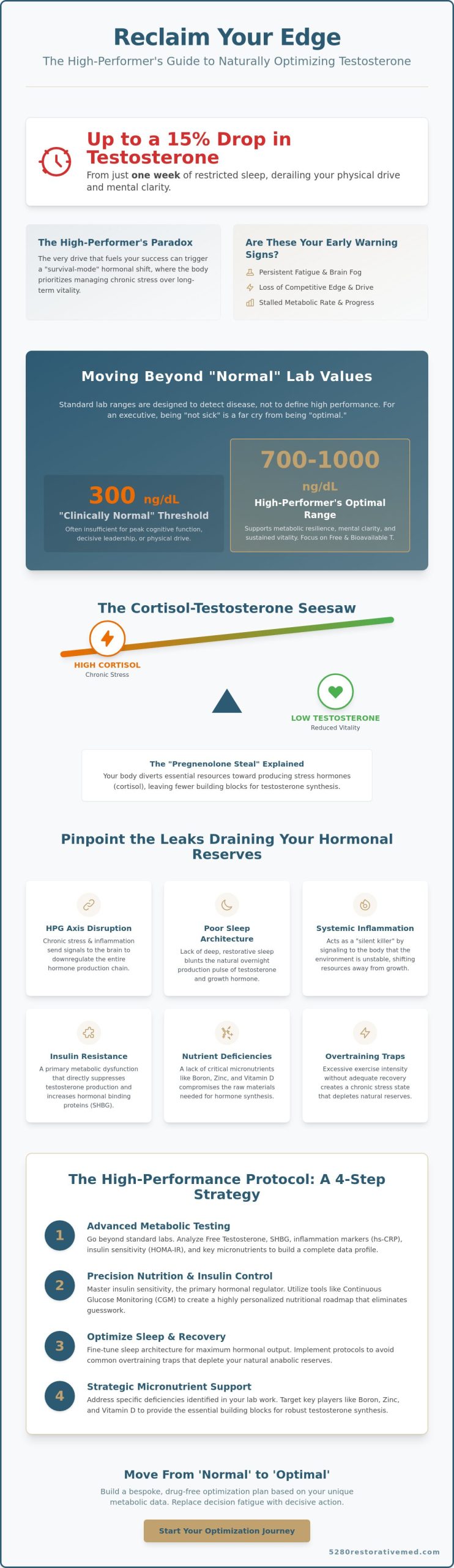
A single week of restricted sleep can plummet a healthy man’s testosterone levels by up to 15 percent, yet many high-performers are told their mounting fatigue and brain fog are simply part of aging. You’ve likely felt the frustration of maintaining a rigorous schedule while your physical drive and mental clarity seem to slip away, even when your standard labs come back within the reference range. If you’re looking for a way to reclaim your edge, optimizing testosterone levels without TRT is not just a possibility; it’s a strategic metabolic necessity. You already know that true vitality isn’t found in a quick fix, but in a body that functions exactly as it was designed to.
This guide shows you how to engineer your body’s natural hormonal production by addressing the underlying metabolic ecosystem. We explore how functional medicine and precision metabolic testing can uncover the specific reasons your hormones have shifted. You’ll discover how to build a sustainable, drug-free health protocol that replaces decision fatigue with decisive action. We move beyond the baseline to help you achieve a state of metabolic resilience that supports both your professional ambitions and your long-term physical health.
Key Takeaways
- Understand why traditional lab ranges are often insufficient for high-performers and how to identify the survival-mode shifts that stall your progress.
- Master the role of insulin sensitivity as a primary regulator of your hormonal signaling and metabolic health.
- Identify the advanced testing protocols required for optimizing testosterone levels without TRT, including the role of critical micronutrients like Boron and Zinc.
- Learn to fine-tune your sleep architecture and exercise intensity to avoid the common overtraining traps that deplete your natural reserves.
- Explore the benefits of continuous glucose monitoring in building a highly personalized roadmap for long-term physiological resilience.
The High-Performer’s Paradox: Why Success Often Signals Hormonal Decline
Success in the boardroom often comes at a hidden physiological cost. This is the High-Performer’s Paradox: the very drive that fuels your professional ascent can trigger a survival-mode hormonal shift that sabotages your physical vitality. When the body perceives chronic executive stress as a threat, it prioritizes immediate survival over long-term anabolic health. This leads to functional hormonal suppression, a state where your system is capable of producing hormones but chooses to downregulate them due to environmental demands. Understanding this distinction is the first step toward optimizing testosterone levels without TRT.
Most clinical laboratories use a broad “normal” range for testosterone, which often begins at a threshold as low as 300 ng/dL. While this number might signal the absence of acute clinical disease, it rarely reflects the requirements for peak cognitive function, decisive leadership, or physical drive. For a high-performer, being “not sick” is a far cry from being “optimal.” Ignoring the early-warning signs, such as a subtle loss of your competitive edge or a stalled metabolic rate, carries a heavy cost. These aren’t just symptoms of aging; they are clear indicators that your metabolic ecosystem is under significant strain.
Beyond the Lab Number: What ‘Optimal’ Really Means
Your total testosterone score only tells a fraction of the story. To understand your true capacity, you must look at Free and Bioavailable Testosterone, which represent the hormones actually available for your tissues to use. The biological role of testosterone extends far beyond muscle mass, influencing everything from neurotransmitter balance to metabolic resilience. Sex Hormone Binding Globulin (SHBG) often acts as a gatekeeper; if your SHBG levels are too high, they bind to your hormones and leave you feeling the symptoms of deficiency despite a “normal” total number. True optimization requires a granular look at these ratios.
The Cortisol-Testosterone Seesaw
Stress and vitality share the same raw biological materials. Through a process often referred to as the “Pregnenolone Steal,” your body diverts cholesterol and pregnenolone toward cortisol production to manage perceived crises, leaving little left for testosterone synthesis. This inverse relationship means that high cortisol levels actively signal your body to halt anabolic growth and repair. Executive burnout creates a persistent feedback loop that suppresses the HPG axis, making it nearly impossible to maintain your physical drive without first addressing the underlying stress architecture and metabolic signaling.
The Biological Foundation: How the HPG Axis Governs Your Natural Production
The Hypothalamic-Pituitary-Gonadal (HPG) axis functions like a sophisticated corporate hierarchy, where the brain and the body must remain in constant, clear communication. Your hypothalamus acts as the CEO, sensing the internal and external environment to release Gonadotropin-Releasing Hormone (GnRH). This signals the project manager, the pituitary gland, to dispatch Luteinizing Hormone (LH) into the bloodstream. This hormone travels to the Leydig cells in the testes, which serve as the production floor for testosterone. When you’re focused on optimizing testosterone levels without TRT, you must ensure every link in this chain is free from metabolic friction. Systemic inflammation, often called the “silent killer,” acts as a direct signal to the hypothalamus to downregulate this production line. The body views chronic inflammation as a sign of environmental instability, choosing to divert resources away from hormonal growth toward immediate survival.
Achieving peak function requires looking at evidence-based lifestyle interventions that address these specific metabolic chokepoints. If the message from the brain is clear but the cellular machinery is compromised, your vitality will remain suppressed regardless of your effort. This systemic approach is the most effective way of optimizing testosterone levels without TRT while simultaneously improving your overall health span.
Insulin Resistance: The Hidden Testosterone Killer
High insulin levels don’t just affect your blood sugar; they act as a potent disruptor of hormonal balance. When insulin remains chronically elevated, it increases the activity of the aromatase enzyme, which converts your hard-earned testosterone into estrogen. This process is often accelerated by visceral fat. This type of fat isn’t merely inert tissue; it’s a metabolically active organ that secretes inflammatory cytokines that further suppress the HPG axis and lower your “free” hormone availability. Insulin sensitivity is the cornerstone of metabolic resilience.
Mitochondrial Function and Steroidogenesis
The actual synthesis of testosterone occurs within the mitochondria of your Leydig cells. This complex process, known as steroidogenesis, requires the efficient conversion of cholesterol into pregnenolone and finally testosterone. When oxidative stress or poor nutrient status damages these cellular powerhouses, production slows to a crawl. It’s like trying to run a high-end manufacturing plant on a failing power grid. Utilizing clinical tools like Red Light Therapy can help optimize mitochondrial function, providing the cellular energy needed for robust hormone synthesis. If you’re ready to identify your specific metabolic roadblocks, a Functional Medicine Consultation can provide the clarity you need to move forward.
Identifying Your ‘T-Leaks’: The Role of Advanced Metabolic Testing
Standard blood panels often provide a surface-level snapshot that misses approximately 80 percent of the biological data relevant to high-performers. When you’re focused on optimizing testosterone levels without TRT, you need to look at the granular details that dictate how your body actually uses its resources. A simple “total T” number doesn’t account for the “leaks” in your system caused by metabolic inefficiencies or chronic nutrient depletion. Identifying these leaks requires a shift from reactive medicine to a proactive, diagnostic-heavy approach.
Your unique biological blueprint plays a significant role in how you synthesize and metabolize hormones. Utilizing Genetic Analysis can reveal specific predispositions, such as how efficiently your body converts precursors into active testosterone. Similarly, a comprehensive Gut Health Assessment is essential; systemic inflammation originating in the digestive tract can derail the HPG axis signaling discussed in previous sections. Without these insights, any attempt at optimization is merely guesswork.
The Micronutrient Co-Factor Audit
Testosterone production is an enzymatic process that depends on specific micronutrient co-factors, primarily Vitamin D3, Zinc, and Magnesium. Vitamin D3 acts more like a hormone than a vitamin, directly influencing the androgen receptors in the testes. Zinc is vital for the pituitary gland to release the luteinizing hormone that triggers production. Magnesium helps lower SHBG, increasing the amount of free testosterone available to your brain and muscles. High-performance lifestyles, characterized by frequent travel, intense training, and high caffeine intake, rapidly deplete these minerals. Off-the-shelf multivitamins rarely solve these issues because they lack the bioavailability and clinical dosages needed to correct a true functional deficiency.
Environmental Toxins and Endocrine Disruptors
Your personal environment often contains hidden “T-leaks” in the form of xenoestrogens. These are chemicals like BPA and phthalates found in plastics and personal care products that mimic estrogen in the body and block testosterone receptors. Research into natural testosterone enhancement highlights how reducing this toxic load is just as important as adding supportive nutrients. Your liver is the primary site for detoxifying these compounds; if your detoxification pathways are sluggish, these disruptors remain in circulation longer, further suppressing your natural production. Swapping plastic containers for glass and choosing paraben-free grooming products are simple, practical steps to reduce this endocrine burden.
The High-Performance Protocol: Strategic Interventions for Natural Optimization
Moving from diagnostics to daily action requires a shift in how you view your lifestyle choices. For the high-performer, every habit either supports or suppresses the endocrine system. Establishing a sustainable framework for optimizing testosterone levels without TRT involves leveraging Functional Health and Wellness principles to remove the biological friction that stalls your progress. When you align your daily protocols with your body’s natural rhythms, you transition from fighting your biology to engineering it for peak capacity.
Sleep as a Hormonal Performance Enhancer
Most of your daily testosterone is synthesized during sleep, specifically during the pulses of Luteinizing Hormone (LH) that occur during REM and deep sleep cycles. To capture the critical 2:00 AM testosterone surge, your sleep architecture must be uninterrupted. Late-night blue light exposure and the cognitive load of “work-winding” before bed disrupt the pineal gland’s melatonin production, which in turn blunts the morning LH response. The “Sleep-Hormone Gap” is the measurable deficit in next-day cognitive performance and physical drive caused by even a single night of fragmented rest. Prioritizing a cool, dark environment and a digital sunset is a clinical necessity for anyone serious about optimizing testosterone levels without TRT.
Strategic Movement: HIIT vs. Heavy Resistance
The “Goldilocks” approach to exercise is essential for high-performers who often default to high-intensity cardio to manage stress. While cardiovascular health is important, excessive steady-state cardio can lead to “Cardio-Induced Low T” by chronically elevating cortisol and suppressing the HPG axis. Compound resistance movements, such as squats and deadlifts, provide the necessary stimulus to increase androgen receptor density. The recommended protocol for 2026 involves a three-day-a-week metabolic stimulus focusing on heavy, multi-joint lifts. This frequency provides enough intensity to signal anabolic growth without crossing the threshold into the overtraining-low-T trap that plagues many driven individuals.
Nutritional Foundations for Steroid Hormones
Your body cannot produce testosterone without the proper raw materials, specifically cholesterol and healthy fats. The typical “Executive Diet,” which is often low in fat or excessively calorie-restricted, starves the Leydig cells of the precursors needed for steroidogenesis. Including adequate saturated and monounsaturated fats ensures your system has a steady supply of building blocks. Simultaneously, integrating cruciferous vegetables like broccoli and kale helps your liver metabolize estrogen more efficiently through compounds like DIM and Indole-3-Carbinol. This ensures a healthy hormone ratio and prevents the aromatization issues discussed in previous sections.
If you are ready to stop guessing and start engineering your vitality, our team can help you build a bespoke plan through a Functional Medicine Consultation tailored to your unique metabolic profile.
Designing Your Bespoke Optimization Plan: Beyond Standardized Care
Generic health protocols fail 90 percent of high-performers because they ignore the unique physiological demands of an executive lifestyle. Standardized care often focuses on bringing a patient back to a baseline of “not sick,” but for those operating at the highest levels, the goal is exceeding that baseline. When optimizing testosterone levels without TRT, your strategy must be as dynamic as your professional life. This requires moving beyond static blood tests and embracing real-time data. Tools like continuous glucose monitoring (CGM) are no longer just for managing disease; they are essential for tracking how your specific stress levels and dietary choices impact your hormonal resilience throughout the day.
Your testosterone level is not just a number to be artificially “boosted” to meet a lab’s reference range. It’s a vital marker of your overall metabolic health and systemic efficiency. High-performance health is a proactive journey. By utilizing Executive Health Programs, you bridge the gap between reactive medicine and a state of peak physical and mental drive. This comprehensive approach ensures that your hormonal state is a byproduct of a resilient, finely tuned metabolism rather than a temporary result of external supplementation.
The Functional Medicine Advantage
At 5280 Restorative Medicine, we believe that true optimization begins with a root-cause assessment. We don’t just look at the symptoms of fatigue or brain fog; we investigate the metabolic “why” behind them. Our process utilizes data-driven insights to pivot your protocols before symptoms become chronic. This boutique clinical partnership provides busy executives with a high-end health partner who is deeply invested in their individual success. We use precision testing to identify exactly where your HPG axis or mitochondrial function is stalling, allowing for a surgical approach to your health optimization.
Next Steps: Taking Control of Your Biology
The transition from wondering about your health to knowing your biological status starts with comprehensive metabolic testing. During a health optimization consultation, we review your genetic predispositions, gut health, and micronutrient status to build your unique roadmap. You’ll move away from trial-and-error wellness and toward a sophisticated, sustainable protocol designed for your specific physiology. Optimizing testosterone levels without TRT is about reclaiming your edge through clinical precision and lifestyle engineering. If you’re ready to master your metabolic resilience, schedule your health optimization assessment with 5280 Restorative Medicine today and begin your journey toward superior function.
Reclaiming Your Physiological Edge in 2026
You’ve seen that true vitality isn’t a static number on a lab report; it’s a reflection of your body’s metabolic resilience. By addressing the High-Performer’s Paradox and repairing systemic chokepoints like insulin resistance and chronic stress, you can restore your natural drive. Optimizing testosterone levels without TRT is a strategic investment in your long-term cognitive and physical performance. It requires moving beyond standard labs to embrace a more granular, data-driven understanding of your unique biology and the delicate signaling of the HPG axis.
At 5280 Restorative Medicine, we specialize in bridging the gap between clinical science and high-end performance. Led by Functional Medicine Expert Dr. Marci Catallo-Madruga, our practice provides bespoke protocols based on advanced metabolic and genetic testing. We are dedicated to executive health optimization, helping you build a sustainable foundation for superior function at every stage of life. Reclaim your edge with a personalized Health Optimization Program at 5280 Restorative Medicine today. Your peak physical and mental state is achievable when you lead with precision.
Frequently Asked Questions
Can diet alone significantly raise testosterone levels without TRT?
Diet is a powerful catalyst for hormonal health but rarely works in isolation. While consuming cholesterol-rich healthy fats provides the raw materials for steroidogenesis, you must also address insulin sensitivity to prevent testosterone from converting into estrogen. A successful strategy for optimizing testosterone levels without TRT involves pairing nutritional changes with targeted recovery protocols to ensure your body remains in an anabolic state rather than a survival-oriented one.
How long does it typically take to see results from natural testosterone optimization?
Most individuals begin to notice improvements in mental clarity and sleep quality within four to six weeks of starting a protocol. However, significant physiological shifts, such as changes in muscle mass or metabolic rate, typically require three to six months of consistent adherence. This timeline allows your endocrine system to stabilize and your HPG axis to recalibrate its natural production levels after years of functional suppression.
Is it possible to have ‘normal’ testosterone levels but still feel the symptoms of Low T?
It’s very common for high-performers to fall within the “normal” lab range while experiencing clinical symptoms of deficiency. This occurs because your Total Testosterone doesn’t reflect how much hormone is actually bioavailable to your tissues. If your Sex Hormone Binding Globulin (SHBG) is elevated, it acts like a sponge, soaking up your active hormones and leaving you with the symptoms of deficiency despite a seemingly healthy lab number.
What are the most common ‘T-leaks’ found in high-performing executives?
The most prevalent “T-leaks” in the executive population include fragmented sleep architecture, high-density blue light exposure, and chronic sympathetic nervous system dominance. These factors create a physiological environment where the brain deprioritizes hormone production in favor of stress management. Environmental endocrine disruptors found in standard office environments also contribute by blocking androgen receptors, effectively muting the signals your body is trying to send to its tissues.
Do over-the-counter testosterone boosters actually work?
Most over-the-counter boosters provide negligible results because they don’t address the underlying metabolic cause of your decline. While certain ingredients like Zinc or Vitamin D can help if you’re deficient, they won’t override a system that’s functionally suppressed by stress or poor gut health. True success in optimizing testosterone levels without TRT comes from engineering your internal ecosystem rather than relying on unverified, one-size-fits-all retail supplements.
How does high stress (cortisol) specifically block testosterone production?
High cortisol acts as a direct emergency signal that tells your brain to shut down non-essential systems for immediate survival. When cortisol remains chronically elevated, it inhibits the release of Gonadotropin-Releasing Hormone (GnRH) from the hypothalamus. This effectively cuts off the communication line to your testes. Without that signal, the production of testosterone slows down as your body shifts its energy toward managing the perceived external threat of your high-stress environment.
What lab tests are essential for a complete hormonal and metabolic profile?
A complete profile must go far beyond a simple testosterone check to provide actionable data. Essential markers include Free and Bioavailable Testosterone, SHBG, Luteinizing Hormone (LH), and Follicle-Stimulating Hormone (FSH) to assess the HPG axis. We also evaluate fasting insulin, C-reactive protein for inflammation, and comprehensive micronutrient panels. These data points allow us to identify the specific metabolic chokepoints that are unique to your physiology and executive lifestyle.
Can optimizing gut health really improve my testosterone levels?
Your gut is a primary site of systemic inflammation, which is a major driver of hormonal decline. When the gut lining is compromised, inflammatory markers enter the bloodstream and signal the brain to downregulate the HPG axis. Optimizing your microbiome reduces this inflammatory burden, allowing your endocrine system to function without interference. A healthy gut also ensures you’re actually absorbing the critical micronutrients required for robust hormone synthesis.