
What if that persistent gray feeling isn’t a sign of burnout, but rather your body’s sophisticated power-save mode triggered by a physiological imbalance? You’ve built a life of high performance, yet you’re quietly struggling with an exhaustion that productivity hacks can’t fix. It’s frustrating to hear from a doctor that your blood work is normal when you feel your mental edge slipping away. Identifying the metabolic root causes of low mood in high-achievers is the first step toward reclaiming your vitality. You aren’t failing; your high-efficiency system is simply running on empty.
In this guide, you’ll discover why high-performance lifestyles often lead to specific physiological shifts that standard medical screenings miss. We will explore how targeted functional medicine interventions, from gut health assessments to hormone optimization, can pinpoint the exact source of your fatigue. You’ll gain a clear, high-efficiency protocol to restore your mental clarity and return to your peak state of function. It’s time to move beyond the absence of illness and pursue a superior state of physical and mental renewal.
Key Takeaways
- Distinguish between high productivity and emotional well-being to recognize when your system has entered a physiological “power-save” mode.
- Identify the specific metabolic root causes of low mood in high-achievers that standard medical screenings frequently miss.
- Understand how the gut-brain axis and mitochondrial health directly dictate your neurochemistry, focus, and daily drive.
- Shift your perspective from “normal” lab results to “optimal” functional ranges to pinpoint early-stage physiological imbalances before they deepen.
- Discover how bespoke protocols, including precision nutrition and executive health programs, can restore your mental clarity and baseline performance.
What is High-Functioning Low Mood in Top Performers?
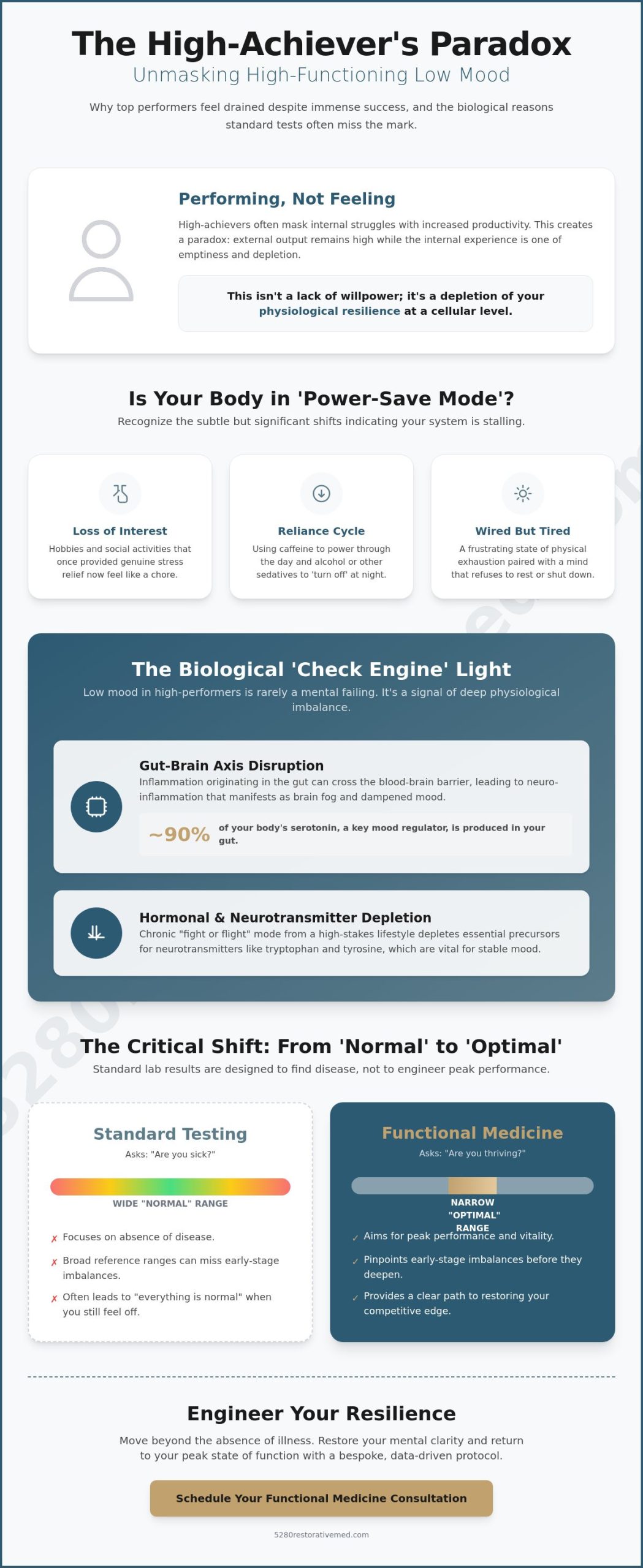
High-achievers possess a unique ability to compartmentalize. You can lead a high-stakes boardroom meeting or close a complex deal while feeling a profound sense of internal emptiness. This state is often described as high-functioning low mood, a condition where you’re “performing but not feeling.” Unlike traditional presentations of low mood that might lead to withdrawal, high-performers often mask their internal struggle with even higher levels of productivity. They use work as a shield, making it difficult for colleagues or even family members to see that anything is wrong.
While this experience is often dismissed as simple burnout, it frequently aligns with the clinical criteria for Persistent Depressive Disorder (PDD). According to the DSM-5-TR, this involves a depressed mood for most of the day, for more days than not, for at least two years. In high-performers, this often manifests as a “functional” low, where the external output remains high while the internal experience remains bleak. Identifying the root causes of low mood in high-achievers requires looking past the functional facade to see the metabolic stalling underneath. This isn’t a lack of willpower; it’s a depletion of your physiological resilience. Your body’s ability to bounce back from stress has been compromised at a cellular level.
The Paradox of Success and Stalling
The very “push through” mentality that fueled your rise to the top eventually becomes your biological undoing. Chronic sympathetic nervous system dominance, the “fight or flight” mode, forces the body to prioritize immediate survival over long-term repair. This constant state of high alert depletes essential neurotransmitter precursors like tryptophan and tyrosine. High-stakes environments effectively accelerate biological aging, stripping the body of the micronutrients required for stable mood regulation. By investigating the root causes of low mood in high-achievers, we find that you aren’t just tired; you’re running on a biological deficit.
Signs Your Body is in “Power-Save Mode”
When the brain senses this chronic depletion, it enters a “power-save mode” to preserve what little energy remains. You might notice your system shifting in subtle but significant ways. Common indicators include:
- A loss of interest in hobbies or social activities that once provided genuine stress relief.
- A growing reliance on caffeine to start the day and alcohol to “turn off” the mental chatter at night.
- The frustrating sensation of being “wired but tired,” where you’re physically exhausted but your mind refuses to rest.
Recognizing these signals is the first step toward a Functional Medicine Consultation that looks beyond standard metrics. We don’t just want to see if you’re “not sick.” We want to understand why your system has stalled and how to restore your competitive edge.
The Biological Root Causes: Why Your “Check Engine” Light is On
When your mood shifts, it’s easy to assume it’s a mental failing. However, for those at the top of their field, the root causes of low mood in high-achievers are almost always physiological. Think of it as a “check engine” light for your biology. Your brain is reacting to a physical environment that can no longer sustain peak performance. Understanding how stress affects the brain at a cellular level reveals that persistent low mood is often the result of systemic imbalances rather than a lack of resilience. Your body isn’t broken; it’s simply signaling that its internal resources are depleted.
The connection between your digestive tract and your mental state is profound. Often, systemic inflammation originating in the gut crosses the blood-brain barrier, leading to neuro-inflammation. This manifests as brain fog and a dampened mood. Since the microbiome produces approximately 90% of your serotonin, any disruption in gut health directly impacts your emotional stability. We often find that mast cell activation syndrome acts as a hidden driver of this inflammation, creating a constant biological “noise” that prevents your brain from reaching a state of calm focus. A targeted Gut Health Assessment is essential to quiet this noise and restore neurochemical balance.
Hormonal Optimization and Mood
Hormonal cascades also play a vital role in your emotional landscape. When you operate in a high-stress environment, your body prioritizes cortisol production, often at the expense of mood-stabilizing hormones like testosterone and estrogen. This “cortisol steal” leaves your endocrine system depleted. Suboptimal levels of sex hormones can mimic the symptoms of clinical depression, leading to a loss of drive and increased irritability. Similarly, a thyroid that is technically “in-range” according to standard TSH tests might still be functioning at a level too low for your high-demand lifestyle. Utilizing BHRT can be a powerful tool for stabilization, helping to restore the hormonal foundation your brain requires to thrive.
The Neuro-Inflammation Connection
Mitochondrial dysfunction is another critical factor in identifying the root causes of low mood in high-achievers. If your cellular “power plants” aren’t producing enough energy, you’ll experience it as a lack of motivation or profound apathy. High-performers also tend to burn through specific micronutrients, such as B vitamins, magnesium, and zinc, much faster than the average person. Without these precursors, your brain simply cannot manufacture the neurotransmitters you need to feel like yourself again. Identifying these gaps through Metabolic Testing allows for a precision approach to recovery that goes far beyond surface-level symptoms.
Standard vs. Functional Testing: Why “Normal” Isn’t “Optimal”
Standard medical diagnostics are designed to identify pathology, not optimize performance. When you’re told your blood work is “normal,” it simply means you aren’t in a state of acute disease. For a high-achiever, this baseline is insufficient. Functional medicine utilizes narrower, “optimal” ranges that signal when your system is beginning to drift toward dysfunction. This proactive approach is critical for uncovering the root causes of low mood in high-achievers before they manifest as a full-blown clinical crisis. We don’t just look for the absence of illness; we look for the presence of vitality.
Standard panels often miss early-stage metabolic stalling because they primarily rely on serum levels. Your body works hard to keep blood levels of certain nutrients stable, even if your tissues are depleted. For example, your serum magnesium might look perfect while your cells are starving for it. We prioritize testing for intracellular nutrients to see what’s actually happening inside your cellular machinery. Additionally, a Genetic Analysis can reveal individual predispositions in neurotransmitter processing, such as MTHFR or COMT variations. These genetic markers dictate how your brain handles stress and clears dopamine, providing a blueprint for your specific neurochemistry.
Advanced Biomarkers for Mood Assessment
To get a complete picture of your internal environment, we utilize advanced testing that goes beyond the surface. Organic Acids Testing (OAT) allows us to see neurotransmitter metabolites and markers for mitochondrial function. A comprehensive stool analysis can identify gut-driven inflammation markers that may be disrupting the gut-brain axis. We also monitor advanced inflammatory markers like C-Reactive Protein (CRP) and Homocysteine. High levels of these markers often correlate with “brain on fire” symptoms, where systemic inflammation directly contributes to a dampened mood and loss of drive.
Interpreting the Data for Performance
Data is only as valuable as its interpretation. We move your care from the “absence of disease” to the “presence of vitality” by analyzing how these biomarkers interact. This data-driven approach allows us to create Supplement Protocols that eliminate the guesswork. You won’t just be taking vitamins; you’ll be fueling your brain with the exact precursors it lacks. By applying functional health and wellness principles, we map a recovery path that is as ambitious as your professional goals. This level of precision is the fastest way to resolve the root causes of low mood in high-achievers and return to a superior state of physical function.
Engineering Resilience: Targeted Protocols for Mood Restoration
Restoring your mental edge requires a departure from vague self-care. We focus on engineering a resilient biological system through data-driven interventions. Precision nutrition provides the specific building blocks your brain lacks, such as tryptophan or tyrosine, identified through your Metabolic Testing. This isn’t about general healthy eating; it’s about targeted Nutritional Counseling that fuels your neurochemistry. When you provide the brain with the precursors it needs, you address one of the primary root causes of low mood in high-achievers: nutritional depletion resulting from high-stress environments.
Cellular energy is the currency of motivation. We utilize red light therapy to stimulate the mitochondria and reduce systemic inflammation. This light-based therapy enhances ATP production, providing the fuel your neurons require for stable mood and focus. Supplementing with NAD+ or NMN precursors can further restore the cognitive drive that often vanishes when your system enters “power-save mode.” These tools don’t just mask symptoms; they rebuild your cellular capacity for performance and emotional stability. Your brain relies on light cues to regulate mood, making morning sunlight exposure a non-negotiable tool for setting your internal clock and ensuring serotonin production.
Bio-Optimization Tools
We leverage advanced tools to reset your nervous system. Cold plunges and saunas provide hormetic stress, which significantly increases dopamine receptor sensitivity. This reset helps you regain the ability to feel drive and pleasure. For those struggling with HPA-axis fatigue, we implement targeted Supplement Protocols to stabilize cortisol rhythms. When necessary, Hormone Optimization using bio-identical hormones bridges the gap during your recovery, ensuring your endocrine system supports your mental health goals. This precision approach addresses the root causes of low mood in high-achievers at the source.
Lifestyle Engineering for Executives
For an executive, recovery isn’t a luxury. It’s a high-value task that must be scheduled with the same discipline as a board meeting. We prioritize circadian rhythm alignment by implementing a “digital sunset” to protect melatonin production from blue light disruption. Additionally, micro-dosing nature and movement throughout the day can lower cortisol spikes and prevent that persistent “wired but tired” feeling. By treating your biology as a high-efficiency machine, you can reclaim the vitality you thought was gone forever. Explore our Executive Health Program to begin your tailored restoration protocol.
The Path Forward: Reclaiming Your Vitality
Reclaiming your mental edge begins with a fundamental shift in perspective. You must recognize that a persistent gray fog isn’t a personality shift or a sign of personal failure. It’s a solvable biological puzzle. By focusing on the root causes of low mood in high-achievers, you move beyond the limitations of standard care that often ignores the unique physiological demands of a high-performance life. A root-cause approach is the fastest path back to your peak state because it addresses the systemic depletions that productivity hacks simply cannot touch. You’ve spent years optimizing your professional output; now, it’s time to apply that same level of strategic precision to your internal environment.
Our executive health programs provide the comprehensive framework necessary for this transformation. We integrate advanced testing with highly personalized protocols to ensure your biology can support the life you’ve built. This isn’t a one-size-fits-all solution. It’s a sophisticated partnership designed to identify exactly where your system has stalled and provide the specific metabolic fuel required to restart it. When you address the root causes of low mood in high-achievers, you don’t just return to a baseline of “not depressed.” You exceed your previous performance levels and reach a superior state of physical and mental renewal.
The 5280 Restorative Medicine Approach
Our methodology is built on clinical authority and bespoke care. We use Metabolic Testing to build your unique health blueprint, identifying the precise nutritional, hormonal, and inflammatory markers that dictate your mood. As a functional medicine denver expert guide, we lead you through a narrative of transformation. In our comprehensive optimization programs, you can expect a deep dive into your Genetic Analysis and gut health, followed by a roadmap that includes Hormone Optimization and targeted Supplement Protocols. We bridge the gap between complex science and your daily well-being, ensuring every intervention is purposeful and effective.
Next Steps for the High-Achiever
It’s time to stop settling for “normal” lab results when you know you’re feeling suboptimal. Your drive, clarity, and mood are too valuable to leave to chance or generic medical advice. Taking the first step toward reclaiming your edge is straightforward:
- Review your unique metabolic markers through specialized testing.
- Move past the “absence of disease” and pursue a superior state of function.
- Schedule a Functional Medicine Consultation to discuss your specific goals.
You deserve a health partner who understands the high-performer’s biology and is deeply invested in your individual success. Reach out today to begin your journey toward lasting vitality and mental clarity.
Reclaiming Your Competitive Edge
You’ve learned that persistent low mood isn’t a lack of discipline; it’s a physiological signal that your high-performance system needs recalibration. By shifting from standard “pathology” ranges to functional “optimal” ranges, you can pinpoint the cellular and hormonal depletions that are holding you back. Identifying the root causes of low mood in high-achievers allows you to move from simply surviving your schedule to thriving with genuine mental clarity and drive.
It’s time to stop guessing and start measuring. Apply for our Executive Health Program to uncover your metabolic root causes and receive a bespoke blueprint for restoration. Our approach includes comprehensive metabolic and genetic testing with personalized protocols designed by Dr. Marci Catallo-Madruga. We offer nationwide virtual consultations, ensuring you have access to specialized care regardless of your location. You don’t have to settle for feeling suboptimal. Your peak state is achievable, and the path to renewal is closer than you think.
Frequently Asked Questions
Is low mood in high-achievers always clinical depression?
Low mood in high-performers isn’t always a primary psychiatric diagnosis. It’s often a state of metabolic stalling where the brain lacks the energy to maintain its usual “edge.” While symptoms might mirror clinical depression, the root causes of low mood in high-achievers are frequently found in the endocrine or digestive systems. Distinguishing between a psychological hurdle and a physiological depletion is essential for selecting the right intervention.
Can hormonal imbalances cause sudden shifts in motivation?
Shifts in motivation are frequently tied to your endocrine system’s health. When chronic stress triggers a “cortisol steal,” your body diverts resources away from producing mood-stabilizing hormones like testosterone and estrogen. This hormonal decline can lead to sudden apathy or a loss of competitive drive. A Hormone Optimization protocol helps restore these levels to their peak state, ensuring your biology supports your professional ambitions.
Why do my blood tests come back normal if I feel so low?
Standard blood panels are designed to identify acute disease, not to evaluate peak performance. A result labeled “normal” simply means you aren’t in a state of clinical failure. We use Metabolic Testing to look at functional ranges, which are much narrower and more precise. This allows us to spot early-stage dysfunction, such as cellular nutrient gaps or sub-clinical thyroid issues, that standard screenings often miss.
How does gut health affect my daily mood and focus?
Your gut and brain are in constant communication via the vagus nerve and chemical signaling. Since the microbiome produces approximately 90% of the body’s serotonin, any intestinal imbalance can lead to dampened mood and brain fog. Systemic inflammation originating in the gut can also cross the blood-brain barrier. A Gut Health Assessment identifies these hidden drivers of neuro-inflammation, allowing for a clear path to mental clarity.
What are the most common nutrient deficiencies in executives?
High-achievers typically burn through magnesium, B-vitamins, and zinc at an accelerated rate due to constant sympathetic nervous system activation. These nutrients are critical for neurotransmitter synthesis and cellular energy production. When these levels drop, you might feel “wired but tired” or lose your mental stamina. Targeted Supplement Protocols replace these specific precursors to keep your brain functioning at a superior level.
How long does it take to see mood improvements with functional medicine?
While every biology is unique, many clients begin to feel shifts in mental clarity and energy within four to eight weeks. This timeline allows for the restoration of cellular nutrient levels and the stabilization of hormonal rhythms. Lasting transformation occurs as we address the root causes of low mood in high-achievers through consistent, data-driven protocols. We focus on sustainable renewal rather than quick fixes.
Can bio-optimization tools like NAD+ help with low mood?
NAD+ and its precursors are powerful tools for restoring mitochondrial function. These molecules are essential for ATP production, which is the primary energy source for your brain cells. By enhancing cellular energy, NAD+ can help lift the “gray” feeling of low mood and restore sharp cognitive focus. This bio-optimization approach is a core component of a sophisticated Executive Health Program designed for peak performance.
Is burnout a psychological issue or a physical one?
Burnout is a physical reality that manifests with psychological symptoms. It’s fundamentally a state of HPA-axis dysfunction where your adrenal system can no longer meet the demands of your lifestyle. While mindset is important, you cannot “think” your way out of a physiological depletion. Addressing the physical foundation through a Functional Medicine Consultation is the most effective way to reverse burnout and reclaim your vitality.