
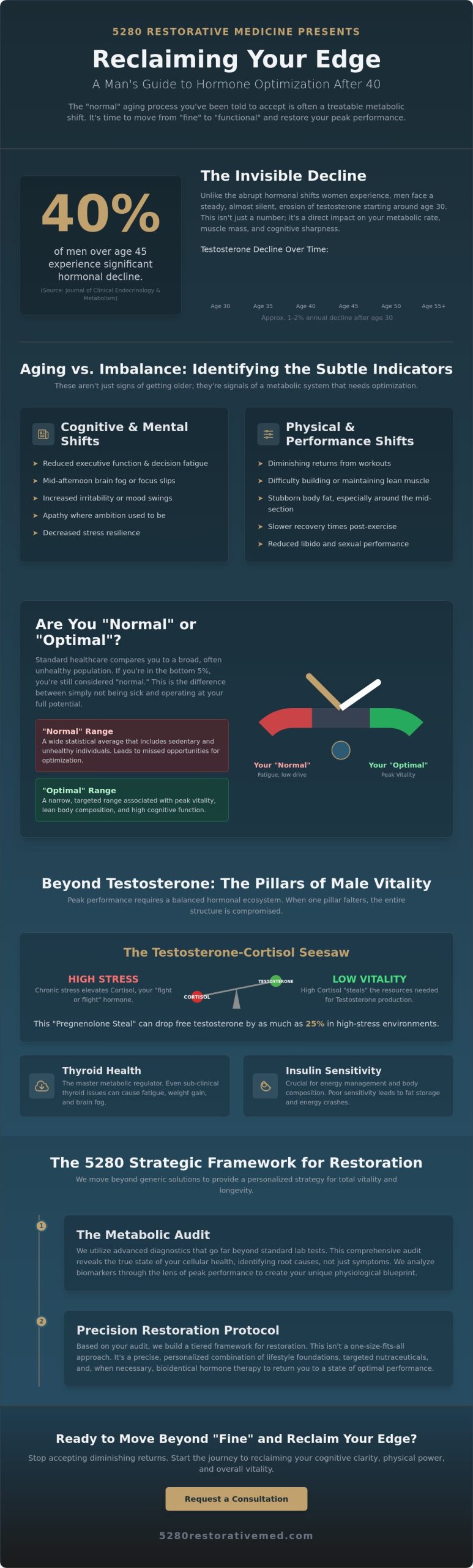
What if the “normal” aging process you’ve been told to accept is actually a treatable metabolic shift? You’ve likely noticed that your 5:00 AM workouts don’t yield the same results they did five years ago, or perhaps your executive focus slips during mid-afternoon meetings. It’s frustrating to put in the work and see diminishing returns on your physical and mental output. Recognizing the signs of hormone imbalance in men over 40 is the first step toward reclaiming the edge you feel slipping away. Clinical data from the Journal of Clinical Endocrinology & Metabolism indicates that nearly 40% of men over age 45 experience significant hormonal decline. You’re not imagining the fatigue; your biology is simply operating on an outdated map.
At 5280 Restorative Medicine, we believe that your peak performance shouldn’t have an expiration date. This guide will show you how advanced metabolic optimization can restore your cognitive clarity and rebuild the lean muscle mass that seems harder to maintain. You’ll learn to identify the subtle indicators of decline and understand the precise science behind hormonal restoration. We’ll explore a path that moves beyond generic solutions to provide a personalized strategy for total vitality and longevity.
Key Takeaways
- Identify the “performance stall” and learn to distinguish between the natural aging process and the specific signs of hormone imbalance in men over 40.
- Understand the “Three Pillars” of hormonal health, including how chronic stress “steals” from your testosterone production and metabolic efficiency.
- Uncover the subtle physical and cognitive shifts—such as reduced executive function and slower recovery—that signal a need for metabolic optimization.
- Discover how a comprehensive Metabolic Audit uses advanced diagnostics to move beyond basic testing and reveal the true state of your cellular health.
- Explore a tiered framework for restoration that combines precision nutraceuticals with lifestyle foundations to return you to a state of peak performance.
The Silent Performance Stall: Why Men Over 40 Experience a Sudden Shift
You’ve spent decades building a career, a reputation, and a life. Then, seemingly out of nowhere, the drive that fueled your ascent begins to flicker. This isn’t the dramatic “mid-life crisis” depicted in movies; it’s a subtle, metabolic erosion. Many high-performers dismiss these early signs of hormone imbalance in men over 40 as the inevitable tax of a high-stress lifestyle or simple aging. At 5280 Restorative Medicine, we recognize this “stall” as a clinical shift that requires more than just “powering through.”
The medical community often refers to this gradual decline as late-onset hypogonadism, or andropause. Unlike the abrupt hormonal cliff women experience during menopause, men face a steady 1% annual decline in testosterone starting around age 30. By the time you reach 45, nearly 40% of men exhibit clinically low levels. This invisible decline impacts everything from your metabolic rate to your cognitive sharpness. Standard reactive medicine often ignores these shifts until they manifest as chronic disease, but restorative medicine intervenes early to maintain your physiological peak.
The Psychology of the Performance Gap
The first casualty of hormonal decline is often professional “edge.” You might notice a creeping sense of apathy where there used to be ambition. Brain fog and increased irritability don’t just stay at the office; they bleed into leadership roles and personal relationships. We view hormone optimization as a critical tool for career longevity. Restoring these levels helps reclaim the mental clarity and decisiveness required to lead effectively in high-stakes environments. It’s about ensuring your internal chemistry matches your external goals.
Normal vs. Optimal: Why “Fine” Isn’t Good Enough
Standard healthcare often fails men over 40 by relying on “normal” reference ranges. These ranges are calculated from a broad, often sedentary and unhealthy population. If your labs fall within the bottom 5% of that group, your primary care physician might tell you that you’re “fine.” However, being “fine” is a far cry from being functional or vibrant. We believe that your health should be measured against your own potential, not a statistical average of a declining population.
At 5280 Restorative Medicine, we look at biomarkers through the lens of peak performance. We don’t compare you to an average, aging demographic; we compare you to the best version of yourself. In restorative medicine, we don’t aim for the absence of disease; we aim for the presence of peak vitality. Identifying the signs of hormone imbalance in men over 40 is the first step toward moving beyond the reactive “sick-care” model and into a proactive era of personalized health optimization.
Beyond Testosterone: The Three Pillars of Male Hormonal Optimization
Achieving peak performance after 40 requires looking past the single-hormone focus often found in mainstream clinics. While testosterone remains the primary driver of muscle mass and libido, it functions within a complex ecosystem. Identifying the hormonal imbalances in men over 40 involves analyzing how different systems interact. When one pillar falters, the entire structure of your vitality begins to lean. At 5280 Restorative Medicine, we focus on four key markers: testosterone, cortisol, thyroid, and insulin.
The Testosterone-Cortisol Seesaw
Stress isn’t just a mental state; it’s a biochemical reality that actively depletes your masculinity. When you experience chronic stress, your adrenal glands prioritize cortisol production over everything else. This physiological process often leads to a “pregnenolone steal,” where the raw materials needed for testosterone are diverted to manage stress. Pushing through exhaustion only deepens this deficit. This drain is a core focus of functional medicine for high-performers, where we engineer resilience rather than just treating symptoms. High cortisol levels can drop free testosterone by as much as 25 percent in high-stress environments, making recovery nearly impossible without clinical intervention.
Thyroid and Metabolic Efficiency
Your thyroid acts as the metabolic thermostat for every cell in your body. Subtle shifts in this gland often manifest as cold intolerance, thinning hair, or stubborn midsection fat that resists even the most disciplined diets. Standard labs often only check Thyroid Stimulating Hormone (TSH), but this rarely tells the whole story. To truly understand your cellular energy, we must test Free T3 and Free T4 levels. These hormones regulate mitochondrial health, the literal power plants of your cells. Without optimized thyroid function, your body cannot efficiently synthesize the other hormones required for peak performance.
Hormonal health is inseparable from insulin sensitivity. Metabolic flexibility, the ability to switch between burning carbs and fats, is essential for maintaining a lean physique. When insulin levels remain chronically high, it triggers systemic inflammation and lowers sex hormone-binding globulin (SHBG), further complicating the signs of hormone imbalance in men over 40. If you’ve noticed a sudden decrease in mental clarity or a 10 pound gain around your waist despite no change in habits, your metabolic markers may be the culprit. We treat these pillars as a unified system to ensure your results are both profound and sustainable. You can start your optimization journey by mapping your personal hormonal blueprint with our team today.
Aging vs. Imbalance: Identifying the Subtle Indicators of Decline
Many men dismiss a fading sense of vitality as an unavoidable part of the aging process. You might notice that your recovery after a weekend hike takes three days instead of one, or that your ability to solve complex professional problems feels sluggish. These aren’t just milestones of getting older; they’re often the primary signs of hormone imbalance in men over 40. When your internal chemistry shifts, your body stops responding to exercise and nutrition the way it once did. Identifying these changes early is the first step toward reclaiming your peak performance.
- Cognitive Decline: Memory lapses and a noticeable drop in creative “flow” states often signal a dip in neuroprotective hormones.
- Emotional Shifts: A loss of enthusiasm for long-term passions or increased anxiety can indicate that your endocrine system is struggling to regulate mood-stabilizing neurotransmitters.
- Physiological Red Flags: A decrease in the frequency of morning erections is one of the most reliable clinical indicators of declining androgen levels and vascular health.
The Physical Transformation
Hormonal shifts frequently manifest as a visible redistribution of weight. When testosterone drops, estrogen can become disproportionately high, leading to “Gynaecomastia,” or the development of excess breast tissue. This state of estrogen dominance also encourages the storage of visceral fat, which wraps around internal organs and increases systemic inflammation. Beyond what you see in the mirror, your skeletal integrity is at risk. Men can lose approximately 1% of their bone mineral density annually after age 40 if their hormones aren’t optimized. This decline significantly increases the risk of fractures. Clinical data also links low hormonal markers to unfavorable lipid profiles, which can increase cardiovascular risk markers by as much as 33%.
Sleep and Recovery Deficits
If you’re waking up tired despite spending eight hours in bed, your body is likely failing to reach the deep stages of repair. Low testosterone levels are frequently linked to obstructive sleep apnea and chronic insomnia, creating a cycle of exhaustion that nutrition alone cannot fix. Waking up unrefreshed is a primary red flag for metabolic dysfunction. Restorative sleep is the specific period of deep, non-REM rest where the body initiates nocturnal hormone pulses to repair cellular tissues and reset metabolic triggers. Without these pulses, your body remains in a state of high cortisol and low recovery. At 5280 Restorative Medicine, we view these sleep disturbances as a roadmap for your personalized restoration plan, ensuring you return to a state of superior health and longevity.
The Metabolic Audit: How Advanced Diagnostics Uncover Root Causes
Identifying the signs of hormone imbalance in men over 40 requires more than a cursory glance at a lab sheet. It demands a deep dive into your unique physiology. At 5280 Restorative Medicine, we move beyond the “normal range” to find your optimal zone. This process begins with a four-step metabolic audit designed to pinpoint exactly where your vitality is leaking.
- Step 1: Comprehensive Blood Panels. We look at the relationship between Free and Total Testosterone, SHBG, and Estradiol to see what’s actually available for your body to use.
- Step 2: Assessing the Adrenal Axis. By measuring the Cortisol Awakening Response (CAR), we determine if chronic stress is sabotaging your hormonal recovery.
- Step 3: Genetic Analysis. We examine your DNA to understand how your body clears hormones and where metabolic bottlenecks exist.
- Step 4: Gut Health Assessment. A healthy microbiome is essential for hormone conversion; we ensure your “second brain” isn’t working against your endocrine system.
The Limitations of Standard Blood Work
Most traditional doctors only check “Total Testosterone.” This number is often misleading. About 98% of the testosterone in your body is bound to proteins like Sex Hormone Binding Globulin (SHBG), rendering it biologically inactive. If your SHBG levels are high, your “Total T” might look fine while your “Free T” is bottoming out. This discrepancy is why many men continue to suffer from signs of hormone imbalance in men over 40 despite being told their labs are normal. Precision is everything. We require this granular data before implementing bhrt to ensure your treatment is as unique as your thumbprint.
Genetic and Metabolic Synergy
Your DNA acts as the blueprint for how you process and clear hormones. Some men possess genetic variations that make them slower at detoxifying estrogen or more prone to systemic inflammation. We track markers like C-Reactive Protein (CRP) because levels above 3.0 mg/L often signal silent inflammation that disrupts hormonal signaling at the cellular level. This sophisticated approach is a hallmark of our executive health programs. By integrating genetic insights with metabolic data, we don’t just mask symptoms; we optimize the entire biological engine. This Denver-based approach ensures you aren’t just reaching a baseline, but achieving a superior state of health that lasts for decades.
Stop guessing about your health and start measuring what matters. Schedule your comprehensive metabolic audit with 5280 Restorative Medicine today.
Reclaiming Vitality: A Strategic Framework for Hormonal Restoration
Restoration follows a strict hierarchy. You can’t out-supplement a poor foundation, which is why we prioritize a tiered approach to metabolic health. We begin with lifestyle and nutrition to provide the raw materials for endocrine function. When these adjustments aren’t enough, we integrate precision nutraceuticals to support natural production pathways. If clinical blood work indicates a significant deficit, Bioidentical Hormone Replacement Therapy (BHRT) becomes the necessary tool to restore physiological levels. We also utilize red light therapy to optimize mitochondrial function, ensuring your cells have the energy to utilize these hormonal signals effectively.
Engineering a High-Performance Lifestyle
Men over 40 require a specific nutritional protocol that prioritizes hormone precursors. This includes increasing healthy fats from sources like avocados and grass-fed beef, which provide the cholesterol necessary for testosterone synthesis. Micronutrient density is equally critical. Clinical data suggests that 42 percent of the US population is deficient in Vitamin D3, a pro-hormone essential for androgen production. Our protocols ensure these gaps are closed using bioavailable sources.
- Nutrition: Focus on high-quality proteins and cruciferous vegetables to manage estrogen metabolism.
- Exercise: Prioritize heavy resistance training at 80 percent of your one-rep max. This triggers a higher acute hormonal response than steady-state cardio.
- Stress: Implement tactical recovery, such as cold exposure or focused breathwork, to reset the nervous system in under ten minutes.
Exercise strategies must shift as you age. While long-distance running can actually increase cortisol and suppress testosterone, short bursts of high-intensity movement preserve lean muscle mass. This metabolic shift is vital for anyone noticing the signs of hormone imbalance in men over 40, as it helps combat the midsection weight gain and muscle loss typical of the decade.
The 5280 Restorative Medicine Approach
At 5280 Restorative Medicine, we provide a boutique clinical experience that moves beyond the generic protocols of traditional clinics. We view the relationship between the doctor and the high-performer as a partnership. Our Denver-based practice focuses on personalized data, using advanced diagnostics to create a roadmap tailored to your specific physiology and professional demands.
We treat health as a proactive journey. By moving away from reactive medicine, we empower you to reach a superior state of health that lasts. If you are ready to move beyond the signs of hormone imbalance in men over 40 and reclaim your peak performance, our team is ready to guide your transformation.
Schedule your consultation to begin your metabolic restoration and experience the 5280 difference.
Take Control of Your Physiological Future
Recognizing the early signs of hormone imbalance in men over 40 isn’t a sign of defeat; it’s a strategic opportunity to pivot. You’ve learned that peak performance relies on more than just high testosterone levels. It requires a precise synergy between metabolic health and genetic predispositions. Dr. Marci Catallo-Madruga and the team at 5280 Restorative Medicine move beyond generic health advice by utilizing advanced functional medicine and metabolic testing. We create a roadmap tailored specifically for high-performers who refuse to settle for a gradual decline.
Our protocols aren’t based on guesswork. We apply data-driven analysis of your unique genetic markers and hormonal profile to ensure your energy remains sustainable and your mental clarity stays sharp. Whether you’re an executive managing a complex portfolio or an athlete maintaining a competitive edge, your biology should support your ambitions. You can redefine how you age by choosing a clinical partner that values precision and measurable results.
Begin Your Performance Restoration Journey with 5280 Restorative Medicine. Your best years don’t have to be behind you when the right science brings your peak potential back into focus.
Frequently Asked Questions
Is it normal to feel more tired after 40 even if I eat well?
Persistent fatigue despite a healthy diet often indicates a decline in testosterone, which typically drops by 1% to 2% each year after age 30. While many men accept this as a natural part of aging, it’s actually a clinical symptom of hormonal shifts. At 5280 Restorative Medicine, we view this as a signal that your cellular health requires attention to restore the vitality you experienced in your 20s.
Can hormone imbalance cause sudden weight gain in the midsection?
Midsection weight gain is one of the most common signs of hormone imbalance in men over 40. When testosterone levels fall, cortisol and estrogen often rise; this leads to increased visceral fat storage around the abdomen. Research published in the Journal of Clinical Endocrinology and Metabolism shows that men with low testosterone have significantly higher body fat percentages. Optimization helps shift your metabolism back into a fat-burning state.
What is the difference between “normal” and “optimal” testosterone levels?
Normal levels are based on a broad laboratory average ranging from 300 to 1,000 ng/dL, which includes men of all ages and health statuses. Optimal levels represent the specific range where you personally experience peak mental clarity and physical performance. We focus on the upper quartile of these ranges to ensure you aren’t just within limits but are actually thriving at your highest potential.
Does stress really affect my testosterone production?
Chronic stress directly suppresses testosterone production through the elevation of cortisol. When your body remains in a fight or flight state, it prioritizes survival over reproductive and restorative hormones. This biological mechanism can lower your total testosterone by up to 25% during periods of high occupational or personal stress. Managing these levels is essential for any successful restoration plan and long-term health.
How long does it take to see results from hormone optimization?
Most patients report improved sleep and mental focus within the first 21 to 28 days of treatment. Physical changes, such as increased muscle mass and reduced body fat, typically become measurable between the 3 and 6 month marks. Because we prioritize cellular health, the timeline reflects your body’s natural pace of regeneration. We monitor your progress every 90 days to ensure your protocol remains perfectly aligned with your goals.
Are bioidentical hormones safer than traditional synthetic options?
Bioidentical hormones are molecularly identical to the hormones your body produces naturally, which allows for more seamless integration at the receptor level. Unlike synthetic versions that may have altered structures, bioidenticals offer a more precise fit for your biological needs. This approach reduces the risk of side effects while maximizing the efficiency of your optimization. Our 5280 Restorative Medicine team selects these options to provide the safest path to longevity.
What happens if I ignore the signs of hormone imbalance?
Ignoring these symptoms can lead to an increased risk of chronic conditions like type 2 diabetes and cardiovascular disease. Studies indicate that men with untreated low testosterone face a 33% higher risk of death over an 18 year period compared to those with healthy levels. Proactive intervention prevents these long-term health complications and ensures you maintain your edge as you age. It’s about protecting your future quality of life today.