
What if the afternoon brain fog that stalls your momentum isn’t a lack of willpower, but a breakdown in how your cells communicate with fuel? You might be eating a disciplined diet and maintaining a rigorous schedule, yet you still find yourself battling stubborn midsection weight and fatigue that hits right when you need to be sharpest. It’s frustrating to feel like your biology is working against your ambitions. You deserve a physiological foundation that matches your drive, and the key lies in implementing strategic lifestyle changes to improve insulin sensitivity that go beyond basic wellness advice.
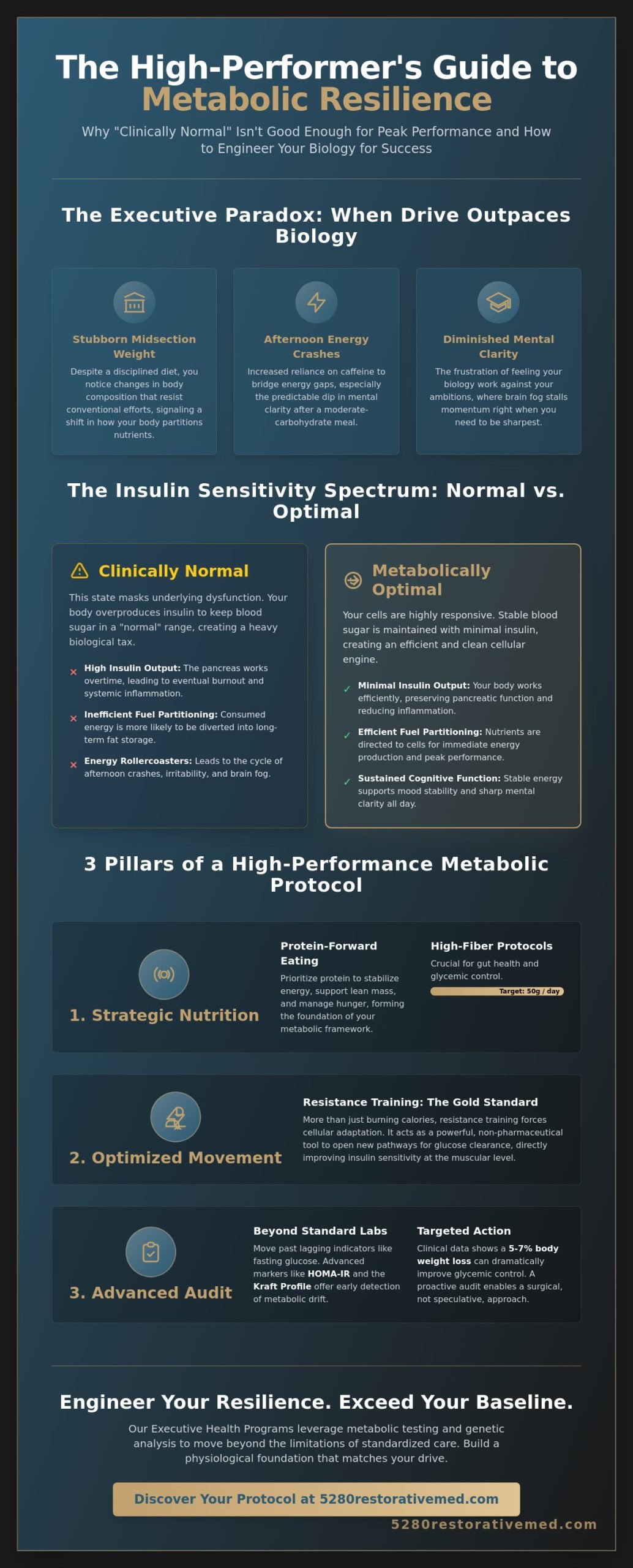
This article provides a functional approach to metabolic resilience, treating your health as a proactive journey rather than a reactive necessity. You’ll discover how to optimize your cellular response to insulin through advanced diagnostics, targeted nutrition, and bio-optimization strategies designed for high-performers. We’ll explore the latest 2026 clinical data, including the 5-7% weight loss target for glycemic improvement and the role of high-fiber protocols reaching 50g per day. From metabolic testing to personalized gut health assessments, we’re outlining a sophisticated roadmap to help you reclaim your energy and exceed your baseline performance.
Key Takeaways
- Distinguish between clinically normal and metabolically optimal states to ensure your body effectively partitions nutrients for peak mental and physical performance.
- Identify early-stage metabolic dysfunction with advanced diagnostics and implement targeted lifestyle changes to improve insulin sensitivity at a cellular level.
- Adopt a nutritional engineering framework that prioritizes protein-forward eating and chronobiology to stabilize your energy and eliminate afternoon crashes.
- Understand the hierarchy of movement and why resistance training remains the gold standard for forcing cellular adaptation and opening new pathways for glucose clearance.
- Explore how bespoke protocols within an Executive Health Program leverage metabolic testing and genetic analysis to move beyond the limitations of standardized care.
Understanding the Insulin Sensitivity Spectrum: Beyond Blood Sugar
Most clinical settings view insulin through a narrow lens of disease management. If your blood sugar isn’t high enough to trigger a diagnosis, you’re often told you’re fine. However, metabolic health isn’t a binary switch; it’s a dynamic spectrum. Insulin sensitivity is the efficiency of your nutrient partitioning. It determines whether the fuel you consume is utilized for cellular energy production or diverted into long-term fat storage. When you embrace a functional medicine approach, you stop looking for the mere absence of illness and start aiming for a state of metabolically optimal vitality.
Traditional labs typically focus on fasting glucose and A1c to identify Insulin Resistance only after it’s well-established. A “clinically normal” result often masks a state where the body requires excessive insulin to maintain “normal” sugar levels. This state, known as hyperinsulinemia, creates a heavy biological tax. In contrast, being metabolically optimal means your cells are highly responsive, maintaining stable blood sugar with very little insulin output. This efficiency directly impacts your cognitive function, mood stability, and daily energy. Without it, you’re susceptible to the energy rollercoasters that lead to afternoon brain fog and irritability.
The Bio-Energetic Role of Insulin
Insulin serves as the primary key for mitochondrial fuel delivery. It signals your cells to open and accept glucose for energy. When cells become resistant, your mitochondria can effectively starve even when blood sugar is high. This creates a cycle of systemic inflammation and accelerated biological aging. Insulin sensitivity is the body’s ability to clear glucose with minimal insulin output. By focusing on lifestyle changes to improve insulin sensitivity, you’re essentially upgrading your cellular engine to run on a cleaner, more efficient fuel cycle.
Why High-Performers Are at Risk
High-performers often face what we call the “Executive Paradox.” You might be highly disciplined in your career but find yourself trapped by high stress and long hours of sedentary desk time. These chronic micro-stresses trigger a silent metabolic drift. Elevated cortisol levels can blunt your insulin response, even if your diet seems “clean.” Early signs of this drift don’t always appear on standard labs. Instead, you might notice:
- Subtle changes in body composition, particularly stubborn weight around the midsection.
- Increased reliance on caffeine to bridge energy gaps throughout the day.
- A noticeable dip in mental clarity after eating a moderate-carbohydrate meal.
Our Executive Health Programs are designed to catch these nuances early. Implementing specific lifestyle changes to improve insulin sensitivity now ensures that your physical health supports, rather than hinders, your professional longevity and cognitive edge.
The Metabolic Audit: Identifying Your Root-Cause Drivers
Standard medical screenings often provide a false sense of security. Relying solely on fasting glucose or HbA1c is like checking the weather by looking at the damage after a storm has passed. These are lagging indicators. By the time your fasting glucose climbs above 100 mg/dL, your body has likely been overproducing insulin for a decade to compensate for cellular resistance. A functional medicine approach shifts the focus toward early detection and root-cause identification. When you understand your unique drivers, the lifestyle changes to improve insulin sensitivity become surgical rather than speculative.
The Kraft Prediabetes Profile and HOMA-IR scoring offer a higher resolution view of the management of insulin resistance by measuring the relationship between insulin and glucose simultaneously. This data reveals whether your pancreas is working overtime to maintain “normal” sugar levels. Additionally, through genetic analysis, we can pinpoint specific polymorphisms that influence how you process carbohydrates and fats. This level of precision allows us to move beyond generic advice and engineer a plan that respects your biological individuality.
Advanced Biomarkers for Insulin Health
A true metabolic audit looks at the insulin-to-glucose ratio rather than isolated numbers. High fasting insulin in the presence of normal glucose is a clear signal that your system is under stress. We also monitor inflammatory markers like hs-CRP. Chronic inflammation can physically block insulin receptors, effectively locking the door to your cells. To turn these abstract numbers into actionable insights, continuous glucose monitors (CGMs) provide real-time data. Seeing how a specific meal or a high-stress meeting impacts your blood sugar allows for immediate, data-driven adjustments to your daily routine.
The Gut-Metabolism Connection
Your microbiome plays a decisive role in how you process fuel. Dysbiosis and “leaky gut” can trigger metabolic endotoxemia, a state where bacterial components leak into the bloodstream and spark systemic inflammation. This immune response directly impairs insulin signaling. Conversely, a healthy gut produces short-chain fatty acids (SCFAs) like butyrate, which act as signaling molecules that enhance receptor sensitivity. A comprehensive functional health and wellness assessment is the first step toward identifying if your gut health is the hidden anchor holding back your metabolic progress. By addressing these internal drivers, you create a fertile environment for your optimization efforts to take root.
Strategic Nutrition and Chronobiology for Cellular Response
Engineering your diet for metabolic flexibility requires moving beyond the restrictive mindset of traditional dieting. Instead of focusing solely on caloric deficits, we prioritize nutritional engineering. This approach ensures your body can seamlessly switch between burning glucose and utilizing stored fats. By implementing targeted lifestyle modifications to improve insulin resistance, you can stabilize your energy levels and protect your cognitive performance throughout the business day.
A protein-forward strategy is foundational to this process. Consuming high-quality protein at every meal, particularly in the morning, helps stabilize the postprandial insulin response. This prevents the sharp spikes and subsequent crashes that often lead to afternoon fatigue. When it’s time for carbohydrates, we match intake to your activity levels and circadian rhythms. Starchy vegetables or grains are best reserved for periods following intense physical exertion when your muscles are primed for glucose uptake. Our Executive Health Program integrates these nutritional strategies with your specific metabolic data to create a bespoke fueling plan.
Sleep hygiene also plays a non-negotiable role in your metabolic health. A single night of poor sleep can significantly impair your morning insulin sensitivity by elevating cortisol levels. This hormonal shift makes your cells less responsive to insulin, often leading to increased hunger and poor food choices the following day. Prioritizing seven to eight hours of restorative sleep is one of the most effective lifestyle changes to improve insulin sensitivity available to high-performers.
Macro-Sequencing and Fiber Optimization
The order in which you consume your food dictates your metabolic response. Adopting a “Fiber First” rule creates a physical buffer in the gut, slowing the absorption of glucose into the bloodstream. We recommend aiming for up to 50g of fiber per day to maximize this effect. For optimal results, consume protein and healthy fats before moving to any carbohydrate sources. Adding an acidic component like vinegar to your meal can further dampen the glycemic load; research suggests that consuming vinegar before a meal can reduce glucose spikes by up to 30%.
Chronobiology: Timing Your Metabolism
Your internal clock, or chronobiology, deeply influences how you process nutrients. Early-window time-restricted feeding (eTRF) aligns your eating schedule with your body’s natural peak in insulin sensitivity during the morning and early afternoon. Late-night eating is the primary disruptor of this rhythm, as your body is biologically programmed to be more insulin-resistant as the sun goes down. Optimizing the “Executive Lunch” with a balance of lean protein, healthy fats, and high-fiber greens is the most effective way to bypass the 3 PM energy crash and maintain peak executive function until the day is done.
Movement and Bio-Optimization: Forcing Cellular Adaptation
Exercise is often presented purely as a weight-loss tool, but its most profound benefit lies in its ability to force cellular adaptation. For the high-performer, movement is a strategic signal that reconfigures how your body handles fuel. While standard guidelines suggest 150 minutes of moderate activity, maximizing your metabolic resilience requires a more nuanced hierarchy. Implementing specific movement-based lifestyle changes to improve insulin sensitivity allows you to bypass the traditional insulin pathway entirely through a process called GLUT4 translocation.
When you engage in intense physical activity, your muscles recruit GLUT4 transporters to the cell surface. These transporters act as a “back door,” allowing glucose to enter the muscle cells without requiring a high insulin signal. This mechanism is vital for executives who struggle with high cortisol levels, as chronic stress often blunts the primary insulin signaling pathway. High-Intensity Interval Training (HIIT) further accelerates this process by stimulating mitochondrial biogenesis. By increasing the number and efficiency of your mitochondria, you’re essentially expanding your body’s internal capacity to process energy and clear glucose more effectively.
Resistance Training and Muscle Mass
Think of your skeletal muscle as a metabolic sink. It’s responsible for clearing the vast majority of post-meal glucose from your bloodstream. Strength training is the most effective way to expand this sink. You don’t need hours in the gym; a minimum effective dose of resistance training twice a week, targeting large muscle groups with at least five different exercises, is sufficient to trigger significant improvements. Even small “movement snacks,” such as a two-minute walk after lunch, can drastically reduce glucose spikes. These short bursts of activity are particularly effective for busy professionals who spend long hours at a desk and need to mitigate the effects of sedentary time.
Advanced Bio-Optimization Strategies
To exceed your baseline performance, you can integrate advanced tools that amplify your results. Cold exposure, for instance, activates brown adipose tissue (BAT), which burns glucose to generate heat. Similarly, red light therapy supports mitochondrial function, enhancing the cellular environment for better insulin signaling. Regular sauna use also contributes to resilience by triggering heat shock proteins that protect against metabolic stress. Combining these bio-optimization techniques with a data-driven Metabolic Testing protocol ensures your efforts are yielding measurable physiological results and moving you toward a superior state of function.
Engineering Resilience: The 5280 Restorative Medicine Protocol
Generic health advice often fails high-performers because it ignores the intricate metabolic fingerprint of a high-stress, high-output life. Standard recommendations are designed for the average person, but your physiological demands are anything but average. At 5280 Restorative Medicine, we move beyond the “eat less, move more” mantra to provide a bespoke engineering approach. Our Executive Health Programs integrate advanced metabolic testing with personalized nutrition and lifestyle interventions to ensure your biology supports your professional ambitions.
Optimizing your internal environment often requires looking at the hormonal axis. Insulin does not work in a vacuum; it is deeply influenced by cortisol, growth hormone, and sex hormones. For many individuals, physician-guided BHRT serves as a critical tool to restore the hormonal balance necessary for peak insulin function. By addressing age-related hormonal shifts, we create a stable foundation that makes your lifestyle changes to improve insulin sensitivity significantly more effective. This comprehensive strategy ensures you aren’t just avoiding disease but are actively exceeding your baseline performance.
Personalized Supplementation and Support
We move beyond basic multivitamins to utilize targeted supplement protocols that act as biological levers. Based on your specific lab results, we may implement pharmaceutical-grade sensitizers such as Berberine, Alpha-Lipoic Acid, and Magnesium. These compounds are selected to enhance glucose disposal and mitochondrial efficiency. However, supplementation is never a “set it and forget it” solution. We prioritize clinical accountability and regular diagnostic re-testing to monitor your progress in real time. This iterative process allows us to refine your protocol as your body adapts, ensuring long-term metabolic resilience.
Your Path to Metabolic Mastery
The journey from metabolic dysfunction to peak vitality begins with a deep-dive Functional Medicine Consultation. During this initial session, we review your history, lifestyle, and goals to identify the unique barriers to your success. We understand that your time is your most valuable asset. Therefore, we design protocols that fit seamlessly into a demanding professional schedule, focusing on high-impact lifestyle changes to improve insulin sensitivity that yield the greatest physiological return.
You don’t have to accept afternoon fatigue or cognitive decline as an inevitable part of aging or a busy career. By applying a functional, data-driven framework, you can reclaim your energy and sharpen your mental edge. Take the first step toward metabolic mastery by scheduling a comprehensive metabolic assessment with our team today. Your peak physical and mental state is achievable, and we are here to provide the expert guidance to help you reach it.
Achieving Peak Metabolic Resilience
Your journey to metabolic mastery requires moving beyond standardized care and embracing a data-driven, personalized strategy. Shifting your focus from avoiding disease to optimizing cellular function unlocks a level of vitality that supports both your professional longevity and daily well-being. We’ve explored how the synergy of advanced diagnostic testing, chronobiology, and resistance training creates a powerful environment for physiological renewal. Implementing these specific lifestyle changes to improve insulin sensitivity is the most effective way to eliminate energy crashes and reclaim your cognitive edge.
At 5280 Restorative Medicine, we specialize in bridging the gap between complex science and your daily life. Led by Dr. Marci Catallo-Madruga, our practice utilizes advanced metabolic and genetic testing to engineer protocols specifically tailored for executives and high-performers. You don’t have to settle for “clinically normal” when peak performance is within reach. Take control of your biological future today. Schedule Your Comprehensive Metabolic Assessment and begin your transformation toward a superior state of health. Your best years of focus and energy are still ahead of you.
Frequently Asked Questions
How long does it take to improve insulin sensitivity with lifestyle changes?
You can observe measurable improvements in cellular insulin response within as little as two to seven days of consistent intervention. However, reversing established metabolic dysfunction and achieving a stable, optimized state typically requires three to six months of dedicated lifestyle changes to improve insulin sensitivity. This timeframe allows for structural changes in body composition and mitochondrial efficiency to take full effect.
Can you be thin and still have insulin resistance?
Yes, individuals with a low Body Mass Index (BMI) can still harbor significant insulin resistance, a condition often referred to as “Thin Outside, Fat Inside” (TOFI). This usually occurs when visceral fat accumulates around internal organs despite a slender outward appearance. Advanced body composition testing or a waist-to-hip ratio measurement is often more predictive of metabolic health than weight alone for these individuals.
What are the best supplements to boost insulin sensitivity naturally?
Targeted supplement protocols often include Berberine, Alpha-Lipoic Acid (ALA), and Magnesium to enhance glucose disposal. Berberine, for instance, has been shown in clinical studies to be highly effective in managing blood sugar by activating the AMPK pathway. We always recommend these be part of a physician-guided plan to ensure they complement your unique genetic and metabolic profile without interfering with other optimizations.
Is intermittent fasting safe for everyone trying to improve insulin response?
While intermittent fasting is a powerful tool for many, it’s not a universal solution, especially for high-performers facing chronic stress. For those with significant HPA-axis dysfunction or high cortisol, long fasting windows can sometimes exacerbate metabolic stress rather than relieving it. We prefer to use continuous glucose monitoring to determine if fasting is helping or hindering your specific insulin response before making it a permanent fixture.
How does chronic stress specifically cause insulin resistance?
Chronic stress elevates cortisol, which signals the liver to release stored glucose for immediate energy. When this “fight or flight” response stays active, your body remains in a state of high blood sugar, forcing the pancreas to pump out insulin continuously. Over time, your cells become desensitized to this constant insulin presence, leading to the metabolic drift commonly seen in high-pressure executive roles.
What is the single most effective exercise for improving glucose uptake?
Resistance training is the most effective modality because it increases the size of your “metabolic sink” by building skeletal muscle mass. Muscle is responsible for clearing roughly 80% of post-meal glucose from the bloodstream. By increasing your lean mass, you provide more surface area for GLUT4 transporters to move sugar out of the blood and into the cells for energy without relying solely on insulin.
Are there specific fruits I should avoid if I have low insulin sensitivity?
You don’t necessarily need to avoid all fruit, but you should prioritize low-glycemic options like berries, green apples, and citrus. Tropical fruits such as mangoes, pineapples, and grapes contain higher concentrations of fructose and glucose, which can trigger larger insulin spikes. Pairing any fruit with a source of protein or healthy fat further blunts this glycemic impact and protects your energy levels.
How often should I test my insulin levels if I am making lifestyle changes?
We recommend re-testing your fasting insulin and HOMA-IR scores every three to six months when you are actively implementing lifestyle changes to improve insulin sensitivity. This frequency provides enough time for physiological adaptations to occur while giving us the data needed to pivot your protocol. Regular monitoring ensures your plan remains aligned with your body’s evolving needs as you move toward peak vitality.