
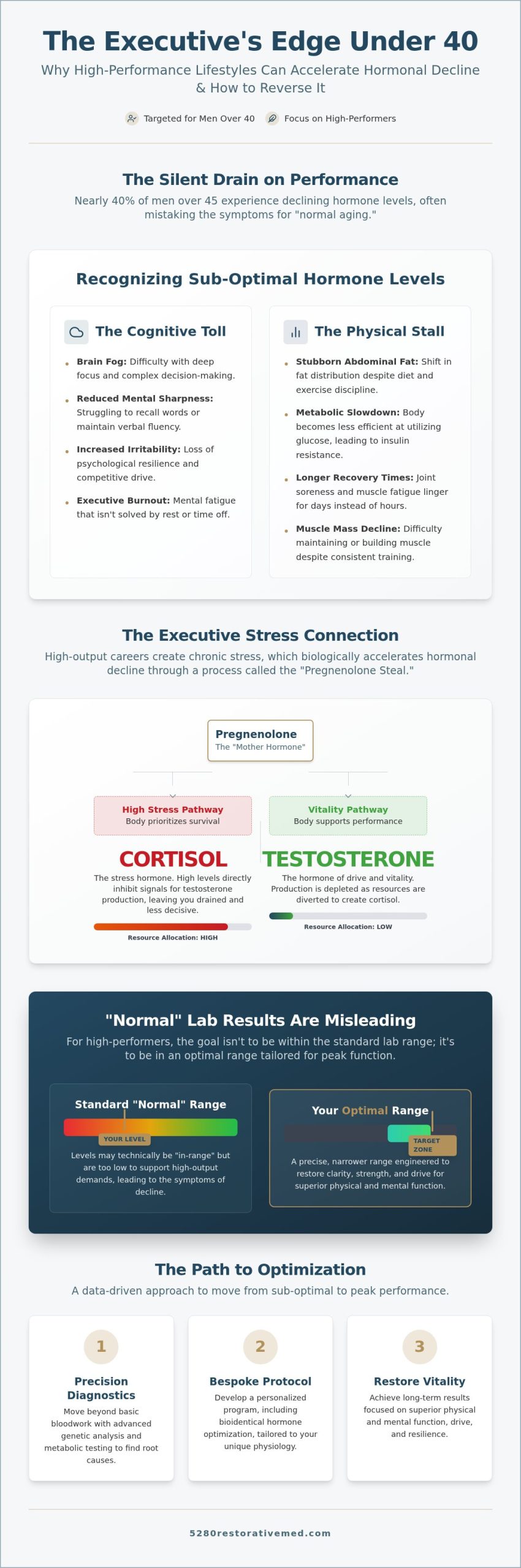
Nearly 40% of men over 45 are currently navigating the silent drain of declining hormone levels, yet most dismiss the warning signs as an inevitable part of aging. You’ve likely noticed the shift; the afternoon crashes that caffeine can’t fix, a sudden lag in decision-making speed, or the stubborn abdominal fat that persists despite your usual discipline. These are the classic symptoms of low testosterone in men over 40, and they represent more than a minor inconvenience. For a high-performer, these changes signal a breakdown in the biological foundation that supports your executive edge and physical vitality.
It’s frustrating to feel your peak performance slipping away when your professional and personal demands are higher than ever. You deserve a strategy that respects your ambition and your biology. This guide will show you how to move beyond generic advice and identify the specific metabolic markers holding you back. We’ll explore how a precision functional medicine approach, utilizing advanced diagnostics and hormone optimization, can restore your clarity, strength, and drive to their rightful levels.
Key Takeaways
- Identify the subtle symptoms of low testosterone in men over 40 that often masquerade as “normal aging” but actually indicate a sub-optimal hormonal state.
- Uncover the biological link between high-output executive stress and premature hormonal decline through the mechanism of the “pregnenolone steal.”
- Learn why “normal” lab results can be misleading and how to transition toward an “optimal” reference range tailored to your unique physiology.
- Discover how genetic analysis and metabolic testing provide the precision data needed to create a bespoke protocol for long-term vitality.
- Understand the role of bioidentical hormone replacement within a multi-month Executive Health Program focused on achieving superior physical and mental function.
Recognizing the Symptoms of Low Testosterone in Men Over 40
Most men in their 40s expect a slight slowdown. But there’s a world of difference between the natural aging process and living with a physiological deficit. Clinical Understanding Hypogonadism (Low Testosterone) usually involves levels so low they cause overt medical issues, but many high-performers suffer in the “sub-optimal” zone. Here, your numbers might technically fall within a standard laboratory reference range, yet they’re insufficient to support your high-output lifestyle. The symptoms of low testosterone in men over 40 appear gradually, often creeping in over years until the loss of your “edge” becomes your new, frustrating baseline.
This decline isn’t just about physical strength; it manifests as a subtle erosion of your psychological resilience. You might find yourself more irritable during board meetings or feeling a sense of “executive burnout” that isn’t solved by a weekend off. It’s a loss of the competitive drive that defined your 30s. Beyond the mood shifts, these hormonal changes impact your long-term metabolic health. Low levels are linked to increased cardiovascular risk and a higher likelihood of metabolic syndrome. Identifying the symptoms of low testosterone in men over 40 is a critical health assessment rather than a vanity project.
The Cognitive Toll: Brain Fog and Mental Sharpness
Declining androgens hit the brain where it hurts most for a professional: executive function. Research suggests that testosterone plays a key role in spatial memory and verbal fluency. When levels drop, you might struggle to recall specific words during a presentation or lose the ability to maintain deep focus during a twelve-hour workday. Mental fatigue becomes a constant companion, making complex decision-making feel like wading through mud. Testosterone acts as a neuroprotective signaling molecule that maintains the structural integrity and efficient communication of neurons within the brain.
Physical Changes: Body Composition and Metabolic Stall
You’re still hitting the gym and watching your macros, yet your midsection is expanding. This shift in fat distribution is a hallmark of hormonal imbalance. As testosterone declines, your basal metabolic rate slows down, and your body becomes less efficient at utilizing glucose. This often leads to insulin resistance, creating a feedback loop where abdominal fat further suppresses testosterone production. You’ll also notice that recovery takes longer. The joint soreness that used to vanish overnight now lingers for days, and the muscle mass you worked hard to build seems to be fading despite your best efforts. It’s a metabolic stall that requires a precision-engineered solution.
The Executive Stress Connection: Why High-Output Lifestyles Accelerate Decline
High-performers often believe their ambition protects them from the slow creep of aging. In reality, the relentless pressure of an executive career can act as a biological accelerator for hormonal decline. While many sources suggest a standard 1% annual drop in hormone levels, chronic stress creates a much steeper trajectory. This is where the symptoms of low testosterone in men over 40 become intertwined with occupational burnout. You aren’t just “getting older”; you’re likely experiencing the physiological fallout of a high-output life.
Central to this acceleration is a process known as the “Pregnenolone Steal.” Pregnenolone is the “mother hormone,” the raw material your body uses to create both cortisol and testosterone. When you’re perpetually in “fight or flight” mode, your body prioritizes survival over reproduction. It siphons off the available pregnenolone to produce cortisol, leaving your testosterone production depleted. This isn’t just a lifestyle issue; it’s a physical diversion of resources that leaves you feeling drained and less capable of decisive action.
Cortisol vs. Testosterone: The Physiological Tug-of-War
Your body operates via two primary systems: the HPA (hypothalamus-pituitary-adrenal) axis for stress and the HPG (hypothalamus-pituitary-gonadal) axis for reproduction. They exist in a delicate feedback loop. Elevated cortisol levels directly inhibit the release of gonadotropin-releasing hormone, effectively shutting down the signal to produce testosterone. You can’t achieve peak performance if your internal alarm system is constantly blaring. Utilizing functional health and wellness strategies allows you to address these systemic stressors at the root, rather than just treating surface symptoms.
Environmental factors in a professional setting also play a significant role. Late nights spent under blue light disrupt your circadian rhythm, which is when the majority of your testosterone is produced. Exposure to endocrine disruptors in modern office environments can further interfere with your hormone receptors. Understanding Testosterone Therapy Benefits and Risks is helpful, but it’s equally vital to look at how your daily environment sabotages your natural output. If you’re seeing the symptoms of low testosterone in men over 40, your workspace and sleep hygiene are likely contributing factors.
The Role of Mitochondrial Health in Hormone Production
Testosterone is produced within the Leydig cells of the testes, a process that’s incredibly energy-intensive. This energy comes from your mitochondria. If your cellular engines are sluggish due to poor nutrition, chronic inflammation, or toxin exposure, your hormonal output will suffer. Building mitabolic resilience ensures your cells have the capacity to meet the demands of hormone synthesis. If you’re ready to reclaim your edge, a Functional Medicine Consultation can help identify these specific cellular bottlenecks and restore your executive drive.
Why ‘Normal’ Lab Results Often Mask Low Testosterone Symptoms
It’s a common and frustrating scenario: you present with the classic symptoms of low testosterone in men over 40, but your primary care physician insists your labs are fine. This disconnect happens because standard reference ranges are staggeringly broad. The American Urological Association generally sets the threshold for low testosterone at 300 nanograms per deciliter (ng/dL), but this number is a statistical average of the general population. It includes men who are sedentary, overweight, or struggling with chronic illness. If you’re a high-performer aiming for peak cognitive and physical output, being “average” compared to an unhealthy population isn’t the goal.
Your personal history matters more than a generic mean. If your baseline in your 20s was 900 ng/dL and you’ve dropped to 350 ng/dL, you’ll likely experience profound symptoms despite technically being within the “normal” range. Accuracy also depends on the timing of your tests. Testosterone levels peak in the early morning, so a blood draw taken in the afternoon will often yield an artificially low or inconsistent result that doesn’t reflect your actual physiological capacity.
Free vs. Total Testosterone: Understanding Bioavailability
Total testosterone only tells half the story. Sex Hormone Binding Globulin (SHBG) is a protein that binds to testosterone, effectively “locking it up” so it can’t interact with your receptors. You can have a high total testosterone level but still suffer from the symptoms of low testosterone in men over 40 if your SHBG is too high. Testing free testosterone is non-negotiable for an accurate diagnosis because it measures the bioavailable hormone that’s actually free to support your metabolic and mental function.
Optimal vs. Reference Ranges in Functional Medicine
Functional medicine practitioners interpret data through a lens of vitality rather than the mere absence of disease. We define an “optimization zone” where your hormonal profile supports high-level cognitive clarity and physical resilience. By integrating these insights into a comprehensive executive health program, we move past generic care toward a bespoke strategy that restores your competitive edge. This approach ensures that we’re treating the individual, not just the lab paper.
Precision Diagnostics: Moving Beyond Basic Bloodwork
Standard blood panels often provide an incomplete picture of your hormonal health. While they might show a raw number, they fail to explain how your body actually processes that hormone. For men experiencing the symptoms of low testosterone in men over 40, precision diagnostics offer a map of your unique biological terrain. We don’t just look at the fuel in the tank; we examine the efficiency of the entire engine. This requires looking at the genetic and metabolic factors that dictate your response to treatment.
A truly optimized state requires more than just a testosterone prescription. It demands an understanding of your body’s nutrient status. Co-factors like Vitamin D, Zinc, and Magnesium are essential for the enzymatic reactions that produce and utilize testosterone. If these are depleted, even the most advanced hormone protocol will underperform. We use these data points to build a foundation for long-term health rather than a temporary fix.
Genetic Analysis: COMT, MTHFR, and Hormone Metabolism
Your DNA is the blueprint for your endocrine system. Genetic variations in the COMT and MTHFR genes can significantly impact how you metabolize and detoxify hormones. For instance, the COMT gene influences how you break down estrogens and catecholamines, while MTHFR dictates your methylation capacity. If these pathways are sluggish, you may experience unwanted side effects or a lack of clinical improvement even with “normal” levels. Integrating these genetic insights allows our clinical team to craft bespoke dosing protocols that maximize performance while minimizing potential risks.
Advanced Metabolic Markers
Inflammation is a primary driver of hormonal decline. We measure high-sensitivity C-reactive protein (hs-CRP) to evaluate systemic inflammation, which can directly inhibit the Leydig cells in the testes. Furthermore, your gut health plays a critical role in nutrient absorption and the elimination of hormone metabolites. A compromised gut can lead to recirculating toxins that further suppress your natural output. By evaluating these markers, we develop a root-cause optimization strategy that addresses the symptoms of low testosterone in men over 40 from the inside out. If you’re ready to see what’s happening beneath the surface, our Genetic Analysis can provide the clarity you need to move forward.
The Path to Optimization: The 5280 Restorative Medicine Approach
Resolving the symptoms of low testosterone in men over 40 isn’t a quick fix; it’s a comprehensive recalibration. It demands a sophisticated, multi-month health optimization protocol designed to realign your internal biochemistry with your external ambitions. Unlike traditional models that focus on reactive symptom management, our approach treats hormone optimization as a foundational pillar of your executive health. We integrate precision diagnostics with nutritional counseling and bespoke supplement protocols to ensure your body has the raw materials it needs to thrive. This isn’t about hitting a generic number; it’s about engineering a state of peak physical and mental function that lasts.
Continuous monitoring is the hallmark of a high-end clinical partnership. We don’t just set a protocol and walk away. We use ongoing data from metabolic testing and advanced bloodwork to make real-time adjustments. This ensures your levels remain in the “optimization zone” rather than fluctuating between extremes. Recent clinical data has refined our understanding of hormone safety, allowing for more confident, personalized care that respects your long-term health. By treating your health as a proactive journey, we help you exceed your previous baseline performance and maintain your competitive edge.
BHRT for Peak Performance
Bioidentical Hormone Replacement Therapy, or BHRT, is a precision tool that uses hormones chemically identical to those your body produces naturally. This distinction is vital for high-performers who require metabolic resilience without the side effects often associated with synthetic alternatives. Whether you choose subcutaneous pellets for steady release or topical formulations for daily control, the delivery method is tailored to fit your professional lifestyle. The ultimate goal is to restore the physiological profile of your prime years, providing the energy and clarity necessary for high-stakes decision-making.
Engineering Your Long-Term Healthspan
Optimization is about more than feeling better today; it’s about protecting your future. By resolving the symptoms of low testosterone in men over 40, you’re also supporting long-term cardiovascular health and cognitive function. This proactive health partnership shifts the focus from avoiding illness to maximizing your healthspan. When your hormones are balanced, your body is better equipped to manage inflammation and maintain lean muscle mass. If you’re ready to reclaim your vitality and exceed your current baseline, you can Schedule your initial functional medicine consultation to begin your personalized journey toward renewal.
Reclaiming Your Executive Edge
Accepting a decline in your performance isn’t a requirement of aging. We’ve explored how the symptoms of low testosterone in men over 40 are often masked by broad lab ranges and accelerated by the unique physiological pressures of a high-output career. By shifting your focus from generic reference ranges to personal optimization, you can identify the specific metabolic and genetic bottlenecks that are currently holding you back. This precision approach ensures that your health strategy is as sophisticated as your professional one.
Led by Dr. Marci Catallo-Madruga, a dedicated functional medicine expert, our practice provides bespoke care for national high-performers through precision protocols based on genetic and metabolic testing. You deserve a health strategy that matches your professional ambition and restores your biological drive. It’s time to move past the frustration of sub-optimal health and embrace a proactive journey toward renewal. Apply for an Executive Health Optimization Program today and rediscover what it feels like to operate at your true potential. Your peak physical and mental states are well within reach.
Frequently Asked Questions
What are the most common symptoms of low testosterone in men over 40?
Hallmarks include decreased sex drive, erectile changes, increased abdominal fat, and lower energy. You might also notice subtle cognitive shifts like reduced motivation or irritability. Almost 40% of men over 45 experience these issues. Recognizing the symptoms of low testosterone in men over 40 is the first step toward a precision-engineered recovery plan that restores your executive edge and physical vitality.
Can I have low testosterone symptoms if my lab results are ‘normal’?
You can definitely experience symptoms even if your total testosterone falls within the standard reference range of 300 to 1,000 ng/dL. These ranges are based on broad population averages rather than individual optimization. If you’re noticing the symptoms of low testosterone in men over 40, your personal baseline is what matters most. We focus on your specific optimization zone to ensure your hormonal profile supports high-level performance.
How does high stress affect testosterone levels in executives?
Chronic executive stress triggers the “pregnenolone steal,” where your body prioritizes cortisol production over sex hormones. This physiological diversion leaves your testosterone levels depleted. High cortisol levels also inhibit the HPG axis, effectively shutting down the signal to produce more testosterone. Managing this stress response is essential. You simply don’t have the capacity to optimize your hormones while your body remains in a perpetual state of “fight or flight.”
Is brain fog a recognized symptom of low testosterone?
Brain fog is a significant and frequent cognitive symptom of hormonal decline. Testosterone acts as a neuroprotective signaling molecule that influences spatial memory and verbal fluency. When levels drop, you may struggle with decision-making speed and sustained focus during long working hours. Restoring your levels often clears this mental fatigue. This allows you to regain the sharp cognitive clarity required for high-stakes professional environments and complex problem-solving.
What is the difference between bioidentical and synthetic testosterone?
Bioidentical hormones are chemically identical to the molecules your body naturally produces. This allows for a more seamless integration into your metabolic pathways compared to synthetic versions. Bioidentical options, often used in BHRT, aim to restore your physiological profile to its prime state. Synthetic hormones have different molecular structures. These can sometimes lead to varying side effects or less predictable responses in high-performance optimization protocols designed for long-term health.
How long does it take to see results from a hormone optimization program?
Most men begin to notice improvements in energy, mood, and mental clarity within three to six weeks. However, physical changes like muscle gain and fat loss typically take three to six months of consistent optimization. We utilize multi-month protocols because true metabolic restoration requires time. Continuous monitoring and data-driven adjustments ensure your progress stays on track as your body recalibrates to its new, superior state of function.
Does low testosterone cause weight gain around the midsection?
Low testosterone directly contributes to increased abdominal fat and a slower basal metabolic rate. This hormonal shift often leads to insulin resistance, making it difficult to lose weight despite consistent exercise. Visceral fat also contains aromatase, an enzyme that converts testosterone into estrogen. This creates a frustrating cycle of further hormonal depletion. Breaking this cycle requires a targeted approach to restore your metabolic efficiency and physical strength.
Are there natural ways to boost testosterone before starting BHRT?
Improving sleep hygiene, reducing alcohol, and prioritizing resistance training can support your natural output. Ensuring adequate intake of Vitamin D, Zinc, and Magnesium is also vital for hormone synthesis. While these lifestyle adjustments are foundational, they’re often not enough to overcome a significant clinical deficit. We integrate these natural strategies into our broader Executive Health Program to maximize the effectiveness of your bespoke hormone optimization protocol.