
What if the lab results sitting on your doctor’s desk are technically “normal,” yet they’re the very reason you feel like you’re running on empty? You aren’t alone in this gap. Research from the American Thyroid Association suggests that up to 60 percent of people with thyroid dysfunction remain undiagnosed because standard screenings don’t account for individual vitality. You likely know the feeling of waking up exhausted or losing your cognitive edge by 2:00 PM, only to be told your tsh levels fall within the standard reference range. It’s a frustrating cycle that leaves many high performers settling for a baseline of “fine” instead of the excellence they expect from themselves.
At 5280 Restorative Medicine, we believe your health shouldn’t be a “wait and see” game. This guide bridges the gap between conventional medicine and true hormonal optimization. You’ll discover the critical difference between surviving within a lab range and thriving with optimal thyroid function. We’ll explore how a functional medicine approach identifies the root causes of metabolic slowing and provides a clear, personalized roadmap for the restoration and optimization of your long-term vitality.
Key Takeaways
- Learn why standard laboratory ranges often fail high-performers and how “normal” results can mask persistent symptoms of exhaustion.
- Discover the narrow functional medicine target for tsh levels that distinguishes clinical baseline from peak metabolic vitality.
- Understand why relying solely on a TSH test may miss 50% of your thyroid story and which specific “fuel” markers are essential for cellular energy.
- Explore the sophisticated feedback loop between your brain and thyroid to identify where your metabolic communication may be breaking down.
- See how 5280 Restorative Medicine transitions your care from passive monitoring to active optimization for a superior state of health.
Why Your “Normal” TSH Levels Might Still Leave You Feeling Exhausted
You’ve likely experienced the frustration of a clinical consultation where your symptoms are dismissed because your lab work falls within the “normal” range. For high-performers in Denver, the gap between being “not sick” and being “optimized” is where the most critical health work happens. Your pituitary gland produces Thyroid-stimulating hormone to act as a metabolic thermostat. It senses how much energy your body needs and signals the thyroid to produce more or less fuel. When this signaling becomes sluggish, your entire system follows suit.
At 5280 Restorative Medicine, we see patients every day who struggle with persistent brain fog and weight gain despite having tsh levels that their primary care physician labeled as acceptable. True restoration requires looking beyond the broad averages of a sick population to find your personal peak. We believe that health is a proactive journey, not a reactive response to a failing system.
The Problem with Standard Reference Ranges
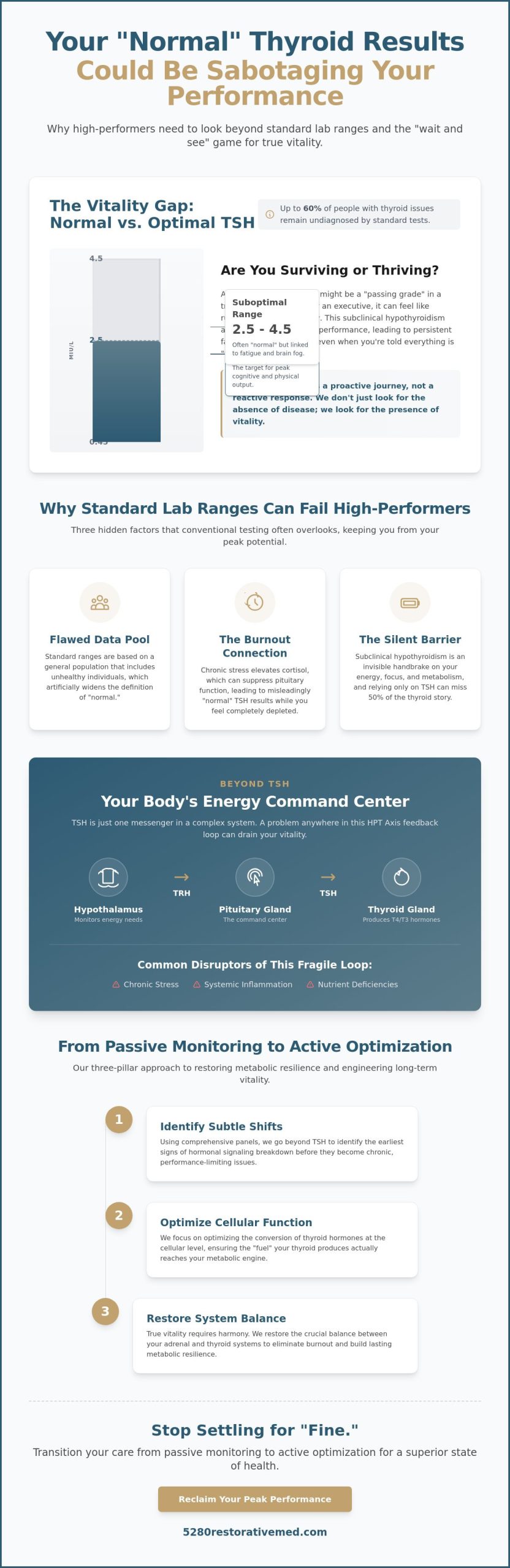
Standard lab ranges are calculated using a bell curve of the general population, which includes individuals with undiagnosed conditions and poor lifestyle habits. Most diagnostic labs consider a range of 0.45 to 4.5 mIU/L as normal. However, data indicates that the majority of healthy adults without thyroid symptoms maintain a TSH below 2.5 mIU/L. A reading of 4.0 might be a passing grade in a traditional setting, but it’s rarely optimal for someone demanding high cognitive and physical output. Subclinical hypothyroidism acts as a silent barrier to performance, leaving you feeling 20% less effective than your baseline.
The Executive Burnout Connection
Chronic professional stress triggers a cascade of hormonal shifts that can mask thyroid issues. When you’re constantly under pressure, your adrenal glands produce high levels of cortisol. This prolonged elevation can actually suppress pituitary function, leading to misleadingly “normal” lab results while you feel completely depleted. This is the “tired but wired” phenomenon. Your tsh levels might appear normal on a standard test, yet your cellular metabolism is flagging. Building metabolic resilience is essential for professional longevity. Our approach focuses on three key pillars:
- Identifying subtle shifts in hormonal signaling before they become chronic issues.
- Optimizing the conversion of thyroid hormones at the cellular level.
- Restoring the balance between the adrenal and thyroid systems to eliminate burnout.
We don’t just look for the absence of disease; we look for the presence of vitality. Achieving superior health means moving past generic treatment plans and focusing on the unique physiological needs of your high-impact lifestyle. By prioritizing optimization over standard “normalcy,” you can reclaim the energy required for both professional excellence and personal fulfillment.
The Science of Thyroid-Stimulating Hormone (TSH): How it Controls Your Energy
TSH acts as the thermostat of your metabolic engine. While many assume it’s produced by the thyroid itself, it actually originates in the anterior pituitary gland. TSH is the primary messenger that dictates cellular metabolic rate. It functions as a middleman, translating your brain’s energy requirements into actionable instructions for your thyroid gland. Understanding this distinction is vital for high performers who feel their “engine” is stalling despite being told their labs are fine.
The HPT Axis: Your Body’s Energy Command Center
The Hypothalamic-Pituitary-Thyroid (HPT) axis operates as a sophisticated feedback loop. The process starts in the hypothalamus, which monitors your blood and releases Thyrotropin-Releasing Hormone (TRH) when energy demands rise. This signal prompts the pituitary to secrete TSH. When the thyroid responds by releasing Thyroxine (T4), the pituitary senses the increase and throttles back. It’s a constant, real-time adjustment.
Unfortunately, this loop is fragile. Chronic stress, high cortisol, or a lack of essential minerals like iodine and selenium can blunt the pituitary’s sensitivity. Research from clinical studies suggests that systemic inflammation can reduce TSH secretion by up to 30 percent in some cases, masking an underlying thyroid issue. When this happens, your tsh levels might look stable even if your systemic energy is plummeting. The TSH (Thyroid-stimulating hormone) Test is the standard tool clinicians use to monitor this loop, but it only captures one part of a complex conversation.
What TSH Levels Reveal (and What They Hide)
Interpreting these results requires a nuanced perspective. High tsh levels typically signal hypothyroidism; the pituitary is effectively screaming at a thyroid that isn’t responding. Low levels suggest hyperthyroidism, indicating the pituitary is trying to shut down production because there’s too much hormone in circulation.
- High TSH: The brain is demanding more energy, but the thyroid is underperforming.
- Low TSH: The brain is signaling the thyroid to slow down because of an oversupply.
- The “Normal” Trap: Standard lab ranges are often too broad, leaving many patients symptomatic despite being “within range.”
The primary limitation is that TSH is an indirect measure. It tells us what the brain wants, but it hides whether your cells are effectively utilizing the hormone. You can have a perfect TSH score and still suffer from brain fog or fatigue if the conversion of T4 to active T3 is compromised. For those seeking a return to peak performance, optimizing thyroid function requires looking at the whole picture, not just the brain’s request for more power.
Normal vs. Optimal TSH Levels: A Functional Medicine Comparison
Standard lab results often categorize any result between 0.45 and 4.5 mIU/L as healthy. This broad range is based on a statistical average of the general population, which unfortunately includes many individuals already experiencing undiagnosed thyroid fatigue. For high performers, being “within range” is not the same as being optimized. When you receive results from a TSH (Thyroid-stimulating hormone) Test, a value of 4.2 might be labeled normal by a general practitioner, yet it often signals a metabolism that is beginning to stall.
Functional medicine practitioners look for a much narrower window. In 2026, clinical data suggests that most healthy adults feel their best when tsh levels sit between 1.0 and 2.0 mIU/L. This “sweet spot” ensures that the pituitary gland is not overworking to stimulate the thyroid, allowing for a more efficient hormonal feedback loop. Achieving this balance is directly linked to better lipid profiles, as thyroid hormones regulate the clearance of LDL cholesterol. It also supports superior body composition by maintaining a robust basal metabolic rate.
Interpreting these results requires nuance regarding age and gender. A TSH of 3.0 might be acceptable for an individual over 70, but for a 35 year old woman or a male executive, it often correlates with a significant drop in daily performance. We prioritize these distinctions to ensure your hormones support your lifestyle rather than hindering it.
The Functional Medicine Sweet Spot
Maximum mitochondrial efficiency occurs when your thyroid signaling is precise. For athletes and high level executives, the lower end of the 1.0 to 2.0 mIU/L range is typically where mental clarity and physical recovery peak. Maintaining these levels is a core component of functional health and wellness. By focusing on root cause optimization, we ensure your cellular energy production remains consistent throughout the day.
Symptoms of “Normal but Suboptimal” TSH
You may pass a standard lab test while still feeling the heavy drag of subclinical hypothyroidism. Common red flags include:
- Persistent morning fatigue that requires multiple cups of coffee to overcome.
- Thinning hair and chronically dry skin that topical treatments fail to fix.
- A subtle cognitive slowing that makes rapid decision making feel like a chore.
- Feeling cold in rooms where others are comfortable, indicating a sluggish internal thermostat.
These symptoms suggest that while your tsh levels are technically “normal,” your body is struggling to maintain its peak state. Restoration begins by moving beyond generic lab ranges and targeting the specific numbers that unlock your personal vitality. A comprehensive hormone optimization Englewood CO program addresses these subtle imbalances with precision, restoring the cognitive edge and metabolic resilience that standard care routinely overlooks.
Beyond TSH: Why a Full Thyroid Panel is Essential for High-Performers
Relying on TSH alone is a diagnostic shortcut that often leaves high-achievers stranded in a state of sub-optimal health. While standard labs suggest your tsh levels are “normal” if they fall within the broad range of 0.45 to 4.5 mIU/L, this metric only tells half the story. It measures the pituitary’s signal to the thyroid, not the thyroid’s actual output or your body’s ability to utilize those hormones at a cellular level. Clinical data indicates that up to 50% of patients with “normal” TSH still suffer from metabolic slowdown and cognitive fatigue because their cellular “fuel” is missing.
To achieve true hormonal optimization, we must look at the entire pathway. A comprehensive panel provides the data necessary to move from surviving to thriving. This includes:
- Free T4 and Free T3: These represent the unbound, active hormones available to your tissues. T3 is the true “gasoline” for your brain and metabolism.
- Thyroid Antibodies (TPO and TgAb): These markers identify silent autoimmunity. Hashimoto’s affects approximately 1 in 8 women and a growing number of men, often years before tsh levels ever shift out of range.
- Reverse T3: This molecule acts as a metabolic inhibitor, blocking your cells from using active energy.
The T4 to T3 Conversion Process
Your thyroid primarily produces T4, which is biologically inactive. To generate energy, your body must convert T4 into T3 by removing an iodine atom. This process is highly sensitive to your internal environment. Approximately 60% of this conversion occurs in the liver, while 20% happens in the gut. If your digestive health is compromised or your liver is overburdened by toxins or alcohol, your brain will lack the T3 required for sharp executive function. Our approach to functional medicine denver focuses on these root causes to ensure your metabolic machinery operates at peak efficiency.
Reverse T3: The Performance Killer
When you push your body through prolonged periods of high-cortisol stress, it enters a protective survival mode. Instead of creating active T3, it produces Reverse T3 (rT3). Think of rT3 as an emergency brake. It binds to the same receptors as T3 but provides no energy, effectively locking out the fuel your cells need. High-performers often see rT3 levels climb above 15 ng/dL during intense work quarters, leading to a “tired but wired” state. Restoring balance requires more than just a prescription; it demands nutrient optimization and strategic stress management to signal to your body that it’s safe to burn energy again. This is precisely where a data-driven approach to peak performance and metabolic resilience through hormone optimization becomes essential for sustained recovery and long-term vitality.
Don’t settle for “normal” labs when you can have optimal performance. Schedule a comprehensive thyroid evaluation with 5280 Restorative Medicine today.
Engineering Vitality: Restoring Optimal Thyroid Function at 5280 Restorative Medicine
Most traditional practitioners stop investigating once your tsh levels fall anywhere within the broad laboratory reference range. At 5280 Restorative Medicine, we understand that “normal” is a statistical average, not a personal standard for excellence. High performers require more than the mere absence of disease. You deserve a metabolic environment that supports cognitive clarity, physical endurance, and emotional resilience. Our approach shifts the focus from passive monitoring to active restoration.
We utilize advanced metabolic testing to identify the specific bottlenecks in your energy production. While a standard test might show a “normal” result, our deep-dive diagnostics often reveal issues with T4 to T3 conversion or cellular receptor sensitivity. By pinpointing these physiological hurdles, we can engineer a solution that addresses the root cause of your fatigue. We often integrate BHRT into our protocols to achieve precise thyroid restoration. This clinical intervention uses bioidentical hormones to mirror your body’s natural processes, allowing for a level of precision that synthetic alternatives cannot match.
A Personalized Protocol for Peak Performance
Your biology is as unique as your fingerprints. Our initial assessment looks at the complex intersection of your genetics, comprehensive bloodwork, and lifestyle demands. We don’t just look at the thyroid in isolation. We evaluate the thyroid-adrenal axis to ensure your stress response system isn’t sabotaging your metabolic rate. Our protocols combine clinical treatments with targeted supplementation, such as high-grade selenium and zinc, to support natural hormone synthesis. We provide ongoing monitoring to ensure your tsh levels and free hormone concentrations stay within the optimal performance zone as your career or training demands fluctuate.
Your Path to Optimization
The difference between a standard 15-minute physical and a restorative medicine consultation is the depth of the partnership. We take the time to map your health trajectory, moving beyond symptoms to find solutions. Restoring thyroid health does more than just fix a number on a lab report. Our patients frequently report significant improvements in sleep architecture, mood stability, and libido. When your metabolism is firing on all cylinders, every other system in your body follows suit. You don’t have to accept declining energy as an inevitable part of aging. It’s a physiological challenge that we can solve together. Schedule your comprehensive metabolic assessment today and reclaim your edge.
Elevate Your Health Beyond Standard Metrics
You shouldn’t settle for “normal” when your daily performance demands excellence. Standard lab ranges for tsh levels are often too broad to capture the subtle hormonal imbalances that leave high-achievers feeling depleted. True thyroid optimization requires looking past a single metric to evaluate your entire metabolic landscape. By utilizing a full thyroid panel and functional medicine principles, you can identify the root cause of your fatigue and brain fog.
At 5280 Restorative Medicine, Dr. Marci Catallo-Madruga leads a boutique clinical practice dedicated to the unique needs of busy executives. Our team moves beyond basic screenings to provide comprehensive metabolic testing that uncovers what standard labs miss. We specialize in engineering vitality through personalized protocols tailored to your specific biological signature. You’ve spent years building your career; it’s time to invest the same precision into your health.
Reclaim Your Vitality with a Personalized Health Program
Your path to peak performance starts with a clinical partner who understands the science of restoration and optimization.
Frequently Asked Questions
What is the most accurate time of day to test TSH levels?
You should schedule your blood draw between 7:00 AM and 9:00 AM while in a fasting state for the most reliable results. TSH follows a distinct circadian rhythm, peaking overnight and dropping by as much as 50% by the mid-afternoon. Testing early ensures we capture your highest baseline, preventing a false “normal” reading that might occur if you test later in the business day.
Can stress alone cause my TSH levels to fluctuate?
Chronic stress triggers the release of cortisol, which can suppress TSH production by 15% or more. High-pressure environments common for Denver executives often lead to a “functional” hypothyroidism where your tsh levels appear within standard ranges, yet you still experience profound fatigue. Managing the hypothalamic-pituitary-thyroid axis is essential to ensure your hormonal output matches your high-performance lifestyle and cognitive demands.
How do TSH levels change as we age, especially for executives over 40?
TSH levels naturally drift upward at a rate of 0.1 to 0.2 mIU/L per decade after you reach age 40. While standard labs use a broad reference range up to 4.5 mIU/L, we find that most high-performers feel their best when levels are maintained between 1.0 and 2.0 mIU/L. This proactive approach to optimization prevents the slow metabolic decline often dismissed as “normal aging.”
Is it possible to have normal TSH but high thyroid antibodies?
It’s very common to have a TSH within the 0.45 to 4.5 mIU/L range while testing positive for TPO or TgAb antibodies. Data shows that 10% of adults carry these antibodies, which signal an underlying autoimmune process like Hashimoto’s. Identifying these markers early at 5280 Restorative Medicine allows us to implement a restoration plan before the thyroid gland sustains permanent cellular damage.
What lifestyle changes have the fastest impact on optimizing TSH?
Prioritizing 7 to 9 hours of quality sleep and increasing daily selenium intake to 200 mcg can improve thyroid markers within 12 weeks. Research indicates that removing inflammatory gluten proteins can lower antibody counts in 75% of sensitive individuals. These targeted shifts help stabilize your tsh levels and restore the mental clarity required for peak professional performance and long-term vitality.
How does biotin or other supplements affect my TSH test results?
Biotin doses exceeding 5 mg per day can cause falsely low TSH readings and falsely high T4 levels in laboratory assays. The FDA issued a formal safety communication in 2017 regarding this interference, which can lead to an incorrect diagnosis of hyperthyroidism. You’ll need to stop taking any B-complex vitamins or hair and nail supplements at least 72 hours before your scheduled blood work.
What happens if I leave “subclinical” TSH levels untreated?
Leaving subclinical hypothyroidism untreated, which is defined by a TSH between 4.5 and 10.0 mIU/L, increases your risk of cardiovascular events by 18% over a 10 year period. It’s also linked to a 30% decline in cognitive processing speed and executive function. We focus on early intervention to ensure your health trajectory remains focused on longevity and superior performance rather than reactive care.