Your blood work came back “normal.” Your doctor gave you a clean bill of health. So why do you still feel like you’re running on empty, grinding through brain fog that blunts your edge at work and leaves you counting down the hours until you can collapse into bed? If that scenario sounds familiar, you’re not imagining it, and you’re not alone.
The frustrating truth is that “normal” and “optimal” are not the same thing. Conventional medicine is brilliantly designed to detect disease, but it wasn’t built to engineer peak performance. That’s precisely where a functional medicine practice operates differently. Rather than managing symptoms in a 10-minute appointment, this model treats your physiology like a system to be understood, mapped, and optimized using real data.
In this guide, you’ll discover exactly how functional medicine identifies the root causes that standard panels miss, what a personalized health protocol actually looks like in practice, and how high-performers are using this approach to reclaim their energy, sharpen their mental clarity, and build lasting metabolic resilience. Think of it as your roadmap from simply feeling fine to performing at your best.
Key Takeaways
- A functional medicine practice goes far beyond treating symptoms—it uses a systems-biology approach to uncover the root causes of fatigue, brain fog, and metabolic decline that standard medicine routinely misses.
- “Normal” lab results and “optimal” lab results are not the same thing; advanced diagnostics reveal the cellular-level gaps that keep high-performers stuck below their true potential.
- Functional and conventional medicine serve different purposes—knowing which model fits your goals is the first step toward choosing care that actually moves the needle on your performance.
- The patient journey in a professional functional medicine practice is a structured, data-driven process—from deep-dive health history to genetic analysis and gut health assessment—designed to build a protocol as unique as your physiology.
- Executive health programs built on the restorative medicine model offer a clear path from baseline health to peak performance, with national virtual access making expert-level optimization available wherever you live and work.
What Is a Functional Medicine Practice? Defining Root-Cause Care
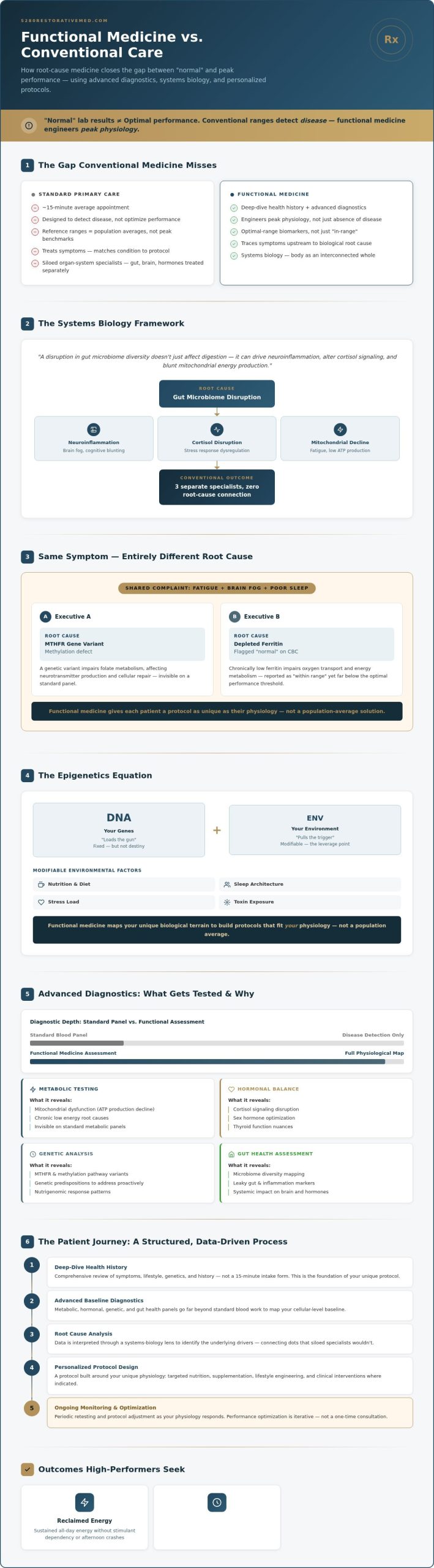
At its core, a functional medicine practice is a medical model built on a single foundational question: why is this happening, not just what is happening? Where conventional care excels at naming a condition and matching it to a treatment protocol, functional medicine works upstream, tracing symptoms back to their biological origins. It’s the difference between silencing a smoke alarm and actually finding the fire.
The clinical framework behind this model is systems biology, which treats the body as a deeply interconnected web of physiological processes rather than a collection of isolated organs. A disruption in gut microbiome diversity doesn’t just affect digestion; it can drive neuroinflammation, alter cortisol signaling, and blunt mitochondrial energy production. Addressing the gut may resolve symptoms that no gastroenterologist, neurologist, or endocrinologist would have connected on their own. That’s the power of thinking in systems.
The Core Philosophy: You Are a Unique Biological System
Two executives can walk into a clinic with identical complaints, fatigue, poor sleep, and declining mental sharpness, and require completely different interventions. One may have a methylation defect driven by a genetic variant in the MTHFR gene. The other may be running on chronically depleted ferritin levels that a standard CBC flagged as “normal.” Same symptom. Entirely different root cause. Entirely different solution.
This is where epigenetics transforms the conversation. Your genes load the gun, but your environment, nutrition, sleep architecture, stress load, and toxin exposure pull the trigger. Functional medicine is the intersection of clinical science and personalized lifestyle engineering, mapping your unique biological terrain to build a protocol that actually fits your physiology rather than a population average.
Why High-Performers Are Seeking Functional Providers
The standard primary care visit averages roughly 15 minutes. That’s enough time to rule out acute illness. It’s not enough time to investigate why a high-functioning professional is losing two productive hours a day to cognitive fog or waking unrefreshed after eight hours of sleep. Those “unexplained” symptoms aren’t mysterious; they’re data points that haven’t been collected yet.
High-performers are increasingly turning to functional providers because they need answers that translate into output. Functional health and wellness bridges the gap between general wellness advice and true clinical medicine, combining the rigor of advanced diagnostics with the precision of individualized care. It’s not a luxury upgrade to standard healthcare. For anyone operating at the edge of their capacity, it’s simply the more effective tool.
The Science of Optimization: Advanced Diagnostics and Data
Standard lab panels were designed with a specific purpose: to identify disease. They do that job reasonably well. What they weren’t designed to do is tell you why a high-functioning professional is losing cognitive sharpness, struggling to sustain energy past noon, or recovering poorly from stress. The reference ranges printed on your results represent statistical averages drawn from broad population samples, not benchmarks for peak human performance. A result that falls within that range may still represent a meaningful gap between where your physiology is and where it could be.
This is the diagnostic gap that a serious functional medicine practice is built to close. Advanced testing doesn’t just look for pathology; it maps the terrain of your cellular function, hormonal balance, genetic predispositions, and gut ecosystem to reveal exactly where your biology is underperforming before that underperformance compounds into something harder to reverse.
Metabolic Testing: Engineering Sustained Energy
Fatigue that persists despite adequate sleep is rarely a mystery once you have the right data. Mitochondrial dysfunction, the gradual decline in your cells’ ability to produce ATP efficiently, is one of the most common drivers of chronic low energy in high-performers, and it’s largely invisible on a standard metabolic panel. Organic acid testing addresses this directly: by measuring specific metabolic byproducts excreted in urine, it identifies bottlenecks in the Krebs cycle, flags deficiencies in critical cofactors like CoQ10, B vitamins, and magnesium at the cellular level, and reveals patterns of oxidative stress that blunt both physical stamina and mental output.
That data doesn’t sit in a file. It directly informs a custom nutrition and supplement protocol built around your specific metabolic profile. The result is targeted intervention rather than the guesswork of generic wellness recommendations.
Hormone Optimization for Mental and Physical Drive
Cortisol is the body’s primary stress-response hormone, and in executives who sustain high cognitive and emotional loads over months and years, its dysregulation is remarkably common. Chronically elevated or blunted cortisol output directly impairs prefrontal cortex function, the part of the brain responsible for decision-making, impulse control, and strategic thinking. You don’t just feel tired; your judgment degrades in ways that are difficult to self-assess.
Comprehensive hormone panels go beyond cortisol. Testosterone, estrogen, progesterone, DHEA, and thyroid markers all interact within a finely tuned endocrine system. When any one of these shifts outside its optimal range, the downstream effects ripple across mood, body composition, libido, and cognitive drive. Bioidentical hormone replacement therapy (BHRT) has become a cornerstone of restorative medicine for high-performers precisely because it works with your body’s existing hormonal architecture rather than overriding it with synthetic alternatives.
Genetic analysis adds another layer of precision here. Variants in genes governing hormone metabolism, detoxification pathways, and neurotransmitter synthesis can explain why two people with identical lab values respond completely differently to the same protocol. Understanding your unique genetic blueprint means your care team can anticipate these variables rather than discover them through trial and error. If you’re ready to move beyond guesswork, exploring a metabolic and hormone assessment is a logical next step toward building a protocol that actually fits your biology.
Functional vs. Conventional Medicine: Choosing the Right Model
Conventional medicine saves lives. That’s not hyperbole; it’s the appropriate acknowledgment of a system brilliantly engineered for acute care. A broken bone, a cardiac event, a bacterial infection: these are exactly the scenarios where emergency rooms, surgical suites, and pharmaceutical protocols perform at their highest level. The problem isn’t that conventional medicine is broken. The problem is that most high-performers are trying to use an acute-care tool to solve a chronic optimization problem, and wondering why it doesn’t fit.
A functional medicine practice operates in an entirely different lane. It’s not designed to stabilize a crisis; it’s designed to prevent one. The distinction matters enormously when you’re a professional whose performance, judgment, and sustained energy are not optional extras but core professional assets.
The ‘Normal Blood Work’ Myth
Standard laboratory reference ranges are built on a statistical bell curve derived from broad population samples. A result is flagged as “normal” if it falls within two standard deviations of the population mean. That sounds rigorous until you realize the population average includes people who are sedentary, nutritionally deficient, and chronically stressed. “Normal” by that standard is a remarkably low bar.
Functional practitioners apply tighter optimal ranges calibrated not to the average patient, but to physiological performance. A ferritin level of 15 ng/mL might clear the conventional threshold, yet a functional provider recognizes it as a meaningful contributor to fatigue and cognitive drag. The gap between those two interpretations is where high-performers lose months, sometimes years, to symptoms they’re told don’t exist. Feeling “fine” is, paradoxically, one of the biggest barriers to reaching your actual ceiling. Fine is survivable. Optimal is a different standard entirely.
Time and Personalization: The Boutique Clinical Experience
Initial consultations in a functional medicine setting typically run 60 to 90 minutes. That’s not inefficiency; it’s the minimum viable time required to understand a human being’s full biological context: sleep architecture, stress history, dietary patterns, genetic predispositions, and the subtle symptom patterns that don’t surface in a 15-minute appointment. You’re not a chart number in this model. You’re a co-pilot in your own health strategy, engaged in a genuine clinical partnership.
The financial question surfaces here reliably: why doesn’t insurance cover this level of care? The honest answer is that insurance is structured to reimburse disease treatment, not performance optimization. Advanced diagnostics and extended consultations fall outside that reimbursement model by design. The more useful question is one of return on investment. Consider what chronic underperformance, compounding fatigue, and a preventable health crisis actually cost: in productivity, in career trajectory, in quality of life. Early intervention through comprehensive testing consistently costs less than managing conditions that could have been caught years earlier. That’s not a wellness philosophy; it’s straightforward risk management.
The executives who engage with this model aren’t spending money on healthcare. They’re investing in the biological infrastructure that everything else in their professional and personal life runs on.
The Patient Journey: What to Expect in a Professional Practice
Most people arrive at a functional medicine practice carrying years of unanswered questions. The journey that follows isn’t a single appointment or a quick lab draw. It’s a structured, four-stage process designed to move you from confusion to clarity, and from clarity to measurable change.
Stage 1: The Deep-Dive Discovery
Before a single test is ordered, your care team needs context. The initial consultation goes far beyond your current complaints, mapping your full health history from birth to present. Childhood illnesses, medication history, stress inflection points, sleep patterns, and occupational demands all become clinically relevant data. This isn’t small talk. It’s the foundation that determines which diagnostic pathways matter most for your specific biology.
Stage 2: Advanced Diagnostic Testing
With that context established, targeted testing begins. Depending on your clinical picture, this may include comprehensive blood panels read against optimal rather than population-average ranges, genetic analysis to identify variants affecting metabolism and hormone processing, and a gut health assessment to evaluate microbiome diversity, intestinal permeability, and inflammatory markers. Each layer of data adds resolution to the picture of your physiology.
Stage 3: The Blueprint
When results are in, your care team builds your protocol. Not a template. Not a standard recommendation with your name on it. A genuinely individualized plan built around what your data actually shows.
Custom Supplement and Nutrition Protocols
Off-the-shelf multivitamins are formulated for statistical averages. If your organic acid testing reveals a specific bottleneck in B12 methylation or a CoQ10 deficit at the cellular level, a generic supplement won’t address it in any meaningful way. Targeted supplementation works differently: the form, dose, and delivery method are selected based on your confirmed deficiencies, not a label designed to appeal to everyone. Nutrition guidance follows the same logic, structured around your metabolic markers and integrated into the reality of a demanding schedule rather than built around an idealized lifestyle you don’t actually have.
The Role of Lifestyle Engineering
Protocol design extends beyond what you swallow. Sleep architecture optimization addresses the specific phases of rest that drive cognitive recovery and hormonal regulation. Tools like red light therapy are incorporated for their clinically supported role in mitochondrial health, reducing cellular oxidative stress in ways that compound over time. Stress management in this model isn’t a meditation app recommendation; it’s a physiologically grounded strategy built around your cortisol patterns and autonomic nervous system data.
Stage 4: Active Monitoring
A protocol that doesn’t adapt isn’t a protocol; it’s a guess. Regular follow-up testing tracks how your biomarkers respond, and your plan adjusts accordingly. This feedback loop is what separates genuine clinical optimization from wellness advice. Your physiology changes, and your care should change with it.
If you’re ready to move from a static snapshot of your health to a dynamic, data-driven strategy, schedule a functional medicine consultation and take the first step toward a protocol built entirely around you.
Elevating Performance with 5280 Restorative Medicine
There’s a meaningful difference between a practice that treats executives and one that’s genuinely built around how executives live, think, and perform. Executive health programs at 5280 Restorative Medicine are designed from the ground up for the latter. Where a standard corporate physical checks boxes and sends you home with a pamphlet, the restorative model starts where that appointment ends, using the data it generates as a launching point rather than a conclusion.
The philosophy is captured in the name itself. Restorative medicine isn’t about maintenance. It’s about reclaiming the cognitive sharpness, physical drive, and metabolic resilience that high-performers often assume they’ve simply lost to age or stress. That assumption is frequently wrong. What looks like inevitable decline is often a correctable biological pattern, one that advanced diagnostics can identify and a personalized protocol can reverse.
Dr. Marci Catallo-Madruga leads this work with a clinical focus on metabolic resilience, the capacity to sustain energy, hormonal balance, and cognitive output under sustained professional pressure. That specialization matters. Metabolic resilience isn’t a generic wellness concept; it’s a measurable physiological state, and building it requires the kind of targeted intervention that only emerges from genuinely comprehensive testing.
Bespoke Health Protocols for the Modern Executive
The 5280 approach bundles metabolic testing, hormone optimization, genetic analysis, nutritional counseling, and ongoing monitoring into a single cohesive experience rather than a disconnected series of referrals. That integration is the point. When your gut health assessment, hormone panel, and organic acid results are interpreted together by one clinical team, the protocol that follows reflects your full biological picture, not isolated fragments of it. Sustainable boardroom energy isn’t built on a single supplement or a dietary tweak. It’s built on understanding exactly where your cellular machinery is losing efficiency and correcting it at the source.
Getting Started: Your National Health Partner
Geography is no longer a barrier to this level of care. 5280 Restorative Medicine serves high-performers across the United States through virtual consultations, which means the transition into a functional medicine practice doesn’t require relocating your life or your schedule. The onboarding process is designed to be straightforward: an initial consultation, targeted lab work coordinated through accessible channels, and a care team that translates complex data into a protocol you can actually execute.
When evaluating any functional provider, look for clinical depth over marketing language. Confirmed credentials, a structured diagnostic process, and a clear framework for follow-up monitoring are the signals that separate genuine optimization medicine from wellness branding.
Your biology isn’t average. Your care shouldn’t be either. Explore the executive health program and take the first concrete step toward a protocol built entirely around your physiology.
Your Next Step Toward a Biology That Performs at Your Level
Feeling “fine” is no longer good enough when you know what optimal actually looks like. A serious functional medicine practice doesn’t just interpret your lab work differently; it rebuilds your entire approach to health around what your unique physiology actually needs, not what a population average suggests.
The key points are straightforward: standard care wasn’t designed to optimize performance, advanced metabolic and genetic testing reveals what standard panels miss, and a personalized protocol built on real data produces results that generic wellness advice simply can’t replicate.
5280 Restorative Medicine brings all of this together through specialized protocols for high-performers, comprehensive metabolic and genetic testing, and national virtual care that fits your schedule wherever you’re based. Expert-level optimization is no longer a geography problem.
Your biology is worth investing in with the same precision you bring to every other high-stakes decision. Schedule your functional medicine consultation with 5280 Restorative Medicine and start building a protocol that’s built entirely around you.
Frequently Asked Questions
Is a functional medicine practice the same as a holistic or naturopathic doctor?
No, and the distinction matters clinically. A functional medicine practice is grounded in conventional medical training and advanced diagnostic testing, including bloodwork, genetic analysis, and metabolic panels. Naturopathic doctors operate under a separate licensing framework that varies significantly by state, and holistic practitioners cover an even broader, less standardized range of disciplines. Functional medicine sits firmly within evidence-based clinical science, using the same laboratory infrastructure as conventional medicine but interpreting and applying results differently.
Why doesn’t my regular doctor order the metabolic tests you use?
It’s not a gap in your doctor’s knowledge; it’s a structural limitation of the system they work within. Standard primary care is reimbursed for diagnosing and treating disease, so testing is typically ordered to rule out pathology rather than to map performance. Organic acid testing, comprehensive hormone panels, and microbiome assessments don’t fit neatly into that reimbursement model. Your primary care physician is working within a system optimized for a different goal than yours.
How long does it typically take to see results in a functional health program?
Most patients notice meaningful shifts in energy, sleep quality, and cognitive clarity within six to twelve weeks of beginning a personalized protocol, though this varies depending on the complexity of the underlying issues. Hormonal recalibration and gut microbiome restoration are biological processes that require time to stabilize. The monitoring built into a structured program tracks your biomarkers at regular intervals so your protocol adjusts as your physiology responds, rather than waiting until something feels wrong again.
Can functional medicine help with autoimmune issues like mast cell activation syndrome?
Functional medicine’s systems-biology approach is particularly well-suited to complex immune dysregulation because it looks at the full biological context rather than managing a single diagnosis in isolation. Gut permeability, toxic load, hormonal imbalances, and nutrient deficiencies all interact with immune function in clinically significant ways. A gut health assessment and comprehensive metabolic workup can identify contributing factors that standard immunology panels don’t capture, creating a more complete picture to build a targeted protocol around.
Do you offer virtual consultations if I am not located near a physical clinic?
Yes. 5280 Restorative Medicine serves high-performers across the United States through virtual consultations, so geography isn’t a barrier to accessing this level of care. Lab work is coordinated through accessible channels regardless of your location, and your care team delivers the same depth of clinical engagement remotely as they would in person. If you’re based outside of Colorado, a virtual functional medicine consultation is a straightforward entry point into the program.
What is the cost structure of a high-performance executive health program?
Because every protocol is built around your specific diagnostic results rather than a standardized package, costs vary based on the scope of testing and the interventions involved. What’s consistent is that this model operates outside standard insurance reimbursement, since insurance is structured to cover disease treatment rather than performance optimization. We’d encourage you to contact 5280 Restorative Medicine directly for accurate program details rather than relying on industry generalizations that won’t reflect your actual clinical picture.
Is functional medicine evidence-based or experimental?
Functional medicine draws on the same peer-reviewed research base as conventional medicine. The diagnostic tools used, including organic acid testing, comprehensive hormone panels, and genetic analysis, are established clinical instruments. What differs is the interpretive framework and the willingness to act on subclinical findings before they progress to diagnosable disease. The Institute for Functional Medicine, a recognized professional body, provides practitioner training grounded in published clinical literature, distinguishing this model clearly from experimental or unvalidated approaches.
Can I work with a functional medicine practitioner alongside my existing primary care doctor?
Absolutely, and this is actually a common and sensible arrangement. A functional medicine practice isn’t a replacement for your primary care physician; it’s a complementary layer focused on optimization rather than acute care. Your primary care doctor remains your point of contact for urgent health concerns, prescriptions, and referrals, while your functional medicine team focuses on the deeper metabolic, hormonal, and nutritional picture. Sharing results between providers typically strengthens your overall care rather than creating conflict.