
Why does the same “perfect” diet that fuels a colleague’s success leave you struggling with persistent brain fog and chronic fatigue? It’s a frustrating paradox to follow every standard health rule and still feel your energy levels crash before an important meeting. If you feel like one-size-fits-all medical advice has failed you, you’re right. Understanding what is bio-individuality in nutrition is the first step toward realizing that your body doesn’t follow a population-level script. While the 2025-2030 Dietary Guidelines offer a baseline for the public, they can’t account for the unique genetic and metabolic nuances that define your specific needs.
We believe that peak physical and mental states are achievable at any stage of life when you stop guessing and start measuring. You can move beyond generic trends by decoding the unique biological markers that dictate your requirements. This clinical guide will provide a clear understanding of the drivers behind your health, offering a roadmap to sustainable high performance. You’ll gain the confidence to choose a personalized path that treats wellness as a proactive journey, ensuring you exceed your baseline performance every single day.
Key Takeaways
- Learn exactly what is bio-individuality in nutrition and why standard population-based dietary guidelines often fail to address your unique biological blueprint.
- Explore how your genetic expression and gut microbiome determine how you absorb nutrients and manage systemic inflammation.
- Understand why popular high-performance protocols like keto or intermittent fasting can sometimes trigger fatigue or hormonal imbalances in high-achieving professionals.
- Discover the advanced diagnostic tools, including metabolic testing and optimized bloodwork, used to identify your specific physiological baseline.
- Find out how to engineer a personalized protocol that removes biological friction and establishes a sustainable path to vitality.
Defining Bio-Individuality in Modern Restorative Nutrition
True health isn’t found in a textbook or a government pamphlet. It’s written in your cells. At its core, what is bio-individuality in nutrition? It’s the clinical recognition that your unique biological blueprint dictates exactly which nutrients your body needs to thrive. While standard dietary guidelines like the Food Pyramid aim to protect the general population, they often fail the individual by ignoring the complexity of human biochemistry. Our focus isn’t just on the absence of disease. We aim for metabolic resilience. This is your body’s ability to adapt to stressors, recover quickly, and maintain peak performance. There’s a vast difference between simply “feeling fine” and achieving optimal biological function as validated by precise clinical markers.
The “One Man’s Meat” Philosophy in a Clinical Context
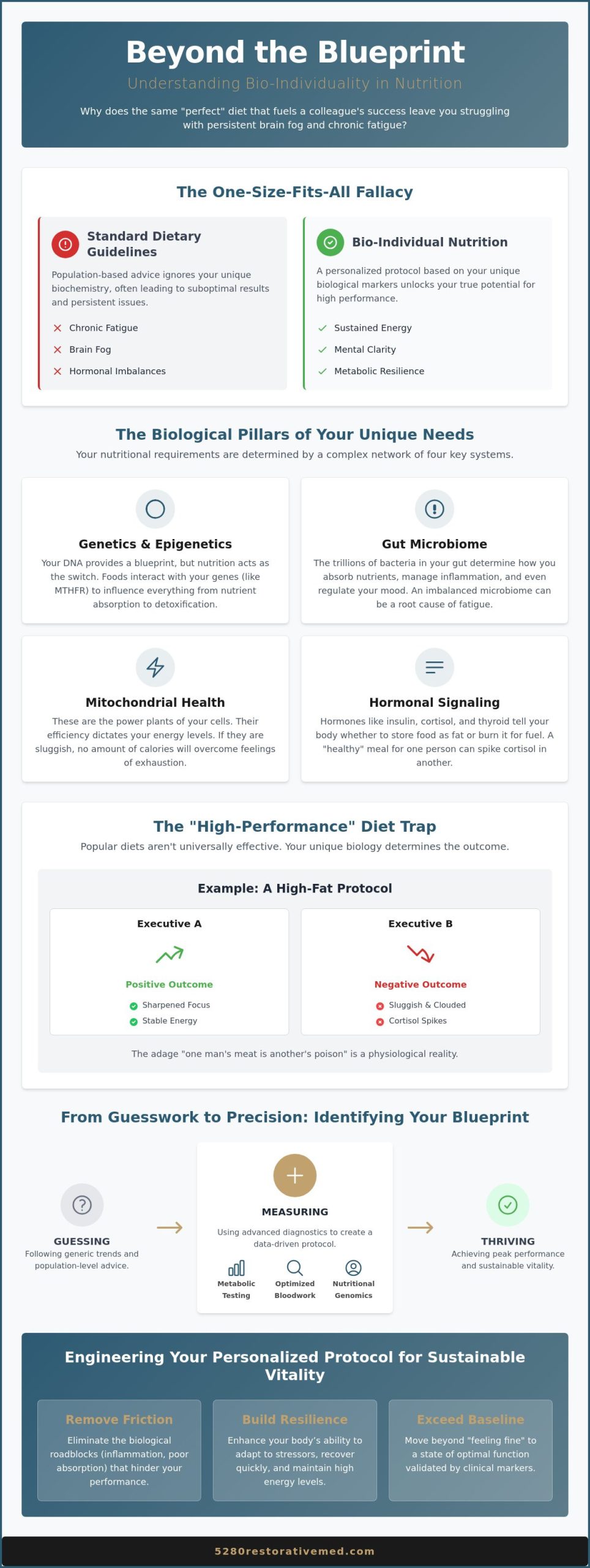
The old adage that one man’s meat is another’s poison isn’t just a philosophy; it’s a physiological reality. A specific calorie count doesn’t translate to the same metabolic outcome for every person. Your biochemical uniqueness influences everything from mitochondrial energy production to the neurotransmitters that govern your cognitive clarity. For example, a high-fat protocol might sharpen one executive’s focus while leaving another sluggish and mentally clouded. We move away from reactive dieting by treating health as a proactive engineering project. By analyzing how your body processes fuel at a cellular level, we ensure your nutrition supports, rather than hinders, your professional and personal demands.
Moving Beyond Population-Based Dietary Guidelines
Standard nutritional studies often rely on an “average” human model that doesn’t actually exist. These models ignore critical variables like ancestral heritage and geographic origins, which deeply influence how we metabolize modern foods. Someone with roots in coastal, high-fat-consuming regions may have vastly different requirements than someone whose ancestors thrived on inland, plant-heavy diets. Functional medicine bridges this gap by utilizing Nutritional genomics to see how specific food compounds interact with your unique genetic code. This data-driven approach allows us to move past the limitations of general research. Instead of guessing based on what works for the “average” person, we create a bespoke protocol designed specifically for your body’s requirements. This shift from population-level advice to individual precision is the hallmark of modern restorative care.
The Biological Pillars: Why Your Nutritional Needs are Unique
While some define what is bio-individuality in nutrition as a matter of personal preference or intuition, we recognize it as a measurable clinical reality. Your nutritional requirements rest on four specific biological pillars: genetics, the microbiome, mitochondrial health, and hormonal signaling. These systems don’t operate in isolation. They form a complex network that determines how you process every bite of food. When these pillars are out of alignment, you experience the chronic fatigue and brain fog that generic diet plans fail to address. Moving beyond the “average” requires a deep dive into these cellular mechanisms to understand why your body responds uniquely to different stimuli.
Your mitochondria act as the power plants of your cells. Their efficiency determines how effectively you convert oxygen and fuel into energy. If your mitochondria are sluggish, even a high-calorie diet won’t fix your exhaustion. Similarly, hormonal signaling from insulin, cortisol, and the thyroid dictates whether your body stores food as fat or burns it for fuel. A meal that is “healthy” for one person might spike cortisol in another, leading to the inconsistent energy levels many executives face. By identifying these individual drivers, we can shift your body from a state of survival to a state of superior physical function.
Nutrigenomics and the Power of Epigenetics
Your DNA isn’t your destiny; it’s a blueprint that you can influence through targeted nutrition. This field, often called Precision Nutrition, examines how specific food compounds act as switches for your genes. Single Nucleotide Polymorphisms (SNPs), such as the MTHFR mutation, can significantly impair how your body converts folate into its active form. Without identifying these genetic nuances, you might struggle with chronic inflammation or low neurotransmitter production despite eating “clean.” By utilizing Supplement Protocols tailored to your genetic markers, we can effectively “turn off” pathways associated with disease and “turn on” those associated with longevity and vitality.
The Gut-Brain Axis and Metabolic Health
The state of your gut microbiome determines whether your food becomes medicine or poison. When gut permeability, or “leaky gut,” occurs, undigested food particles enter the bloodstream, triggering systemic inflammation. This inflammation is a primary driver of the brain fog that frequently plagues high-performing professionals. Your unique bacterial colony influences everything from nutrient absorption to the production of serotonin. A professional Gut Health Assessment is essential to identify these hidden barriers. Understanding what is bio-individuality in nutrition means recognizing that your gut is the gatekeeper of your metabolic health. If you’re ready to stop guessing and start engineering your health, consider a Functional Medicine Consultation to map your unique biological pillars.
Why Standard “High-Performance” Diets Often Fail Executives
You’ve likely seen a colleague thrive on a strict ketogenic protocol or intermittent fasting, yet when you try the same, you’re met with crushing afternoon fatigue and a clouded mind. This common frustration stems from a fundamental misunderstanding of what is bio-individuality in nutrition. For a high-performing executive, your metabolic demands are unique. They are shaped by the relentless pace of your professional life and your specific physiological response to stress. Following trending fads without personal data is a significant risk. What works for a “biohacker” influencer might be the exact catalyst for your own burnout. True performance engineering requires moving past the colleague comparison and looking at your internal data instead.
Standard high-performance diets often fail because they don’t account for the “Keto Fatigue” trap. While low-carb protocols can be effective for some, they can crash the thyroid or adrenals in a stressed executive. Your body requires specific nutrients to manage the high cortisol levels associated with leadership roles. When you strip away essential fuel sources, your nervous system perceives it as a threat. This leads to inconsistent energy and a decline in executive function. Precision nutrition offers a way out of this cycle by aligning your intake with your actual metabolic state rather than a generic template.
The Hidden Stress of Restrictive Eating
Extreme diets act as an additional stressor on an already taxed nervous system. When you combine a high-pressure career with restrictive eating, you risk significant disruptions to your endocrine system. This is why understanding what is bio-individuality in nutrition is critical for long-term hormone optimization. Metabolic flexibility is the ability to switch fuel sources without performance loss. If your diet is too rigid, you lose this flexibility, making you more vulnerable to energy crashes when you can’t eat on a perfect schedule. We focus on building resilience so your body can handle the demands of your life without failing.
Case Study: When “Healthy” Foods Cause Inflammation
Even “healthy” foods can be the root cause of your brain fog. We often see clients who consume large amounts of spinach, almonds, or legumes, unaware that they have sensitivities to oxalates or lectins. These compounds can trigger systemic inflammation, leading to joint pain and cognitive decline. These sensitivities are frequently ignored in standard healthy diets but are central to the work we do in functional medicine. By identifying these hidden triggers, we remove the biological friction that prevents you from reaching a superior state of physical function. This root-cause identification is the only way to ensure your nutrition truly supports your professional success.
Identifying Your Blueprint: Advanced Diagnostic Tools
If you’re tired of guessing which diet might work, it’s time to look at the data. Understanding what is bio-individuality in nutrition isn’t about intuition; it’s about utilizing precise clinical diagnostics to map your unique physiological requirements. We move beyond the surface-level advice of wellness influencers by looking at the specific genetic and metabolic drivers that dictate your health. By identifying your biological blueprint, we can remove the guesswork and create a targeted plan for renewal. This data-driven approach ensures that every dietary choice you make is moving you toward a superior state of physical function.
Advanced bloodwork is a cornerstone of this process. Standard medical exams often focus on “normal” ranges designed to identify the absence of disease, but we look for “optimal” levels designed for peak performance. This might include analyzing inflammatory markers or specific micronutrient deficiencies that a standard test would overlook. When combined with Continuous Glucose Monitoring (CGM), we gain real-time data on how your specific meals affect your blood sugar stability. This allows us to see exactly which foods trigger energy crashes and which ones provide a steady fuel source for your brain throughout the day.
Metabolic Testing for Energy Optimization
A metabolic assessment differs significantly from a standard physical. While a routine checkup confirms that you aren’t currently ill, metabolic testing measures how your body actually processes oxygen and fuel. By determining your resting metabolic rate (RMR), we can calculate your precise caloric and macronutrient needs with clinical accuracy. This data-driven approach prevents the chronic under-fueling common in executive health programs. When you align your intake with your actual energy expenditure, you eliminate the “starvation stress” that often leads to executive burnout and inconsistent professional performance.
Genetic Analysis for Targeted Nutrition
Your genes provide the hard-coded instructions your body follows for detoxification and energy production. Testing for specific markers like APOE, which influences lipid metabolism, or MTHFR, which affects folate conversion, changes your nutritional strategy entirely. Knowing your genetic predisposition for inflammation or oxidative stress allows us to intervene before symptoms arise. Nutritional genomics is the clinical application of genetic data to diet. By understanding these markers, we can craft a bespoke path that supports your long-term vitality and cognitive clarity. If you’re ready to see what your data says, we invite you to schedule a Functional Medicine Consultation to begin your personalized health journey.
Engineering Your Personalized Protocol for Sustainable Vitality
Engineering a path to superior health requires more than a simple list of “good” foods. It demands a structured clinical framework that respects your unique physiology. Once we establish what is bio-individuality in nutrition for your specific body, we implement a four-phase restorative protocol designed to optimize your function. This isn’t a temporary diet; it’s a proactive health engineering project. By moving through these phases, you stop reacting to symptoms and start directing your biological outcomes. This systematic approach ensures that your journey toward renewal is grounded in data rather than guesswork.
- Phase 1: Comprehensive Diagnostic Review. We synthesize your Genetic Analysis and Metabolic Testing results to establish a precise biological baseline.
- Phase 2: Removing Biological Friction. We eliminate individual triggers and inflammatory foods identified during your Gut Health Assessment to stop cellular “noise.”
- Phase 3: Targeted Nutrient Replenishment. We fill the specific metabolic and genetic gaps discovered in your lab work through precision Nutritional Counseling.
- Phase 4: Ongoing Monitoring. We use iterative adjustments and follow-up testing to ensure you maintain peak performance as your lifestyle and stressors evolve.
From Data to Plate: Building a Custom Strategy
Translating complex clinical data into daily habits is where the true transformation happens. An effective protocol must account for the realities of a high-travel, high-stress executive lifestyle. It isn’t enough to know your genetic markers; you need a strategy that works during a 14-hour workday or a cross-country flight. Professional guidance is essential in this stage. Interpreting intricate lab results without an expert guide often leads to improper application or “analysis paralysis.” We bridge the gap between hard science and your dinner plate, ensuring your path to renewal is both medically sound and practically sustainable for the long term.
The Role of Bespoke Supplement Protocols
Generic multivitamins are often a wasted investment. At best, they provide nutrients your body already has in abundance. At worst, they contain synthetic forms of vitamins that your genetics can’t process, potentially adding to your metabolic load. Understanding what is bio-individuality in nutrition means recognizing that your body requires specific forms and dosages of nutrients to thrive. For example, if you have specific methylation markers, you need methylated B-vitamins rather than the standard versions found on most store shelves. 5280 Restorative Medicine serves as your expert partner in this personalized journey. We design bespoke Supplement Protocols that align with your unique biological requirements, moving you beyond the absence of illness toward a state of exceeding your baseline performance.
Take Control of Your Biological Narrative
Your journey to peak performance doesn’t have to be a series of failed experiments. By moving beyond trending fads and embracing the data provided by advanced diagnostics, you can finally align your lifestyle with your body’s actual needs. Understanding what is bio-individuality in nutrition is the key to resolving chronic fatigue and reclaiming your professional edge. We’ve explored how your genetic markers, gut health, and metabolic rate create a unique blueprint that generic diets simply cannot address.
Led by Dr. Marci Catallo-Madruga, our practice specializes in functional medicine designed specifically for high-performers. We provide bespoke health engineering that includes comprehensive metabolic and genetic testing to ensure your results are measurable and sustainable. It’s time to stop settling for “fine” and start reaching for a superior state of physical function through targeted clinical interventions.
Apply for our Executive Health Program to discover your unique metabolic blueprint.
You deserve a health partner as invested in your success as you are. Peak vitality is achievable at any stage of life when you have the right roadmap in hand. We look forward to guiding you toward your most vibrant self.
Frequently Asked Questions
Is bio-individuality scientifically proven?
Yes, the concept is firmly rooted in the established fields of nutrigenomics and metabolomics. These scientific disciplines study how individual genetic variations and metabolic processes influence specific nutrient requirements. Peer-reviewed research confirms that the same dietary intervention can produce vastly different glycemic and inflammatory responses across different individuals, proving that a universal diet doesn’t exist at a cellular level.
How does metabolic testing help with bio-individuality?
Metabolic testing provides a precise measurement of your resting metabolic rate and identifies how efficiently your body burns different fuel sources. It moves beyond generic caloric estimates by pinpointing your specific energy expenditure. This data is crucial for defining what is bio-individuality in nutrition for your unique physiology, allowing for a protocol that supports peak energy without causing systemic stress.
Can my nutritional needs change as I age?
Your nutritional requirements evolve as your hormonal profile and cellular metabolism shift over time. Factors like declining hormone levels or changes in muscle mass alter how you process proteins and carbohydrates. Regular clinical assessments ensure your protocol remains aligned with your current biological state, supporting longevity and sustained performance at every stage of life.
What is the difference between a food allergy and a bio-individual sensitivity?
A food allergy is an immediate, often severe immune system reaction, whereas a bio-individual sensitivity is typically a delayed response involving the digestive or nervous systems. Sensitivities to compounds like oxalates or lectins can cause chronic inflammation, brain fog, and fatigue. These subtle reactions are often missed by standard allergy tests but are critical to identify for achieving a superior state of physical function.
How long does it take to see results from a personalized nutrition plan?
Most individuals notice improvements in energy levels and cognitive clarity within two to four weeks of starting their protocol. However, deeper biological changes, such as reduced systemic inflammation or restored gut health, typically require three to six months of consistent adherence. The exact timeline depends on your starting baseline and the amount of biological friction we need to resolve.
Can genetic testing tell me exactly what to eat?
Genetic testing identifies your predispositions, but it doesn’t act as a static daily menu. It reveals how your body is likely to handle certain nutrients, such as fats or specific vitamins, based on your DNA. We use this data as a foundational layer, combining it with real-time bloodwork and metabolic data to create an actionable strategy that accounts for both your hard-coded traits and your current health status.
Why do generic diets work for some people but not for me?
Generic diets are designed for a statistical average that rarely exists in reality. Your unique combination of genetic markers, gut microbiome diversity, and lifestyle stress levels dictates your specific response to food. Understanding what is bio-individuality in nutrition helps explain why a protocol that fuels a colleague might leave you feeling sluggish; it’s a biological mismatch rather than a lack of discipline.
Is bio-individual nutrition more expensive than a standard diet?
While the initial investment in clinical diagnostics and specialized counseling is higher than a generic plan, it often leads to long-term savings by eliminating ineffective supplements and trial-and-error dieting. By identifying exactly what your body needs, you stop spending money on “healthy” foods that might actually be triggering inflammation. It’s a shift from reactive spending on symptoms to a proactive investment in your long-term vitality and performance.