
What if your afternoon energy crash isn’t a sign of burnout, but a symptom of a fuel system that’s lost its gears? It’s a frustrating reality for many high-performers who experience sudden brain fog during high-stakes decision making or struggle to maintain body composition despite consistent training. You don’t have to settle for unpredictable vitality. Understanding what is metabolic flexibility and why it matters is the first step toward reclaiming your cognitive edge and physical resilience.
We know you’re committed to excellence, yet it’s exhausting when your body doesn’t mirror your mental drive. Recent data from early 2026 shows that over 60% of U.S. adults are living with at least one chronic metabolic condition, highlighting how easy it’s to lose your physiological baseline in a demanding environment. This guide will show you how mastering your body’s ability to switch fuel sources can eliminate brain fog and stabilize your energy throughout the day. We’ll preview the latest 2026 clinical guidelines for metabolic health and explain how specialized testing can provide a data-backed roadmap to your peak performance.
Key Takeaways
- Learn how your mitochondria function as a dual-fuel system, allowing you to switch seamlessly between carbohydrates and stored fat for sustained daily energy.
- Understand what is metabolic flexibility and why it matters for executive endurance, specifically how fuel adaptability protects your brain from cognitive fluctuations.
- Identify the physiological warning signs of a stalling metabolic engine, such as frequent “hangry” episodes and unexpected exhaustion after physical exertion.
- Discover the clinical benchmarks for measuring your unique adaptability, including the Respiratory Exchange Ratio (RER) and advanced inflammatory markers.
- Gain a strategic roadmap for restoring your metabolic edge through targeted Zone 2 training and personalized nutritional periodization.
Defining Metabolic Flexibility: Your Body’s Dual-Fuel System
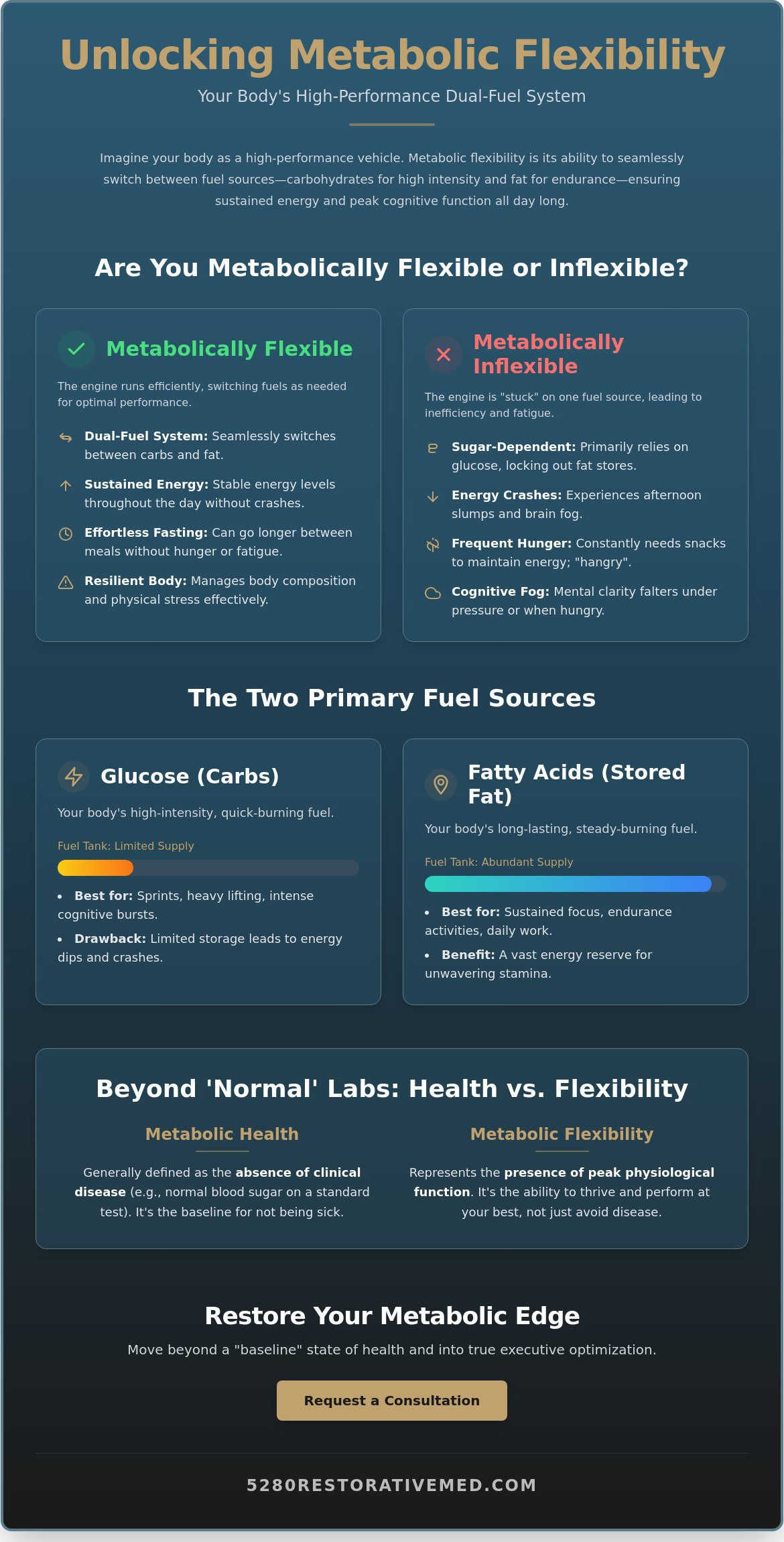
Imagine your body as a sophisticated high-performance vehicle designed to navigate diverse terrains. To maintain peak output, it shouldn’t rely on a single energy source. Metabolic flexibility is the hallmark of mitochondrial health and energetic resilience. It’s the physiological capacity to transition seamlessly between burning carbohydrates (glucose) and stored body fat (fatty acids) based on what’s available and what your current activity demands. Understanding metabolic flexibility and why it matters is essential for anyone looking to sustain elite levels of performance throughout a demanding day.
Your mitochondria are the microscopic power plants within your cells that manage this fuel transition. In an ideal state, they’re highly efficient and responsive. However, our modern environment often disrupts this natural rhythm. Constant snacking, high-carbohydrate diets, and chronic stress keep insulin levels elevated, which effectively locks the door to your fat stores. This leads to a state of “metabolic staleness.” Your body becomes overly dependent on external sugar for energy, resulting in the dreaded mid-afternoon slump and cognitive fatigue when you can’t reach for a snack.
Glucose vs. Fat: The Two Primary Fuel Sources
Your body utilizes two distinct energy systems to power your brain and muscles. Understanding their differences helps explain why metabolic agility is so valuable for high-performers:
- Glucose: This is your body’s high-intensity fuel. It’s perfect for sprinting or intense cognitive bursts, but it’s limited in supply. When you rely solely on glucose, you’re prone to energy crashes once those levels dip, leading to irritability and “hangry” episodes.
- Fatty Acids: These represent a nearly bottomless reservoir of energy. Even lean individuals carry enough body fat to power them through days of activity. This sustainable fuel source provides the steady, long-burning energy required for endurance and unwavering focus.
The “metabolic switch” is the body’s regulatory mechanism that senses your current activity level and nutrient availability. When it functions correctly, your body burns fat while you’re focused at your desk and saves glucose for when you hit the gym or face a high-pressure deadline.
The Difference Between Metabolic Health and Flexibility
It’s a common misconception that having “normal” labs means your metabolism is optimized. Metabolic health is generally defined as the absence of clinical disease, such as Type 2 diabetes or metabolic syndrome. In contrast, metabolic flexibility is the presence of peak physiological function. You might have stable blood sugar readings on a standard test but still feel sluggish because your cells have lost the ability to tap into fat stores efficiently.
This distinction often comes down to insulin sensitivity. When your cells remain sensitive to insulin, your body can lower insulin levels quickly after a meal, signaling the mitochondria to pivot back to fat oxidation. Without this agility, you’re essentially running a high-performance engine on a faulty fuel pump. Reclaiming this flexibility is the key to moving beyond a “baseline” state of health and into a state of true executive optimization.
Why Metabolic Flexibility Is the Ultimate Executive Advantage
Executives often treat their health as a secondary priority to their business objectives. This is a mistake. Your physiology is the engine of your strategy. While much of the public discourse focuses on metabolic health for weight loss, high-achievers need to look closer at what is metabolic flexibility and why it matters for cognitive output. It’s the difference between a brain that stalls during a high-stakes board meeting and one that remains sharp through ten hours of deep work.
This approach to functional medicine for high-performers recognizes that metabolic resilience is the foundation for every other optimization. When you eliminate the 3 PM slump, you’re not just avoiding a nap. You’re preserving the mental bandwidth required for complex problem-solving. If you’re ready to move beyond “normal” labs and optimize your executive engine, a Functional Medicine Consultation can help identify where your metabolic flexibility is currently stalling.
Powering the High-Performance Brain
The brain is an energy-intensive organ. It consumes roughly 20% of your total daily calories despite making up only 2% of your body weight. It’s incredibly sensitive to fuel supply interruptions. If you’re metabolically inflexible, your brain relies almost exclusively on glucose. When your blood sugar dips, your neurons can’t access energy effectively. This creates the “brain fog” and irritability that lead to poor leadership decisions. It’s a physiological trap that derails even the most disciplined minds.
Ketones, derived from fat oxidation, provide a more efficient fuel source for neurons. They produce fewer reactive oxygen species than glucose, acting as a cleaner-burning energy. By stabilizing your blood glucose and improving your fat-burning capacity, you reduce decision fatigue. You maintain a steady state of focus rather than riding a roller coaster of energy peaks and valleys.
Biological Resilience Under Pressure
High-stakes environments are synonymous with high cortisol. Chronic stress forces the body into a glucose-dominant state, which often leads to systemic inflammation and poor sleep. Metabolic flexibility acts as a physiological buffer. It allows your body to remain efficient even when the autonomic nervous system is under pressure. You don’t just survive the stress; you maintain the capacity to recover from it.
This resilience is a primary reason why metabolic testing is a prerequisite for comprehensive executive health programs. Improving your fuel-switching capacity also enhances sleep quality. When your body can tap into fat stores overnight, you avoid the cortisol spikes caused by nocturnal blood sugar drops. You wake up restored rather than depleted, ready to face the day’s challenges with a clear mind and a steady pulse.
The Cost of Inflexibility: Signs Your Engine Is Stalling
When you’re used to operating at a high level, small disruptions in your energy can feel like personal failures rather than physiological signals. However, your body has specific ways of communicating when it has lost its ability to transition between fuel sources. Understanding what is metabolic flexibility and why it matters helps you identify these subtle warning signs before they lead to total burnout. When your system is “stuck” in a glucose-burning state, you’re forced to rely on external calories to maintain basic cognitive function. This creates a fragile state where your productivity is entirely dependent on your next meal.
One of the most common red flags is the “hangry” phenomenon. If you find yourself becoming irritable, shaky, or unable to focus if a meal is delayed by just an hour, your metabolic machinery is brittle. Your body should be able to tap into its own fat stores during these gaps. If it can’t, it triggers a stress response to force you to eat. Similarly, exercise should leave you feeling focused and recharged. If you’re consistently exhausted for hours after a moderate workout, your mitochondria likely aren’t switching to fat oxidation efficiently. This persistent metabolic inflexibility acts as a silent barrier to peak performance, creating a ceiling on your potential that no amount of willpower can overcome.
The Afternoon Slump and Cognitive Dips
The post-lunch energy crash is often dismissed as a normal part of the workday, but it’s actually a sign of reactive hypoglycemia. When you consume “healthy” carbohydrates that your body can’t process efficiently, your insulin spikes too high, causing your blood sugar to over-correct and bottom out. This sudden dip starves the brain of its primary fuel, leading to a sharp decline in executive function. This cycle doesn’t just steal your time; it fuels systemic inflammation. Over time, these daily glucose fluctuations can damage the very mitochondria responsible for your long-term vitality and mental clarity.
Sleep Disruptions and Metabolic Stress
Do you frequently wake up at 3 AM with a racing mind? This is often a metabolic event rather than a psychological one. When your blood sugar drops too low during the night and your body can’t switch to burning fat, your brain perceives a crisis. It signals the adrenal glands to release cortisol and adrenaline to dump stored glucose into the blood. This “emergency” wake-up call makes it nearly impossible to fall back into a deep, restorative sleep. This creates a vicious cycle where poor sleep further reduces your insulin sensitivity the next day. In many cases, strategic interventions like bhrt can support the metabolic repair needed to break this cycle, allowing your body to rest and recover as intended.
Clinical Assessment: How to Measure Your Metabolic Adaptability
High-performers often rely on rigorous data to drive business decisions, yet many treat their internal physiology with guesswork. Subjective feelings of fatigue or focus are important, but they don’t provide the precision needed for true optimization. Moving beyond “normal” labs requires a clinical deep dive into what is metabolic flexibility and why it matters for your specific biology. By quantifying your fuel-switching efficiency, we can move from general wellness advice to a precise, data-backed protocol.
Clinically, metabolic testing serves as the cornerstone of this process. It allows us to move past the surface-level metrics found in standard physicals and look directly at the cellular level. If you’re ready to stop guessing and start measuring, our team provides comprehensive Metabolic Testing to establish your physiological baseline.
The Role of Indirect Calorimetry
Indirect calorimetry is the gold standard for assessing metabolic agility. By measuring the ratio of oxygen consumption to carbon dioxide production, we determine your Respiratory Exchange Ratio (RER). This number reveals exactly which fuel mix your mitochondria are burning at any given moment. An RER of 0.7 indicates pure fat oxidation, while a 1.0 signals total reliance on glucose.
This testing also identifies your “Crossover Point.” This is the specific intensity where your body shifts from burning predominantly fat to burning predominantly carbohydrates. For an elite executive, the goal is to push this crossover point to a higher intensity. This ensures you remain in a fat-burning, cognitively stable state even during high-pressure situations. While a standard resting metabolic rate (RMR) tells us how many calories you burn, the RER tells us the quality of that burn, which is far more relevant for sustained performance.
Biomarkers of Metabolic Efficiency
Standard blood panels often focus on HbA1c, which is a lagging indicator of metabolic health. To assess flexibility, we must look at fasting insulin. This is perhaps the most underutilized marker in modern medicine. Elevated fasting insulin suggests your body is working too hard to manage blood sugar, which effectively prevents you from accessing stored fat. We also analyze the triglyceride-to-HDL ratio, which serves as a highly accurate proxy for systemic insulin sensitivity.
Beyond traditional bloodwork, we utilize GlycA to measure systemic inflammation and conduct detailed Genetic Analysis. Your DNA influences your innate fat-burning potential and how you respond to specific macronutrient ratios. Finally, Continuous Glucose Monitoring (CGM) provides real-time feedback on how your lifestyle choices, from sleep quality to specific meals, impact your glucose stability. This combination of clinical testing and wearable data allows us to engineer a bespoke health protocol that ensures your engine never stalls when it’s needed most.
Strategic Optimization: Restoring Your Metabolic Edge
Reclaiming your physiological agility isn’t about adopting a restrictive, one-size-fits-all diet. It’s about engineering a lifestyle that supports your unique biology. Once you grasp what is metabolic flexibility and why it matters for your long-term cognitive health, the focus shifts from diagnosis to design. Restoring this edge requires a multi-faceted approach that combines nutritional periodization, mitochondrial training, and targeted cellular support. We move beyond the “low carb” trend toward “smart carb” timing, where carbohydrates are utilized as a strategic tool for high-intensity cognitive or physical demands rather than a constant baseline.
Building the machinery to burn fat effectively requires specific physical stimulus. Zone 2 training, performed at an intensity where you can still hold a conversation, is the most effective way to increase mitochondrial density and efficiency. This isn’t about burning calories; it’s about upgrading your cellular power plants. To further support this process, we often integrate advanced modalities like red light therapy and NAD+ protocols. These interventions work at the mitochondrial level to optimize energy production and reduce the oxidative stress that often accompanies an executive lifestyle.
Strategic Fasting and Time-Restricted Feeding
Fasting is a powerful tool to “force” your body to practice fat-burning, but it must be applied with nuance. For many executives, the “stress trap” is a real concern. If you’re already operating in a high-cortisol environment, excessive fasting can become counterproductive, signaling the body to hold onto fat and break down muscle for fuel. We prioritize finding a fasting window that improves insulin sensitivity without triggering a survival response. This often includes planned metabolic “re-feeds” to maintain thyroid function and hormonal balance, ensuring your transition to fat-adaptation doesn’t come at the cost of your endocrine health.
The 5280 Restorative Medicine Approach
At our practice, we believe that peak physical and mental states are achievable at any stage of life. We don’t just hand you a generic meal plan. We integrate your specific Metabolic Testing results with personalized nutrition and lifestyle design to create a sustainable path forward. This partnership between clinician and high-performer ensures that every intervention is data-backed and tailored to your high-stakes schedule.
Your journey toward metabolic resilience begins with a deep dive into your current function. By addressing the root causes of metabolic staleness, we help you exceed your previous baseline and reach a superior state of physical function. If you’re ready to unlock a new level of executive performance, the first step is a comprehensive Functional Medicine Consultation to map out your unique physiological roadmap.
Engineered for Excellence: Your Path to Metabolic Resilience
Reclaiming your physiological edge is about more than avoiding fatigue; it’s about mastering your internal fuel system to ensure your brain and body are always ready for the next challenge. We’ve explored what is metabolic flexibility and why it matters for maintaining steady cognitive output and emotional resilience under pressure. By transitioning from a glucose-dependent state to a dual-fuel system, you eliminate the volatile energy dips that compromise executive decision-making. This shift allows you to maintain clarity during high-stakes moments while supporting long-term mitochondrial health.
At our boutique clinical practice, we don’t believe in standardized care. Guided by Dr. Marci Catallo-Madruga, our team specializes in high-performer health through a highly personalized, data-driven approach. We utilize advanced RER metabolic testing to create bespoke protocols that are as unique as your genetic blueprint. This isn’t just about returning to health; it’s about exceeding your baseline performance and reaching a superior state of physical function.
Reclaim your metabolic edge; apply for our Executive Health Program today.
You’ve spent years building your career. Now it’s time to build the physiology that sustains it. Peak performance is achievable at any stage of life when you have the right guide and a clear, data-backed path forward.
Frequently Asked Questions
How long does it take to become metabolically flexible?
Most individuals see significant physiological shifts within 4 to 12 weeks of consistent, targeted intervention. This timeline depends on your starting insulin sensitivity, mitochondrial health, and adherence to your personalized protocol. While you might feel improvements in mental clarity within the first few weeks, true cellular remodeling is a gradual process that requires steady metabolic practice.
Can I be metabolically flexible if I’m not on a Keto diet?
Yes, you can absolutely achieve metabolic flexibility without following a strict ketogenic diet. True flexibility is the ability to process carbohydrates efficiently when they’re consumed and switch to fat stores during periods of fasting or low-intensity activity. While a temporary low-carb phase can help re-train a “stale” metabolism, the ultimate goal is a periodized approach that includes high-quality carbohydrates.
Is metabolic flexibility the same as being in ketosis?
No, these are distinct physiological concepts. Ketosis is a metabolic state where the body burns primarily fat and produces ketones for energy. Understanding what is metabolic flexibility and why it matters involves recognizing that the goal isn’t to be “stuck” in any one fuel state. Flexibility is the agility to move between glucose and fat oxidation based on your body’s immediate needs.
How does stress affect my body’s ability to burn fat?
Chronic stress triggers the release of cortisol, which prompts the liver to dump glucose into your bloodstream for immediate energy. This persistent elevation in blood sugar keeps insulin levels high, which effectively acts as a biochemical lock on your fat stores. For high-performers, managing the autonomic nervous system is just as vital for fat oxidation as your nutritional intake.
Does coffee or caffeine improve metabolic flexibility?
Caffeine can acutely increase fat oxidation by stimulating the release of fatty acids into the blood. It acts as a helpful ergogenic aid when used strategically before Zone 2 training. However, if excessive caffeine intake leads to poor sleep or heightened anxiety, the resulting cortisol spikes can actually hinder your long-term metabolic agility and mitochondrial health.
What is the best exercise for building a flexible metabolism?
Zone 2 aerobic training is the gold standard for building mitochondrial density and fat-burning capacity. This low-intensity, steady-state exercise teaches your cells to prioritize fatty acids as a primary fuel source. We recommend pairing this with occasional high-intensity interval training (HIIT) to ensure your body also remains highly efficient at utilizing glucose during periods of peak physical or mental demand.
Can metabolic flexibility help with executive burnout?
Addressing what is metabolic flexibility and why it matters is often a turning point in recovering from executive burnout. Burnout is frequently exacerbated by a “fuel crisis” in the brain, where neurons can’t access stable energy. Restoring your fuel-switching capacity provides the consistent, clean-burning energy required to rebuild your cognitive resilience and stabilize your mood throughout the day.
Is metabolic testing covered by standard health insurance?
Standard health insurance typically does not cover specialized metabolic testing, as these diagnostic tools are often categorized as performance optimization rather than acute care. Our practice operates outside the traditional insurance model to provide these advanced, bespoke protocols. This allows us to focus on proactive health and exceeding your baseline performance without the constraints of standardized institutional billing.