
You pay a premium for around-the-clock access and extended appointments, yet you still wake up exhausted every morning. It’s a frustrating paradox: your lab results are labeled as “normal,” your physician is always available, but your health remains an unsolved mystery. You likely feel unheard by a provider you pay a significant retainer to, wondering why your investment hasn’t translated into the vitality you were promised. This happens because the obvious choice for better care, concierge medicine, is often just a more convenient version of the same reactive system that failed you before.
We understand that feeling like a “healthy” person on paper while struggling in reality is exhausting. In this guide, you’ll discover why premium primary care often misses the root causes of chronic fatigue and metabolic stalls. We’ll break down the critical distinctions of concierge medicine vs functional medicine, showing you how a restorative medical model uses advanced biomarkers and genetic analysis to look beneath the surface. You’ll learn how to move beyond standard blood work to finally regain your peak performance and mental clarity.
Key Takeaways
- Understand why premium access doesn’t always lead to better outcomes when a provider relies on the same limited diagnostic frameworks as traditional primary care.
- Explore the critical differences of concierge medicine vs functional medicine to see why solving health puzzles requires a systems-biology approach rather than just longer appointments.
- Learn how to look beyond “normal” lab results that are often based on the averages of an unhealthy population to find your true optimal range.
- Identify the specific metabolic, hormonal, and genetic panels that can uncover hidden performance killers that standard blood work typically overlooks.
- Discover a strategic roadmap for transitioning to a restorative health protocol designed to resolve persistent fatigue and return you to peak vitality.
Beyond Access: When Premium Primary Care Reaches Its Limit
You chose concierge medicine because you value your time and your health. The promise was simple: direct access to your physician, longer appointments, and a more personalized experience. For many, this model delivers exceptional convenience. It eliminates the friction of waiting rooms and provides a reassuring safety net for acute needs. However, a significant gap often emerges when high-performers face complex, lingering health issues that don’t fit into a standard diagnostic box. This is where the distinction between concierge medicine vs functional medicine becomes critical for your long-term vitality.
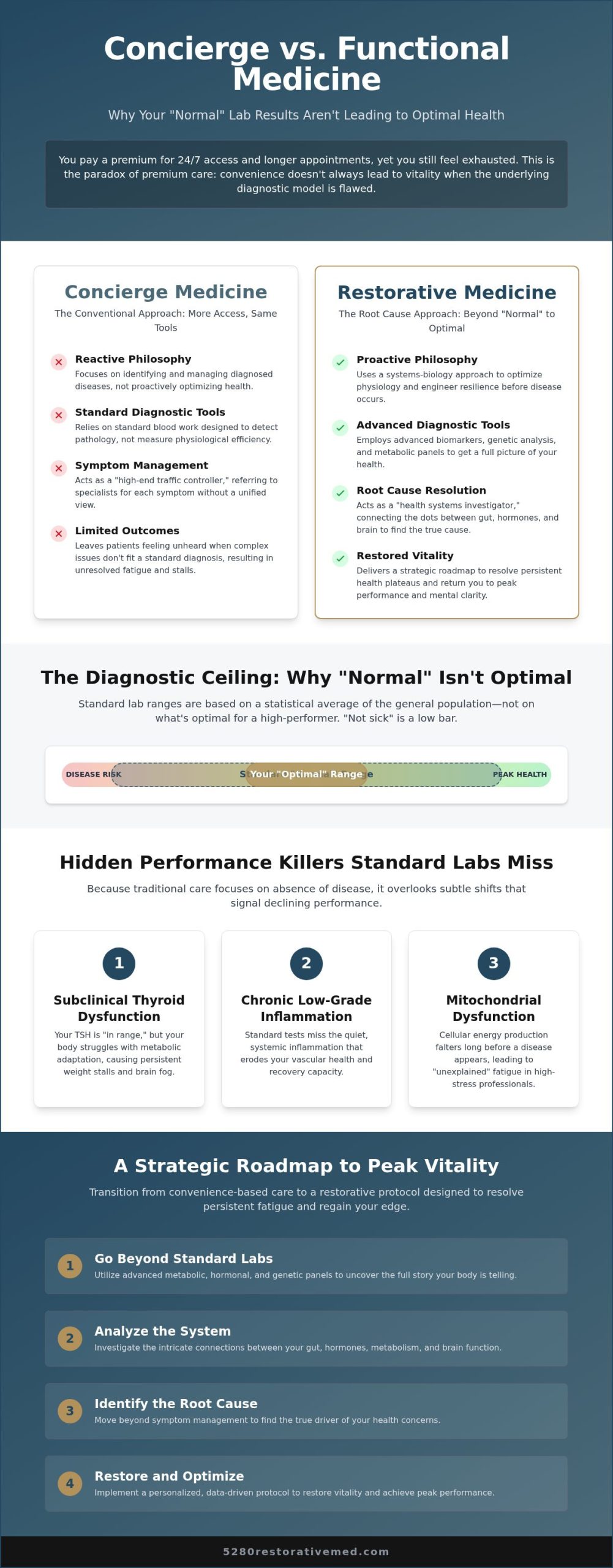
The frustration begins when you realize that a 60-minute appointment is functionally useless if your doctor uses the same 15-minute diagnostic framework found in traditional clinics. While you have more time to talk, the clinical tools remain focused on reactive care. If your symptoms don’t trigger a specific disease diagnosis, you are often caught in a referral loop. Your concierge doctor, acting as a high-end traffic controller, passes you from one specialist to another. Each specialist examines a single organ system, yet no one looks at the biological symphony of your entire body. This cycle takes a heavy psychological toll. Paying a premium for care that yields only traditional “normal” results leaves you feeling unheard and stuck in a state of suboptimal performance.
The Concierge Paradox: More Time, Same Tools
It is essential to understand that concierge medicine is primarily a business model, not a medical specialty. It changes how you pay for and access care, but it does not inherently change the clinical philosophy of the provider. Most concierge physicians are still bound by traditional primary care guidelines and standard insurance-based reference ranges. They are trained to identify pathology, not to optimize physiology. There is a specific moment in every complex case where bedside manner and 24/7 availability are no longer enough. If your provider isn’t trained in systems biology, they lack the roadmap to navigate the intricate connections between your gut, your hormones, and your brain.
Symptoms That Concierge Medicine Often Misses
Because traditional primary care focuses on the absence of disease, it frequently overlooks the subtle shifts that signal a decline in health. You might be told your labs are perfect while you struggle with the following:
- Subclinical thyroid dysfunction: Your TSH may be within the “normal” range, but your body is struggling with metabolic adaptation that causes persistent weight stalls and brain fog.
- Chronic inflammation: Standard CRP tests often miss low-grade systemic inflammation that quietly erodes your vascular health and recovery capacity.
- Mitochondrial dysfunction: In high-stress professionals, cellular energy production can falter long before a recognizable disease state appears, leading to “unexplained” fatigue.
True restorative care requires moving beyond the surface. It demands a shift from convenience-based care to complexity-based care, ensuring that every minute spent with a physician is backed by advanced diagnostic depth.
The Diagnostic Ceiling: Why Your Labs Look Normal While You Feel Suboptimal
You stare at the lab report, and every marker falls within the “normal” range. Yet, your energy is depleted. Your focus is fractured. This frustrating gap is what we call the Diagnostic Ceiling. It represents the point where standard pathology testing stops being useful for anyone who wants to do more than just survive. Most providers in the concierge medicine vs functional medicine debate differ here; while a concierge doctor might see “normal” and stop, a functional approach views those same numbers as the starting point for a deeper investigation.
Standard labs are designed to identify acute disease, not to optimize human performance. They look for the cliff’s edge. If you aren’t falling off the cliff, you’re considered healthy. For a high-performer, “not sick” is a low bar that doesn’t account for the cellular efficiency required to lead a company or maintain an elite training schedule. Being within range is often the enemy of the executive because it masks the slow decline of physiological function.
The Problem with Traditional Reference Ranges
Reference ranges are calculated using a statistical bell curve based on the average population that visits a commercial lab. This group often includes individuals who are sedentary, chronically stressed, or already managing metabolic issues. When your results are compared to this average, you aren’t being measured against health; you’re being measured against a declining societal baseline. An executive needs to be in the top 5% of biological function, not the average 50%. Functional ranges are much narrower and focused on the levels where your body actually thrives. Identifying a trend toward the edge of a range allows for a Functional Medicine Consultation to intervene before a trend becomes a diagnosis.
Advanced Biomarkers Your Doctor Likely Is Not Ordering
To break through the diagnostic ceiling, you must look at data points that traditional primary care rarely considers. These advanced panels provide a high-resolution map of your internal environment:
- Intracellular Micronutrient Testing: This measures what’s actually inside your cells, where energy is produced, rather than just what’s floating in your serum.
- Advanced Lipid Fractionation: Instead of just looking at total cholesterol, this assesses the size and number of particles to determine your actual cardiovascular risk.
- Comprehensive Organic Acid Testing: This acts as a metabolic “smog check,” revealing how well your body processes fuel and where your cellular machinery is stalling.
By moving beyond the standard panel, we can identify the specific roadblocks preventing you from reaching your superior state of physical function. A comprehensive Functional Medicine Consultation can reveal these hidden patterns, providing the clarity needed to move from “normal” to optimal.
Concierge vs. Functional Medicine: Understanding the Medical Philosophy Gap
The core of the concierge medicine vs functional medicine debate isn’t about how quickly you can get an appointment; it’s about what happens once you’re in the room. Concierge medicine is essentially a superior service layer applied to a traditional medical philosophy. It’s often reactive care in a tuxedo. While your doctor is available and attentive, they’re still largely operating within a symptom-specialist model. If you have a headache, they look at your head. If your stomach hurts, they look at your gut. Each symptom is treated as an isolated event rather than a signal from an integrated system.
Functional medicine operates on a systems-biology model. It recognizes that your body is a single, interconnected web where a metabolic stall in one area often stems from a deficiency in another. Instead of acting as a traffic controller who manages referrals to various specialists, a functional medicine practitioner acts as a dedicated health partner. We integrate your genetic data, environmental exposures, and lifestyle habits into one cohesive protocol. This approach seeks the “why” behind the “what,” ensuring that we aren’t just managing symptoms but restoring the underlying biological machinery that drives your performance.
Reactive Care vs. Proactive Optimization
Traditional medicine is inherently built to wait for a “break” before attempting a fix. It’s a defensive strategy that relies on pathology to justify intervention. In contrast, functional medicine is an offensive strategy. We focus on Functional Medicine for High-Performers to engineer metabolic resilience before failure occurs. This means optimizing your cellular energy, gut microbiome, and hormonal balance while you’re still “healthy” on paper. We aren’t waiting for a diagnosis; we’re building a buffer against it.
The Executive Health Program Difference
High-performers and executives operate under unique physiological pressures that a standard primary care operating system isn’t designed to handle. A single-visit annual physical, even a comprehensive one, is a snapshot in time that can’t account for the dynamic nature of your health. Our Executive Health Programs utilize multi-month protocols rather than isolated checkups. This duration allows us to implement meaningful biological changes, monitor your response, and refine your plan based on real-time data. It’s the difference between a one-time inspection and a continuous performance-tuning partnership that treats your health as a proactive journey toward superior function.
A Strategic Roadmap for Resolving Unexplained Health Plateaus
If you’ve hit a wall with your current care, moving forward requires a tactical shift. Transitioning from a model of convenience to one of clinical depth is a process of reclaiming your biological data. Navigating the choice between concierge medicine vs functional medicine often comes down to this specific moment: when you realize that more time with the wrong diagnostic lens won’t solve a complex puzzle. To break through your current plateau, you need a structured approach that moves beyond the standard physical.
Your first step is a thorough audit of your diagnostic history. Look for the gaps. If your records only contain basic blood counts and standard metabolic panels, you’ve barely scratched the surface. You must request advanced testing that targets the specific systems driving your performance. This includes comprehensive gut health assessments, detailed hormonal pathways, and metabolic markers like fasting insulin and inflammatory cytokines. Once you have these requests in hand, observe your doctor’s reaction. If they dismiss the need for “optimal” ranges or seem uncomfortable with non-standard testing, you’ve identified the limit of their model.
The final phase of this roadmap is seeking a second opinion from a specialist in restorative medicine. This isn’t about replacing your primary care for acute needs, but about adding a high-level partner who can interpret your data through a systems-biology lens. Transitioning to a root-cause protocol allows you to stop managing symptoms and start engineering a superior state of function.
Questions to Ask Your Current Concierge Physician
Direct communication can reveal whether your current provider is equipped to help you reach the next level. During your next consultation, consider asking these specific questions:
- Are we looking at functional ranges or just lab defaults? This determines if they are comparing you to a sick population or to an elite baseline.
- What metabolic markers are we missing that explain my persistent fatigue? This pushes the conversation toward cellular energy and nutrient deficiencies.
- Are you comfortable managing my health through a systems-biology lens? This identifies if they can connect the dots between disparate symptoms.
Identifying the Right Partner for Your Next Phase
When you’re ready to move beyond the diagnostic ceiling, look for clinicians who prioritize metabolic and genetic analysis. The right partner understands that your health is a dynamic system requiring a bespoke, data-driven strategy. For a deeper look at this approach, explore our Functional Health and Wellness Guide, which outlines the future of root-cause optimization. We believe that high-performers deserve a clinical operating system that matches their ambition. If you’re ready to stop guessing and start optimizing, schedule a consultation with our team to begin your restorative journey.
Engineering Resilience: Transitioning to a Restorative Health Protocol
Once you recognize that the 24/7 access of a concierge plan hasn’t solved your persistent fatigue or brain fog, you’ve reached a pivotal crossroads. The choice between concierge medicine vs functional medicine is ultimately a choice between maintaining your current state and actively evolving your biology. 5280 Restorative Medicine fills the clinical gap left by traditional primary care by prioritizing diagnostic depth over mere administrative convenience. We don’t just provide a doctor who knows your name; we provide a partnership that understands your unique cellular machinery.
Our approach centers on identifying hidden performance killers that standard labs routinely ignore. By utilizing comprehensive metabolic testing, we can pinpoint exactly where your energy production is stalling. This data allows us to move beyond generic wellness advice. Instead, we build bespoke Supplement Protocols and customized nutrition plans that align with your specific biochemistry. The result is a return to sustainable energy and a level of mental clarity that allows you to lead with precision once again.
The Role of Metabolic and Genetic Analysis
We believe that your DNA should be the primary architect of your lifestyle choices. At 5280 Restorative Medicine, we use Genetic Analysis to uncover how your body processes nutrients, manages stress, and clears toxins. This information is foundational. While traditional medicine often relies on trial and error, we use your genetic blueprint to remove the guesswork from your health journey.
Metabolic testing acts as the black box recorder of your health, capturing the intricate data of your internal environment. It reveals how your body is actually responding to your current environment and habits. By analyzing these biomarkers, we can engineer your vitality with clinical accuracy. We move you from a state of reactive maintenance to a model of proactive resilience, ensuring your physiology can support your highest ambitions.
Your Path to Peak Performance
Transitioning into our Executive Health Program is a structured, high-touch process designed for the busy professional. It begins with an exhaustive diagnostic review that looks far beyond standard reference ranges. We analyze your gut health, hormonal balance, and metabolic efficiency to create a high-resolution map of your current function. From there, we develop a custom protocol that evolves as you do.
Expect a partnership that is as invested in your success as you are. This isn’t a single annual checkup; it’s a continuous, data-driven journey. The ultimate goal of our restorative model is to help you exceed your previous baseline and reclaim your competitive edge. By focusing on root-cause optimization, we help you achieve a superior state of physical and mental function that lasts for the long term.
Reclaiming Your Biological Edge
You’ve invested in premium access, but access alone isn’t a substitute for diagnostic depth. Navigating the choice between concierge medicine vs functional medicine is the first step toward solving the complex health puzzles that standard primary care often misses. True restoration requires moving past “normal” lab results and embracing a systems-biology approach that identifies the actual root cause of your fatigue and performance stalls. By utilizing Advanced Metabolic Testing and genetic analysis, you can finally transition from reactive maintenance to proactive optimization.
Our practice brings Root-Cause Clinical Authority to every case, moving beyond surface-level treatments to engineer Bespoke Executive Protocols. We focus on returning you to a state of superior function where your health supports your highest ambitions rather than limiting them. You deserve a partner who looks at your body as an integrated system, not a collection of isolated symptoms. Ready to break through the diagnostic ceiling? Schedule your Comprehensive Health Consultation with 5280 Restorative Medicine today. Your peak physical and mental states are achievable at any stage of life; it’s simply a matter of having the right clinical roadmap.
Frequently Asked Questions
Why is my concierge doctor missing my diagnosis?
Your concierge doctor likely relies on a traditional diagnostic framework designed to identify acute disease rather than subtle physiological imbalances. While they offer exceptional access, they typically use standard reference ranges that compare you to an average, often unhealthy, population. If your symptoms don’t trigger a specific disease marker, the root cause remains invisible. This is the primary clinical gap in the concierge medicine vs functional medicine comparison.
Is functional medicine different from concierge medicine?
Yes, functional medicine is a clinical philosophy centered on systems biology, while concierge medicine is a membership-based business model for primary care. Concierge medicine prioritizes convenience and access to traditional treatments. Functional medicine focuses on identifying the underlying biochemical causes of symptoms. One changes how you access the doctor, while the other changes the investigative process. This distinction is the core of the concierge medicine vs functional medicine debate for high-performers.
What advanced labs should I ask for if I am always tired?
Persistent fatigue often stems from issues that standard blood work ignores. You should request advanced panels that evaluate intracellular micronutrient levels to assess cellular energy and comprehensive adrenal pathways. It’s also vital to check thyroid markers like Free T3 and Reverse T3, along with systemic inflammatory markers like hs-CRP. These provide a high-resolution view of your internal environment, revealing why your energy production has stalled despite “normal” basic results.
Can I keep my concierge doctor while seeing a functional medicine specialist?
Many high-performers maintain both relationships because they serve different purposes. Your concierge doctor is excellent for acute needs, standard physicals, and specialist referrals within the traditional system. A functional medicine specialist acts as your health architect, focusing on long-term optimization and root-cause resolution. This combination ensures you have 24/7 access for urgent care while following a data-driven protocol for peak physical and mental function.
Why are my labs normal if I have brain fog and low energy?
Standard labs use broad reference ranges based on a statistical average of the general population. “Normal” simply means you don’t have an advanced disease state. Brain fog and low energy are often symptoms of subclinical imbalances that fall within these wide margins but outside of your personal optimal range. We look for functional markers that indicate your systems are struggling long before they reach the point of clinical failure.
What is restorative medicine for executives?
Restorative medicine is a specialized clinical approach designed to return high-performers to their superior state of function. It moves beyond basic wellness by utilizing genetic analysis and metabolic testing to create bespoke protocols. For executives, this means addressing the physiological toll of high-stress environments, such as cortisol dysregulation and mitochondrial fatigue. The goal isn’t just the absence of illness, but the active engineering of resilience and mental clarity.
How do I know if I have outgrown my current primary care provider?
You have likely outgrown your current provider if you consistently feel suboptimal despite “perfect” lab results. If your doctor dismisses concerns about persistent fatigue or metabolic stalls as “part of aging,” it’s a sign their diagnostic lens is too narrow. High-performers require a provider who views health as a proactive journey and uses advanced biomarkers to push beyond the limitations of standard primary care protocols.
Is metabolic testing worth it for high-performers?
Metabolic testing is essential for anyone whose career or lifestyle demands peak performance. It acts as a black box recorder, revealing exactly how your body processes fuel and manages cellular energy. Without this data, you are simply guessing with supplements and diet. For high-performers, the insights gained from understanding your unique biochemistry are invaluable for achieving sustainable energy and avoiding the burnout that often accompanies a high-stakes professional life.