
Why does your standard blood work show you’re in perfect health while you’re struggling to maintain focus during a high-stakes board meeting? It’s a common frustration for high-performers who do everything right, from clean eating to consistent exercise, yet still feel their metabolic edge slipping away. You recognize that the “aged” feeling isn’t just about birthdays; it’s a physiological shift that feels like your internal battery is no longer holding a charge. Recognizing low nad+ symptoms is the first step in understanding why your cognitive and physical stamina are stalling despite your best efforts.
At 5280 Restorative Medicine, we believe that peak physical and mental states are achievable at any stage of life. This clinical guide will help you identify the subtle red flags of cellular energy depletion and provide the protocols needed to restore your mental clarity and metabolic drive. We’ll examine the science of NAD+ optimization and explain how moving beyond standard lab limitations through metabolic testing can help you achieve sustainable, all-day energy and faster physical recovery cycles.
Key Takeaways
- Identify the subtle low nad+ symptoms that manifest as executive brain fog and metabolic stalling, even when standard medical tests return “normal” results.
- Understand the physiological “battery” of your cells and how chronic stress and aging deplete the essential coenzymes required for mental and physical stamina.
- Compare the efficacy of clinical restoration methods, from high-bioavailability IV protocols to targeted oral precursors, to determine the most effective path for your unique biology.
- Discover how bespoke metabolic optimization within a comprehensive Executive Health Program helps you exceed baseline performance and restore your cognitive edge.
Beyond the Basics: Recognizing the Symptoms of Low NAD+ in High-Performers
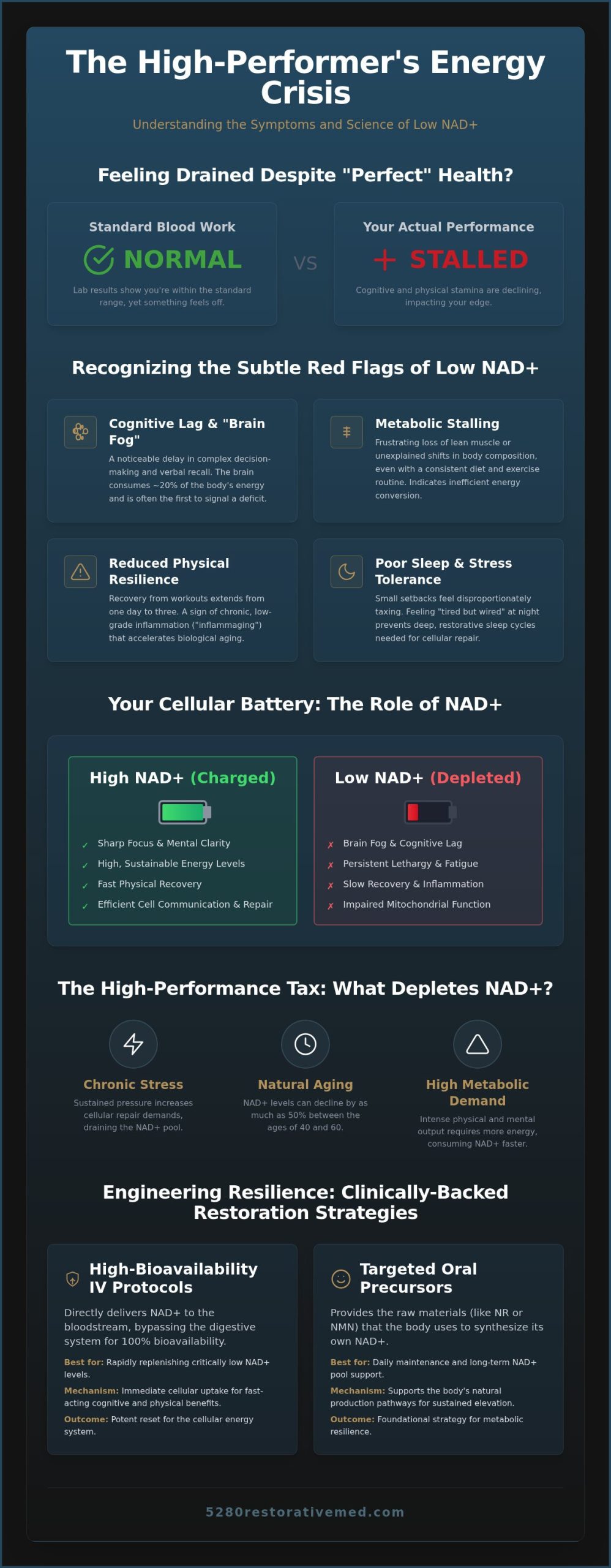
High-performance is defined by the ability to maintain cognitive sharpness and physical vigor under sustained pressure. For many leaders, there comes a point where standard healthy habits no longer yield the same results. You might feel a subtle, persistent decline in your capacity to process complex information or recover from a demanding week. This isn’t just a byproduct of aging; it’s a cellular energy crisis. Identifying low nad+ symptoms requires looking beyond general fatigue and examining how your internal systems are failing to meet the demands of your high-stakes lifestyle.
Because NAD+ is essential for nearly every metabolic process, its depletion manifests across several physiological domains. High-achievers typically notice these shifts first in their executive function and physical resilience. Common indicators include:
- Decreased focus and a noticeable “lag” in complex decision-making
- Persistent lethargy and a reduced tolerance for high-intensity exercise
- Metabolic stalling and unexplained shifts in body composition
- Altered circadian rhythms and diminished resilience to daily stressors
Cognitive Lag and the “Brain Fog” Phenomenon
The human brain accounts for only about 2% of body weight but consumes roughly 20% of the body’s energy. Because of this massive demand, the central nervous system is frequently the first to signal a decline in Nicotinamide adenine dinucleotide (NAD+) levels. This isn’t the same as the “sleepy” feeling you get after a late night. It’s a distinct cognitive lag. You might find yourself re-reading the same paragraph multiple times or experiencing a delay in verbal recall during meetings. Cognitive endurance is essentially the measure of how long your brain can maintain high-level output before cellular NAD+ availability drops below the threshold required for efficient mitochondrial function.
Metabolic Stalling and Physical Recovery
When NAD+ levels are sub-optimal, your body struggles to convert macronutrients from your diet into usable ATP. This metabolic stalling often manifests as persistent lethargy or a frustrating loss of lean muscle mass, even if your workout routine hasn’t changed. Low NAD+ is also closely linked to “inflammaging,” a state of chronic, low-grade systemic inflammation that accelerates biological aging. High-performers often notice this as a reduced tolerance for exercise or a recovery cycle that stretches from one day to three. Within our Executive Health Program, we focus on reversing these trends by addressing the root cause of mitochondrial inefficiency.
Beyond the physical and mental, a depletion in your NAD+ pool affects your emotional baseline. You may notice your stress resilience has diminished, making small setbacks feel disproportionately taxing. Your circadian rhythms might also shift. You might feel “tired but wired” at night, unable to reach the deep, restorative sleep cycles needed for cellular repair. These subtle behavioral shifts are often the most overlooked low nad+ symptoms, yet they are critical indicators that your cellular battery needs a clinical recharge.
The Biological Engine: Why NAD+ is the Currency of Cellular Energy
To understand why your body feels stalled, you have to look at the microscopic level. Think of Nicotinamide Adenine Dinucleotide (NAD+) as the primary currency of your biological economy. It’s a critical coenzyme found in every living cell that facilitates the transfer of electrons; essentially, it’s the shuttle that moves energy from the food you eat into the powerhouse of your cells. While the physical signs of depletion are frustrating, understanding the science behind low nad+ symptoms empowers you to take control of your biological trajectory. It’s not just a “helper” molecule. It’s a biological necessity.
The easiest way to visualize this process is through the “battery” analogy. Your cells operate on a continuous cycle between NAD+ (the oxidized form) and NADH (the reduced form). This constant exchange is what keeps your internal engine running. When your “battery” is fully charged, your cells communicate efficiently, repair damage quickly, and produce energy on demand. However, as levels decline, this cycle slows down. This drop acts as a primary sensor for cellular health, signaling to your body that it’s under environmental or physiological stress. This is why we view NAD+ levels as a cornerstone of functional health and wellness; without sufficient cellular currency, peak performance remains out of reach.
Mitochondrial Health and ATP Production
Your mitochondria are the engines responsible for creating Adenosine Triphosphate (ATP), the actual fuel your body uses for every movement and thought. NAD+ plays a starring role in the electron transport chain within these mitochondria. Without enough NAD+, the production of ATP falters. This is why mitochondrial optimization is the foundation of advanced bio-hacks like red light therapy. By supporting these powerhouses, you build “metabolic resilience,” which is your body’s ability to maintain high energy output even during periods of intense professional or physical stress. When this resilience breaks down, you start to notice the classic low nad+ symptoms of fatigue and stalling.
Sirtuins and the Guarding of the Genome
Beyond energy production, NAD+ is the essential fuel for sirtuins, often called the “longevity genes.” Sirtuins are a family of proteins that act as cellular managers, regulating DNA repair, gene expression, and the aging process. They’re like a security team guarding your genome, but they can only work if they have enough NAD+ to pay their “wages.” A depleted NAD+ pool leaves your DNA vulnerable to oxidative damage and has been linked to various ageing-associated diseases. When your sirtuins are underfunded, cellular aging accelerates, and your body loses its ability to bounce back from the wear and tear of a high-performance life.
Reclaiming your edge starts with a deep dive into your unique metabolic markers. A tailored Functional Medicine Consultation provides the clinical clarity needed to bridge the gap between your current state and your peak potential.
The High-Performance Tax: How Stress and Aging Deplete Your NAD+ Pool
Even the most disciplined high-achievers often find themselves baffled. You follow a strict nutritional plan, prioritize organic produce, and never miss a workout, yet you still experience low nad+ symptoms like cognitive lag and metabolic stalling. This leads to a common question: Why are my levels low if I eat a healthy diet? The reality is that for a high-performer, your lifestyle often creates a biological demand that outpaces your body’s natural supply. We call this the “high-performance tax.”
The primary driver of this depletion is chronic cortisol elevation. When you’re managing high-stakes meetings or navigating constant travel, your body stays in a state of “survival mode.” In this state, your physiology prioritizes immediate stress responses over long-term cellular repair. This creates a massive “NAD+ drain.” Additionally, your body contains an enzyme called CD38, which naturally increases with age and systemic inflammation. CD38 is an aggressive consumer of NAD+. It essentially “steals” the coenzyme to fuel inflammatory responses, leaving very little left for your mitochondria to produce energy or for sirtuins to repair your DNA.
Chronic Stress and Cellular “Theft”
In the hierarchy of biological needs, immediate survival always wins. When your system is flooded with stress hormones, it diverts NAD+ away from longevity pathways and toward the acute stress response. High-performers face unique environmental stressors that accelerate this “cellular theft.” Constant exposure to blue light from screens, frequent time-zone shifts, and chronic sleep deprivation all signal the body to consume more NAD+ for circadian regulation and oxidative stress management. This is why high-achievers are at a significantly higher risk for premature cellular aging; your cells are working overtime just to maintain a baseline of function.
Why “Normal” Labs Are Not Optimal Labs
One of the greatest frustrations for our clients is being told their blood work is “normal” while they feel significantly sub-optimal. Standard metabolic panels are designed to identify disease states, not peak performance. They rarely capture intracellular energy deficits or the nuances of mitochondrial function. At 5280 Restorative Medicine, we use functional medicine for high-performers to look at deeper biomarkers. There’s a profound difference between being “disease-free” and being “performance-optimized.”
While lifestyle adjustments are foundational, they are often not enough to refill a severely depleted pool. This is where clinical intervention becomes necessary. Many of our clients find that strategic NAD+ supplementation or advanced delivery protocols are the only way to bypass the digestive limitations and cellular “theft” mentioned above. By measuring your specific biological needs through metabolic testing, we can move you from a state of depletion back to exceeding your baseline performance.
Engineering Resilience: Clinically-Backed Strategies to Restore NAD+ Levels
Recognizing low nad+ symptoms is only the first step toward reclaiming your cognitive and physical edge. While standard nutritional advice often suggests increasing your intake of vitamin-rich foods like fish or mushrooms, these dietary sources are simply insufficient to reach the therapeutic levels required for true restorative medicine. High-performers need a more sophisticated approach. Clinical protocols focus on optimizing the “salvage pathway,” which is the body’s primary mechanism for recycling NAD+ within the cells. By supporting this pathway, we can ensure your biological engine has a consistent supply of cellular currency to fuel high-stakes performance.
The method of delivery is just as critical as the protocol itself. At-home subcutaneous injections and in-clinic IV therapy are highly effective because they bypass the digestive system entirely, offering superior bioavailability compared to standard oral routes. For those seeking consistent, long-term maintenance, transdermal patches provide a steady release of the coenzyme. The choice of delivery depends on your specific goals, whether you’re looking for a rapid “loading dose” to overcome a period of intense burnout or a sustainable monthly protocol to maintain your peak state.
The Precursor Debate: NMN vs. NR vs. NAD+
Precursors are the raw materials your body uses to build NAD+. Nicotinamide Mononucleotide (NMN) and Nicotinamide Riboside (NR) are the two most researched options. A 72-week study published in Cell Metabolism demonstrated that daily supplementation with 1,000mg of NR can increase whole-blood NAD+ levels by 40% to 90% in healthy adults. While both molecules are effective, the “best” choice is never one-size-fits-all. It depends on your unique metabolic profile. We use advanced metabolic testing to determine how your body processes these precursors, ensuring your optimization strategy is engineered for your specific cellular environment.
Synergistic Bio-Hacks for Mitochondrial Peak
To truly exceed your baseline, NAD+ optimization should be paired with other mitochondrial support tools. Combining restoration protocols with red light therapy creates a compounding effect, as the light energy helps stimulate the electron transport chain that NAD+ fuels. Additionally, incorporating CD38 inhibitors like apigenin can help preserve your existing pool by blocking the enzymes that “steal” your energy. Don’t overlook the basics; high-quality sleep hygiene acts as a powerful force multiplier for these treatments, providing the quiet environment your sirtuins need to perform deep DNA repair. To move beyond generic solutions and discover your specific cellular needs, we recommend starting with a tailored Functional Medicine Consultation.
Lifestyle interventions also play a vital role in maintaining these levels. Intermittent fasting and cold exposure act as positive stressors, signaling your body to increase its natural production of NAD+. When these habits are integrated with clinical-grade protocols, you create a state of metabolic resilience that allows you to perform at your highest level, regardless of the external pressure.
Bespoke Metabolic Optimization: The 5280 Restorative Medicine Protocol
Identifying low nad+ symptoms is a critical first step, but for the high-performer, recognition must lead to precise action. At 5280 Restorative Medicine, we move beyond the generic advice found in standard wellness circles to provide a clinical framework that treats your health as a proactive journey. NAD+ optimization serves as a foundational pillar of our Executive Health Program. Under the guidance of Dr. Marci Catallo-Madruga, our practice specializes in designing root-cause protocols that bypass the “normal” lab limitations of traditional, reactive medicine.
Transitioning to a restorative model means you’re no longer waiting for a diagnosis to start feeling better. We believe that peak physical and mental states are achievable at any stage of life, provided you have the right data. Sustainable, all-day energy isn’t the result of guesswork or following the latest supplement trends. It’s the outcome of precision testing and a deep understanding of your unique cellular landscape. Our approach is designed to help you exceed your baseline performance, not just reach it.
Advanced Metabolic Testing and Genetic Analysis
Your specific NAD+ requirements are dictated by your unique biological makeup. Genetic markers, such as MTHFR variations or specific sirtuin SNPs, play a massive role in how efficiently your body produces and recycles cellular energy. We use comprehensive bloodwork and metabolic testing to monitor your progress at a microscopic level. By analyzing these data points, we can adjust your protocol in real-time. This ensures faster, more sustainable performance gains. This data-driven approach removes the uncertainty often found in standard care, allowing us to engineer a state of metabolic resilience that matches your professional ambitions.
Designing Your Executive Performance Blueprint
When you begin your journey with us, you’re receiving a comprehensive blueprint for cellular vitality. During your initial functional medicine consultation, we look at the intersection of your genetics, your current metabolic state, and your lifestyle demands. We then integrate targeted nutrition, bespoke supplement protocols, and advanced therapies into a single, high-performance plan. This personalized approach ensures that you aren’t just managing low nad+ symptoms, but actively reversing the trends of cellular depletion. It’s time to stop settling for “fine” and start reaching for a superior state of function.
Apply for the Executive Health Program to reclaim your metabolic edge.
Reclaim Your Cellular Edge and Redefine Your Peak
You don’t have to accept a decline in cognitive stamina or metabolic drive as a permanent part of aging. As we’ve explored, the subtle low nad+ symptoms you’re experiencing are often the result of a cellular energy crisis driven by high-stakes stress and biological depletion. By moving beyond standard lab results and utilizing advanced metabolic testing, you can identify the specific root causes of your fatigue and stalling. This data-driven approach ensures that your path to restoration is based on precision science rather than trial and error.
Under the clinical guidance of Dr. Marci Catallo-Madruga, our practice focuses on engineering metabolic resilience through personalized protocols that treat health as a proactive journey. We bridge the gap between complex science and your daily well-being, focusing on root-cause optimization for sustainable high-performance. Sustainable energy and mental clarity are achievable when you have a high-end health partner invested in your individual success. We invite you to Apply for the Executive Health Program today to begin your transformation. It’s time to exceed your baseline and return to the superior state of function you deserve.
Frequently Asked Questions
What is the most common symptom of low NAD+ in professionals?
Cognitive lag and executive brain fog are the most frequent indicators for high-performers. You might notice a subtle delay in decision-making or a diminished capacity for deep work during high-stakes meetings. This isn’t standard tiredness; it’s a mitochondrial inefficiency that makes complex problem-solving feel unusually taxing. Recognizing these early low nad+ symptoms allows for proactive intervention before your professional performance is significantly compromised.
Can I test my NAD+ levels with standard blood work?
Standard blood work typically fails to measure intracellular NAD+ levels. Traditional metabolic panels are designed to identify disease states but don’t assess the “battery charge” of your individual cells. To get an accurate reading, we use specialized metabolic testing that looks specifically at coenzyme availability and mitochondrial function. This advanced analysis is necessary to bypass the “normal” lab limitations that often mask cellular energy depletion.
What is the difference between NAD, NAD+, and NADH?
NAD is the umbrella term for the coenzyme, while NAD+ and NADH represent its two states in the cellular energy cycle. NAD+ is the oxidized form, ready to pick up electrons, while NADH is the reduced form carrying them to the mitochondria for ATP production. Maintaining a high ratio of NAD+ to NADH is essential for metabolic health and DNA repair. Without this balance, cellular aging accelerates and energy production stalls.
Are NMN supplements the best way to increase NAD+ levels?
NMN is an effective precursor, but the “best” method depends on your unique metabolic profile and absorption capacity. While oral supplements are convenient, they often face digestive degradation. Clinical protocols frequently prioritize IV therapy or subcutaneous injections for higher bioavailability. We use genetic analysis to determine which precursor or delivery method will most effectively raise your levels based on your specific biological requirements.
How does chronic stress affect cellular NAD+ pools?
Chronic stress acts as a direct drain on your cellular NAD+ pools by activating enzymes like CD38. When your body is in a state of constant cortisol elevation, it prioritizes immediate survival over long-term repair. This “cellular theft” redirects NAD+ away from longevity pathways and toward managing oxidative stress and inflammation. High-achievers often experience accelerated depletion because their professional demands create a continuous biological tax on their energy currency.
How long does it take to see improvements from NAD+ optimization?
Most clients report improved mental clarity and focus within a few days of starting clinical-grade protocols. Physical improvements, such as faster recovery from exercise and stabilized metabolic drive, usually become evident after three to four weeks of consistent optimization. Because we use data-driven protocols, we can monitor these shifts through follow-up testing to ensure you’re reaching and exceeding your baseline performance targets.
Can diet alone fix an NAD+ deficiency?
Diet alone is generally insufficient to reverse a clinical deficiency in high-performers. While foods like grass-fed beef and fatty fish provide precursors, they don’t offer the concentration required to overcome the “high-performance tax” of stress and aging. Clinical intervention is necessary to provide the therapeutic loading doses needed to refill your depleted pools and restore your cognitive edge to a superior state of function.
Is NAD+ therapy safe for long-term performance optimization?
NAD+ therapy is considered very safe when administered under the supervision of a clinical expert like Dr. Marci Catallo-Madruga. Because NAD+ is a naturally occurring coenzyme already present in every cell, optimization simply restores your levels to a more youthful, efficient state. We utilize personalized protocols and regular metabolic monitoring to ensure your journey toward peak performance remains safe, effective, and tailored to your evolving biological needs.