
What if the “normal” testosterone levels on your latest lab report are actually the very thing sabotaging your peak performance? You’ve likely felt the subtle shift: the unexplained brain fog during a high-stakes meeting, the stubborn midsection fat that refuses to budge, or a quiet decline in the drive that once defined your professional and personal life. It’s easy to dismiss these changes as the inevitable cost of a demanding career, but accepting a baseline of mediocrity isn’t necessary for the modern executive.
Identifying the symptoms of low testosterone in men is more complex than checking a single box. These signs often manifest as a systemic metabolic bottleneck rather than a simple hormonal dip. We agree that being told your health is “fine” isn’t enough when you’re aiming for excellence. In this 2026 guide, you’ll learn how to move beyond standard reference ranges toward true metabolic optimization. We’ll examine the physiological root causes of executive burnout and provide a clear roadmap for restoring your mental clarity, muscle mass, and sexual health. It’s time to stop reacting to decline and start proactively reclaiming your vitality.
Key Takeaways
- Recognize that the early symptoms of low testosterone in men often appear as executive burnout and mental fatigue rather than just a drop in libido.
- Understand the bidirectional link between stubborn midsection fat and hormonal decline to stop the cycle of muscle wasting.
- Decode your bloodwork by understanding why Free Testosterone levels matter more than the statistical “normal” ranges found on standard lab reports.
- Shift from reactive treatments to proactive health using genetic analysis and metabolic testing to find the root cause of your decline.
- Discover how a tailored Executive Health Program uses bioidentical optimization to restore your drive and long-term metabolic resilience.
Recognizing the Subtle Signs: Beyond Low Libido
Many high-performing men assume that if their drive in the bedroom remains intact, their testosterone levels must be optimal. This is a common misconception that often delays effective intervention. In reality, Hypogonadism is a complex decline in androgenic signaling that affects multiple biological systems simultaneously. By 2026, the medical community increasingly recognizes “andropause” not as an inevitable slide into old age, but as a systemic metabolic shift that requires a proactive, personalized response.
Libido is frequently the last symptom to appear, not the first. Your body is biologically wired to prioritize reproductive function, often maintaining it even while other vital processes begin to fail. The earliest symptoms of low testosterone in men are usually much more subtle, manifesting as a gradual erosion of your professional edge and mental stamina. If you find yourself struggling to maintain the decisiveness that once defined your leadership style, you aren’t just tired; you’re likely experiencing a physiological shift in your hormonal foundation that demands attention.
The Cognitive Toll: Brain Fog and Loss of Edge
Your brain is highly sensitive to hormonal fluctuations because testosterone receptors are concentrated in areas responsible for focus and dopamine regulation. When these levels drop, you experience a persistent “brain fog” that standard rest or caffeine cannot fix. This isn’t just a general feeling of being tired. It is a specific neurological deficit where the mental energy required to process complex information feels significantly higher than it did previously. Chronic low testosterone is specifically associated with a measurable decline in spatial memory, making it harder to visualize complex strategies or retain detailed technical data during high-stakes negotiations.
Emotional Shifts: Irritability and the “Grumpy Man” Syndrome
The emotional impact of hormonal decline is often misdiagnosed as clinical depression or simple burnout. As testosterone levels fall, the body frequently sees a compensatory rise in cortisol, the primary stress hormone. This creates a state of high-alert irritability often called “grumpy man” syndrome. You might find your patience wearing thin over minor setbacks or feel a persistent sense of emotional fatigue. These shifts mirror the symptoms of executive burnout but are rooted in a clear hormonal imbalance. Monitoring these emotional markers is essential for maintaining your resilience:
- Reduced Stress Tolerance: Feeling overwhelmed by tasks that were once routine.
- Loss of Motivation: A lack of “fire” or ambition for new professional ventures.
- Unexplained Irritability: Increased conflict with colleagues or family members without a clear external trigger.
- Social Withdrawal: A newfound preference for isolation over high-energy networking or social interactions.
The Metabolic Connection: How Low T Sabotages Your Physique
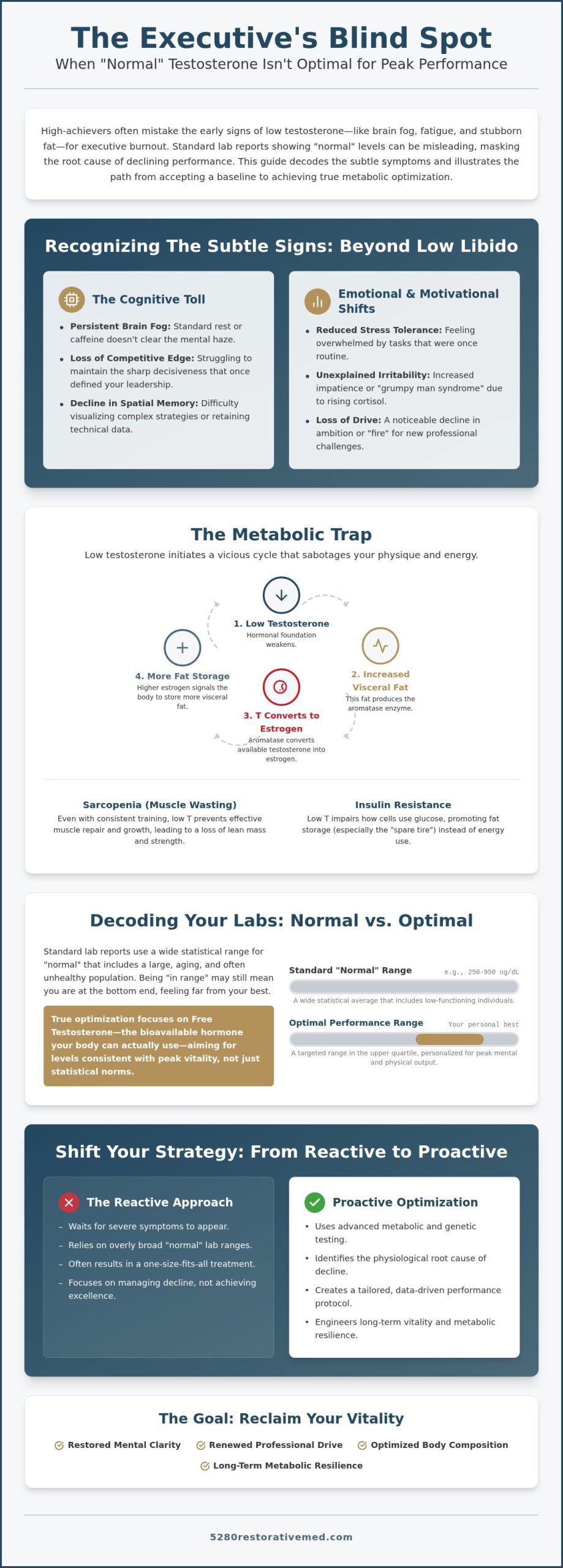
Testosterone is far more than a driver of libido; it’s a primary regulator of your metabolic engine. A complex, bidirectional relationship exists between your endocrine system and your body composition. Visceral fat, the deep tissue around your organs, isn’t just stored energy. It acts as an active endocrine organ that produces an enzyme called aromatase. This enzyme converts your available testosterone into estrogen, which in turn signals your body to store even more fat. This cycle is one of the most frustrating symptoms of low testosterone in men who are otherwise disciplined with their diet and exercise.
Beyond fat accumulation, low T levels directly contribute to sarcopenia, the gradual wasting of lean muscle tissue. Even if you maintain a consistent resistance training routine, your body cannot effectively repair or build muscle without sufficient androgenic signaling. This decline eventually impacts your skeletal health, as testosterone is vital for maintaining bone mineral density. Integrating hormone optimization into your routine is often the only way to break this catabolic cycle and restore your physical foundation.
Insulin Resistance and the “Spare Tire”
Testosterone influences how your muscle cells respond to insulin and process blood sugar. It helps facilitate glucose uptake, ensuring your body uses carbohydrates for energy rather than storage. When levels drop, insulin sensitivity often follows, leading to the dreaded “spare tire” that seems resistant to traditional cardio. This is why many high-performers find it impossible to lose weight through simple calorie restriction. By adopting a functional medicine approach, we can address these metabolic bottlenecks. Properly diagnosing and treating male hypogonadism involves looking at this entire metabolic picture, not just a single number on a lab report.
Mitochondrial Dysfunction and Physical Stamina
Your physical stamina is directly tied to mitochondrial health, the microscopic power plants within your cells. Testosterone supports mitochondrial biogenesis, the process of creating new energy-producing units. When these levels are deficient, ATP production, your body’s primary energy currency, falters. You’ll likely notice that your recovery time after a heavy lifting session or a cross-country flight has doubled. To combat this at a cellular level, we often pair hormonal protocols with red light therapy to stimulate mitochondrial function. If you’re ready to stop guessing and start optimizing, a Functional Medicine Consultation can help you engineer a more resilient physique.
Normal vs. Optimal: Why Your Lab Results May Be Misleading
Your doctor calls with your results and says you’re “within the normal range,” yet you still feel the unmistakable symptoms of low testosterone in men. This discrepancy exists because standard laboratory reference ranges are merely statistical averages of the general population. These ranges include individuals with varying levels of chronic illness, obesity, and sedentary lifestyles. For a high-performing executive, being “average” among a declining population is a recipe for mediocrity, not peak performance. True health is defined by how you feel and function, not where you sit on a bell curve of a sick population.
To understand your true hormonal status, you must look beyond Total Testosterone. Think of Total T as the balance in your savings account; it’s there, but it isn’t all available for immediate use. Free Testosterone represents the “cash on hand” actually available for your tissues to utilize. This distinction is often governed by Sex Hormone Binding Globulin (SHBG), a protein that acts like a lock on your hormones. If your SHBG is too high, it effectively binds your testosterone, leaving you with the symptoms of a deficiency despite having a “normal” total score on a standard test.
The Problem with Age-Based Averages
Standard medicine often benchmarks your levels against others in your specific age bracket. However, being “normal” for a 50-year-old often means accepting a significant performance deficit compared to your prime years. We believe your biological age, which reflects your cellular health and vitality, is far more important than the date on your birth certificate. Biological age often differs from chronological age in hormonal health, and a high-performer’s goals require levels that support recovery and focus, not just the absence of clinical disease.
Beyond the T-Score: Looking at the Full Panel
A comprehensive assessment requires a deep dive into your entire endocrine landscape. We evaluate Luteinizing Hormone (LH) and Follicle-Stimulating Hormone (FSH) to determine if the issue lies in the brain’s signaling or the testes’ production. Additionally, monitoring Estradiol is critical. Elevated estrogen can mimic many symptoms of low testosterone in men, including persistent fatigue and emotional shifts. We also consider systemic barriers like mast cell activation syndrome, which can trigger chronic inflammation and disrupt your delicate hormonal balance. True optimization is about harmonizing all these markers to ensure your biology supports your professional and personal ambitions.
A Functional Medicine Approach to Assessment
A standard medical assessment usually begins and ends with a simple blood draw. While this provides a snapshot, it fails to capture the systemic complexity of your health. We utilize a functional health and wellness framework that treats the symptoms of low testosterone in men as a signal of deeper physiological imbalances rather than an isolated deficiency. This approach integrates advanced metabolic markers, gut health, and genetic data to create a comprehensive map of your current state and future potential.
Metabolic Testing: Finding the Root Cause
Testosterone production is heavily influenced by the health of your thyroid and adrenal glands. If your adrenal system is constantly pumping out cortisol due to high-stakes professional stress, your body will prioritize survival over reproduction, effectively “tanking” your testosterone levels. This biological trade-off is often referred to as a hormonal steal, where precursors are diverted to make stress hormones instead of androgens. We look for these hidden stressors during our assessment to ensure we aren’t just treating a symptom but fixing the source. We also screen for critical nutrient deficiencies that often go unnoticed in traditional panels. Without adequate levels of Zinc, Vitamin D, and Magnesium, your body simply lacks the raw materials required for efficient hormone synthesis.
Genetic Analysis for Precision Optimization
Your DNA provides a unique “hormonal blueprint” that dictates how you metabolize and respond to various treatments. Some men are genetically predisposed to convert testosterone into estrogen more rapidly, while others may have androgen receptors that are less sensitive to circulating hormones. Genetic analysis allows us to move beyond the one-size-fits-all protocols that often lead to treatment failure in traditional settings. By understanding your specific genetic markers, we can personalize your nutrition, supplement, and optimization protocols with surgical precision. This ensures that every intervention is tailored to your body’s specific biological requirements.
The health of your gut also plays a significant role in this equation. The microbiome is responsible for the detoxification and elimination of used hormones. If your gut is compromised, these “spent” hormones can recirculate in the bloodstream, leading to further imbalance or estrogen dominance. It’s this level of detail that distinguishes a boutique clinical practice from a standard healthcare provider. To begin identifying the root cause of your decline, we invite you to schedule a Functional Medicine Consultation and start your journey toward metabolic resilience.
Reclaiming Vitality: Engineering Your Performance Protocol
Once we’ve identified the root causes of the symptoms of low testosterone in men, the focus shifts to strategic restoration. We don’t view hormone optimization as a standalone fix, but as a foundational pillar of a comprehensive executive health program. This program is designed to move you beyond merely resolving a deficiency and toward achieving peak physical and mental states. By aligning your hormonal profile with your metabolic health, we create a synergistic effect that enhances every aspect of your professional and personal performance.
Our protocols utilize Bioidentical Hormone Replacement Therapy (BHRT) rather than synthetic alternatives. Bioidentical hormones are molecularly identical to the ones your body produces naturally. This precision allows for better integration and fewer side effects compared to traditional synthetic options often found in institutional settings. To sustain these optimized levels, we integrate custom nutrition and lifestyle hacks, such as specific circadian rhythm adjustments and targeted supplement protocols, ensuring your vitality is sustainable for the long term. We believe that true health is a proactive journey, and your protocol should reflect that philosophy.
The Executive Health Advantage
Choosing a boutique clinical practice over a standard institutional provider offers a level of personalized care that high-performers require. We provide ongoing monitoring and frequent protocol adjustments based on real-time data, ensuring you never settle for a “good enough” baseline. This isn’t just about managing aging; it’s about engineering longevity and maintaining the high-performance energy needed for a demanding career. Our team acts as your high-end health partner, deeply invested in your individual success and long-term resilience. You’ll experience a level of clinical authority and empathetic care that is often missing in larger, more impersonal healthcare settings.
Next Steps: From Symptoms to Solutions
It’s time to move beyond self-diagnosis and the frustration of “normal” lab results that don’t reflect how you feel. The symptoms of low testosterone in men are a call to action, not a life sentence. Your journey begins with an initial functional medicine consultation, where we’ll review your advanced testing and genetic blueprint to build your bespoke protocol. Take control of your biological future and reclaim the drive that defines you. Schedule your consultation with 5280 Restorative Medicine today and start your transition from baseline to peak performance.
Reclaiming Your Competitive Edge
The path to peak performance requires moving beyond the limitations of standard medicine. We’ve explored how the symptoms of low testosterone in men are often the first signs of a systemic metabolic bottleneck rather than just an age-related decline. By shifting your focus from “normal” lab ranges to optimal biological function, you can break the cycle of executive burnout and physical stagnation.
Under the expert guidance of Dr. Marci Catallo-Madruga, we utilize comprehensive metabolic and genetic testing to identify the root causes of your decline. This isn’t about a one-size-fits-all prescription. It’s about engineering a bespoke protocol that restores your mental clarity, muscle mass, and metabolic resilience. You don’t have to accept a baseline of mediocrity when superior physical and mental states are within your reach.
Optimize your performance with a personalized Executive Health Program at 5280 Restorative Medicine
Your journey toward renewal starts with a single, proactive step. Reclaim the vitality you deserve.
Frequently Asked Questions
Can stress alone cause symptoms of low testosterone in men?
Yes, chronic stress triggers a physiological process often called the “cortisol steal.” When your body is in a constant state of high alert, it prioritizes the production of stress hormones over sex hormones like testosterone. This survival mechanism can lead to a significant downregulation in your natural production, causing you to experience the classic symptoms of low testosterone in men even if your primary health is otherwise sound.
What is the difference between “normal” and “optimal” testosterone levels?
A “normal” level is simply a statistical average of a broad population that includes many unhealthy individuals. In contrast, “optimal” levels are the specific ranges where you personally experience peak cognitive focus, high energy, and efficient muscle recovery. We focus on reaching the upper quartile of these ranges to ensure you’re performing at your best rather than just avoiding a clinical diagnosis.
How long does it take to see improvements after starting a hormone optimization program?
Most men report a noticeable lift in mental clarity and mood within the first three to four weeks of treatment. Physical changes, such as improved muscle tone and a reduction in visceral fat, generally become more apparent between the three and six month marks. We use frequent monitoring during this period to adjust your protocol and ensure your body is responding effectively to the optimization.
Are there natural ways to boost testosterone before considering BHRT?
You can support your natural production by correcting nutrient deficiencies in Zinc, Vitamin D, and Magnesium while engaging in heavy resistance training. These lifestyle adjustments are foundational, but they often have a ceiling for men experiencing significant age-related decline. We evaluate your current lifestyle markers to determine if natural interventions are sufficient or if a more specialized protocol is necessary for your goals.
Do I have to take testosterone for the rest of my life if I start treatment?
Hormone optimization is typically a long-term commitment because it addresses a persistent biological decline. If you stop the protocol, your levels will likely return to their previous baseline, and your symptoms may reappear. Our approach focuses on creating a sustainable, high-performance lifestyle that integrates treatment seamlessly so you can maintain your vitality for decades to come.
Can low testosterone cause anxiety or “executive burnout”?
Low testosterone levels often manifest as a reduced threshold for stress, which many high-performers interpret as anxiety or burnout. Because testosterone influences the brain’s neurochemistry, a deficiency can leave you feeling emotionally fragile or easily overwhelmed by routine professional demands. Restoring your hormonal balance often provides the resilience needed to handle high-pressure environments without the persistent sense of mental fatigue.
What role does sleep play in maintaining healthy testosterone levels?
Sleep is the most critical window for hormone synthesis, as the majority of your daily testosterone is produced during deep, REM cycles. If your sleep is fragmented or too short, you are effectively cutting off your body’s primary production time. We find that resolving sleep issues is often a non-negotiable step in managing the symptoms of low testosterone in men and achieving long-term metabolic health.
How does gut health affect my hormone levels?
Your gut microbiome is responsible for the detoxification and elimination of used hormones through specific enzymatic processes. If your gut health is compromised, “spent” hormones like estrogen can recirculate in your bloodstream instead of being excreted. This recirculating estrogen can further suppress your testosterone production, creating a cycle of hormonal imbalance that only a root-cause functional approach can break.