
What if your “normal” blood work is actually the reason you’ve lost your competitive edge? You are getting enough sleep, yet the persistent brain fog remains. You are disciplined with your diet, but you are facing metabolic stalling and unexplained weight gain that feels like premature aging. If you’re frustrated with the 15 minute primary care model, you aren’t alone. Over 51% of American adults are now managing two or more chronic conditions, and many are finding that standard protocols simply don’t offer the depth they need. These are the subtle signs you need a functional medicine doctor who looks beyond the surface.
You deserve more than just the absence of disease; you deserve a return to peak performance. We understand that “normal” labs are not the same as optimal health. In this article, we’ll explore the physiological red flags that traditional medicine often misses. You will find a clear roadmap to identify the root causes of your symptoms and reclaim the vitality you thought was gone. Let’s look at the 12 specific indicators that it is time for a more personalized, boutique approach to your well-being.
Key Takeaways
- Understand the critical distinction between pathological lab ranges used to detect disease and functional ranges designed to optimize your performance.
- Recognize how HPA-axis dysfunction and glucose fluctuations contribute to the “wired but tired” cycle common among high-performers.
- Identify the 12 subtle signs you need a functional medicine doctor to resolve the systemic imbalances connecting your gut health to your mood and energy.
- Learn how to audit your current care plan to ensure you are prioritizing root-cause resolution over temporary symptom management.
- Explore how advanced metabolic testing and genetic analysis provide the precise data necessary to engineer long-term physiological resilience.
The “Normal Lab” Paradox: Why You Feel Suboptimal Despite Clear Results
Imagine sitting in a sterile office, hearing that your blood work is “perfect” while you can barely muster the energy to finish your workday. This is the Normal Lab Paradox. It occurs when clinical reference ranges fail to account for your unique physiological baseline. Standard medicine is designed to catch acute failure or disease, but it often misses the subtle stalling of performance. One of the clearest signs you need a functional medicine doctor is when you’re told you are healthy, yet your daily experience suggests otherwise. You aren’t imagining your symptoms; you’re simply being measured against the wrong yardstick.
Pathological vs. Functional Lab Ranges
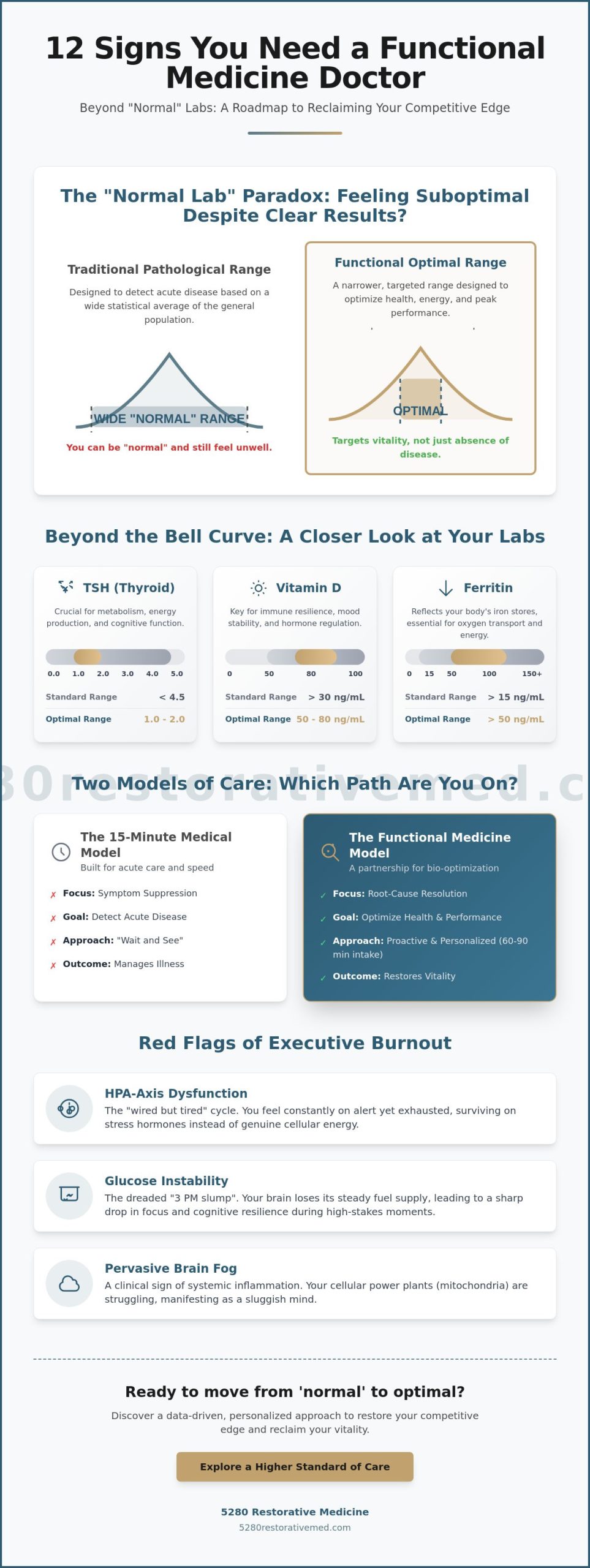
Most standard labs are based on a statistical bell curve of the general population. Since over half of American adults manage chronic conditions, that “normal” average is actually skewed toward a state of sub-health. Pathological ranges identify disease, like full-blown hypothyroidism. Functional ranges, however, target health optimization. A functional approach looks for trends within your data rather than waiting for an isolated outlier to trigger a prescription. Consider these common discrepancies:
- TSH (Thyroid): Standard ranges allow for levels up to 4.5, while functional targets usually sit between 1.0 and 2.0 for peak energy.
- Vitamin D: A “normal” 30 ng/mL might prevent bone loss, but optimal levels for immune resilience often require 50 to 80 ng/mL.
- Ferritin: Lab lows might start at 15 ng/mL, but many people experience hair thinning and fatigue unless they are above 50 ng/mL.
The Limitations of the 15-Minute Medical Model
The traditional healthcare system is built for speed and acute care. In a 15-minute primary care visit, there’s rarely time to map the systemic connections between your gut, your hormones, and your brain. This is where functional medicine differs significantly. It replaces symptom-suppression with deep-dive root-cause analysis. Recognizing these systemic failures is often one of the first signs you need a functional medicine doctor to step in as your high-end health partner.
Transitioning to a model of functional health and wellness involves an extensive intake process, often lasting 60 to 90 minutes. This allows your provider to see how your lifestyle, genetics, and environment intersect. Instead of a “wait and see” approach, the focus shifts to bio-optimization. The goal isn’t just the absence of illness; it’s the restoration of your competitive edge through a proactive, personalized strategy.
Signs of Executive Burnout: When High-Performance Becomes Unsustainable
High-performers often mistake endurance for health. You push through the day with caffeine and finish the night with a sleep aid, ignoring the signals your body is sending. This “wired but tired” state is a hallmark of HPA-axis dysfunction. It’s one of the primary signs you need a functional medicine doctor. When your adrenals are no longer communicating effectively with your brain, your body stays in a state of high alert even when you’re exhausted. You’re surviving on stress hormones rather than genuine cellular energy.
The “3 PM Slump” isn’t just a lull in the workday. It’s a physiological signal of glucose instability. When your insulin sensitivity drops, your brain loses its steady fuel supply, leading to a loss of cognitive resilience. You might find yourself struggling to maintain focus during high-stakes meetings or losing your mental map mid-sentence. Chronic stress acts as a mask, hiding underlying nutrient deficiencies by keeping you in a constant state of fight or flight. This functional medicine model prioritizes identifying these hidden gaps before they lead to total burnout.
The Neurochemistry of Brain Fog
Brain fog isn’t a lack of willpower. It’s a clinical sign of systemic inflammation or gut-brain axis disruption. Your mitochondria, the power plants of your cells, are likely struggling to produce ATP efficiently. This cellular fatigue manifests as a sluggish mind and delayed processing. Bio-optimizations like red light therapy can help target these energy gaps by supporting mitochondrial function and reducing oxidative stress. By addressing the root cause of neuro-inflammation, you can restore the sharp executive function you once took for granted.
Metabolic Stalling and “Stress Belly”
Have you noticed weight gain despite no changes in your routine? This “stress belly” is often the result of visceral fat accumulation driven by elevated cortisol and insulin resistance. Working harder in the gym can actually backfire if your hormones are already redlining. Recognizing this metabolic stalling is one of the key signs you need a functional medicine doctor to help you pivot. If your performance is stalling, it’s time to reclaim your physical edge by investigating your unique biological markers.
Systemic Red Flags: Signs Your Body Systems Are Out of Sync
Your body operates as an intricate web where a single imbalance triggers a cascade of seemingly unrelated issues. While conventional specialists often focus on one organ at a time, Functional medicine doctors look for the “Web of Dysfunction” connecting your systems. For example, chronic joint pain or sudden skin flare-ups are frequently misunderstood as isolated problems. In reality, these are often signs you need a functional medicine doctor to investigate food sensitivities that manifest far beyond the digestive tract. When your immune system stays in a constant state of hyper-vigilance, it affects everything from your mood to your metabolic rate.
This systemic approach is essential when dealing with the hormonal cascade. A drop in libido or sudden mood swings are rarely just about one hormone. They’re the result of a delicate interplay between your adrenals, thyroid, and sex hormones. Utilizing targeted interventions like bhrt can be a vital part of restoring this balance. However, this is only effective after the underlying systemic triggers are identified and addressed through comprehensive analysis.
The Gut-Immune Connection
Chronic congestion or seasonal allergies that never seem to clear are often overlooked signs you need a functional medicine doctor. These symptoms can point to “Leaky Gut,” where undigested food particles enter the bloodstream and trigger systemic inflammation. In more complex cases, this might involve mast cell activation syndrome. This condition acts as a hidden barrier to peak performance. It keeps your body in a state of high-alert sensitivity to environmental and dietary triggers that most standard tests ignore.
Hormonal Imbalance Beyond the Basics
Traditional TSH tests are notorious for missing subclinical thyroid issues that leave you feeling sluggish and cold. Similarly, imbalances like estrogen dominance or low testosterone can quietly erode your executive drive and recovery capacity. Aging gracefully doesn’t mean accepting a slow decline in vitality. It’s about maintaining the physiological environment required for high-level function. By looking at the full hormonal picture, you can identify why your body is out of sync and implement a roadmap to return to your superior state of health.
A Checklist for Transitioning to Functional Care
Moving toward a superior state of health requires an honest assessment of your current trajectory. If you’ve been settling for the absence of disease, you’re missing the opportunity for true physiological renewal. One of the most significant signs you need a functional medicine doctor is the realization that your standard care plan is focused on maintenance rather than improvement. Transitioning to a functional model is a proactive step toward reclaiming the vitality required for a high-stakes lifestyle.
- Step 1: Audit your current “Normal.” Review your daily energy, sleep quality, and mental clarity. If you’re consistently feeling suboptimal but your labs remain “within range,” you’re likely settling for a baseline that is far below your potential.
- Step 2: Review your medication list. Are you taking prescriptions to suppress symptoms like acid reflux, high blood pressure, or anxiety? Ask yourself if these treatments are addressing why the issue exists or if they’re simply masking the underlying dysfunction.
- Step 3: Evaluate your recovery. High-performers often rely on external stimulants to function. If you don’t wake up feeling naturally restored and instead feel “caffeinated” just to reach baseline, your body’s restorative processes are compromised.
- Step 4: Assess your health trajectory. Project your current state five years into the future. If your metabolic health isn’t actively improving, you’re managing a slow decline rather than engineering resilience.
When Traditional Medicine is the Wrong Tool
Traditional medicine is an incredible tool for acute care. If you’re facing a broken bone or a severe infection, the conventional model is exactly what you need. However, it often lacks the framework for chronic optimization. There is a specific gap in care where traditional doctors run out of options because they’re trained to wait for a diagnosis before intervening. Our executive health programs are designed to fill this void by focusing on metabolic health and biological age before disease takes hold.
Questions to Ask Your Current Provider
Finding the right partner is critical for your success. Use these questions as a litmus test for your current provider: “Are you willing to look at functional lab ranges for health optimization?” and “Do you incorporate advanced metabolic or genetic testing into your protocols?” If your provider dismisses these concerns or lacks the time to investigate root causes, these are clear signs you need a functional medicine doctor who views health as a collaborative, data-driven journey. You deserve a partner who is as invested in your peak performance as you are. You can schedule a functional medicine consultation to begin building a bespoke roadmap for your future health today.
Beyond Symptoms: The 5280 Restorative Medicine Approach
Once you recognize the signs you need a functional medicine doctor, the focus shifts from identifying problems to executing a precision-based solution. At 5280 Restorative Medicine, we specialize in “Engineering Metabolic Resilience.” This framework is designed specifically for high-performers who require their biology to keep pace with their professional and personal ambitions. We move beyond general wellness advice by building a bespoke health architecture based on your unique physiological data. This ensures your return to peak performance is both measurable and sustainable.
Data-Driven Health Optimization
Guesswork has no place in high-end clinical care. We utilize advanced metabolic testing and genetic analysis to uncover the specific biological bottlenecks stalling your progress. By analyzing your genetic markers, we can identify how your body processes nutrients, manages stress, and recovers from exertion. This data allows us to create personalized functional medicine denver style protocols that are available to our clients nationally. Our multi-month health optimization programs include continuous clinical monitoring. This allows for real-time adjustments to your supplement protocols and hormone optimization as your body begins to reset and renew.
Reclaiming Your Vitality
The psychological benefit of finally having a clear, scientific explanation for your symptoms is profound. You’re no longer fighting an invisible enemy; you’re following a strategic roadmap. During the first 90 days of a restorative medicine program, most clients experience a significant shift in cognitive clarity and physical endurance. We transition you from a state of survival back to a superior state of function. This boutique clinical experience is deeply invested in your individual success. It provides the depth of information and personalized care that the impersonal 15 minute medical model simply cannot offer.
It’s time to stop searching for signs you need a functional medicine doctor and start executing a plan for your long-term vitality. Reclaiming your edge starts with a single, decisive step toward understanding your biology. Schedule a functional medicine consultation today to review your health architecture and begin your journey toward metabolic resilience. Your peak physical and mental states are achievable at any stage of life when you have the right health partner by your side.
Reclaiming Your Physiological Edge
You don’t have to settle for a life defined by “normal” lab results that leave you feeling suboptimal. Recognizing the subtle signs you need a functional medicine doctor is the first step toward moving from a state of survival to one of peak performance. By looking at functional lab ranges and identifying the “Web of Dysfunction” connecting your gut health, hormones, and cognitive resilience, you can finally move beyond symptom management and toward true metabolic resilience.
At 5280 Restorative Medicine, we provide a boutique clinical experience that reaches clients nationally. Led by Dr. Marci Catallo-Madruga, our practice specializes in high-performer metabolic optimization. We utilize comprehensive protocols based on advanced genetic and metabolic data to ensure your health architecture is engineered for sustainable energy and long-term vitality. Our approach is designed to treat the individual, not just the diagnosis.
It’s time to stop guessing about your health and start executing a plan backed by clinical science. Reclaim your edge and schedule your comprehensive health consultation today. You have the power to redefine your health trajectory and achieve a superior state of function at any stage of life.
Frequently Asked Questions
How is a functional medicine doctor different from my primary care physician?
A functional medicine doctor focuses on identifying the root cause of systemic imbalances rather than just managing symptoms or diagnosing disease. While your primary care physician is essential for acute care and urgent needs, functional practitioners specialize in health optimization and long-term vitality. They use longer consultation times to map your entire health history and lifestyle. This deeper investigation is one of the key signs you need a functional medicine doctor to reclaim your biological edge.
Does functional medicine treat specific conditions like Hashimoto’s or IBS?
Yes, functional medicine is highly effective for managing complex chronic conditions like Hashimoto’s or IBS by addressing their underlying triggers. Instead of only prescribing medication to suppress symptoms, we utilize gut health assessments and nutritional counseling to identify inflammatory drivers. Our goal is to restore systemic balance and improve your physical function. This allows you to move beyond a baseline of just surviving with a chronic diagnosis.
Why does functional medicine focus so much on gut health even if I have no digestive issues?
The gut microbiome is the foundation of your immune system and hormone production, regardless of whether you experience digestive discomfort. Systemic inflammation, brain fog, and skin issues often originate in the gut. By performing a comprehensive gut health assessment, we can identify imbalances that affect your entire physiology. This proactive approach ensures that your body’s “second brain” is supporting your executive performance rather than hindering it.
Can a functional medicine doctor work alongside my current specialist?
Functional medicine is designed to be a collaborative partner to your existing medical team. We often work alongside endocrinologists, cardiologists, or other specialists to provide a more holistic view of your health architecture. While your specialist manages specific organ systems, we focus on the metabolic and genetic foundations that support your overall recovery. This integrated approach ensures you receive the most comprehensive care possible for your unique biology.
What kind of testing does a functional medicine doctor use that my regular doctor doesn’t?
Functional medicine utilizes advanced metabolic testing and genetic analysis that goes far beyond standard annual blood work. We look at functional lab ranges to identify early signs of physiological stalling before they become pathological. These tests might include comprehensive hormone panels, micronutrient status, and detailed microbiome mapping. This data-driven approach eliminates the guesswork and allows us to create highly personalized supplement protocols and lifestyle interventions for our clients.
Is functional medicine covered by standard health insurance?
Most standard insurance plans do not fully cover functional medicine services because they fall outside the traditional acute care billing model. While some basic labs might be covered, advanced testing and extended consultations are typically paid for out of pocket. Many of our clients successfully use Health Savings Accounts (HSAs) or Flexible Spending Accounts (FSAs) to manage these costs. It is a strategic investment in your long-term health resilience and performance.
How long does it typically take to see results with a functional approach?
Most clients begin to notice measurable shifts in energy and mental clarity within the first 90 days of a restorative program. However, achieving long-term metabolic resilience typically requires a six to twelve month commitment to your bespoke protocol. Since we are addressing the root cause rather than masking symptoms, the timeline depends on the complexity of your systemic imbalances. Recognizing the signs you need a functional medicine doctor early can often lead to faster recovery times.
Is functional medicine just about taking a lot of supplements?
Supplement protocols are only one component of a comprehensive functional plan. Our approach integrates hormone optimization, nutritional counseling, and metabolic testing to create a holistic strategy for your well-being. We focus on lifestyle improvements and biological enhancements that support your body’s natural ability to perform. Supplements are used strategically to fill specific nutrient gaps identified through your data, not as a replacement for foundational health habits.