
What if the “normal” blood work sitting on your desk is actually the ceiling preventing your next professional breakthrough? You’ve likely navigated the maze of elimination diets and generic wellness advice, yet the persistent brain fog and social anxiety from digestive discomfort haven’t budged. It’s exhausting to maintain an executive pace when your internal systems feel sluggish and unpredictable. We understand that for a high-performer, “fine” is never the goal; you require a body that matches your mental ambition.
In this guide, we’ll move past the noise of the $21.7 billion gut health supplement market to show you exactly how to restore gut health through a rigorous, clinical lens. This isn’t a temporary “reset” but a data-driven engineering project for your biology. You’ll discover how to leverage advanced metabolic testing and genetic analysis to eliminate fatigue and sharpen your decision-making. We’re moving beyond standard care to provide a bespoke roadmap that aligns your microbiome with your highest performance goals, ensuring your health becomes your greatest competitive advantage.
Key Takeaways
- Shift your perspective from treating digestive symptoms to optimizing your gut as “mission control” for metabolic energy and mental focus.
- Discover why generic probiotics often fail and how metabolic testing identifies the specific root causes of dysbiosis and systemic fatigue.
- Follow a data-driven clinical protocol on how to restore gut health by removing specific inflammatory triggers before attempting to rebuild your microbiome.
- Establish a personalized roadmap for long-term resilience, moving away from temporary “resets” toward a sustainable state of peak physiological function.
Understanding Gut Health as a Performance Asset
For the high-performer, gut restoration isn’t a wellness trend; it’s a clinical imperative. We define gut restoration as the systematic process of re-establishing a diverse microbial ecosystem and repairing the integrity of the intestinal barrier. When you’re managing high-stakes decisions, you can’t afford a “mission control” that’s offline. Your gut dictates your metabolic energy levels, acting as the primary engine for how your body converts fuel into focus. If you’re wondering how to restore gut health, you must first view your digestive system as a performance asset rather than a liability to be managed.
The connection between intestinal permeability, often called leaky gut, and cognitive brain fog is direct. When the intestinal lining is compromised, undigested food particles and endotoxins can enter the bloodstream, triggering a systemic immune response. This inflammation doesn’t stay in the gut. It crosses the blood-brain barrier, slowing your processing speed and clouding your clarity. Our goal is to move you beyond the mere absence of illness and toward a state of physiological optimization where your body fully supports your mental output.
The Microbiome-Brain-Performance Axis
Your gut is responsible for producing up to 95% of your serotonin and a significant portion of GABA, the neurotransmitters that govern mood stability and executive decision-making. These chemicals travel via the vagus nerve, a literal information superhighway connecting your gut to your brain. This pathway is why stress can immediately disrupt digestion and why a disrupted gut can make you feel “on edge” in the boardroom. Understanding the Gut Microbiome is essential because it functions as a dynamic organ that dictates your systemic inflammation levels. By optimizing this axis, you’re not just fixing a stomach ache; you’re upgrading your mental hardware.
Symptoms of Gut Dysfunction in the High-Pressure Workplace
In a high-pressure environment, gut dysfunction often wears a mask. You might experience a sharp midday energy crash or find that your resilience to stress has vanished. These are “silent” symptoms of chronic dysbiosis. Traditional medical models often overlook these signs because “normal” blood work rarely includes the specific markers needed to identify gut-driven systemic inflammation, which is why we utilize advanced metabolic testing to establish a true baseline. When you learn how to restore gut health, you address the root cause of why your hormones might feel imbalanced or why you’re fatigued despite a clean diet. Dysbiosis prevents you from absorbing the very nutrients your brain needs to thrive, creating a cycle of depletion that no amount of caffeine can solve.
The Science of Restoration: Identifying Root Causes
Stop guessing with your biology. Many high-performers treat their gut like a science experiment, cycling through expensive probiotics without a clear objective. This trial and error approach often does more harm than good, as it can inadvertently feed the very opportunistic bacteria you’re trying to eliminate. When you’re investigating how to restore gut health, clinical precision is the only way to achieve lasting results. Whether it’s dysbiosis, which is an imbalance between beneficial and opportunistic microorganisms, or hidden food sensitivities, the data must lead the way. While you can find general evidence-based strategies for gut health online, executive optimization requires a deeper dive into your unique physiological profile.
Metabolic dysfunction and gut health are inextricably linked. If your microbiome is compromised, your body’s ability to regulate blood sugar and manage energy production suffers. We use advanced bloodwork to uncover sensitivities that standard panels miss, ensuring your nutrition plan supports rather than sabotages your performance. Identifying these root causes is the difference between a temporary fix and a permanent upgrade to your metabolic engine.
Advanced Diagnostic Testing: GI-MAP and Beyond
Standard stool tests are designed to find pathogens and acute disease. In contrast, we use DNA-based microbial analysis to map the entire ecosystem of your gut. We combine this with metabolic testing to see how your body processes nutrients at a cellular level. By integrating genetic analysis, we can even predict how you’ll respond to specific dietary protocols. This level of detail is essential when determining how to restore gut health for individuals with high metabolic demands. It allows us to move beyond generic advice and create a protocol tailored to your specific genetic and microbial makeup.
Common Disruptors of the Executive Microbiome
The executive lifestyle presents unique biological challenges. Frequent travel across time zones disrupts your circadian gut rhythms, while chronic “executive stress” keeps cortisol levels high. High cortisol physically degrades the protective gut lining, leading to increased permeability. We also account for environmental toxins and the unintended consequences of over-sanitization in modern professional environments. If you’re struggling to maintain your edge, reviewing your data through a Functional Medicine Consultation can reveal the hidden disruptors holding you back from peak performance.
Beyond Probiotics: Why Surface-Level Fixes Fail
The allure of a 7-day gut reset is powerful, especially when you’re desperate for relief from persistent brain fog. However, these quick fixes are almost always a biological illusion. Most rapid “resets” result in temporary water weight loss and a brief reduction in bloating, but they fail to address the underlying microbial architecture. True physiological change takes months of targeted intervention. If you want to know how to restore gut health, you must look past the marketing of “detoxes” and focus on long-term ecological restoration.
Taking a probiotic without first conditioning the gut environment is like planting high-end seeds in a desert. If the “soil”—your intestinal lining and existing microbial balance—is hostile, those expensive cultures simply won’t thrive. While incorporating specific foods that improve digestion is a necessary step, it’s only one piece of a complex puzzle. Generic colon cleanses can actually set you back by aggressively stripping away the very beneficial bacteria you need to maintain metabolic stability and cognitive clarity.
The Probiotic Paradox
Blindly supplementing with probiotics can often backfire. For individuals with Small Intestinal Bacterial Overgrowth (SIBO), adding more bacteria, even “good” strains, can exacerbate symptoms like extreme bloating and mental fatigue. We prioritize the environment first. You need prebiotics to fuel beneficial microbes and postbiotics, such as butyrate, to support the structural integrity of the gut barrier. Probiotic diversity is more important than sheer CFU counts; a balanced ecosystem is far more resilient than one dominated by a single high-dose strain.
Standard Care vs. Restorative Medicine
Traditional gastroenterology is essential for diagnosing acute diseases like Crohn’s or colitis. However, many high-performers fall into a clinical gap where they feel unwell despite “normal” test results. This is where functional medicine provides a critical advantage. Instead of stopping at the absence of disease, we use root-cause analysis to engineer peak health. Our bespoke care protocols prevent the revolving door of digestive symptoms by identifying why the system failed in the first place, ensuring your results are as sustainable as they are measurable. We don’t just want you to be “not sick”; we want you to reach a state of superior physical function.
A Data-Driven Protocol to Restore Gut Health
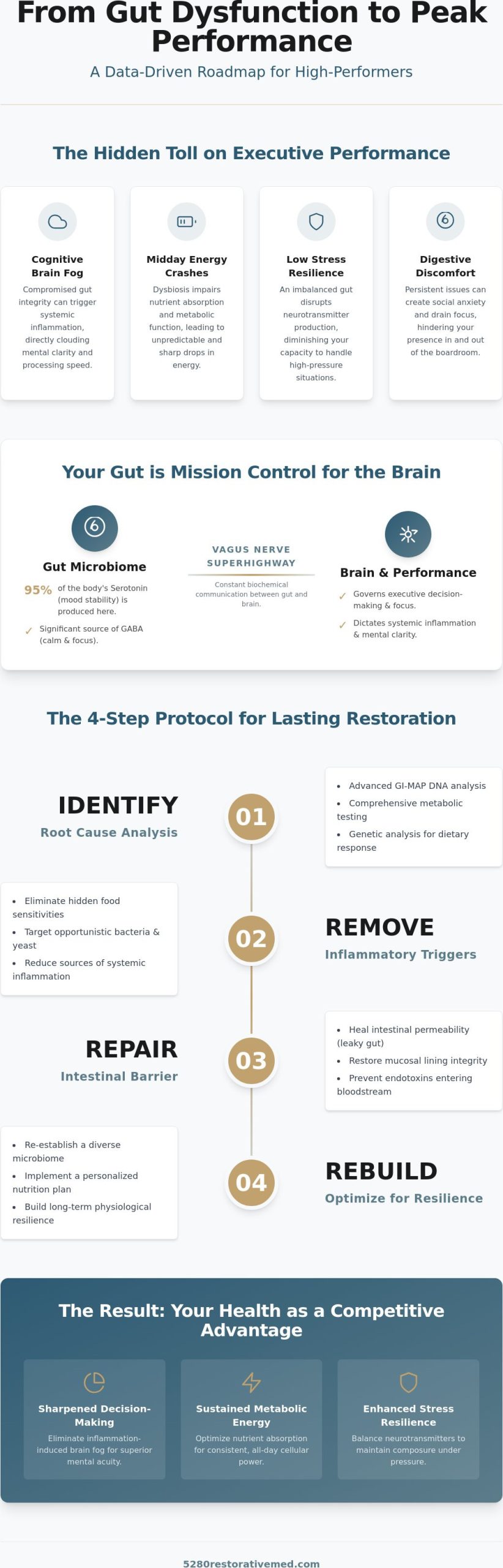
Restoring your physiological baseline requires a systematic, four-step clinical framework. We don’t rely on broad dietary generalizations because high-performers need specific interventions that account for their unique metabolic demands. To understand how to restore gut health effectively, we move through a sequence designed to clear interference before rebuilding the system. This ensures that every intervention is layered upon a stable biological foundation.
- Step 1: Clinical Assessment. We begin by utilizing metabolic testing to establish a precise baseline. This identifies specific markers of inflammation and nutrient deficiencies that generic panels miss.
- Step 2: Remove. We systematically eliminate pathogens, overgrowths, and inflammatory triggers identified through your diagnostics. This phase is about reducing the total toxic load on your system.
- Step 3: Replace & Reinnoculate. We introduce targeted supplement protocols and precision probiotics. These are selected based on your DNA-based microbial analysis rather than off-the-shelf popularity.
- Step 4: Repair. We nourish the gut lining using clinical-grade amino acids like L-glutamine and specific phytonutrients. This repairs the intestinal barrier to prevent future permeability issues.
Precision Nutrition for the Microbiome
Healthy eating isn’t enough when your microbiome is in a state of dysbiosis. We move beyond general advice to a protocol rooted in your unique genetic analysis. We prioritize high-potency polyphenols and fermented foods that specifically support the microbial diversity your body lacks. Meal timing is equally critical. By supporting the Migrating Motor Complex (MMC)—the “housekeeping” wave of the digestive tract—through strategic fasting windows between meals, we ensure your system clears debris and prevents bacterial stagnation.
The Executive Stress-Gut Loop
You can’t digest properly while in a state of sympathetic nervous system dominance. We implement clinical strategies to shift your body into a “rest and digest” state before you consume nutrients. We often incorporate red light therapy as a tool for systemic inflammation reduction, which supports mitochondrial health and gut mucosal repair. Sleep quality remains a non-negotiable pillar; without deep, restorative sleep, the gut lining cannot undergo the daily cellular regeneration required for peak performance. If you’re ready to stop the cycle of fatigue, a specialized Gut Health Assessment can provide the clarity you need to reclaim your edge.
Engineering Long-Term Gut Resilience
Achieving a superior state of physical function isn’t a one-time event; it’s a continuous process of calibration. Once you’ve successfully navigated the initial clinical phases of how to restore gut health, your focus must shift from active restoration to the engineering of long-term resilience. For a high-performer, this means maintaining a microbiome that can withstand the rigors of frequent travel, high-stakes negotiation, and the physiological demands of aging. We view this phase as the transition from “repairing the engine” to “tuning for peak performance.”
Regular health monitoring is essential because your metabolic demands are never static. As your professional responsibilities or athletic goals evolve, your gut environment must be adjusted to support those new energy requirements. It’s also vital to recognize that your gut serves as the biological foundation for hormone optimization. Without a healthy microbiome to process and recycle hormones, even the most precise optimization protocols will underperform. 5280 Restorative Medicine acts as your long-term partner in this journey, ensuring your internal systems remain as ambitious as your professional goals.
The Future of Personalized Restorative Medicine
In 2026, the landscape of executive health is moving toward real-time biological feedback. Emerging research into microbial metabolites is allowing us to understand how to restore gut health with more precision than ever before. We now utilize tools like continuous glucose monitoring (CGM) to assess gut-metabolic health, observing how your unique microbiome influences your glycemic response to specific foods. This data-driven approach is why having a bespoke health partner is essential. We help you navigate advanced clinical innovations, filtering out the noise of a $70.96 billion digestive health market to focus on what actually moves the needle for your biology.
Actionable Next Steps for High-Performers
The transition from self-diagnosis to professional clinical oversight is the most significant step you can take for your longevity. When you commit to a comprehensive gut health assessment, you’re choosing a path of clarity over confusion. You can expect a deep dive into your unique microbial landscape, followed by a multi-month protocol designed for sustainable biological transformation. This isn’t a temporary fix; it’s a commitment to a superior state of health. By partnering with experts who understand the intersection of clinical science and high-performance living, you ensure that your body remains an asset that fuels your success rather than a liability that limits it.
Reclaim Your Biological Competitive Advantage
True high performance is impossible without a resilient gut. We’ve moved beyond the myth of the quick fix to establish a clinical protocol rooted in precision and metabolic data. By shifting your focus from surface-level symptoms to root-cause restoration, you’re not just resolving discomfort; you’re upgrading your body’s entire operating system. Understanding how to restore gut health is the essential first step toward reclaiming the mental clarity and sustainable energy your professional life demands.
You don’t have to navigate this complex biological journey alone. Our boutique clinical approach provides the specialized guidance needed to exceed your health baseline and reach a superior state of function. Through an Advanced Metabolic Testing Review and Personalized Genetic Analysis, we create a bespoke roadmap tailored specifically to your unique physiology. Under the clinical oversight of Dr. Marci Catallo-Madruga, you’ll gain the tools to transform your health into your greatest competitive asset.
Apply for a Comprehensive Executive Health Program at 5280 Restorative Medicine today. It’s time to stop settling for “normal” and start achieving the peak physical and mental state you deserve.
Frequently Asked Questions
How long does it take to restore gut health professionally?
Professional restoration typically requires three to six months of targeted intervention. While you might feel better within weeks, meaningful shifts in microbial diversity and the full repair of the intestinal lining take time. We monitor your progress through follow-up testing to ensure your biology is actually moving toward a superior state of function. It’s about sustainable transformation rather than a temporary fix.
Can high stress levels permanently damage my gut microbiome?
Chronic stress can cause significant damage to the gut lining, but it isn’t usually permanent. High cortisol levels physically degrade the mucosal barrier, yet the body possesses an incredible capacity for renewal. By implementing a clinical protocol on how to restore gut health, we can reverse the effects of sympathetic dominance and rebuild a resilient ecosystem. Restoration is a proactive journey toward reclaiming your baseline.
Are over-the-counter probiotics enough for gut restoration?
Over-the-counter probiotics are rarely enough for true clinical restoration. Most retail supplements don’t have the strain specificity or the colony-forming units necessary to displace opportunistic pathogens. We use bespoke supplement protocols based on your specific DNA-based microbial analysis. This ensures you aren’t just adding more bacteria to a system that isn’t ready to receive them. Our approach focus on precision rather than volume.
What is the difference between a leaky gut and IBS?
Leaky gut refers to a structural compromise of the intestinal barrier, while IBS is a functional diagnosis based on symptoms. You can have both simultaneously. Leaky gut allows undigested particles to enter the bloodstream, triggering systemic inflammation and brain fog. IBS describes the resulting digestive distress like cramping and bloating. Identifying the structural root cause is the only way to move beyond managing symptoms toward a permanent solution.
Can I restore my gut health while still maintaining a busy executive schedule?
Absolutely. We specialize in creating protocols that fit into a demanding executive lifestyle. You don’t need to take a sabbatical to fix your biology; you need a strategy that accounts for travel and high-stakes stress. Our team provides the clinical oversight and streamlined roadmap necessary to achieve results without compromising your professional output. Efficiency is a core pillar of our restorative approach to high-performance health.
What role does genetic testing play in improving my digestion?
Genetic analysis provides the blueprint for your unique digestive capacity. It identifies how your body processes specific fats, proteins, and carbohydrates, highlighting predispositions to inflammation. By understanding your genetic makeup, we can tailor your nutritional counseling to avoid triggers that are unique to you. This precision is what distinguishes a boutique clinical practice from generic wellness advice. It’s the difference between a guess and a roadmap.
Why do I feel bloated even when I eat healthy foods?
Bloating from healthy foods often indicates an underlying imbalance like SIBO or a specific food sensitivity. Even “clean” fibers can cause distress if they ferment in the wrong part of the digestive tract. When you’re learning how to restore gut health, you’ll find that testing reveals exactly which “healthy” foods are currently sabotaging your progress. Precision diagnostics replace the frustration of trial and error with actionable data.
Is a ‘gut reset’ the same as a clinical restoration protocol?
A “gut reset” is typically a short-term dietary change aimed at quick relief, while a clinical protocol is a comprehensive engineering project. We use metabolic testing and genetic analysis to create a long-term strategy for physiological optimization. Resets often provide temporary results because they don’t address the underlying architecture. A clinical protocol addresses the root causes of dysfunction to ensure your energy and focus remain at peak levels.