
What if the “healthy” spinach salad or aged balsamic glaze you enjoyed for lunch is the secret reason your afternoon board meeting feels like a mental marathon? It’s incredibly isolating to feel your cognitive edge slipping away while your standard lab results insist everything is normal. You know your body isn’t performing at its peak, and the sudden flushing or unpredictable brain fog suggests you need a specialized histamine intolerance diet to reset your system. These symptoms are often signals of a metabolic bottleneck rather than a permanent decline.
We understand that for a high-performer, health is the ultimate leverage. This article provides a comprehensive functional medicine roadmap to help you use a precision low-histamine protocol to recalibrate your immune system and reclaim the cognitive edge lost to systemic inflammation. We’ll examine the role of the DAO enzyme, identify internal triggers beyond just food, and provide a clear framework that transitions you from restrictive eating back to metabolic resilience and peak performance. You’ll learn how to stop reacting to your environment and start reclaiming the clarity you need to lead effectively.
Key Takeaways
- Understand why histamine intolerance is a “threshold” issue rather than a standard allergy, allowing you to manage your total systemic load more effectively.
- Explore the “Executive Stress Loop” and how high cortisol levels can lower your threshold for reactivity during high-pressure periods.
- Learn how to implement a precision histamine intolerance diet as a strategic reset to clear systemic inflammation and restore mental clarity.
- Uncover the internal triggers, such as gut dysbiosis and SIBO, that may be filling your biological bucket from the inside out.
- Shift your focus from lifelong dietary restriction to building metabolic resilience and optimizing mitochondrial function for sustained peak performance.
Understanding Histamine Intolerance (HIT) vs. Traditional Allergies
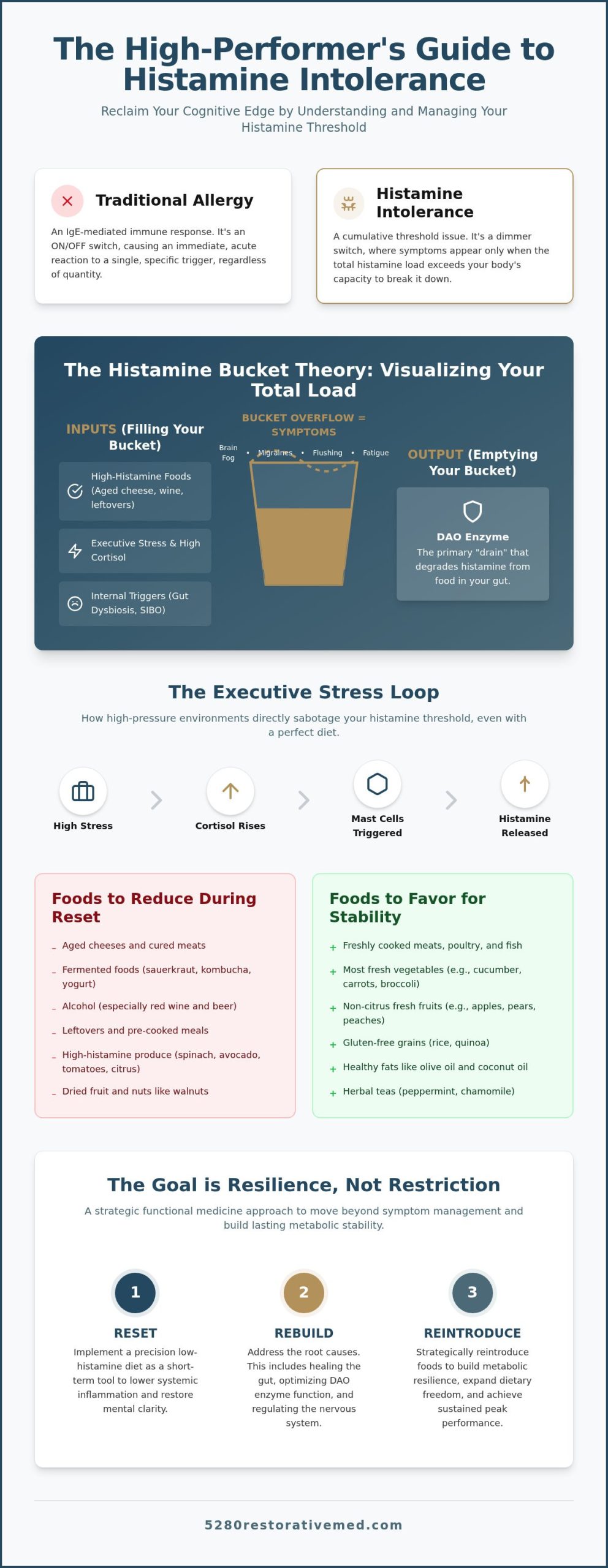
Histamine is often misunderstood as a biological nuisance. In reality, it’s a vital neurotransmitter and immune signaling molecule that manages everything from your sleep-wake cycle to stomach acid production. When you’re Understanding Histamine Intolerance, it’s helpful to view it as a metabolic mismatch between histamine intake and the capacity for degradation. Unlike a traditional IgE-mediated allergy where a single exposure triggers an immediate, acute reaction, HIT is a cumulative threshold issue.
We often use the “Bucket Theory” to explain this to our clients. Your body has a specific capacity to process histamine. You might feel fine after a glass of wine; however, if you pair that wine with aged cheese and a stressful day, your bucket overflows. This is where a strategic histamine intolerance diet becomes essential. It isn’t about avoiding these foods forever. It’s about lowering the total load so your body can keep up and maintain its cognitive edge.
The primary clearinghouse for this process is the diamine oxidase (DAO) enzyme. Located mainly in the gut lining, DAO acts as a biological filter. It neutralizes histamine from your food before it reaches your systemic circulation. If your DAO levels are depleted due to genetics, medications, or gut inflammation, your bucket fills up much faster than it should. This metabolic gap is the core of the condition.
The Chameleon Effect: Why Symptoms Are So Diverse
Histamine symptoms are notoriously difficult to pin down because histamine receptors, known as H1 through H4, are found throughout your entire body. They’re located in your brain, gut, skin, and heart. For high-performers, this often manifests as performance killers like sudden migraines, post-prandial fatigue that creates an afternoon slump, or unexplained tachycardia. This systemic nature is why HIT often overlaps with mast cell activation syndrome. These conditions act as a hidden barrier, preventing you from reaching your baseline of health and clarity.
The Difference Between HIT and Mast Cell Activation
While the symptoms often look identical, the underlying mechanisms differ. Histamine intolerance is primarily a degradation problem. Your body lacks the janitorial enzymes like DAO to clean up the mess. Mast Cell Activation Syndrome (MCAS) is a production problem. In MCAS, your immune cells are overactive, releasing a flood of histamine even without a dietary trigger. A functional medicine approach must distinguish between the two. We focus on whether we need to fix the disposal system, calm the overactive cells, or both to ensure your systemic stability. Using a histamine intolerance diet is a powerful first step in either scenario to reduce the immediate inflammatory pressure on your system.
The Performance Cost: Why High-Stress Lifestyles Trigger Histamine Flares
High-stress careers often come with a hidden biological tax that standard blood work fails to capture. While you might blame your packed schedule for feeling drained, the culprit is often a physiological feedback loop. When you’re under intense pressure, your body releases cortisol. This hormone directly triggers mast cell degranulation, causing these immune cells to dump a flood of histamine into your bloodstream. This is the “Executive Stress Loop.” If you’re already following a histamine intolerance diet, you might find that high-pressure environments “fill your bucket” even when your meals are technically compliant.
The Vagus nerve acts as the primary communication line for your parasympathetic nervous system, serving as the biological “brake” for your immune response. In high-performers, this nerve is often under-stimulated due to constant “fight or flight” mode. Without that vagal signal to calm down, your immune system remains hyper-vigilant and prone to over-releasing inflammatory markers. This is why functional medicine for high-performers prioritizes nervous system regulation alongside dietary changes. To move beyond basic symptom management, a Functional Medicine Consultation can help identify if your nervous system is the primary driver of your histamine load.
Neuro-Inflammation and the “Brain Fog” Connection
Histamine is a small molecule that easily crosses the blood-brain barrier. Once it enters the central nervous system, it acts as an excitatory neurotransmitter. While some histamine is necessary for alertness, an excess causes neuro-inflammation. This manifests as cognitive slowing, reduced verbal fluency, and poor decision-making. Pushing through this “brain fog” isn’t a sustainable strategy; it’s an inflammatory trigger that further depletes your metabolic reserves and compromises your executive function when you need it most.
Circadian Rhythms and Histamine Spikes
Histamine levels aren’t static throughout the day. They naturally fluctuate with your internal clock, typically peaking in the early morning hours. This explains why many executives experience sudden wakefulness around 3:00 AM accompanied by a racing heart or itchy skin. It’s not just “work stress” keeping you up; it’s a physiological histamine spike. Aligning your schedule with your biological curve is vital, and a scientific review of low-histamine diets suggests that timing your nutrient intake can help stabilize these nocturnal surges and improve executive sleep quality.
Beyond the Plate: Identifying the Root Causes of Your Histamine “Bucket”
While a histamine intolerance diet is a foundational tool, focusing solely on what you eat is like trying to empty a bathtub with a teaspoon while the faucet is still running. The “Bucket Theory” suggests that your total histamine load is cumulative. A single strawberry or a handful of spinach isn’t inherently toxic; it’s simply the “last drop” that causes your biological bucket to overflow into systemic inflammation. To achieve true dietary freedom, we must look at the internal factors filling that bucket from the bottom up.
Internal bio-stressors often create a constant histamine drip that keeps your immune system in a state of high alert. Conditions like “Leaky Gut” allow undigested proteins to enter the bloodstream, while environmental factors like mycotoxin exposure from mold can lead to chronic immune hyper-vigilance. This is why we use functional health and wellness as our diagnostic framework. By identifying these hidden stressors, we can stop the overflow at its source. According to a comprehensive scientific review on histamine intolerance, identifying these non-dietary triggers is as critical as the diet itself for long-term recovery and performance optimization.
Gut Dysbiosis and the Microbiome
Your gut microbiome is either a factory for histamine or a clearinghouse for it. Certain bacterial strains, such as Lactobacillus bulgaricus, are known histamine producers. Conversely, beneficial strains like Bifidobacterium infantis help degrade it. When Small Intestinal Bacterial Overgrowth (SIBO) is present, the sheer volume of bacteria in the small intestine can overwhelm your DAO enzyme capacity. Healing the gut lining is a non-negotiable step. Without resolving dysbiosis, any histamine intolerance diet will feel like a temporary patch rather than a permanent solution.
Hormonal Influence on Histamine Stability
For high-performing women, the Estrogen-Histamine loop is a frequent culprit for cyclical flares. Estrogen stimulates mast cells to release more histamine, while histamine simultaneously signals the ovaries to produce more estrogen. This bidirectional relationship often causes symptoms to peak during specific phases of the menstrual cycle when estrogen is dominant. Progesterone acts as a natural stabilizer for these mast cells, helping to quiet the immune response. In many cases, optimizing these levels through BHRT can provide the hormonal stability needed to resolve chronic histamine issues and restore cognitive clarity.
Implementing a Precision Histamine Intolerance Diet and Advanced Testing
Standard IgE allergy tests look for an acute immune response, but they’re insufficient for diagnosing HIT because the issue is metabolic, not allergic. You need a data-driven approach that moves beyond generic “yes/no” food lists found online. A precision histamine intolerance diet begins with a Phase 1 “Elimination” period typically lasting 2 to 4 weeks. This phase establishes a metabolic baseline by removing high-risk triggers like fermented foods, aged meats, alcohol, and histamine liberators such as citrus. Once systemic inflammation subsides and your cognitive clarity returns, we move to a “Precision Reintroduction.” This systematic process allows us to determine your specific threshold without triggering a full-scale flare that compromises your productivity.
We don’t guess; we test. Our Executive Health Program utilizes advanced diagnostics to uncover why your clearance is sluggish. This includes measuring DAO enzyme activity directly and conducting Genetic Analysis of the DAO and HNMT genes to see if you’re biologically predisposed to slow histamine processing. We also utilize Organic Acid Testing (OAT) to identify metabolic roadblocks, such as B6 or copper deficiencies, which are critical cofactors for the enzymes that break down histamine. Identifying these variables is the only way to build a protocol that is as unique as your DNA.
Advanced Diagnostic Laboratory Testing
Our clinical approach prioritizes efficiency. By analyzing your genetic predispositions, we can identify if your “bucket” is naturally smaller due to inherited enzyme variations. We also look for metabolic markers that suggest your body is struggling to process biogenic amines. This level of detail allows us to move past trial and error, providing you with a clear roadmap for recovery. We find that when high-performers understand the data behind their symptoms, they’re much more successful at maintaining the lifestyle shifts required for long-term health.
The Executive Low-Histamine Kitchen
For the busy professional, freshness is the absolute priority. Histamine levels increase on leftovers through bacterial activity, so typical meal-prep strategies can actually backfire. We recommend a “cook-to-eat” approach or immediate freezing to halt histamine production. Focus on “Performance Foods” like fresh-caught white fish, sprouted grains, and specific cruciferous vegetables that support detoxification. To protect your cognitive edge during travel or high-stakes dinners, we often design bespoke Supplement Protocols. These may include high-potency exogenous DAO enzymes and natural mast cell stabilizers like Quercetin and Luteolin to provide a biological buffer against environmental triggers.
Restriction to Resilience: Path to Systemic Stability
Long-term success isn’t found in a life of permanent restriction. While an initial histamine intolerance diet is vital for clearing the “inflammatory fog,” the ultimate goal is to grow the size of your biological bucket. True systemic stability comes from increasing your metabolic resilience so you can eventually enjoy a wider variety of foods without a crash. This recalibration requires a focus on mitochondrial optimization. When your cellular power plants are functioning efficiently, they provide the energy necessary for mast cells to remain stable and for enzymes to degrade histamine effectively. You aren’t just avoiding triggers; you’re building a more robust physiological engine.
Nervous system “re-wiring” is another pillar of this transition. By actively stimulating the Vagus nerve, you send a signal to your immune system that the environment is safe. This reduces mast cell sensitivity and prevents the hyper-reactive states common in high-stress lifestyles. Our Executive Health Program serves as the vehicle for this comprehensive biological reset. We move beyond simple avoidance, using data to guide the expansion of your dietary and lifestyle boundaries. This ensures that your histamine intolerance diet acts as a bridge to health rather than a permanent cage.
Bio-Hacking for Immune Resilience
We utilize advanced modalities like red light therapy to support mitochondrial health and lower systemic inflammation. This creates a more stable foundation for your immune system to operate from. Hormetic stressors, such as cold exposure and heat therapy, can also be powerful tools for resilience. However, these must be introduced carefully so they don’t overflow your current bucket capacity. Additionally, implementing “Clean Living” protocols, such as high-quality air and water filtration, reduces the environmental load on your system. This leaves more room in your bucket for the occasional culinary indulgence or high-pressure work event without the risk of a flare.
Sustainable Success: The 5280 Restorative Approach
The 5280 Restorative approach focuses on moving beyond the plate. We address the root metabolic and environmental causes that lead to histamine overload in the first place. For high-achieving professionals, a bespoke, data-driven protocol is the only way to ensure that your health supports your ambitions rather than hindering them. It’s time to move from the frustration of symptom management to a state of peak-performance health. By identifying your unique triggers and strengthening your biological defenses, you can return to a state where your body is a resilient asset, capable of exceeding your previous baseline of performance.
Reclaim Your Cognitive Edge and Metabolic Resilience
You’ve learned that managing histamine isn’t just about what’s on your plate; it’s about expanding your biological capacity. By addressing the “Executive Stress Loop” and resolving underlying gut dysbiosis, you can move from restrictive eating to a state of systemic stability. A precision histamine intolerance diet serves as the initial reset, but the ultimate goal is building a body that can handle the demands of a high-performance lifestyle without inflammatory crashes.
If you’re ready to stop guessing and start engineering your recovery, we’re here to help. Our evidence-based functional medicine approach, led by Dr. Marci Catallo-Madruga, focuses on personalized protocols that address your unique biological blueprint. We utilize advanced metabolic and genetic diagnostic analysis to identify the root causes of your symptoms. Apply for an Executive Health Consultation to identify your systemic triggers and return to your peak physical and mental state. You don’t have to settle for “normal” labs when you know you’re capable of more. Reclaiming your health is the first step toward exceeding your baseline performance and leading with clarity once again.
Frequently Asked Questions
Is histamine intolerance the same as a food allergy?
No, it’s not an allergy in the traditional sense. While a food allergy involves an immediate IgE-mediated immune response to a specific protein, histamine intolerance is a metabolic deficiency. It occurs when your body can’t break down the histamine you ingest or produce. This creates a cumulative threshold effect where symptoms only appear once your biological bucket overflows. It’s a matter of capacity rather than a binary allergic reaction.
Can I ever eat fermented foods again if I have HIT?
Yes, the ultimate goal of a functional approach is metabolic resilience rather than lifelong restriction. While fermented foods are temporarily removed during the initial phase of a histamine intolerance diet, they can often be reintroduced once the underlying gut dysbiosis is resolved. We focus on healing the intestinal lining and optimizing enzyme production so you can eventually enjoy high-histamine foods without triggering systemic inflammation or cognitive crashes.
How long does it take for the low-histamine diet to work?
Most high-performers notice a significant shift in cognitive clarity and physical comfort within two to four weeks of strict adherence. This initial reset period is necessary to lower your total systemic load and establish a baseline. While some individuals report improved focus and reduced flushing in as little as 48 hours, a full biological recalibration often takes longer as we address internal triggers like gut health and hormonal balance.
Why do my symptoms get worse when I am stressed or sleep-deprived?
Stress and sleep deprivation are powerful biological triggers that lower your histamine threshold. When you’re under intense pressure, cortisol signals your mast cells to release more histamine into your bloodstream. Similarly, poor sleep disrupts your circadian rhythms, which naturally regulate histamine levels. This combination fills your bucket from the inside out, making you much more reactive to even small amounts of histamine in your food during high-pressure work weeks.
What is the best supplement to help with histamine intolerance?
There isn’t a single best supplement, but high-potency DAO enzymes are the most effective for immediate mealtime support. These exogenous enzymes help break down histamine in the gut before it enters your system. We also frequently utilize natural mast cell stabilizers like Quercetin and Luteolin to prevent the over-release of histamine. Vitamin C and Vitamin B6 are also essential, as they act as necessary cofactors for your body’s natural histamine-degrading enzymes.
Can hormonal changes like perimenopause trigger histamine issues?
Yes, hormonal fluctuations are a frequent root cause for women in high-stakes careers. Estrogen has a bidirectional relationship with histamine; it stimulates mast cells to release more histamine and simultaneously downregulates the DAO enzyme. During perimenopause, periods of estrogen dominance can significantly lower your threshold for reactivity. Addressing these shifts through hormone optimization often provides the systemic stability needed to resolve chronic histamine flares and maintain peak mental performance.
Is histamine intolerance a lifelong condition?
For most people, it’s a temporary state of metabolic mismatch rather than a permanent diagnosis. It is often secondary to other issues like SIBO, leaky gut, or environmental mold exposure. Once these root causes are identified and corrected through a personalized protocol, your body’s ability to process histamine typically returns to normal. The goal is to move from a state of reactive avoidance back to a baseline of total dietary freedom.
What is the difference between histamine intolerance and MCAS?
The primary difference lies in the mechanism of the overflow. Histamine intolerance is a degradation problem where you lack the enzymes, like DAO, to clean up histamine. Mast Cell Activation Syndrome (MCAS) is a production problem where your immune cells are hyper-reactive and release a flood of histamine even without dietary triggers. While the symptoms often overlap, a functional approach distinguishes between the two to determine if we need to fix the disposal system or calm the cells.