
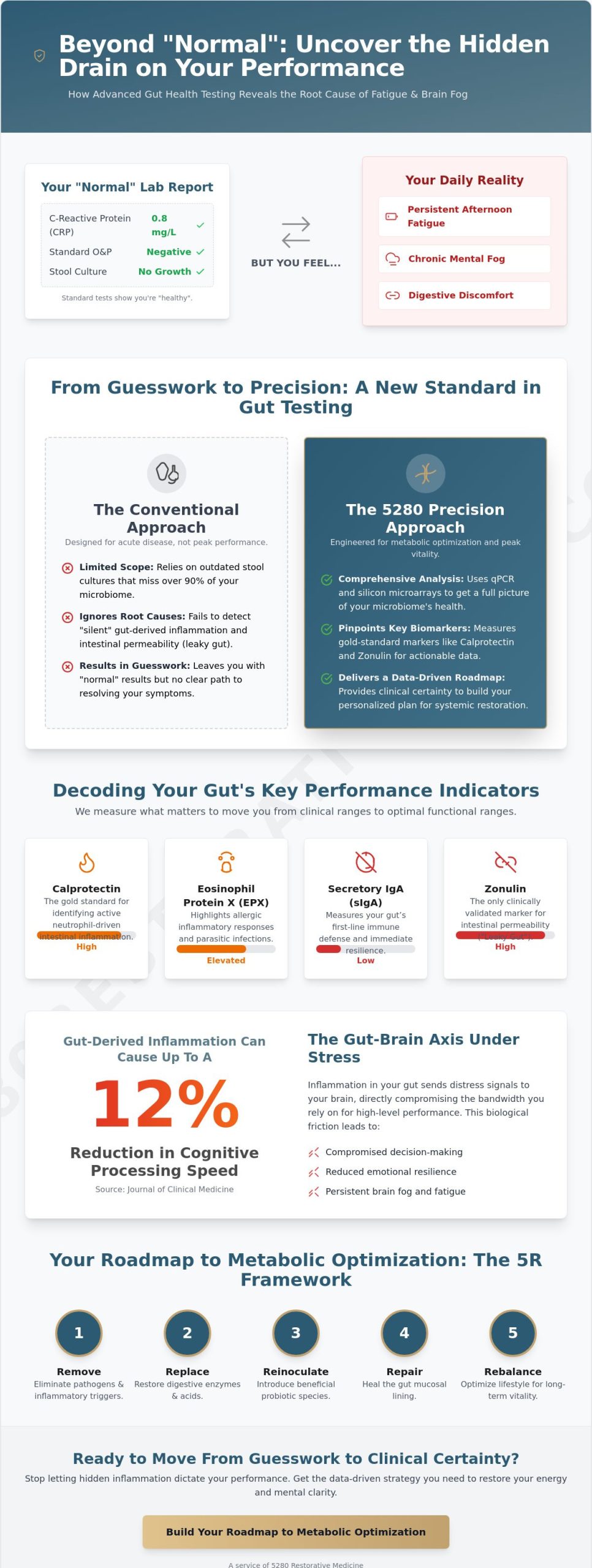
What if the “normal” lab results sitting on your desk are actually masking the hidden source of your persistent afternoon fatigue and mental fog? You’ve likely been told everything is fine; yet, you’re still navigating a cycle of digestive discomfort that disrupts your travel schedule and steals your focus during high-stakes meetings. It’s frustrating to feel your performance slipping when traditional metrics say you’re healthy. Research published in the Journal of Clinical Medicine shows that gut-derived inflammation can reduce cognitive processing speeds by up to 12% in otherwise healthy adults, which is why we prioritize advanced gut health testing for inflammation to uncover what standard blood work misses.
At 5280 Restorative Medicine, we believe that true vitality requires looking beneath the surface with a precision approach. You deserve a data-driven strategy that replaces guesswork with clinical certainty and identifies the specific diagnostic markers that trigger systemic issues. This guide explores how we use these specialized insights to build your personalized roadmap for metabolic optimization. We’ll show you how to restore the mental clarity and energy you need to lead effectively and reach a superior state of health.
Key Takeaways
- Identify why standard diagnostic tests often miss the “silent inflammation” originating in the gut mucosal lining that hinders peak performance.
- Discover how advanced gut health testing for inflammation utilizes gold-standard biomarkers like Calprotectin and EPX to provide a data-driven roadmap for systemic restoration.
- Compare modern methodologies, including qPCR and silicon-based microarrays, to understand which precision tools offer the deepest insights into your unique microbiome.
- Learn the “5R” clinical framework used to prioritize health interventions, moving from pathogen removal to total metabolic optimization.
- Explore how integrating gut diagnostics with comprehensive metabolic analysis creates a personalized strategy for long-term vitality and cellular resilience.
Beyond the Surface: Why Standard Gut Tests Miss Chronic Inflammation
You feel the fog setting in by 2:00 PM. Your focus wavers despite a clean diet and rigorous exercise. When you seek answers, standard medical tests often return “normal” results. This happens because traditional “ova and parasite” (O&P) tests are designed to find acute infections, not to measure chronic optimization. These tests look for obvious intruders like Giardia or Salmonella. They ignore the nuanced shifts in the gut microbiota that drive silent inflammation. This inflammation originates deep within the gut mucosal lining, acting as a hidden drain on your vitality.
Standard blood markers like C-Reactive Protein (CRP) often fail to detect localized intestinal permeability. You might have a CRP level under 1.0 mg/L, which clinicians label as healthy, yet still suffer from significant gut-derived stress. High-performers require a shift from clinical ranges, which target the absence of disease, to optimal functional ranges that prioritize peak output. Advanced gut health testing for inflammation bridges this gap by looking at what standard labs ignore. For example, a “normal” range for zonulin, a marker of leaky gut, might be anything under 45 ng/mL in some labs, but an optimal state for a high-performer is often much lower, indicating a tight, secure intestinal barrier.
The Failure of the Conventional Stool Culture
Traditional cultures rely on growing live bacteria in a petri dish. This method misses approximately 90% of the over 1,000 species in your microbiome because most gut bacteria are anaerobic and die when they hit the air. A culture provides a static snapshot of a dynamic environment that changes within a 24 to 48 hour window. Because standard insurance-based testing is incentivized to find only extreme pathology, it overlooks the subtle imbalances that precede chronic illness. Investing in advanced gut health testing for inflammation allows you to move past guesswork and into precise, data-driven restoration.
The Performance Toll of Gut-Derived Inflammation
Intestinal dysbiosis triggers systemic cytokine production, leading to neuroinflammation that manifests as brain fog and fatigue. This biological friction directly impacts the functional health and wellness of high-performers who need every bit of cognitive bandwidth. The gut-brain axis is a bidirectional communication highway influenced by microbial metabolites. When your gut is inflamed, your brain receives distress signals that compromise your decision-making and emotional resilience. By addressing these root causes, you don’t just fix a symptom; you restore your body’s natural capacity for high-level performance.
Decoding the Biomarkers: How Advanced Testing Measures Inflammation
You can’t optimize what you don’t measure. When high-performers experience brain fog or persistent fatigue, they often look for answers in traditional blood panels that miss the localized cellular activity within the GI tract. Using advanced gut health testing for inflammation allows us to move beyond guesswork and pinpoint the exact source of your discomfort.
We start by analyzing Calprotectin, the gold standard biomarker for identifying neutrophil-driven intestinal inflammation. While a standard physical might overlook minor digestive shifts, a Calprotectin level exceeding 50 ug/g signals that your immune system is actively patrolling the gut lining. For those dealing with hidden sensitivities or parasitic infections, we monitor Eosinophil Protein X (EPX). This marker specifically highlights allergic inflammatory responses that often go undetected in routine screenings. To assess your immediate resilience, we measure Secretory IgA (sIgA), which serves as your gut’s first line of immune defense. Finally, we look at Zonulin, the only clinically validated marker for measuring intestinal permeability, or “Leaky Gut,” which can allow toxins to enter your bloodstream and trigger systemic flares.
Inflammatory Markers vs. Digestive Markers
Distinguishing between a lack of digestive power and an active immune attack is vital for your recovery. While markers like Steatocrit and Elastase tell us if you’re failing to break down fats or proteins, they don’t explain why your system feels “on fire.” We prioritize measuring Short-Chain Fatty Acids (SCFAs), specifically Butyrate, because these molecules provide 70 percent of the energy your colon cells need to stay healthy. High levels of Beta-glucuronidase are equally telling; this enzyme can reverse the detoxification of hormones, leading to estrogen dominance and toxic recirculation. At 5280 Restorative Medicine, we use these data points to create a personalized optimization plan tailored to your unique biology.
The Microbiome Balance: Commensals vs. Pathobionts
Your gut is a complex ecosystem where “Keystone” species like Akkermansia muciniphila act as peacekeepers. When these levels drop below 1 percent of your total microbial abundance, the gut barrier weakens. Research into the gut microbiota and inflammation shows that an overgrowth of opportunistic bacteria, or pathobionts, can trigger a low-grade immune flare that drains your daily energy. A diverse microbiome acts as a biological shield against systemic oxidative stress. By leveraging advanced gut health testing for inflammation, we identify these microbial imbalances before they evolve into chronic conditions, ensuring you maintain peak performance at any age.
Comparing Methodologies: PCR, DNA Sequencing, and the Zoomer Advantage
Achieving peak metabolic resilience requires moving beyond the guesswork of standard medical labs. When we utilize advanced gut health testing for inflammation, we rely on three primary technological pillars to map your internal ecosystem. Quantitative PCR (qPCR) technology, a staple in the GI Effects profile, acts as a high-speed diagnostic tool. It amplifies specific DNA segments to identify pathogens with a sensitivity nearly 1,000 times greater than traditional stool cultures. This precision ensures we catch low-grade infections that often masquerade as general fatigue or persistent brain fog.
The “Zoomer” methodology represents a significant shift toward immunological precision. By using silicon-based microarrays, these tests detect peptide-level immune responses. Rather than looking for a whole protein, the Zoomer identifies reactions to specific peptide fragments. This level of detail is vital for high-performers who need to eliminate systemic inflammation at its source. While 16S rRNA sequencing provides a broad overview of bacterial families, shotgun metagenomics offers the highest resolution available. It sequences all the DNA in a sample, allowing us to see not just who is in your microbiome, but exactly what they’re doing. For executive health optimization, this functional data is the difference between a generic recommendation and a targeted biological intervention.
Why Clinical-Grade Testing Trumps Consumer Kits
Consumer-grade kits often prioritize a user-friendly app experience over clinical depth. These services frequently provide proprietary “wellness scores” that obscure the raw data. At 5280 Restorative Medicine, we believe you deserve access to your primary biological signals. Clinical labs maintain rigorous standards for specimen stability, reducing the 25 to 30 percent false-negative rate often seen in budget kits. Our role as your health partner is to filter the noise, ensuring that every data point leads to a measurable improvement in your daily vitality.
Turnaround Times and Data Depth
Precision takes time. You should expect a 14 to 21 day window for advanced genomic sequencing to produce a complete profile. This duration allows for the complex processing required to map your unique microbial landscape. More data isn’t always better unless it’s viewed through a structured interpretation framework. We integrate these results with functional medicine for high-performers to engineer a strategy that addresses your specific inflammatory markers. This synergy ensures your path to restoration is grounded in hard science rather than fleeting health trends.
From Data to Performance: Interpreting Results for Systemic Restoration
Raw data only provides value when it’s translated into a strategic roadmap for your health. Advanced gut health testing for inflammation reveals a hierarchy of needs that we must address systematically to achieve peak performance. At 5280 Restorative Medicine, we don’t just look at isolated markers. We prioritize the resolution of active infections, such as H. pylori or parasitic overgrowths, before we attempt to address intestinal permeability or microbiome diversity. This sequence ensures the foundation of your digestive tract is stable before we begin the optimization process.
We utilize the clinical 5R Framework to guide this transformation. This process involves five distinct stages:
- Remove: Eliminating pathogens, allergens, and inflammatory triggers.
- Replace: Adding back essential digestive secretions like hydrochloric acid or bile salts.
- Reinnoculate: Introducing beneficial microbes to restore ecological balance.
- Repair: Providing the specific nutrients needed to heal the intestinal lining.
- Rebalance: Addressing lifestyle factors that influence long-term gut stability.
Seeing a “positive” marker for inflammation, such as an elevated fecal calprotectin level above 50 ug/g, doesn’t automatically necessitate a pharmaceutical prescription. Instead, it signals a need to investigate the specific root cause of that immune response. We integrate these findings with your genetic predispositions, such as FUT2 or HLA-DQ status, to determine if your body requires more intensive support for secretory IgA production or a strict avoidance of specific proteins. This personalized approach ensures your protocol is as unique as your DNA.
Developing a Targeted Supplement Strategy
Choosing the right probiotic depends entirely on your clinical results. If advanced gut health testing for inflammation shows an overgrowth of traditional strains, we often opt for spore-based probiotics like Bacillus coagulans. These species survive the stomach’s acidic environment more effectively than standard Lactobacillus. Blindly supplementing with generic bacteria can exacerbate issues like SIBO, leading to a 30% increase in gas production. For those with compromised barriers, we select specific mucosal supports such as Serum Bovine Immunoglobulins or L-Glutamine based on the severity of the intestinal leak.
Lifestyle and Nutritional Bio-Hacks for Gut Recovery
Your intestinal barrier follows a strict circadian rhythm. Research indicates that even a single night of disrupted sleep can alter the microbiome’s composition within 24 hours. We recommend intermittent fasting to activate the migrating motor complex, which acts as a cleansing wave for the small intestine every 90 to 120 minutes during a fasted state. Chronic stress elevates cortisol, which physically thins the protective mucus layer of the gut, leaving the underlying tissue vulnerable to irritation and systemic inflammation.
The 5280 Protocol: Engineering Metabolic Resilience Through Precision Gut Diagnostics
The 5280 Protocol doesn’t stop when the lab results arrive. We use advanced gut health testing for inflammation as the foundation of a comprehensive, multi-month roadmap designed to shift your biology from survival to peak performance. Our clinical team integrates these findings with deep-dive blood panels and metabolic analysis to identify the precise drivers of systemic fatigue. We focus on restoration. We don’t settle for the absence of symptoms; we aim for the optimization of your entire physiological system. This process involves continuous clinical monitoring, allowing us to adjust your protocol as your microbiome shifts and your cellular health improves.
The Executive Health Advantage
High-performers require a different set of “normal” ranges to maintain a sharp cognitive edge. Standard laboratory ranges are often based on a bell curve of the general population, which includes individuals with chronic illness. We target optimal ranges that support 95th-percentile performance. By utilizing advanced gut health testing for inflammation, we reduce the systemic load on your body. This allows for faster recovery from high-stress periods and protects your long-term vitality. Maintaining gut integrity isn’t just about digestion; it’s a critical strategy for longevity and preventing the cognitive decline often associated with chronic systemic inflammation.
- Precision Targeted Nutrition: We move beyond generic diets to provide specific fuel sources your unique microbiome requires.
- Reduced Systemic Load: Lowering gut-derived inflammation preserves cortisol for productive stress responses.
- Cognitive Clarity: Optimizing the gut-brain axis ensures consistent focus during high-stakes decision-making.
Your Path Forward: The Comprehensive Assessment
Your journey begins with a 60-minute diagnostic review where we bridge the gap between your symptoms and your underlying biology. We transition you from “guessing” with over-the-counter supplements to “knowing” your exact biological status. We analyze biomarkers like zonulin for gut permeability and calprotectin for active inflammation to build your custom strategy. This data-driven approach ensures every intervention is purposeful and effective. It’s time to stop reacting to fatigue and start engineering your resilience.
Engineer Your Metabolic Resilience Through Precision
True vitality isn’t a matter of luck; it’s a measurable outcome of precise biological data. Standard screenings often overlook the subtle markers of chronic systemic inflammation that erode your cognitive edge and physical recovery. By utilizing advanced gut health testing for inflammation, you move beyond generic advice into the realm of cellular optimization. Our approach, clinically led by Dr. Marci Catallo-Madruga, combines comprehensive metabolic and genetic integration to identify the specific triggers affecting your unique microbiome.
We’ve moved past the era of one-size-fits-all medicine to focus on customized protocols that ensure sustainable high performance. Whether you’re addressing hidden gut dysbiosis or seeking to sharpen your mental clarity, the 5280 Protocol provides the roadmap for systemic restoration. You deserve a health partner who views your wellness as a proactive journey toward longevity rather than a reactive response to illness. Take the definitive step toward engineering your metabolic resilience today.
Apply for our Executive Health Program to begin your diagnostic journey.
Your path to a superior state of health is waiting, and we’re ready to guide you every step of the way.
Frequently Asked Questions
How is advanced gut health testing different from a colonoscopy or standard stool test?
Advanced gut health testing for inflammation focuses on functional and microbial imbalances rather than structural abnormalities like polyps or tumors found during a colonoscopy. While a standard stool test might only look for 6 common pathogens, advanced diagnostics use quantitative PCR technology to map over 100 species of bacteria, fungi, and parasites. This level of precision allows us to identify sub-clinical issues that traditional screenings often overlook.
Can advanced gut testing identify the cause of my brain fog and fatigue?
Yes, these tests identify the specific microbial imbalances that trigger systemic neuroinflammation through the gut-brain axis. When your intestinal barrier is compromised, inflammatory markers like lipopolysaccharides enter the bloodstream, which research from the Journal of Neuroinflammation shows can reduce cognitive processing speed by 15%. By identifying these triggers, we can restore your mental clarity and physical energy levels through targeted, data-driven protocols.
Do I need to stop taking supplements or probiotics before the test?
You should generally stop taking probiotics and antimicrobial supplements 14 days before your collection to ensure an accurate baseline. Antibiotics require a minimum 4-week window to allow the microbiome to stabilize before testing. We provide a specific checklist during your consultation at 5280 Restorative Medicine to ensure your results reflect your true physiological state, allowing for precise optimization of your future treatment plan.
How long does it take to see improvements after starting a gut restoration protocol?
Most patients report a 30% improvement in digestive comfort and energy within the first 21 days of a targeted protocol. However, complete cellular restoration of the gut lining typically takes 90 to 180 days of consistent intervention. This timeline allows for the full turnover of intestinal cells and the establishment of a stable, diverse microbial ecosystem that supports long-term vitality and peak performance.
Is leaky gut a real medical condition that these tests can measure?
Leaky gut is a recognized clinical state formally known as increased intestinal permeability. We measure this using validated markers like Zonulin; a protein that regulates the openings between cells in your digestive tract. Elevated Zonulin levels are found in 70% of patients with autoimmune triggers. Advanced gut health testing for inflammation provides the objective data needed to move beyond theory and into a concrete, measurable recovery plan.
What is the most accurate test for intestinal inflammation available in 2026?
In 2026, Whole Genome Sequencing paired with metatranscriptomic analysis stands as the gold standard for diagnostic accuracy. This technology identifies 99.9% of the organisms in your microbiome and reveals exactly which genes those bacteria are expressing in real time. Unlike older methods, this provides a functional view of microbial activity, allowing for a level of personalization that was impossible just 24 months ago.
Can advanced gut testing help if I have already been diagnosed with IBS?
Advanced testing is essential for IBS patients because it moves beyond a symptom-based label to find the underlying cause. Clinical data indicates that up to 60% of IBS cases are actually Small Intestinal Bacterial Overgrowth or specific fungal dysbiosis. By pinpointing the exact microbial imbalance, we can transition you from managing chronic symptoms to a targeted strategy that aims for total resolution and gastrointestinal optimization.
Why does my standard blood work show no inflammation when I feel inflamed?
Standard blood markers like C-Reactive Protein often remain within normal ranges unless you have an acute infection or major systemic disease. They don’t detect the localized, low-grade inflammation occurring in the gut tissue itself. We use specialized stool markers like Calprotectin and Secretory IgA, which are 85% more sensitive than blood tests for detecting early-stage mucosal irritation. This explains why you feel unwell despite having perfect labs.