
A “perfect” lab report is often the biggest obstacle to actually feeling your best. It’s a frustrating cycle many high performers face; you’re struggling with persistent fatigue or a lack of mental clarity, yet your doctor insists you’re healthy because your numbers fall within a standard range. The reality is that these reference ranges are statistically derived to include 95% of the population, meaning they are designed to catch overt disease rather than define peak vitality. By learning the nuances of interpreting your own blood test results, you can stop settling for “not sick” and start aiming for true restoration.
We agree that a ten minute consultation isn’t enough to address the subtle shifts in your metabolic health. This guide promises to move you beyond confusing medical abbreviations and into a deeper understanding of functional biomarkers. You’ll learn to identify the early warning signs of hormonal decline and understand why “normal” is often a failing grade for anyone seeking longevity. We will preview the specific differences between pathological and optimal ranges, giving you the tools to lead a sophisticated, empowered conversation with your health partner about your path to 5280 levels of vitality.
Key Takeaways
- Understand why standard “normal” ranges are designed to detect overt disease rather than define the peak performance required for a high-achieving lifestyle.
- Learn the specific methodology for interpreting your own blood test results by utilizing narrow functional ranges that highlight suboptimal health patterns.
- Move beyond basic lipid and metabolic panels to uncover the deeper story of your cardiovascular health and hormonal efficiency.
- Identify the biomarker “clusters” that signal early metabolic syndrome or HPA axis dysfunction caused by chronic high-performance stress.
- Discover how to bridge the gap between raw data and a personalized protocol to restore your vitality and ensure long-term health optimization.
Beyond “Normal”: Why Standard Lab Reference Ranges May Fail You
You have likely sat in a clinical office feeling drained, only to be told your labs are “fine” because they fall within the standard window. This disconnect happens because standard Reference ranges for blood tests are built on a statistical bell curve designed to capture the middle 95% of the population. If you aren’t in the bottom or top 2.5%, you’re labeled “normal.” For a high performer, being “average” in a population that is increasingly sedentary and metabolically compromised isn’t the goal. Interpreting your own blood test results requires understanding that these thresholds were designed to catch acute disease, not to foster elite performance.
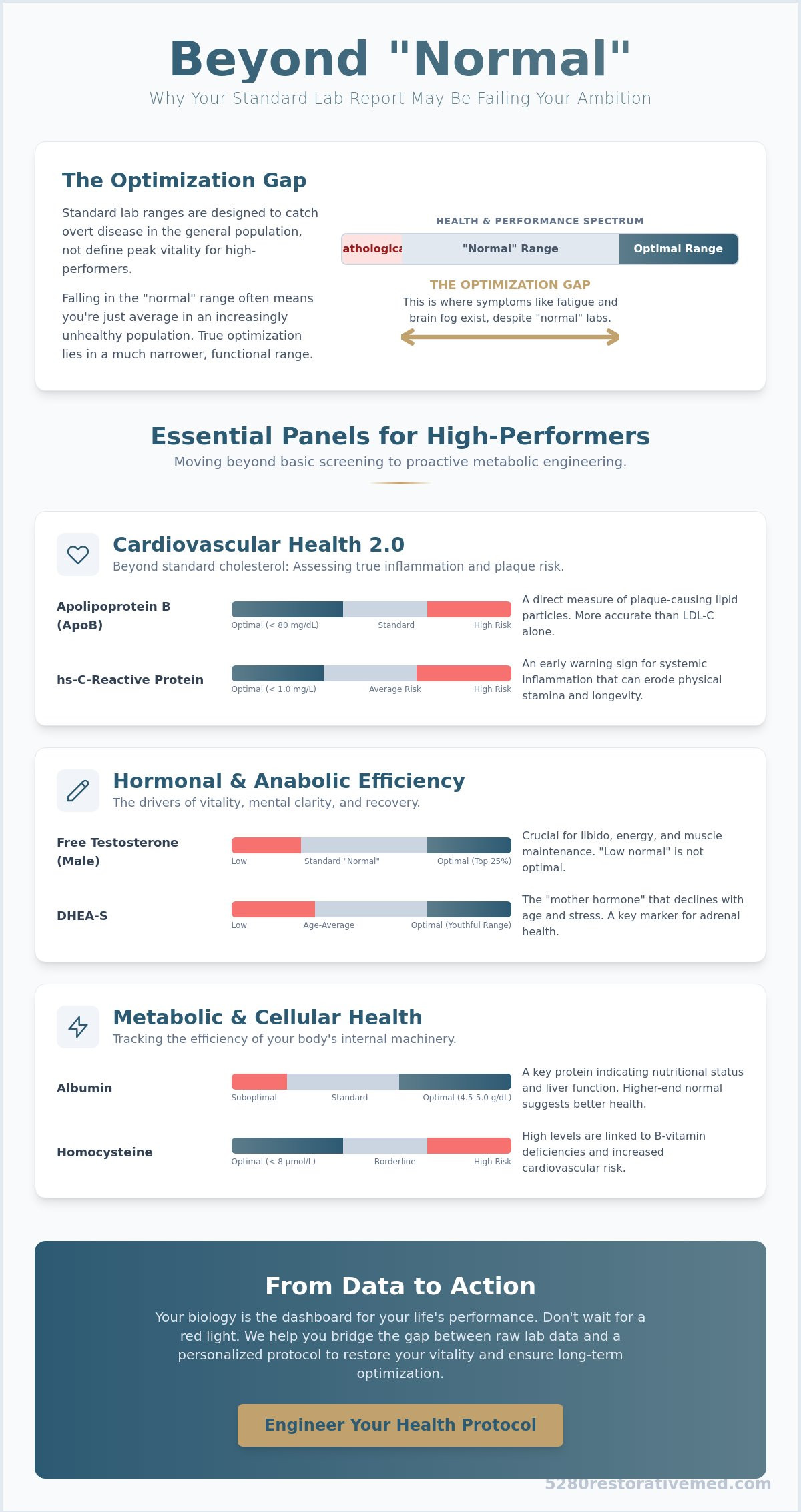
There is a distinct difference between clinical pathology and physiological sub-optimization. A pathological range indicates that an organ system is failing or a disease is already present. Sub-optimization, however, is the gray area where you feel the symptoms of decline even though you haven’t crossed the threshold of a formal diagnosis. The optimization gap is the space between laboratory normal and peak vitality.
The Limitations of Conventional Lab Analysis
Traditional medicine is masterful at managing acute crises, but it often struggles with the slow, chronic decline of cellular health. Most providers use a “wait and see” approach. They wait for a marker to drift into the red before they offer an intervention. This reactive model ignores the fact that your symptoms, like brain fog or low libido, often precede lab abnormalities by years. By the time a marker is officially “out of range,” the underlying physiological damage is already well underway. We believe you shouldn’t have to wait for a diagnosis to start feeling better.
The High-Performer’s Perspective on Biomarkers
You should view your blood work as a high-resolution dashboard for bio-optimization rather than a simple pass or fail test. Success in functional health and wellness depends on catching sub-clinical trends before they become permanent limitations. Instead of reactive treatment, we focus on proactive metabolic engineering. We don’t just want to keep you out of the hospital. We want to ensure your biology supports your highest ambitions. Interpreting your own blood test results through this lens allows you to take command of your health journey with 5280 levels of precision and confidence.
Essential Panels for Metabolic and Hormonal Optimization
To begin interpreting your own blood test results effectively, you must look at the data through the lens of efficiency rather than just the absence of failure. A Comprehensive Metabolic Panel (CMP) is the foundational starting point. It offers a snapshot of your liver and kidney function, electrolyte balance, and blood sugar. While a standard review might only flag results that indicate organ damage, we look for subtle shifts in albumin or alkaline phosphatase that suggest your body is working harder than it should to maintain equilibrium. This level of scrutiny ensures your internal machinery supports your external output.
Cardiovascular health requires a more sophisticated approach than the traditional Lipid Panel. While most clinics focus solely on LDL-C, this is only half the story. The “Lipid Panel 2.0” looks at particle size and count, specifically ApoB, to determine your true risk of plaque accumulation. We also prioritize inflammatory markers like high-sensitivity C-Reactive Protein (hs-CRP) and Homocysteine. These markers act as an early warning system for systemic inflammation, which can erode both physical stamina and long-term longevity. To help you Understand Your Lab Results from a foundational perspective, government resources provide a baseline, but optimization requires a more targeted analysis of these advanced markers.
Establishing hormonal baselines is another critical step for the high achiever. Testing for bhrt markers like free testosterone, DHEA-S, and IGF-1 should happen before you feel the “crash.” Understanding where you sit during peak performance allows us to create a roadmap for restoration as you age, ensuring you never have to settle for the standard decline in vitality.
Metabolic Health: Beyond Fasting Glucose
Relying on fasting glucose alone is a common mistake. True metabolic control is found in the relationship between glucose, HbA1c, and fasting insulin. You might have a “normal” glucose reading, but if your fasting insulin is elevated, your body is overcompensating to keep blood sugar stable. This hidden struggle signals early insulin resistance, which directly impairs executive cognitive function and energy stability. Comprehensive Metabolic Testing can reveal these hidden bottlenecks before they impact your daily productivity.
The Missing Links: Micronutrients and Oxygen Transport
Your daily energy depends on efficient oxygen transport and nutrient availability. When interpreting your own blood test results, pay close attention to the CBC. Markers like RDW (Red Cell Distribution Width) and MCH (Mean Corpuscular Hemoglobin) can hint at early B12 or iron deficiencies long before you become anemic. We frequently see high-performers with “low-normal” Ferritin and Vitamin D levels who struggle with brain fog. Standard labs often ignore these until they are critically low, but for peak performance, we aim for levels that support cellular health and robust mitochondrial function.
Decoding the Data: Functional vs. Pathological Ranges
When you look at your lab report, you’ll see a reference range provided by the laboratory. This is the pathological range. It is the zone where medical intervention is required because the values suggest a disease state is already active. If your glucose is 126 mg/dL, you have diabetes. If it’s 99 mg/dL, you’re “normal” by standard definitions, but you’re standing on the edge of a metabolic cliff. Interpreting your own blood test results effectively means recognizing that the absence of disease isn’t the same thing as the presence of health.
To achieve 5280 levels of performance, we use the functional range. This is a much narrower window representing optimal physiological function. While understanding your lab results through a standard lens is a good start, high-performers need to look for “High-Normal” and “Low-Normal” red flags. These are results that sit at the extreme ends of the laboratory’s window. They signal that your body is compensating for a stressor and is nearing its breaking point. A “normal” TSH might still indicate hormone optimization is needed if your active thyroid levels are insufficient to meet your metabolic demands.
Example: The Thyroid Functional Window
Clinical TSH ranges often span from 0.4 to 4.5 uIU/mL. In our restorative model, we look for a functional sweet spot between 0.5 and 2.0 uIU/mL. If your TSH is 3.5, a standard doctor won’t treat you, but you may be experiencing the weight of executive burnout. Testing Free T3 and Free T4 is non-negotiable because TSH is only the signal from the brain. Free T3 is the active hormone that drives mental clarity and metabolic speed. If your active levels are low despite a “normal” TSH, your performance will suffer.
Example: Vitamin D for Immune and Cognitive Resilience
Most labs consider 30 ng/mL the threshold for “sufficiency.” This level is the floor for survival; it prevents bone disease, but it doesn’t foster resilience. We target a functional range of 60 to 80 ng/mL for systemic inflammation control and cognitive sharpness. Vitamin D acts as a pro-hormone in high-stress environments. Maintaining these higher levels is essential for keeping your immune system responsive and your mood stable during demanding seasons. When interpreting your own blood test results, don’t settle for just being “sufficient.”
Identifying Patterns: How Biomarkers Interact to Signal Burnout
A single data point is a snapshot, but a cluster of markers is a story. When you’re interpreting your own blood test results, looking at markers in isolation is a common mistake that leads to missed opportunities for restoration. High performers often maintain “normal” levels through sheer physiological grit, but the underlying patterns tell a different tale. We look for the “HPA Axis” signal, where we see elevated cholesterol levels paired with a plummeting DHEA-S. This interaction suggests your body is redirecting hormonal precursors to keep up with chronic stress, a state often called the “pregnenolone steal.” It’s a clear warning that your drive is currently outstripping your recovery.
Your liver enzymes, specifically ALT and GGT, offer another layer of insight into your metabolic resilience. While standard medicine only flags these when they suggest active liver damage, we view them as indicators of your toxic load and oxidative stress. If these markers are creeping into the high-normal range, it suggests your internal filtration systems are struggling to keep up with your lifestyle. Pattern recognition is the hallmark of sophisticated health management. A single “off” marker might be an outlier, but a three year trend of drifting values is a call to action. If you’re ready to move beyond basic labs, our Functional Medicine Consultation can help you decode these complex interactions.
The Lipid-Metabolic Connection
The relationship between your triglycerides and HDL is one of the most potent predictors of metabolic health. High triglycerides paired with low HDL are a much stronger signal of cardiovascular risk and insulin resistance than total cholesterol alone. We focus on the Triglyceride-to-HDL ratio to assess how well your body processes fuel. A ratio higher than 2.0 often indicates that your metabolism is beginning to stall. This is where functional medicine excels, as it uses these specific ratios to predict and prevent negative health outcomes years before they manifest as disease.
Tracking Trends Over Time
We recommend an “Annual Health Audit” for every high achiever. This isn’t just about checking boxes; it’s about delta-analysis, or measuring the rate of change between your reports. You should never delete an old lab report. By comparing your current results to your baseline from two or three years ago, you can see if your “normal” is actually a slow slide toward dysfunction. You can correlate these shifts with data from digital health trackers to see how your sleep and recovery scores mirror your internal chemistry. Interpreting your own blood test results over time allows you to catch the subtle drift before it becomes a full-blown performance crash.
From Data to Action: Engineering Your Personalized Health Protocol
Data is only as valuable as the action it inspires. Once you’ve mastered the skill of interpreting your own blood test results, the next phase is moving into the engineering stage of your health journey. Generic wellness advice often fails the high performer because it ignores the unique genetic and metabolic nuances that define your individual biology. A supplement protocol that works for one executive might be ineffective or even counterproductive for another. This is especially true if there are hidden barriers like mast cell activation syndrome or specific genetic polymorphisms impacting your detoxification pathways. True restoration requires a strategy as rigorous and personalized as your business plan, focusing on root causes rather than surface level symptoms.
We treat health as a proactive journey rather than a reactive necessity. Moving from interpretation to implementation means aligning your nutrition, lifestyle, and supplementation with the specific needs revealed in your labs. For example, if your inflammatory markers are elevated, a generic “healthy” diet might still include triggers that exacerbate your unique sensitivities. By using advanced testing to identify these hidden hurdles, we can clear the path for cellular health and sustained energy. This targeted approach ensures that every intervention you make is designed to move your biomarkers toward the functional ranges we discussed earlier.
The Executive Health Roadmap
Building a personalized protocol starts with clinical prioritization. You can’t fix every biomarker at once, so we identify the “keystone” markers that offer the highest leverage for your immediate performance and long term vitality. If your metabolic data shows significant insulin resistance, that becomes the primary focus before we address secondary hormonal nuances. We utilize a 90 day re-test cycle to measure the efficacy of your nutrition, lifestyle, and supplement interventions. This data driven feedback loop ensures we are constantly optimizing your protocol based on measurable internal shifts rather than subjective guesswork. We believe that regular monitoring is the only way to ensure your biological systems are actually moving toward a state of optimization. While interpreting your own blood test results provides the foundation, professional guidance is the final step to ensure your efforts yield the highest return on health.
Partnering for Peak Performance
Standard healthcare models are rarely equipped to handle the complexities of bio-optimization. Most providers are trained to manage symptoms and acute pathology, not to engineer elite vitality for a demanding lifestyle. Our executive health programs provide the depth and clinical partnership necessary to bridge the gap between complex lab data and daily cognitive clarity. We act as your expert health partner, helping you navigate the science of longevity with the precision you expect in every other area of your life. At 5280 Restorative Medicine, we believe that taking control of your data is the first step toward reaching a superior state of health. Don’t let your performance potential remain hidden behind standard lab reports that ignore your unique physiological needs. Reach out to our Denver team today to schedule a comprehensive metabolic assessment and begin your journey toward total restoration.
Take Command of Your Biological Future
Your health journey shouldn’t be defined by the absence of disease, but by the presence of peak vitality. By shifting your focus from standard laboratory averages to narrow functional windows, you unlock the ability to catch metabolic decline years before it becomes a clinical crisis. Mastering the art of interpreting your own blood test results allows you to move past the frustration of “normal” lab reports and begin addressing the root causes of fatigue and cognitive fog. Led by Dr. Marci Catallo-Madruga, an expert in Functional Medicine, our team provides the advanced diagnostic analysis that high-performers need to stay at the top of their game.
We don’t settle for generic care; we build tailored protocols that respect your unique genetic and metabolic profile. Whether you’re looking to restore hormonal balance or engineer long term longevity, the right data is your most powerful asset. Ready to stop guessing and start optimizing? Schedule your Comprehensive Metabolic Assessment with 5280 Restorative Medicine today. You deserve a health partner who is as invested in your success as you are. Let’s start building your 5280 level of vitality together.
Frequently Asked Questions
What are the most important blood markers to track for energy and focus?
High performers should prioritize Ferritin, Vitamin D3, and Free T3 to maintain elite cognitive function. Ferritin reflects your iron stores and oxygen carrying capacity, while Vitamin D3 supports neurotransmitter synthesis. Free T3 is the active thyroid hormone that determines your metabolic speed. If these sit at the low end of a standard range, you’ll likely experience brain fog despite a “normal” lab report.
Can I order my own blood tests without a doctor?
You can absolutely order your own labs through direct to consumer platforms in most states as of 2026. These services use licensed clinicians to authorize orders at CLIA certified laboratories. This allows for interpreting your own blood test results without waiting for a primary care appointment. It’s a vital tool for those who want to track their data more frequently than the standard annual physical allows.
What does it mean if my labs are “normal” but I still feel tired?
Feeling exhausted despite “normal” labs usually indicates that your biomarkers are sitting in the sub-clinical range. This is the space where you aren’t sick enough for a diagnosis but aren’t healthy enough for peak performance. We focus on functional ranges that are much narrower than standard lab windows. Your body is likely struggling to maintain homeostasis, which drains your energy reserves before a true pathology appears.
How often should a high-performer get blood work done?
We recommend a comprehensive health audit at least once a year to establish your baseline. However, if you’re implementing new supplement protocols or lifestyle changes, a 90 day re-test cycle is more effective. This cadence allows you to see the physiological impact of your interventions in real time. Frequent tracking ensures you stay in the optimal window and prevents subtle drifts from becoming permanent performance plateaus.
What is the difference between a standard lipid panel and an advanced NMR lipoprofile?
A standard lipid panel measures the total weight of cholesterol in your blood, which is an incomplete metric. An advanced NMR lipoprofile or ApoB test measures the actual particle count and size. Smaller, denser particles are more likely to cause arterial damage than larger ones. Interpreting your own blood test results with this level of detail provides a much more accurate picture of your true cardiovascular risk.
How do I know if my lab results are affected by supplements or fasting?
Specific supplements like Biotin can significantly skew thyroid and hormone results if taken within 72 hours of a draw. You should also ensure you’ve fasted for at least 12 hours for metabolic markers like insulin and glucose. Always document your current regimen before testing. This transparency helps us distinguish between a true physiological trend and a temporary spike caused by your morning stack or a recent meal.
Is it possible for my blood test results to be “too good”?
Results can occasionally look “too good” in ways that signal underlying dysfunction. For instance, extremely low cholesterol can sometimes point to malabsorption or a hyper-active immune system. Similarly, IGF-1 levels that are excessively high might suggest over-supplementation that could increase long term risks. We look for a balanced “Goldilocks” zone where your markers support high output without putting undue stress on your cellular machinery.
What should I do if my doctor refuses to order advanced metabolic markers?
You should seek a partnership with a boutique clinical practice that specializes in restorative medicine if your current provider is restricted by standard insurance models. Many primary care doctors are limited to ordering only what is “medically necessary” for a diagnosis. If they won’t order advanced markers like fasting insulin or ApoB, you can use direct access testing or schedule a functional medicine consultation to get the data you need.