
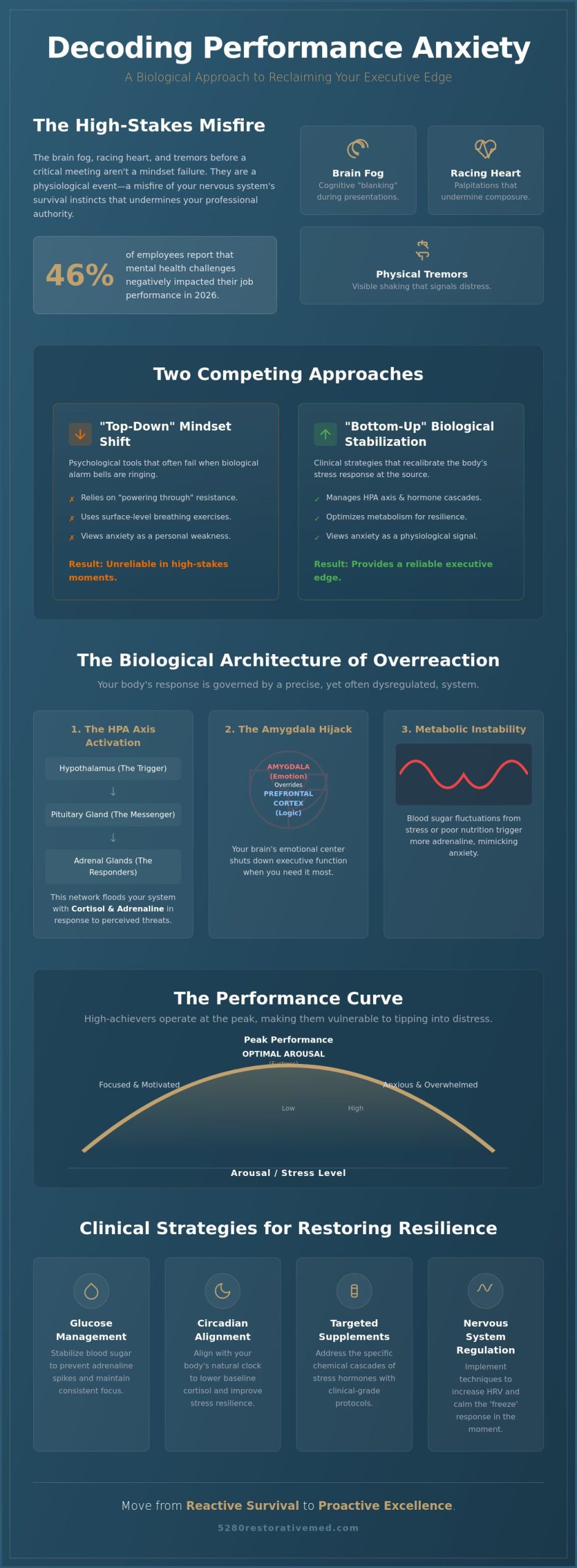
What if the brain fog and racing heart you feel before a high-stakes meeting aren’t signs of a failing mindset, but a biological misfire of your nervous system? You’ve likely tried “powering through” or using basic breathing exercises, yet the physical tremors and palpitations continue to undermine your authority. It’s frustrating when your body’s survival instincts interfere with your professional expertise. In 2026, 46% of employees feel their mental health has negatively impacted their job performance; for high-achievers, this often manifests as a physiological disconnect. Successfully managing performance anxiety at work starts with recognizing that your response is a clinical event, not a personal weakness.
This article will help you decode the physiological root causes of your stress response and implement clinical strategies to restore your executive edge. We’ll explore how the HPA axis influences your focus and why metabolic optimization is the key to lasting composure. You’ll discover immediate techniques to stabilize your nervous system in the heat of the moment, alongside long-term protocols for building metabolic resilience. By understanding the “why” behind your physical symptoms, you can move from reactive survival to proactive excellence and reclaim your peak performance state.
Key Takeaways
- Shift your perspective by viewing anxiety as a manageable physiological response of the HPA axis rather than a professional shortcoming.
- Understand why traditional “top-down” mindset shifts often fail during high-stakes moments and how biological stabilization provides a more reliable executive edge.
- Discover how clinical interventions like glucose management and circadian rhythm alignment can recalibrate your body’s baseline stress response for consistent focus.
- Gain actionable insights into managing performance anxiety at work by implementing targeted supplement protocols that address the specific chemical cascades of adrenaline and cortisol.
- Explore how the 5280 Restorative Medicine framework uses root-cause identification to help you exceed baseline performance and maintain composure under pressure.
The High-Stakes Reality of Managing Performance Anxiety at Work
For the modern executive, the boardroom can feel like a high-altitude environment where the air suddenly thins. You’ve likely felt that sudden tightening in your chest or the frustrating sensation of your mind going blank just as you’re asked a critical question. Managing performance anxiety at work isn’t about building more confidence; it’s about understanding that your body has transitioned from a state of productive arousal into a state of biological alarm. This isn’t a character flaw or a sign of professional weakness. It’s a physiological event that occurs when your internal resources are overwhelmed by external demands.
To understand this, we look at the “Performance Curve,” also known as the Yerkes-Dodson Law. Every high-performer needs a baseline level of arousal to stay sharp, focused, and motivated. This “eustress” is what keeps you at the top of your game. However, there is a specific threshold where productive tension turns into debilitating anxiety. High-achievers are uniquely susceptible to autonomic nervous system dysregulation because they constantly operate at the peak of this curve. When you push your metabolic limits without adequate recovery, the hidden costs mount quickly. Globally, the cost of lost productivity due to low employee engagement is estimated at $438 billion, a figure often driven by unmanaged chronic stress that erodes decision-making and leadership presence.
Identifying the Executive ‘Freeze’ Response
The “Freeze” response is often more damaging than the traditional “Fight or Flight” in professional settings. It manifests as cognitive symptoms like sudden memory lapses or “blanking” during presentations. Biologically, we see acute cortisol spikes and a significant drop in heart rate variability (HRV), which indicates a loss of nervous system flexibility. This isn’t just an internal struggle; it subtly undermines your perceived authority. When your physiology is in a state of alarm, your non-verbal cues can signal distress to your team, potentially eroding the executive presence you’ve worked years to build.
The Myth of ‘Stage Fright’ in the Boardroom
While many people equate workplace stress with standard stage fright, the executive experience is distinct. It’s rarely about a simple fear of being seen. Instead, it’s about the weight of professional reputation and the reality of high-stakes outcomes. To truly address the underlying biology of performance anxiety, we must look beyond mindset shifts. Performance anxiety is a systemic biological response to perceived professional threat. In an environment where every decision impacts the bottom line, your nervous system perceives a missed metric as a threat to your survival. Managing performance anxiety at work requires a transition from reactive coping to proactive physiological optimization, ensuring your body is as resilient as your strategy.
The Biological Architecture: Why Your Body Overreacts Under Pressure
Managing performance anxiety at work requires a deep dive into your physiological hardware. Your body’s stress response is governed by the HPA axis, a complex communication network between the hypothalamus, the pituitary gland, and the adrenal glands. When you face a high-stakes presentation, your hypothalamus signals the pituitary to release hormones that prompt your adrenals to flood the system with cortisol and adrenaline. While this chemical cascade is designed for survival, in a boardroom setting, it often leads to the “Amygdala Hijack.” This occurs when the emotional center of your brain overrides the prefrontal cortex, effectively shutting down your logical thinking and executive function right when you need it most.
Modern research from the National Institute of Mental Health provides a foundational clinical understanding of anxiety, yet for high-performers, the issue is often exacerbated by metabolic health. Blood sugar instability is a primary culprit. When your glucose levels fluctuate wildly due to skipped meals or high-stress caffeine consumption, your body releases more adrenaline to compensate. This physiological dip mimics the sensations of a panic attack, making a standard work day feel like a series of emergencies. Identifying these biological triggers through a Functional Medicine Consultation allows for a precision approach to reclaiming your composure.
Neurotransmitters and Executive Function
Your ability to maintain “calm focus” depends on the delicate balance between GABA and Glutamate. GABA acts as your brain’s natural brake system, while Glutamate is the accelerator. When chronic workplace stress depletes your dopamine levels, you become hypersensitive to minor stressors, making the task of managing performance anxiety at work feel insurmountable. Additionally, low serotonin can erode your social confidence and resilience, leaving you feeling exposed during critical peer reviews. Restoring these chemical messengers is essential for returning to a superior state of physical and mental function.
The Gut-Brain Axis and Mood Stability
The health of your microbiome directly influences your production of stress-regulating chemicals. Intestinal permeability, or “leaky gut,” can trigger systemic inflammation that travels to the brain, manifesting as neuro-anxiety and brain fog. This inflammatory state keeps your nervous system in a state of constant hyper-vigilance. In some cases, underlying issues like mast cell activation syndrome can contribute to systemic stress sensitivity, acting as a hidden barrier to peak performance. By addressing gut health, you create a stable biological foundation that supports emotional regulation and long-term metabolic resilience.
Beyond Mindset: Why Psychological Tools Often Fail High-Performers
Many high-performers spend years perfecting their mindset, yet they still find themselves paralyzed by physical symptoms during high-stakes presentations. While Cognitive Behavioral Therapy (CBT) and mindfulness are valuable, they’re “top-down” approaches that rely on the prefrontal cortex to regulate the rest of the brain. When you’re in the middle of a cortisol spike, your logical brain is effectively offline. You can’t rationally argue with a racing heart or a sudden tremor because your body’s ‘fight-or-flight’ mechanism has already taken full control of your physiology. For those managing performance anxiety at work, relying solely on psychological tools is like trying to rewrite software while the hardware is on fire.
Even commonly recommended “quick fixes” like deep breathing can backfire. If your CO2 tolerance is low, taking deep, expansive breaths can actually signal more danger to your brain, increasing the very panic you’re trying to soothe. This is why some executives feel worse after a mindfulness session. We also see the “Tired but Wired” phenomenon, where your body is exhausted but your nervous system stays stuck in high gear. This bio-individual response explains why one leader might thrive under pressure while another, with the same level of expertise, feels their system failing. True resilience isn’t just a mental state; it’s a reflection of your underlying biological capacity.
Hormonal Imbalances and Stress Tolerance
Your threshold for stress is heavily influenced by your endocrine system. Low levels of testosterone or progesterone can significantly lower your “anxiety floor,” making relatively minor professional challenges feel like existential threats. Thyroid dysfunction is another hidden driver, often mimicking the physical symptoms of a panic attack without a clear psychological trigger. Optimizing these levels is a critical step in building a more resilient system. You can explore how targeted interventions work in our BHRT clinical guide, which details the role of hormone replacement in exceeding baseline performance.
Nutrient Deficiencies and the ‘Anxious Brain’
The high-performance lifestyle is notoriously demanding on your internal chemistry. Magnesium is often called “nature’s relaxant,” yet it’s one of the first minerals depleted by chronic stress and high caffeine intake. Without it, your muscles can’t relax and your nervous system remains hyper-excitable. Similarly, B-vitamins are essential for the methylation cycle, which is the biological engine that manages your stress capacity. Metabolic testing can identify specific nutrient gaps that fuel performance anxiety. By filling these gaps, you provide your brain with the raw materials it needs to maintain composure while managing performance anxiety at work, turning a fragile system into a fortress.
Clinical Strategies for Managing Performance Anxiety and Restoring Resilience
Managing performance anxiety at work requires more than just willpower; it demands a stable biological foundation. Your resilience begins with circadian alignment and glucose stability. Exposure to morning sunlight primes your HPA axis, while maintaining steady blood sugar prevents the adrenaline spikes that mimic panic. Biometric tools like Oura or Whoop provide real-time data on your heart rate variability (HRV). This allows you to predict and prevent anxiety spikes before they manifest during a critical meeting. For those seeking deeper cellular support, advanced therapies like NAD+ and red light therapy optimize mitochondrial function, ensuring your brain has the energy required for sustained composure.
Supplement protocols also play a vital role in both acute and chronic stress support. We often utilize adaptogens to modulate the cortisol response and amino acids like L-theanine to promote alpha-wave brain activity without causing drowsiness. These clinical interventions help bridge the gap between your current state and your peak potential. By addressing the biological “hardware,” you ensure that your body supports your professional expertise rather than undermining it.
The ‘Bottom-Up’ Reset: Physiological Inroads to Calm
You can influence your nervous system directly through “bottom-up” interventions. Cold exposure and Vagus nerve stimulation increase your overall stress tolerance by training the autonomic nervous system to recover quickly from alarm states. Tactical breathing exercises allow you to shift from sympathetic dominance to parasympathetic calm in seconds. By optimizing your “Executive Morning” with these protocols, you prime your system to handle the day’s high-stakes demands without triggering a survival response. These small, purposeful actions build the metabolic resilience needed to stay sharp under pressure.
Metabolic Testing: The Diagnostic Key
Comprehensive bloodwork is the first step in managing performance anxiety at work. Standard check-ups often miss the nuances of high-performance health, but specialized Metabolic Testing reveals exactly how your body processes stress. Analyzing cortisol rhythms through DUTCH testing helps distinguish between chronic adrenal fatigue and acute stress responses. Additionally, identifying genetic predispositions like COMT or MTHFR mutations can explain why you might process adrenaline more slowly than others. These insights allow us to build a bespoke protocol that moves you beyond baseline performance and into a state of renewal.
Reclaiming Your Edge: The Functional Medicine Approach to Executive Health
Standard healthcare models often struggle to address the complexities of managing performance anxiety at work because they’re built for reactive, acute care. If you’ve ever presented these concerns to a primary care physician, you were likely offered a standard prescription or a referral for talk therapy. While these tools have their place, they rarely investigate the metabolic “why” behind your physical symptoms. Our framework at 5280 Restorative Medicine focuses on root-cause identification rather than just masking the alarm bells. We don’t just want to help you cope with a racing heart or brain fog. We aim to engineer a level of metabolic resilience where those responses no longer interfere with your focus. This transition from symptom management to physiological optimization is the cornerstone of a comprehensive executive health program.
Personalized Health Protocols for High-Performers
Your biological blueprint is entirely unique. We use sophisticated tools like genetic analysis and metabolic testing to understand how your system handles stress at the cellular level. This data allows us to build a resilience blueprint tailored specifically to your unique physiology. Unlike traditional primary care, which often relies on standardized protocols for the average patient, functional medicine for high-performers is a bespoke, high-touch experience. We provide continuous clinical support, adjusting your supplement protocols and lifestyle interventions as your professional demands shift. This ensures you aren’t just returning to a baseline state, but exceeding it to reach a superior state of function.
Taking the First Step Toward Peak Vitality
The journey toward reclaiming your executive edge begins with a thorough functional medicine consultation. During this session, we move beyond surface-level symptoms to explore your health history, current metabolic state, and specific professional goals. It’s a high-end health partnership designed to move you from reactive anxiety management to proactive health optimization. You’ll gain a clear understanding of your body’s current limitations and a clinical roadmap to overcome them. Managing performance anxiety at work becomes a predictable process when you have the right biological data. It’s time to stop letting your physiology dictate your professional success and start leading from a place of biological strength. Schedule your consultation with 5280 Restorative Medicine to reclaim your executive edge.
Reclaiming Your Physiological Advantage
You don’t have to accept brain fog or physical tremors as an inevitable part of your professional life. We’ve explored how managing performance anxiety at work is a matter of clinical biology rather than a lack of willpower. By moving beyond generic advice and addressing the root causes through metabolic testing and genetic analysis, you can build a system that thrives under pressure. Our practice, led by Dr. Marci Catallo-Madruga, specializes in these high-performance protocols. We utilize advanced diagnostic testing that goes far beyond standard bloodwork to identify the precise nutrient gaps and hormonal shifts affecting your focus.
Through bespoke, multi-month health optimization programs tailored for executives, we partner with you to engineer lasting resilience and mental clarity. This personalized approach ensures your body supports your ambition rather than undermining it. Start your journey to peak performance with a comprehensive health assessment at 5280 Restorative Medicine. You’ve built your career on excellence; it’s time your health reflected that same standard. Peak physical and mental states are achievable at any stage of your career, and your most focused days are still ahead of you.
Frequently Asked Questions
Is performance anxiety at work a sign of burnout?
Performance anxiety can be a precursor to burnout, but they’re distinct physiological states. Burnout is characterized by chronic exhaustion and cynicism, while performance anxiety is an acute overreaction of the HPA axis to specific high-stakes tasks. However, if you don’t address the anxiety, the constant hyper-arousal will eventually deplete your metabolic reserves and accelerate the onset of full-scale burnout.
Can hormone imbalances cause sudden performance anxiety in executives?
Yes, significant shifts in testosterone, progesterone, or thyroid hormones can lower your threshold for stress and trigger sudden anxiety. When these levels are suboptimal, your nervous system becomes hypersensitive to professional pressure. This often manifests as unexplained heart palpitations or a loss of composure during meetings that you previously handled with ease, making hormone optimization essential for executive resilience.
What is the fastest way to stop a physical anxiety response during a meeting?
The fastest way to interrupt a stress response is through tactical breathing or Vagus nerve stimulation. Try exhaling for twice as long as you inhale to signal safety to your brain and lower your heart rate. You can also discreetly apply pressure to the Vagus nerve or touch something cold. These physical “bottom-up” interventions work much faster than trying to rationalize your way out of a panic response.
How does metabolic testing help in managing performance anxiety at work?
Metabolic testing identifies the specific physiological drivers, such as glucose instability or nutrient deficiencies, that fuel your stress response. By analyzing your unique biochemistry, we can create a precision protocol for managing performance anxiety at work. This data-driven approach moves you beyond generic advice and allows us to address the root causes of your physical symptoms with clinical accuracy.
Are there specific supplements that help with workplace stress without causing drowsiness?
L-theanine and adaptogens like Rhodiola Rosea are highly effective for promoting “calm focus” without any sedative effects. L-theanine encourages alpha-wave brain activity, which is the state of being relaxed yet alert. Magnesium glycinate is another excellent tool for stabilizing the nervous system. These targeted supplement protocols help you maintain your executive edge by providing the raw materials your brain needs to stay composed under pressure.
What happens if I ignore my performance anxiety symptoms long-term?
Ignoring these symptoms leads to chronic autonomic dysregulation and systemic inflammation, which can eventually erode your leadership authority. Over time, persistent cortisol spikes impair your decision-making and can lead to metabolic issues like insulin resistance. What begins as occasional meeting jitters can transform into a permanent state of “tired but wired” exhaustion that compromises both your long-term health and your career trajectory.
How does sleep deprivation specifically impact my ability to handle work pressure?
Sleep deprivation weakens the connection between the prefrontal cortex and the amygdala, making you much more susceptible to emotional “hijacks.” When you’re underslept, your body also fails to regulate cortisol rhythms properly. This creates a fragile biological state where your nervous system perceives minor workplace challenges as existential threats, significantly reducing your ability to handle high-pressure environments with clarity and poise.
Can I really ‘cure’ performance anxiety with functional medicine?
Functional medicine can effectively resolve the underlying biological triggers that cause your body to overreact to stress. By optimizing your hormones, gut health, and nutrient levels, we recalibrate your nervous system’s baseline response. This doesn’t just mask the symptoms; it engineers a superior state of physical function. You’ll find that your body remains calm and capable even when you’re facing the most demanding professional challenges.